
In the production of heavy machine tool castings, we face significant challenges due to their complex structures, substantial variations in wall thickness—ranging from over 200 mm to as thin as 15–20 mm—and stringent performance requirements. These machine tool castings must exhibit high mechanical properties, with tensile strengths exceeding 300 MPa, superior elastic modulus to resist deformation, and uniform hardness on machined surfaces, typically not less than 190 HB. To address these demands, we implemented orthogonal experimental methods to optimize key parameters, including chemical composition, silicon-to-carbon ratio, and cupola furnace design. Our goal was to enhance the overall performance of machine tool castings, ensuring they meet rigorous industrial standards while minimizing defects such as porosity and shrinkage.
We began by focusing on the chemical composition and silicon-to-carbon ratio, as these factors critically influence the microstructure and mechanical properties of machine tool castings. Using an orthogonal array design, we selected five factors—carbon content, silicon content, manganese content, phosphorus content, and sulfur content—each at three levels, as summarized in Table 1. The silicon-to-carbon ratio was also considered a key parameter, with a target range around 0.7. Our experiments involved melting iron in cold-blast side-blown cupola furnaces with capacities of 5 tons and 7 tons, using raw materials including pig iron from various sources, scrap steel, and coke. We employed rapid thermocouples for temperature measurement and conducted tests on standard cast samples to evaluate tensile strength and hardness, ensuring consistency with actual machine tool casting components.
| Factor | Level 1 | Level 2 | Level 3 |
|---|---|---|---|
| C (%) | 2.9 ± 0.1 | 3.0 ± 0.1 | 3.1 ± 0.1 |
| Si (%) | 1.7 ± 0.1 | 1.8 ± 0.1 | 1.9 ± 0.1 |
| Mn (%) | 0.8 ± 0.1 | 0.9 ± 0.1 | 1.0 ± 0.1 |
| P (%) | ≤ 0.10 | ≤ 0.10 | ≤ 0.10 |
| S (%) | ≤ 0.10 | ≤ 0.10 | ≤ 0.10 |
| Si/C Ratio | 0.55 ± 0.05 | 0.60 ± 0.05 | 0.65 ± 0.05 |
The orthogonal experiment followed an L18 array, with 18 trials conducted to assess the effects on tensile strength and hardness. Results indicated that the optimal combination for high-performance machine tool castings was a carbon content of 3.0 ± 0.1%, silicon content of 1.8 ± 0.1%, manganese content of 0.9 ± 0.1%, with phosphorus and sulfur controlled below 0.1%, and a silicon-to-carbon ratio of 0.60 ± 0.05. This formulation consistently yielded tensile strengths above 300 MPa and improved hardness uniformity. The relationship between silicon content and tensile strength can be expressed as: $$\sigma_b = k_1 \cdot \text{Si} + k_2 \cdot \text{C} + c$$ where $\sigma_b$ is the tensile strength, Si and C are the silicon and carbon percentages, and $k_1$, $k_2$, and $c$ are constants derived from regression analysis. Similarly, the hardness correlation is modeled as: $$HB = a \cdot \sigma_b + b$$ where HB is the Brinell hardness, and $a$ and $b$ are empirical coefficients. These optimizations significantly enhanced the quality of machine tool castings, reducing defects and improving machinability.
Next, we turned our attention to the cupola furnace structure and operational parameters, aiming to achieve higher iron temperatures—specifically, 1450–1500°C—while maintaining a melting rate of 5 tons per hour and a coke-to-iron ratio of 1:10. We selected factors such as tuyere dimensions, blast pressure, blast volume, furnace hearth size, tuyere row spacing, and layer coke ratio, each at three levels, as detailed in Table 2. The experiments were performed on a 7-ton cold-blast cupola, using coke with fixed carbon content around 85% and metal charges under 500 kg. Temperature was monitored with thermocouples, and we recorded average temperature, melting rate, and total coke ratio for each trial.
| Factor | Level 1 | Level 2 | Level 3 |
|---|---|---|---|
| Tuyere Diameter (mm) | Small (e.g., 30) | Medium (e.g., 40) | Large (e.g., 50) |
| Tuyere Angle (°) | 10 | 15 | 20 |
| Tuyere Number | 6 | 8 | 10 |
| Blast Pressure (kPa) | Low (e.g., 15) | Medium (e.g., 20) | High (e.g., 25) |
| Blast Volume (m³/min) | Low (e.g., 50) | Medium (e.g., 60) | High (e.g., 70) |
| Furnace Hearth Size | Small | Medium | Large |
| Tuyere Row Spacing (mm) | 500 | 600 | 700 |
| Layer Coke Ratio | 1:8 | 1:10 | 1:12 |
Analysis of the orthogonal experiments revealed that the optimal configuration involved small tuyere diameters, a 15° angle, 8 tuyeres, medium blast pressure and volume, a specific furnace hearth design, 600 mm row spacing, and a layer coke ratio of 1:10. This setup, termed a “large-spacing waist-restricted cupola,” facilitated a secondary superheating effect, where iron is overheated in two distinct zones, leading to temperatures up to 1500°C. The melting rate was maintained at 5 tons per hour with a total coke ratio of 1:10. The temperature increase can be described by: $$T_{\text{iron}} = T_0 + \Delta T_{\text{overheat}}$$ where $T_{\text{iron}}$ is the final iron temperature, $T_0$ is the base melting temperature, and $\Delta T_{\text{overheat}}$ is the superheating contribution from the optimized furnace design. This advancement is crucial for producing high-quality machine tool castings, as it enhances fluidity and reduces inclusions.
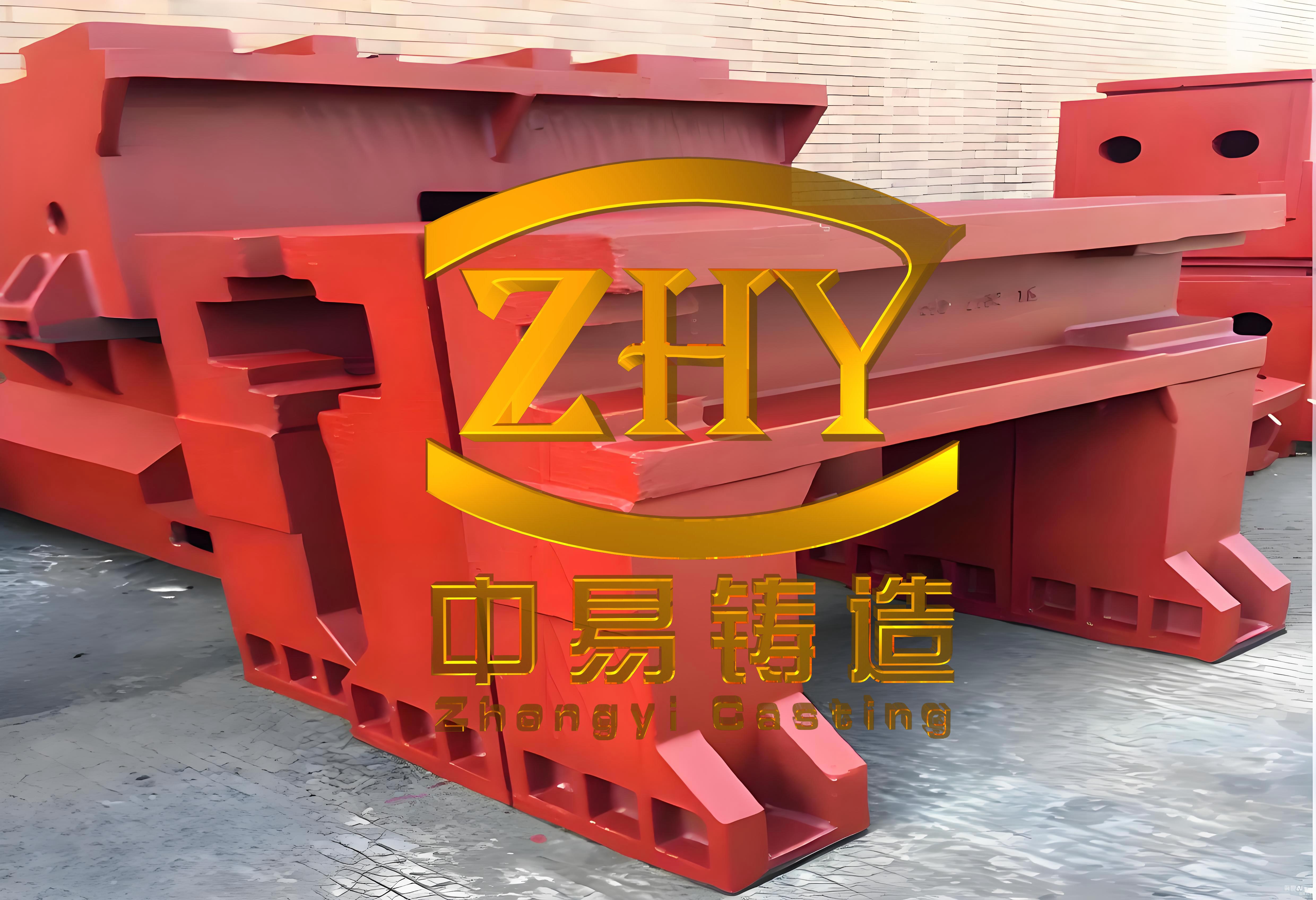
To further investigate the relationship between iron temperature and the properties of gray iron used in machine tool castings, we analyzed data from multiple furnace batches, examining chemical composition, microstructure, tensile strength, and hardness. For a eutectic degree of approximately 0.9, we observed that tensile strength increases with rising iron temperature, as shown by the statistical analysis of sample groups. The correlation is expressed as: $$\sigma_b = m \cdot T + n$$ where $\sigma_b$ is the tensile strength in MPa, $T$ is the iron temperature in °C, and $m$ and $n$ are constants derived from linear regression. For instance, when temperature rises from 1400°C to 1500°C, tensile strength can increase by up to 20%. Hardness, however, exhibits a more complex behavior: it increases with temperature up to about 1450°C but decreases beyond that point, modeled as: $$HB = \begin{cases} p \cdot T + q & \text{for } T < 1450°C \\ r \cdot T + s & \text{for } T \geq 1450°C \end{cases}$$ where $p$, $q$, $r$, and $s$ are coefficients. This underscores the importance of precise temperature control in optimizing machine tool casting performance, as excessive temperatures can soften the material despite higher strengths.
In addition to compositional and furnace optimizations, we implemented enhanced inoculation practices to further improve the properties of machine tool castings. We used a composite inoculant consisting of 75% ferrosilicon and rare earth elements, added at 0.3–0.5% of the iron weight, with a particle size of 3–8 mm and an absorption rate over 80%. The inoculation process was carefully timed to cover more than 60% of the tapping duration, ensuring uniform distribution. This approach significantly refined graphite structures, increased tensile strength, and reduced gas porosity. The effectiveness of inoculation can be quantified by the improvement in strength: $$\Delta \sigma_b = k_{\text{inoc}} \cdot I$$ where $\Delta \sigma_b$ is the increase in tensile strength, $I$ is the inoculant addition rate, and $k_{\text{inoc}}$ is a factor dependent on the inoculant type. Moreover, to maintain high temperatures for large machine tool castings, we employed oxygen enrichment or low-grade calcium carbide additions, which boosted temperatures above 1500°C when using foundry coke. The increased temperature promoted finer graphite and higher carbon absorption, allowing for greater scrap steel usage—up to 30%—which further enhanced strength through carbon pickup. The carbon increase is given by: $$\Delta C = f_{\text{coke}} \cdot t_{\text{contact}}$$ where $\Delta C$ is the carbon gain, $f_{\text{coke}}$ is a coke-related factor, and $t_{\text{contact}}$ is the contact time with coke.
Our experiments also highlighted the role of manganese and silicon content in achieving desired hardness and strength in machine tool castings. By increasing manganese to 0.9–1.0%, we stabilized pearlite formation, leading to higher hardness and tensile strength. The silicon-to-carbon ratio was maintained at 0.6–0.7 to balance strength and castability, with higher ratios reducing free carbon and strengthening the ferrite matrix. For critical components like guide rails, we adjusted compositions to ensure hardness above 190 HB. The combined effects of these measures resulted in machine tool castings that consistently exceed HT300 grade, with minimal defects and excellent machining characteristics.
In conclusion, through systematic orthogonal experimentation, we have optimized the chemical composition, silicon-to-carbon ratio, and cupola furnace parameters for heavy machine tool castings. The best practices include carbon at 3.0 ± 0.1%, silicon at 1.8 ± 0.1%, manganese at 0.9 ± 0.1%, and a silicon-to-carbon ratio of 0.60 ± 0.05, coupled with a large-spacing waist-restricted cupola design that achieves iron temperatures of 1450–1500°C. Enhanced inoculation with ferrosilicon and rare earths, along with temperature management techniques, further elevates performance. These improvements have enabled the production of high-integrity machine tool castings with tensile strengths over 300 MPa, demonstrating the effectiveness of our approach in advancing the quality and reliability of industrial machine tool components.