
In the realm of modern manufacturing, foundry technology has undergone a transformative shift with the integration of digital methods, particularly through sand printing-based approaches. As a researcher deeply involved in this field, I have observed how traditional casting methods often struggle with complex internal geometries and large-scale components, leading to inefficiencies in production cycles. Conventional techniques, such as fully machining castings or welded assemblies, are time-consuming and prone to errors, especially when dealing with intricate non-machined inner surfaces. The advent of digital foundry technology, leveraging 3D printing of sand molds, addresses these challenges by offering rapid response times, high flexibility, precision, and process stability. This article delves into the core aspects of this innovative approach, including three-dimensional digital process design, dual molding material composite techniques, and optimized sand mold design for large-scale applications. Throughout this discussion, I will emphasize the pivotal role of foundry technology in enhancing manufacturing efficiency, supported by empirical insights, mathematical models, and comparative analyses.
The foundation of digital foundry technology lies in its ability to streamline the entire casting process, from design to production. Traditional methods often rely on wooden patterns or刮板 (scraping boards) for mold creation, which are labor-intensive and limited in complexity. For instance, producing a cylindrical component with dimensions like Φ1000 mm × 400 mm could take days using manual pattern-making, and non-cylindrical shapes further exacerbate delays. In contrast, digital foundry technology employs computer-aided design (CAD) to create virtual models, enabling direct translation into 3D-printed sand molds. This eliminates the need for physical patterns, reducing lead times from weeks to mere days. Moreover, simulation tools like Anycasting allow for predictive analysis of solidification behavior, minimizing defects such as shrinkage porosity. The integration of these digital elements not only accelerates prototyping but also ensures reproducibility, a critical advantage in high-mix, low-volume production environments. As foundry technology evolves, it continues to push the boundaries of what is achievable in casting complex geometries.
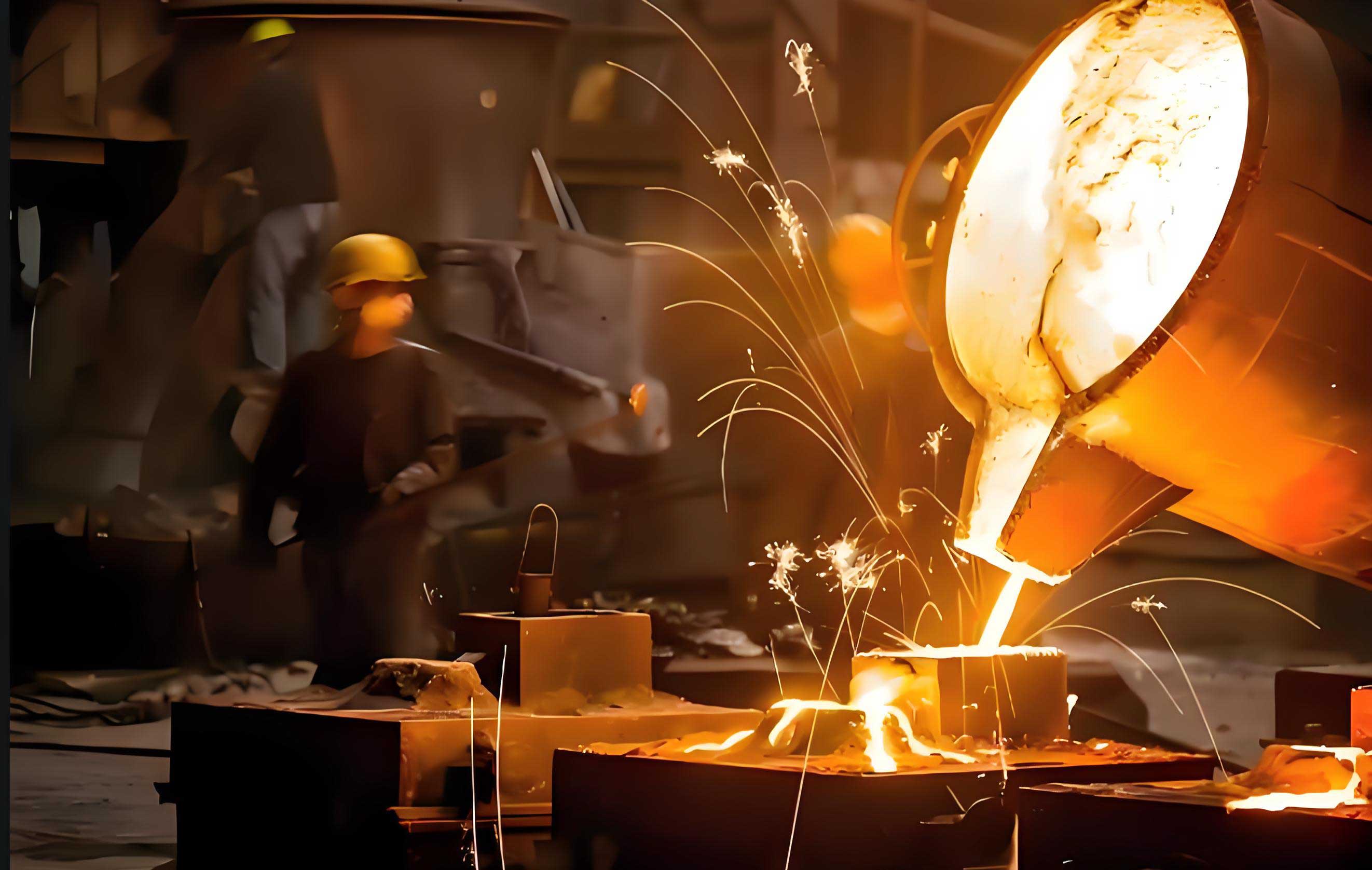
One of the cornerstones of digital foundry technology is three-dimensional digital process design, which revolutionizes how casting parameters are defined and optimized. In traditional two-dimensional drafting, representing complex part structures and gating systems is cumbersome, often leading to misinterpretations and slow response times. By transitioning to 3D models, designers can intuitively visualize and manipulate components, integrating浇注 systems, risers, and cooling elements directly into the digital twin. For example, in a large-scale casting with a diameter of Φ727 mm and height of 810 mm, the internal cavity may feature flanged edges and protrusions that are non-machined. Using 3D CAD software, we can design reinforcement ribs at critical windows to prevent deformation, as illustrated in the structural optimization. The gating system employs gravity pouring with分流浇道 (split runners) to reduce turbulence, thereby mitigating gas entrapment and slag inclusion. Cold irons are strategically placed at the end faces to enhance cooling in thick sections, ensuring dense microstructures. Simulation of solidification behavior predicts shrinkage percentages, allowing for iterative refinements. The governing equation for solidification time, based on Chvorinov’s rule, can be expressed as:
$$ t = B \left( \frac{V}{A} \right)^2 $$
where \( t \) is the solidification time, \( V \) is the volume of the casting, \( A \) is the surface area, and \( B \) is a mold constant dependent on material properties. This mathematical approach underscores the scientific rigor embedded in modern foundry technology, enabling precise control over casting outcomes.
To further elucidate the advantages of 3D digital design, consider the following table comparing traditional and digital methods in foundry technology:
| Aspect | Traditional 2D Design | Digital 3D Design |
|---|---|---|
| Design Cycle Time | 2 weeks or more | 1 week or less |
| Complexity Handling | Limited by manual drafting | High, with intuitive 3D modeling |
| Error Rate | High due to misinterpretations | Low, with simulation validation |
| Cost Implications | Higher for pattern making | Lower, reducing physical prototypes |
Another innovative aspect of digital foundry technology is the dual molding material composite technique, which harmonizes different造型 materials to balance precision and efficiency. In conventional casting, uniform sand types are used throughout the mold, but this can be suboptimal for components with varying surface requirements. For instance, a large casting might have a simple exterior that does not demand high accuracy, while its internal features require tight tolerances and smooth finishes. By combining hand-molded resin sand for the outer mold with 3D-printed sand for the internal core, we achieve a synergistic approach. The key lies in designing printed core heads with嵌槽 (embedding slots) that fit seamlessly into the hand-shaped sections, ensuring precise alignment. This method resolves the矛盾 (contradictions) between complexity and manufacturability, as well as between dimensional stability and production speed. The composite technique reduces the overall printing workload by limiting 3D printing to critical areas, thus shortening the manufacturing timeline. In practice, this involves calculating the interface strength between materials, which can be modeled using the following equation for bonding strength:
$$ \sigma_b = k \cdot \frac{E_m \cdot A_c}{d} $$
where \( \sigma_b \) is the bonding strength, \( k \) is a material-dependent constant, \( E_m \) is the modulus of elasticity of the mold material, \( A_c \) is the contact area, and \( d \) is the interface thickness. Such formulations are integral to advancing foundry technology, as they enable reliable performance in hybrid molding scenarios.
When dealing with large-scale castings, 3D printing of sand molds introduces unique challenges, such as size limitations and handling issues. Standard printing equipment often cannot accommodate monolithic molds for components exceeding certain dimensions, necessitating a分块 (blocking) strategy. A纵横交错 (crisscross) partitioning scheme is employed, where transverse splits facilitate the placement of cooling elements and cleaning, while longitudinal splits are staggered to prevent metal leakage during pouring. To mitigate the risk of跑火 (run-out), anti-leakage grooves are incorporated into the longitudinal interfaces, which are later filled with compacted clay sand or resin sand. This design nearly eliminates leakage risks, as validated through multiple production trials. Additionally, cylindrical positioning pins and layered identification marks enhance assembly accuracy, reducing the likelihood of misalignment. The following table summarizes the key parameters for effective sand mold partitioning in foundry technology:
| Parameter | Description | Optimal Value Range |
|---|---|---|
| Block Size | Maximum dimensions per block | Based on printer bed size (e.g., 500 mm × 500 mm) |
| Interface Groove Depth | Depth of anti-leakage grooves | 5–10 mm |
| Positioning Pin Diameter | Diameter of alignment pins | 10–20 mm |
| Staggering Offset | Offset between longitudinal splits | 10–15% of block width |
Handling and transporting large 3D-printed sand molds pose another hurdle, as traditional methods rely on metal core bones and lifting hooks embedded during manual molding. In digital foundry technology, where sand is deposited layer by layer, integrating such features requires innovative designs. For lighter molds, we print integrated handles that allow manual or strap-based lifting. For heavier molds exceeding 400 kg, we incorporate lifting holes and metal handles, calculating the insertion depth and diameter to ensure structural integrity. The lifting force \( F_l \) can be derived from the following equation:
$$ F_l = \frac{m \cdot g}{n \cdot \cos(\theta)} $$
where \( m \) is the mass of the sand mold, \( g \) is gravitational acceleration, \( n \) is the number of lifting points, and \( \theta \) is the angle of the lifting force relative to vertical. This approach not only facilitates safe handling but also addresses venting requirements for cores by designing card slots for metal rod insertion. These advancements in foundry technology demonstrate how digital tools can overcome physical constraints, enabling the production of massive, intricate castings with minimal human intervention.
The implementation of digital foundry technology extends beyond design and handling to encompass material science and thermodynamics. For example, the choice of sand and binder systems in 3D printing influences the mold’s thermal conductivity and collapsibility post-casting. The heat transfer during solidification can be modeled using the Fourier heat equation:
$$ \frac{\partial T}{\partial t} = \alpha \nabla^2 T + \frac{q}{\rho c_p} $$
where \( T \) is temperature, \( t \) is time, \( \alpha \) is thermal diffusivity, \( q \) is heat generation rate, \( \rho \) is density, and \( c_p \) is specific heat capacity. By optimizing these parameters, foundry technology ensures uniform cooling and reduces residual stresses in cast components. Furthermore, statistical process control (SPC) methods can be applied to monitor printing accuracy, with standard deviations in dimensional tolerances often falling below 0.1 mm for printed sand molds. This level of precision is unattainable with traditional pattern-based methods, where wear and tear lead to progressive degradation.
In conclusion, the integration of digital foundry technology based on sand printing represents a paradigm shift in casting manufacturing. Through three-dimensional digital process design, we achieve unprecedented speed and flexibility, reducing development cycles by over 50% compared to conventional approaches. The dual molding material composite technique elegantly balances efficiency and accuracy, while advanced sand mold partitioning and handling solutions address the scalability challenges of large castings. As foundry technology continues to evolve, future directions may include AI-driven optimization of gating systems and real-time monitoring of printing parameters. The empirical evidence and mathematical models presented herein underscore the transformative potential of this technology, paving the way for more sustainable and adaptive manufacturing ecosystems. By embracing these innovations, the foundry industry can overcome longstanding limitations, ushering in an era of digital mastery over complex casting production.