
In my experience working with high manganese steel casting, I have observed that crack formation is a predominant issue, accounting for over 80% of casting defects in components like liners for grinding mills. High manganese steel casting is critical in industries requiring high impact resistance and durability, such as mining and mineral processing. The inherent properties of high manganese steel casting, including high linear shrinkage and low thermal conductivity, make it prone to cracking during solidification and service. Through extensive research and practical applications, I have developed comprehensive strategies to mitigate these cracks, focusing on optimized design, precise process control, and rigorous heat treatment. This article delves into the root causes of cracks in high manganese steel casting and presents effective prevention measures, supported by data tables and mathematical models to enhance understanding and implementation.
The fundamental reasons for crack formation in high manganese steel casting stem from its material characteristics. Firstly, the linear shrinkage of high manganese steel ranges from 2.4% to 3.5%, which is more than double that of carbon steel. This significant shrinkage during solidification induces substantial internal stress when restrained. Mathematically, the shrinkage strain ε can be expressed as ε = α ΔT, where α is the coefficient of thermal expansion and ΔT is the temperature change. For high manganese steel casting, α is relatively high, leading to greater strain and stress buildup. Secondly, the thermal conductivity of high manganese steel is only 1/4 to 1/6 that of carbon steel, resulting in large thermal gradients and associated stresses during cooling or heating. The thermal stress σ can be modeled as σ = E α ΔT / (1 – ν), where E is Young’s modulus and ν is Poisson’s ratio. In high manganese steel casting, these stresses often exceed the material’s strength, initiating cracks. Additionally, the coarse grain structure and presence of brittle carbides and non-metallic inclusions at grain boundaries further embrittle the casting, reducing its resistance to crack propagation under impact loads.
| Property | Value for High Manganese Steel | Comparison with Carbon Steel |
|---|---|---|
| Linear Shrinkage | 2.4% – 3.5% | Approx. 2 times higher |
| Thermal Conductivity | Low (specific values vary) | 1/4 to 1/6 of carbon steel |
| Grain Structure | Coarse grains with carbides | More prone to embrittlement |
To address these issues, I have implemented several preventive measures in high manganese steel casting processes. Optimizing the casting design is paramount; I ensure uniform wall thickness and adequate fillet radii to minimize stress concentrations. The gating and risering systems are meticulously designed to facilitate rapid filling and directional solidification. For instance, using side risers or break-off risers instead of top risers reduces thermal stress during cutting. The cross-sectional dimensions of ingates are typically maintained between 40 mm × 60 mm or 30 mm × 80 mm to prevent shrinkage cavities. Incorporating chills in combination with risers enhances cooling uniformity and refines grain structure, thereby reducing crack susceptibility. The effectiveness of chill placement can be quantified using the Fourier number Fo = α t / L², where α is thermal diffusivity, t is time, and L is characteristic length, ensuring optimal heat extraction in high manganese steel casting.
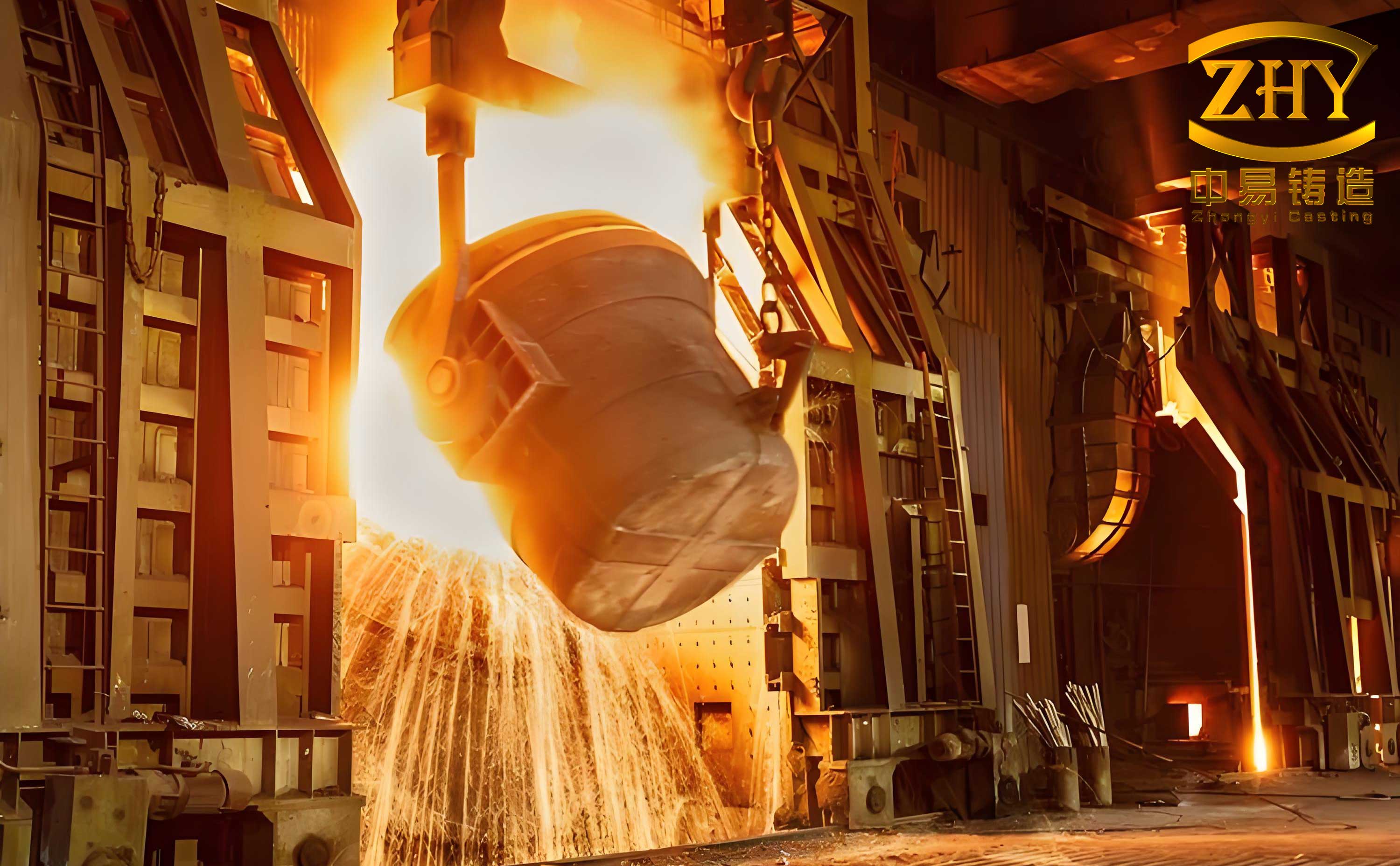
Control of pouring temperature and chemistry is crucial in high manganese steel casting. I adhere to low-temperature rapid pouring, typically between 1370°C and 1390°C, to minimize thermal stresses. The carbon and phosphorus contents are strictly regulated; for high-impact applications, carbon is kept at 0.9% to 1.0%, and phosphorus below 0.06%, as higher levels promote carbide precipitation and embrittlement. The manganese-to-carbon ratio (Mn/C) is maintained at 8 to 10, with adjustments based on section thickness. The relationship between composition and crack propensity can be expressed using empirical formulas, such as the crack sensitivity index S = k C P, where k is a constant, C is carbon content, and P is phosphorus content. By optimizing these parameters, I have significantly reduced defects in high manganese steel casting.
| Element | Target Range (%) | Influence on Crack Formation |
|---|---|---|
| Carbon (C) | 0.9 – 1.2 | Higher carbon increases carbide formation and brittleness |
| Manganese (Mn) | 11 – 14 | Maintains austenitic structure; Mn/C ratio critical |
| Phosphorus (P) | ≤ 0.06 | Reduces phosphide eutectics that weaken grain boundaries |
| Silicon (Si) | 0.3 – 0.8 | Affects fluidity and oxidation resistance |
In melting and heat treatment processes for high manganese steel casting, I employ both oxidation and non-oxidation methods based on charge materials. For oxidation melting, I focus on dephosphorization by maintaining high-basicity oxidizing slags and controlling carbon levels below 0.20% before reduction. The reduction phase involves using calcium carbide slag for effective deoxidation, with rare earth silicon additions for grain refinement. The heat treatment cycle is carefully controlled; I ramp up temperatures slowly at 50°C/h to 80°C/h below 650°C to avoid thermal shock, followed by soaking at austenitizing temperatures to dissolve carbides. The soaking time t_soak can be determined by t_soak = k d, where k is a constant (e.g., 1 h per 50 mm thickness) and d is section thickness. Quenching is performed rapidly in water below 40°C to retain the austenitic structure and prevent carbide precipitation. This holistic approach ensures that high manganese steel casting achieves optimal toughness and crack resistance.
The application of these strategies has yielded remarkable improvements in high manganese steel casting quality. By enforcing strict operational protocols and refining process parameters, defect rates have plummeted, and service life of components like mill liners has extended significantly. For instance, in large-scale grinding equipment, high manganese steel casting liners now withstand intense impact without failure, demonstrating enhanced performance. Continuous monitoring and adaptation of these methods are essential, as variations in raw materials or operating conditions can affect outcomes. Through persistent efforts, high manganese steel casting has become more reliable, meeting the demanding requirements of heavy-industry applications.
| Stage | Temperature Range (°C) | Rate/Time | Objective |
|---|---|---|---|
| Heating | Up to 650 | 50 – 80°C/h | Minimize thermal stress |
| Soaking | Austenitizing (e.g., 1050°C) | 1 h per 50 mm thickness | Dissolve carbides |
| Quenching | Water cooling | ≤ 2 min transfer time | Retain austenite; prevent carbide formation |
In conclusion, addressing cracks in high manganese steel casting requires a multifaceted approach that integrates design, process control, and metallurgical excellence. By understanding the material’s behavior and applying scientific principles, I have successfully mitigated crack issues, enhancing the durability and efficiency of high manganese steel casting components. Future work will focus on advanced simulation techniques to predict stress distributions and optimize processes further, ensuring that high manganese steel casting continues to evolve as a cornerstone of industrial applications.