
In my experience at our foundry, the production of high manganese steel castings using furan resin sand has been a significant technological advancement, particularly for applications in demanding environments like mining electric shovels. High manganese steel castings are renowned for their exceptional wear resistance and toughness, which stem from their unique work-hardening properties. However, these very characteristics pose challenges in casting processes, such as susceptibility to cracking, dimensional inaccuracies, and surface defects. This article delves into the theoretical analysis and practical implementation of furan resin sand for producing high-quality high manganese steel castings, focusing on key aspects like material properties, process optimization, and defect mitigation. Throughout this discussion, the term “high manganese steel casting” will be emphasized to underscore its centrality in industrial applications.
High manganese steel castings, such as those used in electric shovels, must meet stringent technical requirements, including internal integrity verified by radiographic testing (RT) and surface quality assessed through penetrant testing (PT). Some castings even require destructive testing of the first article to ensure compliance. The work-hardening behavior of high manganese steel castings is a double-edged sword: it provides excellent surface wear resistance but complicates machining due to rapid tool wear. Consequently, most high manganese steel castings are used in as-cast conditions or with minimal finishing, such as grinding, necessitating precise dimensional control from the casting process itself.
To understand the intricacies of producing high manganese steel castings, it is essential to analyze the material’s chemical composition and physical properties. The typical composition of high manganese steel, such as the P&H7C grade, includes elements like carbon, manganese, chromium, and molybdenum. A key parameter is the carbon equivalent (CE), which influences fluidity and solidification behavior. The CE can be calculated using the formula:
$$ CE = C + \frac{Mn}{6} + \frac{Cr + Mo}{5} $$
For high manganese steel castings, this value typically ranges from 3.21 to 3.78, indicating high carbon content and excellent fluidity. This allows for lower pouring temperatures, reducing the risk of defects like hot tearing and sand burn-in. However, the high carbon equivalent also contributes to a narrow solidification range, with a liquidus temperature of approximately 1400°C and a solidus temperature of 1350°C. The linear shrinkage of high manganese steel castings is notably higher than that of carbon steels, often leading to cracking if not properly managed. The shrinkage rate (ε) can be determined empirically using the equation:
$$ ε = \frac{L_1 – L_2}{L_2} \times 100\% $$
where L1 is the pattern dimension and L2 is the casting dimension after solidification. In initial trials, we observed shrinkage rates between 2.5% and 3.5% for high manganese steel castings produced with furan resin sand, necessitating adjustments in pattern design.
| Element | Content (wt%) |
|---|---|
| Carbon (C) | 1.0 – 1.4 |
| Manganese (Mn) | 11.0 – 14.0 |
| Silicon (Si) | 0.3 – 0.8 |
| Chromium (Cr) | 1.5 – 2.5 |
| Molybdenum (Mo) | 0.2 – 0.5 |
| Phosphorus (P) | ≤ 0.05 |
| Sulfur (S) | ≤ 0.03 |
The furan resin sand system, known for its high strength and dimensional accuracy, presents both advantages and challenges when used for high manganese steel castings. Furan resin is an acid-curing binder that decomposes at temperatures above 250°C, while silica sand undergoes phase transformation at 573°C, leading to expansion. This can cause mold wall movement, cracking, or veining if not controlled. Moreover, the acidic nature of furan resin sand can react with the basic oxides in high manganese steel, such as MnO, forming low-melting-point compounds like MnO·SiO2. This reaction results in chemical burn-on or penetration, making it difficult to clean the castings and potentially causing surface defects. The reaction can be represented as:
$$ \text{MnO} + \text{SiO}_2 \rightarrow \text{MnO} \cdot \text{SiO}_2 $$
To address these issues, we implemented several production controls. First, the selection of sand types was critical. For face sand, we used high-quality chromite sand from South Africa due to its high refractoriness and neutral pH, which minimizes reactions with the steel. Backup sand consisted of high-purity silica sand from Fujian, with controlled grain size distribution to enhance permeability and reduce gas evolution. The tensile strength of the sand molds was optimized: face sand was maintained at 10–15 kg/cm² to resist erosion and metal penetration, while backup sand was set at 5–10 kg/cm² to allow for controlled contraction and reduce stress on the high manganese steel casting during cooling.
Coating selection played a pivotal role in preventing defects in high manganese steel castings. We chose an alcohol-based magnesia coating for its alkaline nature, high refractoriness, and good adherence properties. The coating was applied in two layers: a primer with lower viscosity to penetrate the sand surface and enhance bonding, and a topcoat with higher viscosity to build a thickness of 1–2 mm. This dual-layer system effectively prevented metal penetration, sand inclusion, and burn-on defects. The coating’s performance can be evaluated based on its ability to withstand thermal shock and chemical attack, which is crucial for high manganese steel castings given their prolonged interaction with the mold at high temperatures.
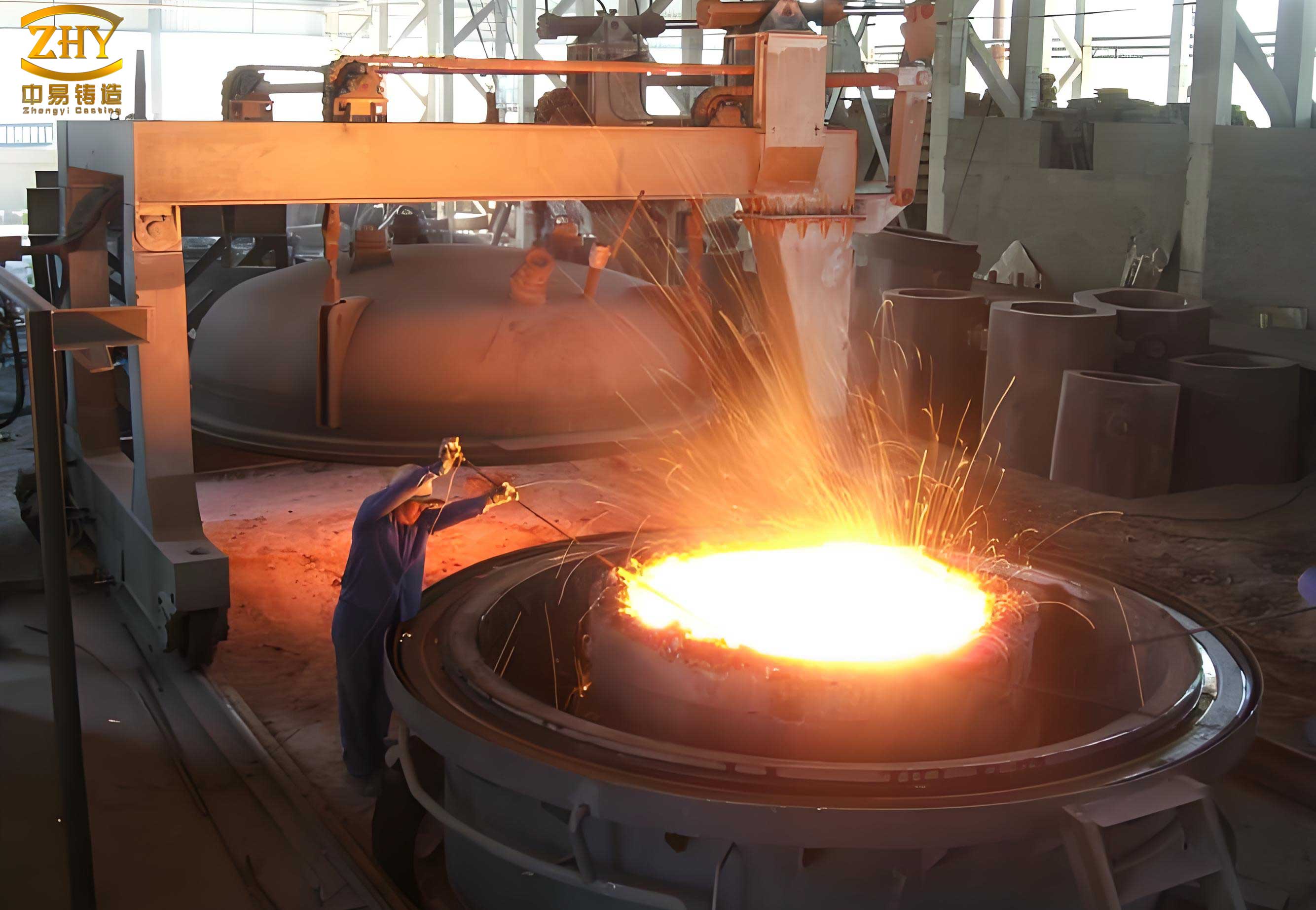
Pouring temperature control is another critical factor in producing sound high manganese steel castings. Based on theoretical analysis, the high fluidity of high manganese steel, due to its elevated carbon equivalent, allows for lower pouring temperatures. Initially, we experimented with temperatures ranging from 1450°C to 1470°C, but this led to issues like sticking and cracking. After adjusting to 1420–1450°C, with a preference for the lower end, we observed a significant reduction in defects. The relationship between pouring temperature (T_p) and defect incidence can be modeled empirically, but it largely depends on the specific geometry of the high manganese steel casting and the mold design. For instance, thicker sections may require slightly higher temperatures to avoid mistruns, while thin-walled areas benefit from lower temperatures to minimize thermal stress.
In terms of molding operations, the high dimensional accuracy required for high manganese steel castings necessitated robust sand mold integrity. We avoided traditional methods like adding sawdust to cores for improved collapsibility, as this could compromise surface finish. Instead, we optimized the sand mixture’s strength and used specialized venting techniques to facilitate gas escape during pouring. The molding process involved careful ramming to achieve uniform density, and cores were designed with adequate drafts and reinforcements to withstand metallostatic pressure. For box-shaped high manganese steel castings, which are prone to hot tearing due to restrained contraction, we incorporated strategic weakening points in the backup sand to allow for controlled deformation without cracking.
The solidification behavior of high manganese steel castings is influenced by the mold material’s properties. Furan resin sand, with its low thermal conductivity, prolongs the cooling time, which can exacerbate segregation and shrinkage porosity. To mitigate this, we employed chills and exothermic padding in critical areas to promote directional solidification. The rate of heat transfer (q) between the casting and the mold can be described by Fourier’s law:
$$ q = -k \frac{dT}{dx} $$
where k is the thermal conductivity of the sand, and dT/dx is the temperature gradient. By selecting sands with appropriate k values and applying coatings that enhance heat dissipation, we achieved more uniform cooling in high manganese steel castings, reducing the likelihood of internal defects.
Quality assurance for high manganese steel castings involved non-destructive testing methods. Radiographic testing (RT) was used to detect internal discontinuities like shrinkage cavities or inclusions, while penetrant testing (PT) identified surface cracks or pores. In first-article inspections, destructive tests such as microstructure analysis and mechanical property evaluations were conducted. The microstructure of high manganese steel castings typically consists of austenite with carbide precipitates, which must be controlled through heat treatment to achieve optimal toughness. The solution treatment involves heating to 1050–1100°C followed by water quenching to dissolve carbides and retain a fully austenitic structure, enhancing the work-hardening capability.
| Parameter | Value/Range |
|---|---|
| Pouring Temperature | 1420–1450°C |
| Sand Tensile Strength (Face) | 10–15 kg/cm² |
| Sand Tensile Strength (Backup) | 5–10 kg/cm² |
| Coating Thickness | 1–2 mm |
| Linear Shrinkage Rate | 2.5–3.5% |
| Solidification Time Factor | Modulated with chills |
Throughout the production of high manganese steel castings, we encountered and overcame several challenges. For example, the tendency toward sand fusion was addressed by optimizing the coating application process and using higher-purity sands. Additionally, the risk of cracking was minimized by designing molds with generous radii and avoiding sharp corners that act as stress concentrators. The mechanical properties of high manganese steel castings, such as impact toughness and hardness, were consistently verified to meet specifications, with typical values exceeding 200 J for Charpy impact energy and 200 HB in the as-cast condition, improving to over 500 HB after work-hardening in service.
In conclusion, the application of furan resin sand for high manganese steel castings requires a deep understanding of both the material’s properties and the molding process. By integrating theoretical analysis with practical adjustments—such as controlled sand strength, tailored coatings, and optimized pouring parameters—we successfully produced high-integrity high manganese steel castings for electric shovels. This approach not only enhanced dimensional accuracy and surface quality but also reduced defect rates, demonstrating the viability of furan resin sand in advanced casting applications. Future work could focus on refining these techniques for larger or more complex high manganese steel castings, potentially incorporating simulation tools to predict solidification patterns and stress distributions.
The production of high manganese steel castings remains a dynamic field, with ongoing research into alternative binder systems and advanced coatings. However, the principles outlined here provide a solid foundation for leveraging furan resin sand to achieve reliable results. As industries continue to demand durable components for harsh environments, the role of high manganese steel castings will only grow, underscoring the importance of continuous process improvement and innovation in foundry practices.