
In the production of compressor components, the counter balance plays a critical role in mitigating imbalances during high-speed rotation. Traditionally, brass counter balances were manufactured through hot forging, but this method incurred high costs. To address this, I explored the use of high manganese steel casting via investment casting, a precision-forming technique that offers superior dimensional accuracy and surface finish. High manganese steel is an ideal material due to its non-magnetic properties when heat-treated to an austenitic structure, combined with excellent wear resistance and toughness under impact. This article details the comprehensive process optimization for producing high manganese steel casting components, focusing on chemical composition, wax pattern fabrication, shell building, melting, pouring, and heat treatment. Through systematic improvements, I achieved a 40–50% cost reduction while meeting stringent quality requirements, including a surface roughness of Ra 1.6 μm and minimal residual magnetism. The successful application of high manganese steel casting in this context underscores its potential for replacing costly alloys in precision parts.
The counter balance, as a deep-hole, thin-walled component, presented significant challenges in manufacturing. Its design features smooth arcs with stepped holes, a minimum wall thickness of 1.25 mm, and a depth of 17.0 mm, necessitating a process capable of high precision. Investment casting, with its ability to produce complex geometries and tight tolerances (CT4–CT6 and Ra 0.8–1.6 μm), was selected. Key issues included preventing defects like shrinkage, porosity, and magnetic retention, which were addressed through material and process refinements. The high manganese steel casting process involved multiple stages, each requiring precise control to ensure the final product’s integrity and non-magnetic characteristics. Below, I elaborate on each step, incorporating tables and formulas to summarize critical parameters and theoretical foundations.
Chemical composition design is paramount in high manganese steel casting to achieve a stable austenitic structure and non-magnetic properties. Manganese (Mn) is the primary alloying element that expands and stabilizes the austenite phase, with a minimum of 16 wt% required to maintain this structure at room temperature. Carbon (C) also enhances austenite stability but must be controlled to avoid excessive hardness that complicates machining. Based on practical considerations, I optimized the composition to balance cost and performance, as shown in Table 1. The high manganese steel casting formulation ensures adequate Mn and C levels while minimizing impurities like sulfur and phosphorus, which can degrade mechanical properties.
| Element | Content Range |
|---|---|
| C | 0.5–1.0 |
| Mn | 13.0–18.0 |
| Si | 0.2–0.9 |
| S | ≤0.08 |
| P | ≤0.09 |
| Fe | Balance |
The relationship between Mn and C in high manganese steel casting can be expressed using empirical formulas to predict austenite stability. For instance, the martensite start temperature (Ms) decreases with increasing Mn content, which is critical for non-magnetic applications. A simplified equation is:
$$ Ms = 539 – 423C – 30.4Mn – 17.7Ni – 12.1Cr – 7.5Mo $$
where element symbols represent weight percentages. In high manganese steel casting, maintaining Ms below room temperature ensures a fully austenitic matrix post-heat treatment. This principle guided the composition adjustments, reducing reliance on expensive elements like nickel.
Wax pattern fabrication is the first step in investment casting for high manganese steel components. I used a specialized wax material (P201) and controlled environmental conditions (24±2°C temperature, 40–70% humidity) to prevent deformation. The wax injection parameters included a temperature of 80°C, pressure of 3 MPa, and times of 20 s for patterns and 24 s for runners. Each wax tree assembled 40 patterns with a 12 mm spacing, angled to facilitate dewaxing and slag removal during pouring. The gating system design incorporated long sprue runners that doubled as feeders for shrinkage compensation, along with reinforcement ribs to enhance shell strength. This setup ensured efficient production and high pattern integrity for the high manganese steel casting process.
Shell building involved creating a multi-layer mold capable of withstanding the high pouring temperatures of high manganese steel casting. The process parameters, detailed in Table 2, were rigorously controlled to achieve a dense, gas-permeable shell. The primary layer used a slurry of silica sol and white alumina powder to form a smooth surface, while subsequent layers employed mullite for cost-effectiveness. Each coating required precise viscosity and drying times to prevent defects like sand inclusion or gas porosity. Environmental controls mirrored those in wax pattern fabrication to maintain consistency. Challenges in drying deep-hole areas were mitigated by reducing shell density in drying chambers and increasing air circulation, ensuring uniform hardening for the high manganese steel casting.
| Coating Layer | Coating Composition | Liquid-to-Powder Ratio | Zahn Cup Viscosity (s) | Stucco Material | Drying Time (h) |
|---|---|---|---|---|---|
| Primary | Silica sol + 320-mesh white alumina | 3.6:1 | 42–45 | 70–80 mesh white alumina | 4–6 |
| Secondary | Same as primary | 3.6:1 | 42–45 | 70–80 mesh white alumina | 4–6 |
| Tertiary | Silica sol + mullite powder | 3.6:1 | 22–25 | 70–80 mesh mullite | 8 |
| Fourth | Same as tertiary | 3.6:1 | 16–19 | 70–80 mesh mullite | 8 |
| Fifth | Same as tertiary | 3.6:1 | 13–16 | 70–80 mesh mullite | 8 |
| Sealer | Silica sol + mullite powder | 3.6:1 | 16–19 | — | 14 |
The shell’s performance in high manganese steel casting depends on its mechanical strength and thermal stability. The green strength can be estimated using the formula for ceramic shell integrity:
$$ \sigma_g = k \cdot \frac{E \cdot \phi}{1 – \nu} $$
where \(\sigma_g\) is the green strength, \(k\) is a material constant, \(E\) is the modulus of elasticity, \(\phi\) is the porosity, and \(\nu\) is Poisson’s ratio. For high manganese steel casting, optimizing these parameters ensured the shell could handle thermal shocks during pouring.
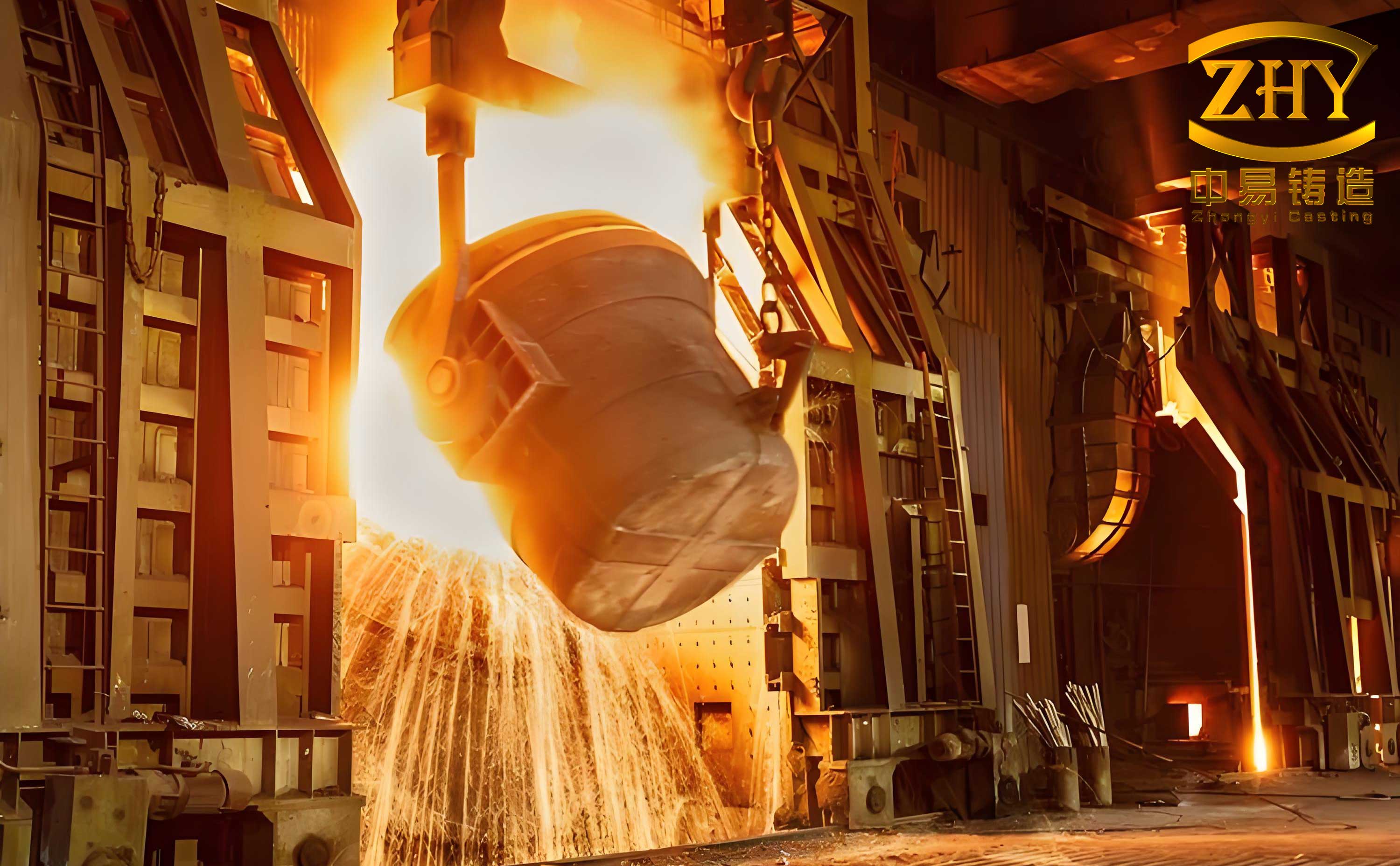
Melting and pouring are critical phases in high manganese steel casting, requiring precise temperature control to avoid defects. I used a medium-frequency induction furnace with a charge of 100 kg carbon steel scrap, 11.5 kg high-carbon ferromanganese, 10 kg medium-carbon ferromanganese, 0.1 kg aluminum wire for deoxidation, 0.2 kg calcium-silicon-manganese for desulfurization, and 1 kg slag remover. The melting temperature ranged from 1600 to 1620°C, with pouring at 1560–1580°C to ensure fluidity while minimizing gas absorption. A key improvement involved switching from coal gas to natural gas for shell preheating, achieving temperatures above 1050°C for at least 30 min. This eliminated issues like incomplete burning, which previously caused sand inclusion and shrinkage in high manganese steel casting. The high fluidity of high manganese steel facilitated filling of thin sections, but careful gating design was essential to prevent turbulence.
Heat treatment is the final step to achieve the desired non-magnetic properties in high manganese steel casting. Conventional water toughening involves heating to 950°C or higher for austenitization, followed by rapid water quenching to retain the austenite phase. However, this often led to surface oxidation and subsequent “floating magnetism” due to strain-induced martensite during descaling. To overcome this, I modified the process using a mesh-belt furnace with a protective atmosphere of dissociated ammonia. The furnace comprised a heating zone and a cooling zone with water channels, allowing controlled cooling without direct water contact. The thermal cycle, illustrated in Figure 3, involved rapid heating to 1100°C in 40 min, holding for 10 min, and cooling to 800°C in 10 min under the protective gas. This prevented oxidation and eliminated the need for shot blasting, directly yielding bright, non-magnetic high manganese steel casting components.
The kinetics of austenite formation during heat treatment in high manganese steel casting can be described by the Avrami equation:
$$ X = 1 – \exp(-k t^n) $$
where \(X\) is the fraction transformed, \(k\) is a rate constant, \(t\) is time, and \(n\) is the Avrami exponent. For high manganese steel, rapid heating and cooling suppress carbide precipitation, ensuring a homogeneous austenitic structure. The improved process not only enhanced magnetic properties but also streamlined production by reducing post-treatment steps.
Results from the optimized high manganese steel casting process demonstrated a product yield exceeding 95%, with weights within 86±2 g and residual magnetism below \(5 \times 10^{-4}\) Tesla. Relative magnetic permeability was maintained at or below 1.05, meeting the stringent requirements for compressor applications. The cost analysis revealed savings of 40–50% compared to brass forging, primarily due to material substitution and process efficiencies. This success highlights the viability of high manganese steel casting for precision components, leveraging its unique combination of durability and non-magnetic behavior. Future work could explore further refinements in alloy design or automation to enhance consistency in high manganese steel casting.
In conclusion, the investment casting of high manganese steel counter balances represents a significant advancement in manufacturing efficiency and cost reduction. Through meticulous optimization of composition, shell building, melting, and heat treatment, I achieved a robust process that delivers high-quality, non-magnetic components. The integration of protective atmosphere heat treatment was pivotal in resolving magnetic issues, underscoring the importance of tailored solutions in high manganese steel casting. This approach not only benefits compressor production but also sets a precedent for applying high manganese steel casting in other industries requiring precision and economy.