
In the field of railway infrastructure, the integrated high manganese steel casting frog represents a critical component due to its monolithic structure, ease of processing, and maintenance convenience. The manufacturing process encompasses multiple disciplines, including metallurgy, casting, heat treatment, machining, explosion hardening, and non-destructive testing, making it a complex and lengthy endeavor. With increasing demands for higher standards in railway applications, enhancing the comprehensive quality and performance of these frogs has become a pressing challenge. This research focuses on the development of key technologies for the 50N-16 integrated high manganese steel casting frog, addressing surface quality, internal integrity, and material properties through innovative process improvements.
The high manganese steel casting process for the 50N-16 frog involves a VRH water glass sand molding technique, which significantly influences the surface quality of the final product. To mitigate defects such as sand adhesion and surface pores, we implemented strict controls on the sand grain size distribution and immediate compressive strength of the mold. Specifically, the main grain size fractions were optimized to ensure a cumulative percentage of at least 75% in key sieve sizes, as detailed in the table below. This approach enhances the mold’s permeability and surface roughness, reducing the risk of defects during pattern withdrawal and subsequent casting.
| Main Grain Size (mm) | Control Standard (%) | Measured Value 1 (%) | Measured Value 2 (%) | Measured Value 3 (%) |
|---|---|---|---|---|
| 0.600 | Sum ≥ 75% | 14.08 | 21.11 | 18.98 |
| 0.425 | Sum ≥ 75% | 24.21 | 24.05 | 20.44 |
| 0.300 | Sum ≥ 75% | 25.04 | 19.09 | 24.57 |
| 0.212 | Sum ≥ 75% | 17.11 | 11.99 | 23.54 |
| Total Percentage | ≥ 75% | 80.44% | 76.24% | 87.53% |
Additionally, the immediate compressive strength of the mold sand was maintained at or above 0.85 MPa to ensure structural integrity during handling and pouring. This control minimizes damage to the mold cavity surface, as shown in the following table, which summarizes the strength measurements.
| Control Standard (MPa) | Measured 1 (MPa) | Measured 2 (MPa) | Measured 3 (MPa) |
|---|---|---|---|
| ≥ 0.85 | 0.96 | 0.98 | 0.94 |
To address subsurface porosity, which often arises from inadequate drying of the mold and coatings, we introduced a hot-air drying process. The mold cavity was subjected to a temperature of 200 °C for no less than 30 minutes prior to closing and pouring. This step ensures thorough drying of the alcohol-based refractory coatings and sand, effectively eliminating shallow surface pores in the high manganese steel casting. Furthermore, after the water toughening treatment, which is essential for improving the material’s microstructure and mechanical properties, the frog surface often exhibits residual oxide scales and sand residues. To achieve a uniform surface quality, we employed shot blasting and grit blasting processes. This not only removes oxides and residues but also induces a shallow surface hardening, resulting in a consistent appearance and easier defect inspection.
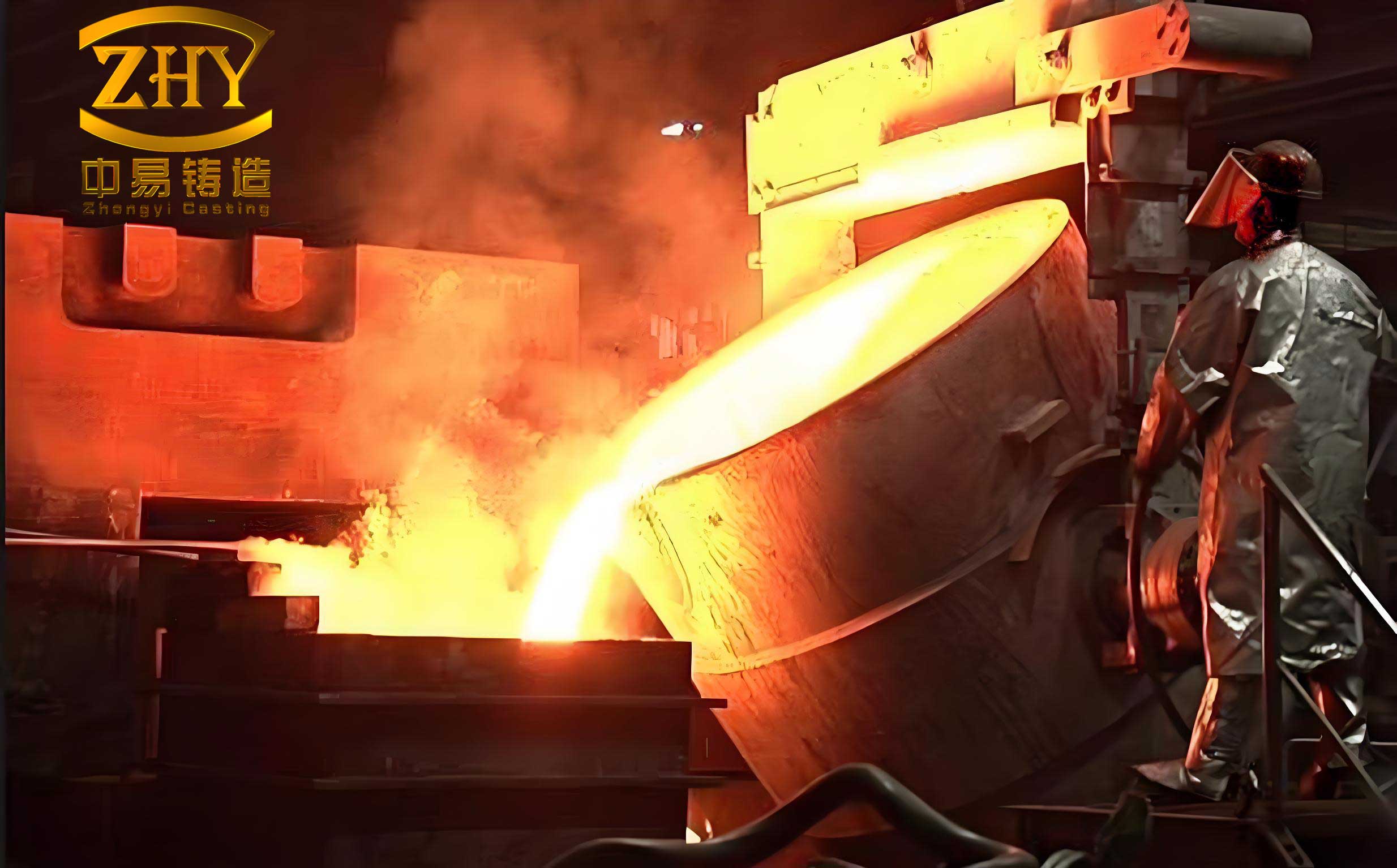
The 50N-16 high manganese steel casting frog features multiple dowel holes, typically up to 28 per unit, which are cast directly. Initial production revealed issues with sand adhesion and dimensional inaccuracies in these holes, primarily due to the challenges in controlling coating thickness on small-diameter cores. To overcome this, we switched to using coated sand for molding the dowel holes. Coated sand offers finer grain size and superior strength, allowing for more uniform coating application and better drying. This change significantly reduced internal sand adhesion, porosity, and dimensional deviations, ensuring that the hole diameters meet the strict tolerance of ±0.5 mm. The comparison between traditional magnesium olivine sand and coated sand cores demonstrated a marked improvement in surface smoothness and defect reduction.
Internal quality is paramount for the high manganese steel casting frog, especially in critical areas such as the wheel transition zones, leg ends, and nose rail tips. We utilized high-energy digital radiography to monitor internal defects, aiming for a Grade 1 standard in key regions. The casting process was designed with exothermic risers at the nose rail and end sections to enhance feeding and reduce shrinkage defects. Additionally, the rail top surface was cast in the lower mold with continuous chill plates to promote rapid solidification, resulting in a denser structure that meets the radiographic requirements to a depth of 25 mm. The following table outlines the internal quality control standards for specific areas.
| Inspection Area | Specific Location | Required Grade |
|---|---|---|
| Wheel Transition Zone | 400 mm length from nose rail tip to heel, depth 25 mm | A1, B1, C1 |
| Leg End | 200 mm length from theoretical point to throat and heel, depth 25 mm | A1, B1, C1 |
| End Section | 0–50 mm from end | A1, B1, C1 |
The mechanical properties of the high manganese steel casting are heavily influenced by the heat treatment process, which aims to achieve a microstructure of austenite with minimal carbides. The standard water toughening treatment involves heating to 1060 °C for 3.5 hours to achieve full austenitization, followed by quenching. However, to further suppress carbide precipitation, which begins around 960 °C and accelerates at 850 °C, we modified the process by adding a high-temperature holding stage at 1080 °C for 0.5 hours. This adjustment compensates for temperature losses during transfer, ensuring the casting enters the water at an optimal temperature and minimizing the formation of brittle carbides. The heat treatment curve can be represented by the following equations to illustrate the temperature profiles:
$$ T(t) = T_0 + \Delta T \cdot e^{-k t} $$
where \( T(t) \) is the temperature at time \( t \), \( T_0 \) is the initial temperature, \( \Delta T \) is the temperature difference, and \( k \) is a constant related to the cooling rate. For the high manganese steel casting, the cooling rate from 1060 °C to 960 °C is critical, typically ranging from 160 to 190 °C/min, with a transfer time of 45–55 seconds to water quenching. By controlling the instantaneous temperature variation within ±2 °C during the high-temperature stages and maintaining water temperature below 40 °C with agitation for at least 10 minutes, we achieved a significant reduction in carbide content and improved mechanical properties.
The microstructural analysis of the high manganese steel casting after heat treatment reveals a predominantly austenitic matrix with minimal carbides, as shown in metallographic examinations. The mechanical properties were evaluated through tensile tests and hardness measurements, demonstrating substantial improvements. For instance, the yield strength reached an average of 424 MPa, exceeding the minimum requirement of 400 MPa; the tensile strength averaged 990 MPa, well above the 740 MPa standard; the elongation averaged 70%, surpassing the 35% threshold; and the hardness averaged 192 HBW, higher than the 170 HBW minimum. These results are summarized in the table below, highlighting the effectiveness of the process optimizations.
| Property | Sample 1 | Sample 2 | Sample 3 | Average | Standard Requirement |
|---|---|---|---|---|---|
| Yield Strength (MPa) | 420 | 413 | 439 | 424 | ≥ 400 |
| Tensile Strength (MPa) | 983 | 1001 | 985 | 990 | ≥ 740 |
| Elongation (%) | 65 | 73 | 72 | 70 | ≥ 35 |
| Hardness (HBW) | 190 | 200 | 185 | 192 | ≥ 170 |
In conclusion, the development of key technologies for the 50N-16 integrated high manganese steel casting frog has led to significant advancements in surface quality, internal integrity, and material performance. By optimizing sand properties, implementing hot-air drying, utilizing shot blasting, and adopting coated sand for dowel holes, we effectively controlled surface and subsurface defects. The use of high-energy digital radiography and tailored casting processes ensured internal quality met stringent standards. Moreover, the enhanced heat treatment protocol, including the 1080 °C holding stage and precise temperature control, resulted in superior mechanical properties with reduced carbide precipitation. These innovations collectively achieve the research objectives for high-performance high manganese steel casting applications in railway systems, paving the way for more reliable and durable infrastructure components.