
In the field of railway infrastructure, the durability and performance of high manganese steel casting components, such as frogs, are critical for ensuring safe and efficient operations. High manganese steel casting exhibits excellent plasticity and toughness after water toughening treatment, but it suffers from low yield strength and susceptibility to deformation under specific service conditions. This material is widely used in integral cast frogs due to its ability to develop high strength, impact toughness, and wear resistance under high-impact and abrasive environments. However, the frog centre, particularly at the 30–40 mm cross-section, experiences severe cyclic loading and impact from wheels, leading to rapid wear and crack initiation. This study focuses on employing a casting-penetration process to enhance the surface properties of high manganese steel casting frog centres, thereby improving their service life and performance.
The casting-penetration technique involves infiltrating alloy powders into the surface layer of a cast component during the pouring process, resulting in a composite alloy layer that integrates metallurgically with the base material. For high manganese steel casting, this approach aims to create a hardened surface layer on the frog centre while maintaining the base material’s inherent toughness. The primary objective is to mitigate early-stage wear and prevent crack formation in critical sections. This research delves into the design of the penetration alloy system, the preparation of test specimens, microstructural analysis, and mechanical property evaluations, all centered on optimizing high manganese steel casting for railway applications.
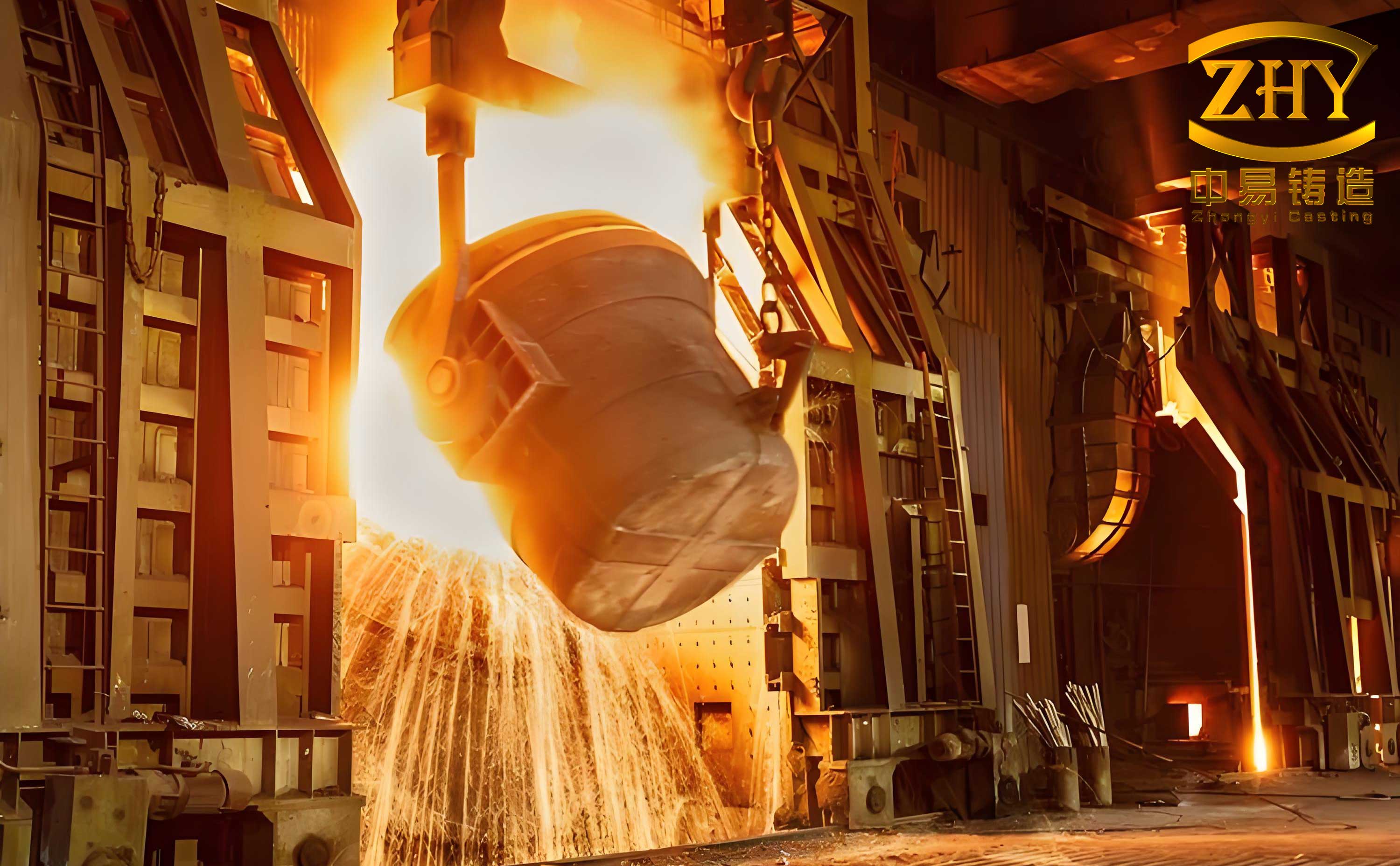
The design of the penetration alloy system is crucial for achieving the desired properties in high manganese steel casting. Alloying elements influence the microstructure and mechanical behavior through solid solution strengthening, formation of hard phases, and grain refinement. Carbon, as a primary element, enhances hardenability and base hardness; however, excessive carbon can lead to brittle carbide formation, reducing toughness. The optimal carbon content for the penetration alloy was determined to be in the range of 0.4% to 0.6%, balancing hardness and ductility. Chromium contributes to solid solution strengthening, improves hardenability, and forms stable carbides that enhance wear resistance. For high manganese steel casting, chromium content was controlled between 1.5% and 2.0%. Molybdenum increases recrystallization temperature, prevents grain growth, and enhances high-temperature strength and corrosion resistance, with levels set at 2% to 5%. Vanadium aids in austenite stabilization, reduces brittleness, and inhibits harmful element segregation, with content maintained at 0.5% to 1%. Silicon, while strengthening the matrix, can embrittle the material and was limited to below 0.8%. Additionally, yttrium-based rare earth modifiers were incorporated at 0.2% to refine grains and promote homogeneous microstructure formation during solidification and heat treatment. The chemical composition of the designed penetration alloy is summarized in Table 1, while the base high manganese steel casting composition for the frog is provided in Table 2.
| Element | Design Range | Selected Value |
|---|---|---|
| C | 0.4–0.6 | 0.5 |
| Cr | 1.5–2.0 | 1.75 |
| Mo | 2–5 | 3.5 |
| V | 0.5–1 | 0.8 |
| Si | <0.8 | 0.5 |
| S | <0.035 | <0.035 |
| P | <0.03 | <0.03 |
| RE (Y-based) | 0.2 | 0.2 |
| Balance | Reduced Iron Powder | |
| Grade | C | Mn | Si | P | S | Mn/C Ratio |
|---|---|---|---|---|---|---|
| Primary | 0.95–1.35 | 11–14 | 0.3–0.8 | ≤0.045 | ≤0.030 | ≥10 |
The penetration agent was prepared by mixing FeCrC8, molybdenum powder, FeV50A, and 0.2% yttrium-based rare earth-titanium modifier, with particle sizes controlled between 100 and 120 mesh. A binder of PVB alcohol solution and a flux of NaF were added to facilitate wetting, reduce oxidation, and promote metallurgical bonding during the high manganese steel casting process. The flux helps purify the alloy particles by adsorbing oxide films, ensuring effective dissolution and diffusion with the molten steel.
Specimen preparation for high manganese steel casting involved using VRH (Vapor Replacement Hardening) molding lines with magnesium olivine sodium silicate sand. The mold consisted of upper and lower boxes, with a initial strength exceeding 1 MPa after pattern drawing. The penetration agent was applied as a 5 mm thick coating on the lower box cavity surface at the frog centre’s 30–40 mm cross-section, ignited, and dried to form a preplaced layer. In the upper box, a 3 mm coating was applied to the bottom of the shaped exothermic riser, dried, and the molds were assembled for pouring. The high manganese steel casting was melted in a 5-ton electric arc furnace using an oxidation process, with composition analyzed by direct reading spectroscopy and temperature monitored by thermocouple. After final deoxidation with silicon-barium-aluminum-strontium in the ladle, the steel was tapped and poured using a bottom-pour ladle at a tilt angle of 6°–8° and a pouring temperature of 1,470°C. This setup allowed the molten steel to fully infiltrate and react with the penetration layer, while the exothermic riser provided gravitational feeding during solidification, resulting in a metallurgically bonded alloy layer of 4–5 mm thickness on the frog centre, as illustrated in the microstructural analysis.
The heat treatment process for high manganese steel casting is essential for achieving the desired austenitic microstructure and enhancing mechanical properties. Before furnace charging, an anti-oxidation and decarburization coating was applied to the frog centre area. The castings were heated to 1,050–1,100°C and water-quenched, with the entry temperature not falling below 950°C. The time from furnace exit to water immersion was kept under one minute, and the water temperature was maintained below 40°C. This water toughening treatment dissolves carbides and stabilizes austenite, crucial for the performance of high manganese steel casting components. The heat treatment cycle can be represented by the following equation describing the temperature-time profile: $$ T(t) = T_0 + (T_{\text{max}} – T_0) \left(1 – e^{-kt}\right) $$ where \( T(t) \) is the temperature at time \( t \), \( T_0 \) is the initial temperature, \( T_{\text{max}} \) is the maximum heating temperature, and \( k \) is a constant dependent on furnace characteristics. This ensures uniform heating and prevents detrimental phase transformations in high manganese steel casting.
Microstructural analysis of the high manganese steel casting frog centre was conducted on samples sectioned from the penetration-treated area. Both as-cast and heat-treated specimens were examined using scanning electron microscopy (SEM) and optical microscopy. The cross-section revealed three distinct zones: the penetration alloy layer (4–5 mm thick), a transition layer, and the high manganese steel base matrix. The transition layer exhibited an interlocked structure with the base matrix, forming a “pinning effect” that ensures strong bonding. In the as-cast state, the penetration layer microstructure consisted of austenite, carbides, and a small amount of pearlite, with austenite and pearlite alternating and carbides appearing as fishbone-like networks with sharp projections. The base high manganese steel casting showed austenite and carbides in blocky and short-bar forms, distributed along grain boundaries. After heat treatment, the penetration layer displayed refined grains, with most carbides dissolved into the matrix and rounded morphologies, reducing stress concentration. The base matrix exhibited austenite with dispersed carbides and spherical particles identified as Fe$_3$Mo$_3$C, TiC-VC, and (FeCr)$_3$C, contributing to solid solution strengthening. Grain size measurements indicated a level 3 for the penetration layer and level 4 for the base matrix, attributed to the grain-refining effect of rare earth modifiers in high manganese steel casting.
The mechanical properties of the high manganese steel casting frog centre were evaluated through tensile tests, hardness measurements, and impact toughness tests. Tensile specimens were machined from the penetration layer (including transition zone) and base matrix, with results presented in Table 3. The penetration layer showed higher tensile strength but slightly lower elongation compared to the base matrix, both exceeding the standard requirements for high manganese steel casting frogs. The relationship between tensile strength (\( \sigma \)) and elongation (\( \delta \)) can be expressed as: $$ \sigma = \sigma_0 + K \delta^n $$ where \( \sigma_0 \) is the base strength, \( K \) is a strengthening coefficient, and \( n \) is a work-hardening exponent, typical for high manganese steel casting materials.
| Sample | Tensile Strength (MPa) | Elongation (%) |
|---|---|
| Penetration Layer + Transition | 953 | 66.5, 957 | 64, 944 | 65 |
| High Manganese Steel Base | 944 | 74, 929 | 71, 928 | 75 |
Hardness tests were performed using a Brinell hardness tester, with results showing a gradient decrease from the surface to the interior, as summarized in Table 4. The penetration layer exhibited the highest hardness due to the formation of hard phases, while the base matrix showed improved hardness from alloy element dissolution. The hardness (\( H \)) can be correlated with carbon content (\( C \)) and alloy content (\( A \)) through: $$ H = H_0 + \alpha C + \beta A $$ where \( H_0 \) is the base hardness, and \( \alpha \), \( \beta \) are constants for high manganese steel casting.
| Sample | Hardness (HBW) Measurements | Average |
|---|---|---|
| Penetration Layer | 322, 318, 313, 322, 331 | 321.2 |
| Transition Layer | 230, 236, 242, 236, 230 | 234.8 |
| High Manganese Steel Base | 200, 205, 196, 200, 196 | 199.4 |
Impact toughness was assessed using unnotched specimens, with results in Table 5. The penetration layer demonstrated higher impact energy absorption, attributed to the refined microstructure and homogeneous phase distribution. Fracture surface analysis revealed ductile fracture characteristics with dimples in both layers, but the penetration layer showed some brittle features and bainitic phases, while the base matrix exhibited typical ductile rupture with deep dimples and reduced inclusions due to rare earth modification. The impact toughness (\( K \)) can be modeled as: $$ K = K_0 \left( \frac{d}{d_0} \right)^{-m} $$ where \( K_0 \) is the reference toughness, \( d \) is the grain size, \( d_0 \) is a reference size, and \( m \) is a constant, highlighting the importance of grain refinement in high manganese steel casting.
| Sample | Impact Toughness (J/cm²) | Average |
|---|---|---|
| Penetration Layer + Transition | 361.0, 358.5, 360.0 | 359.8 |
| High Manganese Steel Base | 330.5, 338.0, 343.5 | 337.3 |
In conclusion, the casting-penetration process successfully enhances the surface properties of high manganese steel casting frog centres, achieving a 4–5 mm thick alloy layer with excellent metallurgical bonding to the base matrix. The optimized alloy system, combined with controlled heat treatment, results in improved tensile strength, hardness, and impact toughness, with a gradient hardness profile from surface to interior. Microstructural analysis confirms grain refinement and the presence of beneficial phases, underscoring the effectiveness of this approach for high manganese steel casting applications. Future work could focus on scaling up the process and evaluating long-term performance in real-world railway environments to further validate the benefits for high manganese steel casting components.