
In the field of railway infrastructure, high manganese steel castings are critical components due to their exceptional wear resistance and toughness. Traditional casting methods for high manganese steel castings, such as conventional sodium silicate sand processes, have been widely used, but they often face limitations in producing components exceeding 6 meters in length. The VRH (Vacuum Replace Hardening) process, which integrates vacuum technology with sodium silicate sand molding, offers significant advantages in terms of product quality, cost-effectiveness, and environmental sustainability. This technique involves placing compacted sand molds in a vacuum chamber to dehydrate them before introducing CO2 for hardening, resulting in superior mold integrity. In this article, we explore the application of the VRH process to manufacture super-long high manganese steel castings, specifically focusing on railway frogs with lengths approaching 10.5 meters. The challenges associated with such dimensions include difficulties in molding, melting, pouring, and heat treatment, necessitating innovative casting process designs.
The super-long high manganese steel casting discussed here features a complex shell structure with overall dimensions of 10,500 mm in length, 600 mm in width, and 190 mm in height. The primary wall thickness is 25 mm, and the material is ZGMn13, known for its high manganese content that enhances impact absorption and durability. Conventional VRH equipment typically accommodates molds up to 8 meters, making it unsuitable for direct application to these oversized high manganese steel castings. To overcome this, we adopted a segmented molding approach, where the mold is divided into two sections, each processed separately in VRH vacuum boxes before being assembled into a complete unit. This method ensures that the benefits of the VRH process—such as reduced gas defects and improved surface finish—are retained while handling the extraordinary length of high manganese steel castings.
The casting process design begins with a horizontal parting line, where the top surface of the high manganese steel casting is oriented downward during pouring. A tilted pouring technique at an angle of 5 degrees is employed to facilitate smooth metal flow and minimize turbulence. The feeding system includes risers positioned at both ends of the casting to handle shrinkage, with exothermic risers added at local hot spots to ensure soundness. Additionally, chill plates 30 mm thick are applied along the entire top surface to enhance densification in critical areas. For the mid-section of the high manganese steel casting, which has a uniform shell structure, no risers are used, relying instead on the chills to promote directional solidification. The modulus method is applied to calculate riser dimensions; for instance, the modulus of a hot spot (M_C) is approximated as that of a cylinder, and the riser modulus (M_R) is determined as 1.1 times M_C. Standard blind risers are selected based on established data series to match the spatial constraints.
The gating system is designed with ingates located at the ends of the high manganese steel casting. The total weight of the casting is 2,100 kg, with a pouring weight of 2,600 kg. A bottom-pour ladle with a stopper rod is used, and an open gating system is implemented to control flow. The cross-sectional area ratios are set as A_nozzle : A_sprue : A_runner : A_ingate = 1.0 : 1.8 : 2.0 : 2.5. To achieve a minimum metal rise velocity of 15 mm/s in the mold cavity, the pouring angle is maintained at 5 degrees, elevating the gating end. The pouring time (t) is calculated using the formula:
$$ t = S_1 \sqrt{\delta \cdot G_L} = 48 \text{ seconds} $$
where S_1 is the pouring coefficient (taken as 1.2), δ is the main wall thickness in mm, and G_L is the total weight of molten steel in the mold in kg. The pouring rate (v_nozzle) is derived as:
$$ v_{\text{nozzle}} = \frac{1.3 \times G_L}{t} = 70 \text{ kg/s} $$
The nozzle cross-sectional area (A_nozzle) is then computed based on the metallostatic head height (H_0) in cm:
$$ A_{\text{nozzle}} = \frac{v_{\text{nozzle}}}{0.248 \times \sqrt{H_0}} = 28.4 \text{ cm}^2 $$
This results in a nozzle diameter of 60 mm, with corresponding areas for the sprue, runner, and ingates as 5,112 mm², 5,680 mm², and 7,100 mm², respectively. These calculations ensure an efficient filling process for the high manganese steel casting, reducing the risk of defects.
Numerical simulation using ProCAST software validates the casting process design. The computational domain includes the high manganese steel casting, risers, chills, gating system, and mold, with mesh sizes of 10 mm for the casting and 30 mm for the mold, totaling over 10 million elements. The simulation results for mold filling show a smooth, laminar flow without significant turbulence, with a total filling time of 49 seconds. Solidification analysis indicates a progressive solidification pattern, with no apparent shrinkage porosity or cavities detected in the high manganese steel casting. This confirms the adequacy of the riser and chill placements, highlighting the robustness of the process for high manganese steel castings.
| Element | Content (%) |
|---|---|
| Manganese (Mn) | 13.0 |
| Carbon (C) | 1.05 |
| Silicon (Si) | 0.6 |
| Other Elements | Balance |
The segmented molding approach is central to producing these super-long high manganese steel castings. The pattern is divided into two sections, and custom sand boxes are designed, consisting of main frames and auxiliary end pieces. Each segment is molded separately using VRH equipment, with the sand mixture comprising olivine sand, sodium silicate binder, and 1% ECOLOTEC-650 resin to improve collapsibility and shakeout. After molding, the segments are joined on a dedicated platform using positioning pins and bolts to ensure dimensional accuracy. A sealing mechanism at the sand mold ends, involving pneumatic cylinders and plates, facilitates mold release and maintains geometric integrity during handling. This innovative method allows the VRH process to be applied effectively to high manganese steel castings beyond standard size limits.
| Parameter | Value |
|---|---|
| Pouring Temperature | 1,450 °C |
| Mold Material | Olivine Sand |
| Vacuum Level in VRH | Adjustable based on sand dehydration |
| CO2 Gassing Time | Optimized for hardening |
| Heat Treatment | Standard for high manganese steel castings |
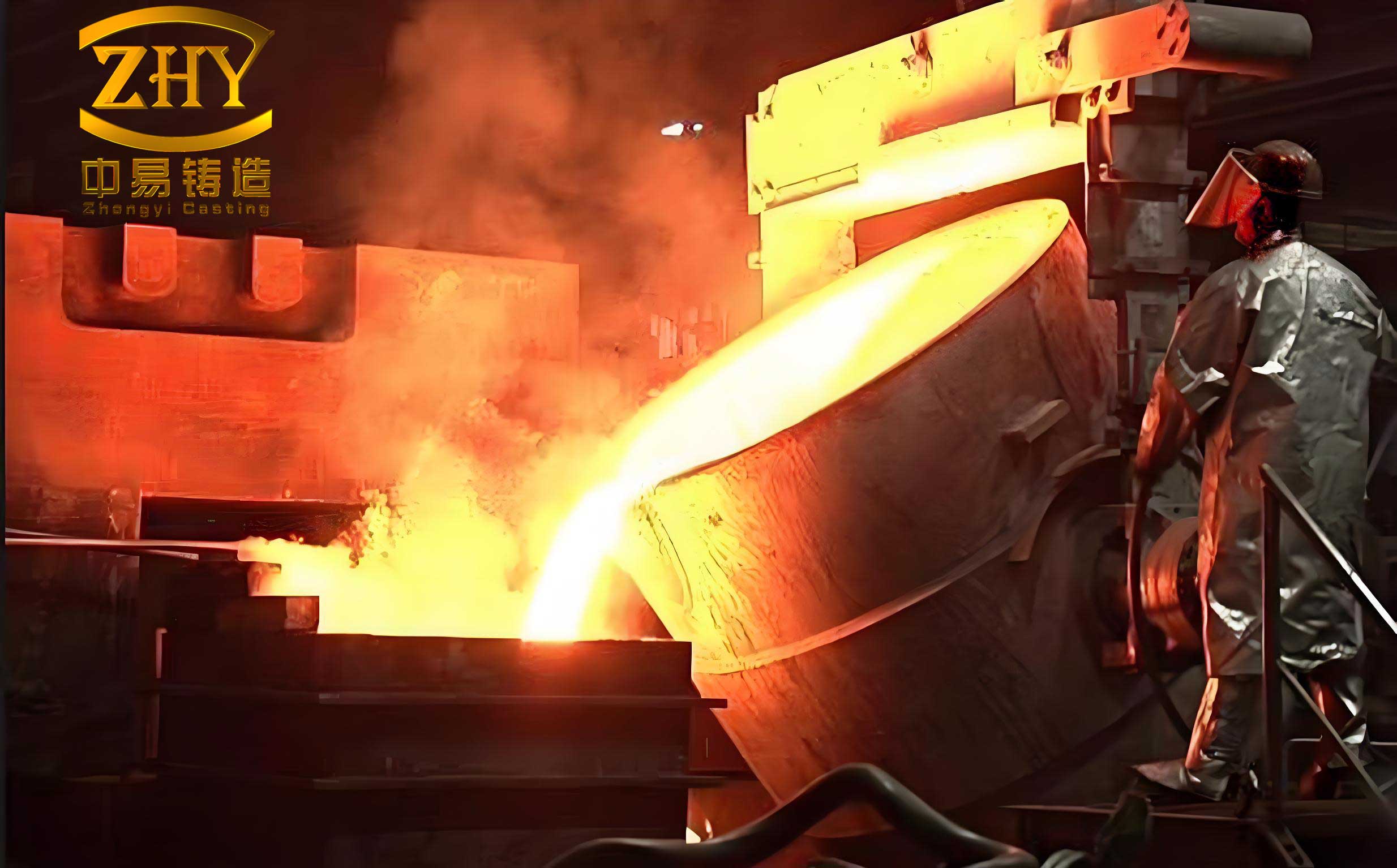
Melting and pouring operations are conducted in a 5-ton electric arc furnace using an oxidizing process. After tapping, the molten steel is refined in the ladle through argon bubbling and wire feeding for 5 minutes, with rare-earth cored wire added at a rate of 6 meters per ton of steel. This refining step enhances the microstructure and mechanical properties of the high manganese steel casting. During pouring, the mold is inclined at 5 degrees, and ignition is used to exhaust gases promptly. Post-pouring, four additional feeds are performed to compensate for shrinkage, ensuring the integrity of the high manganese steel casting.
Inspection of trial high manganese steel castings reveals no surface defects, such as cold shuts or misruns, even at the far ends of the pouring. Radiographic testing confirms the absence of internal flaws like shrinkage cavities or porosity, with all hot spots exhibiting dense structures. Dimensional checks after straightening show compliance with design specifications, demonstrating the success of the VRH-based segmented molding process for high manganese steel castings. The methodology not only meets the stringent requirements for railway applications but also provides a scalable solution for other large-scale high manganese steel castings.
In conclusion, the VRH process, combined with segmented molding, proves highly effective for manufacturing super-long high manganese steel castings. The careful design of feeding and gating systems, supported by numerical simulations, ensures high-quality outcomes. This approach addresses the unique challenges of oversized components, paving the way for broader applications in heavy industry. Future work could focus on optimizing the segment joint interfaces and exploring automated systems for even larger high manganese steel castings, further advancing the capabilities of this innovative casting technique.