
In the field of railway transportation, the demand for durable and efficient components has always been a priority. As a key part of railway switches, high manganese steel castings are widely used due to their excellent impact hardening properties, which provide superior resistance to wear and impact. This study focuses on the development of a new combined 75-12 high manganese steel frog, specifically the manganese frog heart, which is designed for seamless integration with rail lines. The frog consists of a high manganese steel casting core, wing rails, and heel rails, assembled with spacer irons and high-strength bolts. This design allows for online replacement of the high manganese steel casting core, reducing maintenance costs during service. The high manganese steel casting core weighs 1,270 kg and is made of ZGMn13 material, with mechanical properties requiring tensile strength ≥800 MPa, elongation ≥40%, and yield strength ≥400 MPa. Microstructural requirements include an austenitic or austenitic with minimal carbides structure, with precipitated and unmelted carbides not exceeding grade 3 and overheated carbides not exceeding grade 2. Non-metallic inclusions must be below grade 3, and internal quality standards are specified in Table 1.
| No. | Inspection Area | Acceptance Grade |
|---|---|---|
| 1 | Area within 450 mm ahead of the throat, below 15 mm from the wing rail top surface | A2, B2, C2 |
| 2 | Area within 330 mm from the heel end of the heart rail, below 15 mm from the rail top surface | A2, B2, C2 |
| 3 | Area from 200 mm ahead of the theoretical tip to the cross-section where the heart rail width is 50 mm, below 15 mm from the rail top surface | A2, B2, C2 |
| 4 | Area within 160 mm from the heel end spacer iron and 120 mm from the toe end spacer iron | A3, B3, C3 |
| 5 | Area from 160–330 mm from the heel end spacer iron and 120–290 mm from the toe end spacer iron | A4, B4, C4 |
The high manganese steel casting process for the frog core involves complex geometry with multiple hot spots, requiring careful consideration of parting surfaces, shrinkage allowances, gating systems, and pouring methods. The overall dimensions of the frog are 5,261 mm × 440 mm × 192 mm. In this research, I developed a casting process scheme that addresses these challenges, as illustrated in the following sections. The process includes molding, gating and risering systems, melting, pouring, and heat treatment, all tailored to the specific requirements of high manganese steel casting.
For the molding process, I employed the VRH (Vacuum Replacement Hardening) water glass sand molding technique, using olivine sand as the base material. This approach ensures good mold strength and surface quality. To enhance the service life of the high manganese steel casting, chill blocks were uniformly distributed on the rail top surfaces, promoting rapid cooling and forming a fine-grained, dense layer. Additionally, exothermic risers were applied in key areas, such as the grade 2 inspection zones, with spacing not exceeding 300 mm to improve feeding efficiency and effective feeding distance. A slag collection riser was added at the non-gating end to reduce slag inclusions caused by冲刷 during mold filling. The mold surface was coated with a magnesite quick-drying coating, and after drying, manual sanding was performed to ensure low roughness on non-machined surfaces and prevent local gas defects. To further minimize gas defects, the lower mold was baked using a hot air dryer, reducing the temperature difference between the mold and the molten steel, improving filling speed, and slowing solidification to avoid cold shut defects.
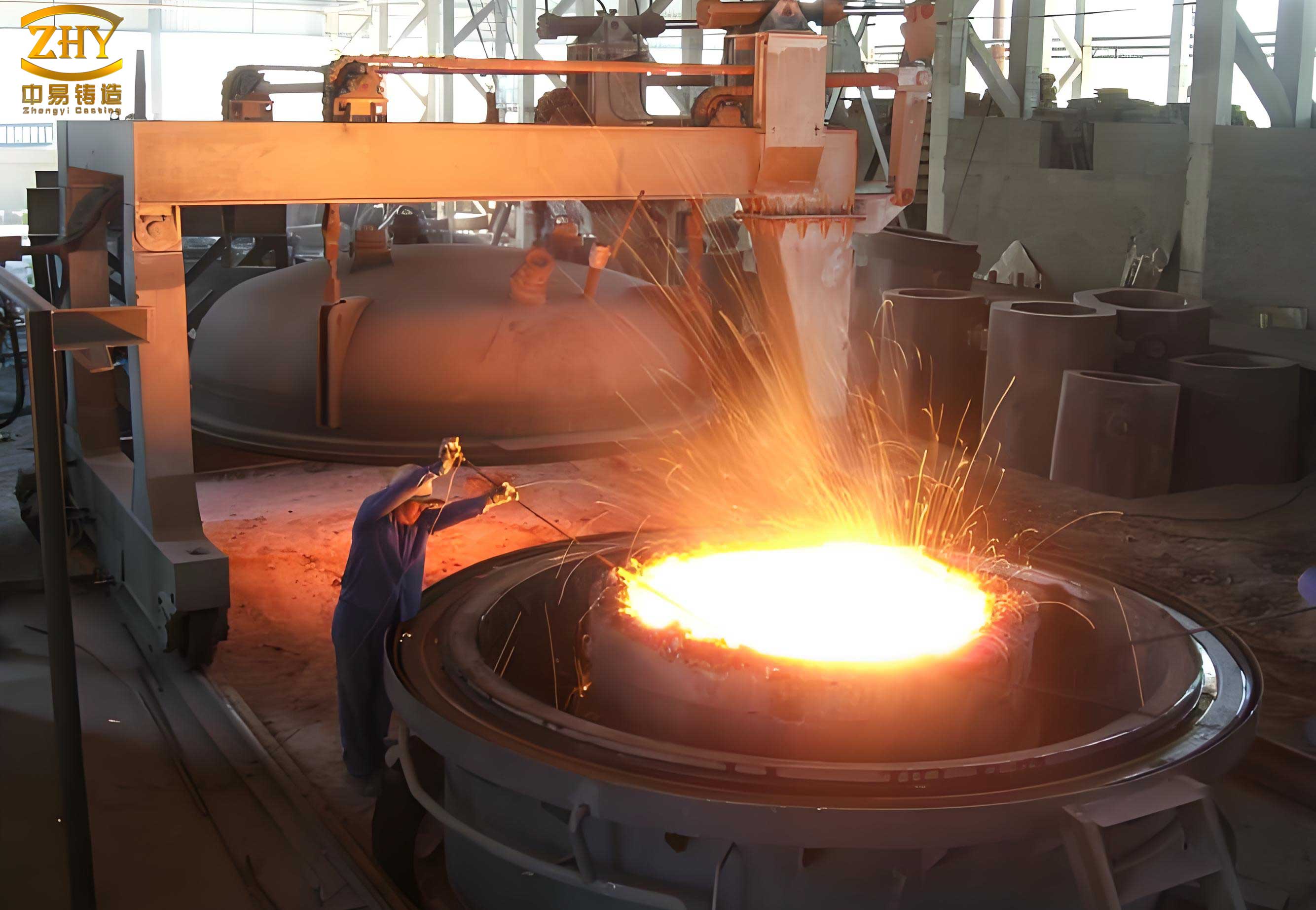
The melting process for high manganese steel casting required strict control of charge composition and the use of clean melting materials. During the reduction period, white slag was created to enhance the reducing atmosphere, and after tapping, LF (Ladle Furnace) argon blowing degassing and refining were performed to reduce gas content in the molten steel. Key melting parameters were monitored closely, and the pouring temperature was controlled within the optimal range of 1,445–1,460°C, with accurate measurements using thermocouples. The relationship between temperature and solidification in high manganese steel casting can be described by the Chvorinov’s rule for solidification time: $$ t = C \left( \frac{V}{A} \right)^2 $$ where \( t \) is the solidification time, \( C \) is a constant dependent on the mold material and casting conditions, \( V \) is the volume of the casting, and \( A \) is the surface area. This formula highlights the importance of geometry in controlling solidification defects in high manganese steel casting.
Pouring was conducted using a positive tilt pouring process with a tilt height of 450–500 mm. This method facilitates the upward flotation of gases and inclusions in the mold cavity and molten steel, reducing internal defects. After the mold was filled, timely and sufficient spot pouring and feeding were performed to minimize shrinkage porosity and cavities, thereby improving the internal quality of the high manganese steel casting. The pouring rate and temperature were optimized based on empirical data and simulations to ensure complete filling and minimal turbulence.
Heat treatment is critical for high manganese steel casting due to its poor thermal conductivity, which makes it prone to cracking from uneven heating. The water toughening process was carefully designed, with a quenching entry time of less than 60 seconds. This was followed by measures such as high water volume, high flow velocity, low water temperature, large spacing between castings, and prolonged agitation to minimize carbide precipitation and ensure excellent mechanical properties. The water toughening process curve is summarized in Figure 2, which illustrates the temperature-time profile. The kinetics of carbide dissolution during heat treatment can be expressed as: $$ \frac{dC}{dt} = -k C^n $$ where \( C \) is the carbide concentration, \( t \) is time, \( k \) is the rate constant, and \( n \) is the reaction order. This equation helps in optimizing the heat treatment parameters for high manganese steel casting to achieve the desired microstructure.
After the initial trial production, the chemical composition, mechanical properties, microstructure, and inclusions of the high manganese steel casting met the design requirements. However, quality inspections revealed two main issues: cracking at the lower slope and rail wall near the first transverse rib at the gating end, and excessive shrinkage cavities and porosity in the core of the second transverse rib at the non-gating end, with X-ray inspection showing grades A1, B1, and C4 against the required A3, B3, and C3. Analysis indicated that the cracking was due to uneven stress distribution during solidification shrinkage, as the width of the first transverse rib hot spot exceeded its length, leading to higher tensile stresses in the length direction. For the shrinkage defects, the addition of a transverse rib at the non-gating end and a 25 mm thick half-round riser pad caused an increase in hot spot size and misalignment between the riser center and rib width center, reducing feeding efficiency.
To address these issues in high manganese steel casting, I implemented optimization measures. For the cracking, the width of the first transverse rib at the gating end was reduced, changing the hot spot structure from a rectangular to a nearly cubic shape to ensure uniform stress distribution during solidification. The modified geometry can be analyzed using the stress-strain relationship: $$ \sigma = E \epsilon $$ where \( \sigma \) is stress, \( E \) is Young’s modulus, and \( \epsilon \) is strain. This adjustment helped balance the stresses and eliminate cracking. For the shrinkage defects, the thickness of the half-round riser pad at the second transverse rib was reduced from 25 mm to 15 mm, decreasing the hot spot size and improving feeding efficiency. The effectiveness of riser feeding can be evaluated using the feeding distance formula: $$ L_f = k \sqrt{A} $$ where \( L_f \) is the feeding distance, \( k \) is a constant, and \( A \) is the cross-sectional area. This optimization ensured that the riser could adequately compensate for solidification shrinkage in high manganese steel casting.
After these improvements, two additional high manganese steel casting trials were conducted. Surface quality inspections showed no cracks, and X-ray tests confirmed that internal quality met the standard requirements. The success of these measures demonstrates the importance of iterative design and process control in high manganese steel casting. The following table summarizes key parameters and results from the optimized process:
| Parameter | Initial Value | Optimized Value | Effect |
|---|---|---|---|
| First Transverse Rib Width | Larger than length | Reduced to near cube | Eliminated cracking |
| Riser Pad Thickness | 25 mm | 15 mm | Reduced shrinkage defects |
| Pouring Temperature | 1,445–1,460°C | Maintained | Consistent filling |
| Quenching Entry Time | < 60 s | Maintained | Minimized carbides |
In conclusion, the molding, melting, pouring, and heat treatment processes adopted for this high manganese steel casting are feasible and effective. Through process optimization, surface and internal quality issues were resolved, and the high manganese steel casting met all standard requirements for chemical composition, mechanical properties, microstructure, and inclusions. This research highlights the critical role of detailed process design and continuous improvement in achieving high-quality high manganese steel casting for railway applications. Future work could focus on further refining the gating system and incorporating advanced simulation tools to predict defects in high manganese steel casting. The overall success of this project underscores the potential for innovative high manganese steel casting techniques to enhance railway safety and efficiency.