
In the production of high manganese steel castings, particularly for critical railway components like self-guard frogs, gas hole defects at the bottom surfaces have posed significant challenges to quality and yield. As a researcher specializing in foundry processes, I have extensively investigated the formation mechanisms of these defects and developed effective countermeasures. High manganese steel casting is renowned for its exceptional wear resistance and toughness, making it ideal for heavy-duty applications. However, the occurrence of gas holes can compromise structural integrity and performance. This article delves into the root causes, primarily focusing on mold sand properties, and presents a comprehensive approach to elimination through rigorous testing and process optimization.
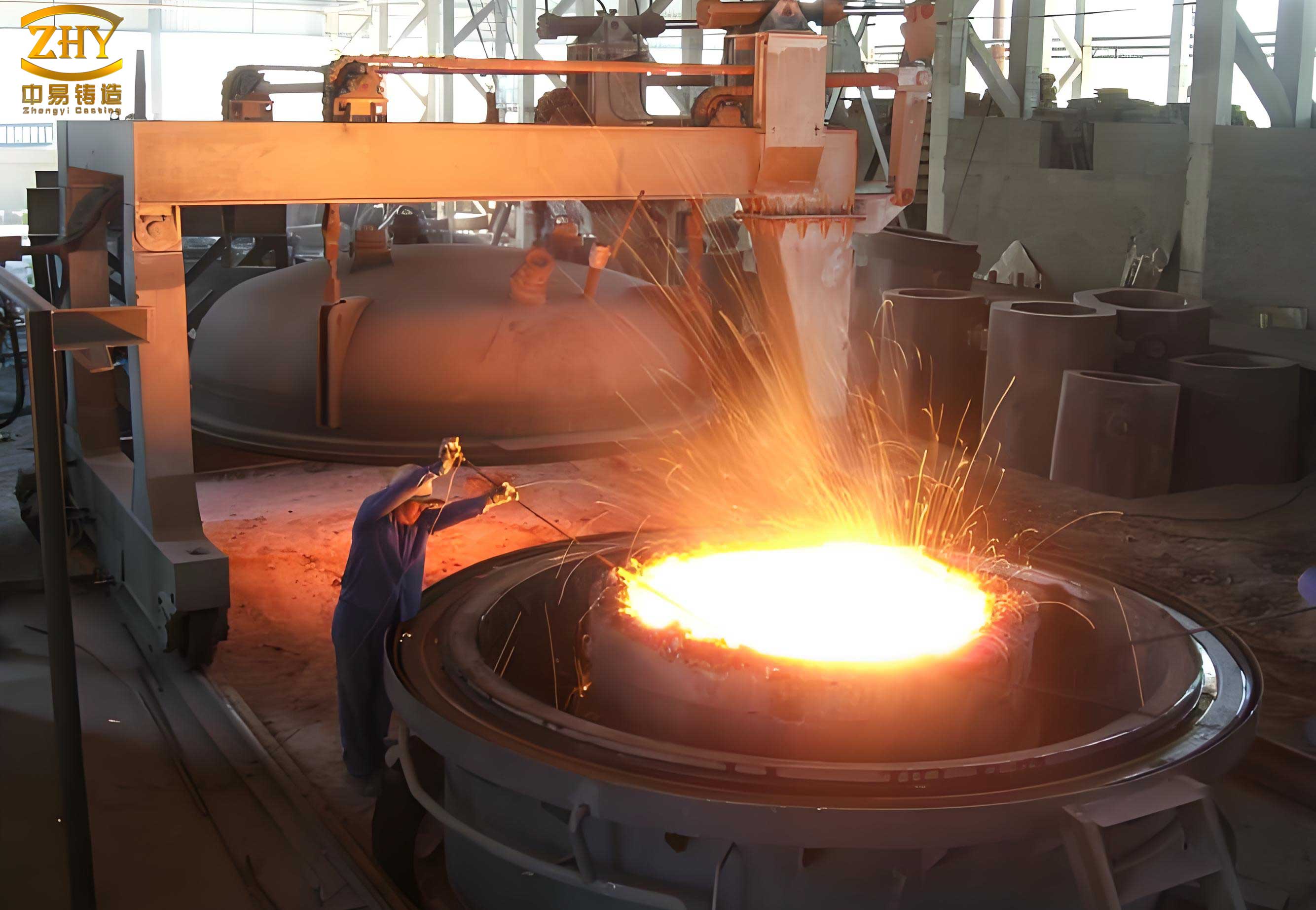
The high manganese steel casting process involves complex interactions between material composition, mold design, and pouring parameters. For self-guard frogs used in North American railways, the chemical composition typically includes carbon content of 0.95–1.30%, manganese at 11.5–14.0%, with strict limits on silicon, phosphorus, and sulfur to ensure Mn/C ratio ≥10. This alloy, when cast using magnesium olivine sand and the VRH (Vacuum Replacement Hardening) method, must meet stringent AREMA standards. Despite controlled melting in electric arc furnaces and bottom-pour techniques, gas holes emerged as a predominant defect, reducing qualification rates to below 30% in initial productions. Through systematic analysis, I identified that the inferior strength and permeability of mold sand were the primary culprits, leading to invasive gas entrapment.
Gas holes in high manganese steel casting manifest as dispersed pores at the bottom regions, often hidden beneath a sound surface layer that requires machining to expose. These defects typically measure 2–20 mm in diameter, appearing spherical or pear-shaped, with rough or oxidized interiors indicating sand inclusion and gas interaction. The distribution is denser near the gating system, tapering off toward distal areas. Such characteristics align with invasive gas holes, where external gases from mold materials penetrate the solidifying metal. To quantify this, the gas pressure (P_g) in the mold cavity can be modeled using the ideal gas law adapted for foundry conditions:
$$P_g = \frac{nRT}{V} + \Delta P_{sand}$$
where (n) is the moles of gas generated, (R) is the gas constant, (T) is the temperature, (V) is the cavity volume, and (\Delta P_{sand}) represents the additional pressure from sand decomposition. In high manganese steel casting, low permeability exacerbates this by hindering gas escape, leading to entrapment.
The investigation involved comparative tests on mold sands from different sources, labeled A, B, and C for anonymity. Standard specimens were prepared using a wheel mill mixer and hardened under VRH conditions to simulate production environments. Key properties like green compressive strength, permeability, and residual moisture were measured. The results, summarized in Table 1, highlight the critical differences that influence gas hole formation in high manganese steel casting.
| Sand Type | Green Compressive Strength (MPa) | Permeability Number | Residual Moisture (%) | Particle Shape |
|---|---|---|---|---|
| A | ≥1.0 | 200–230 | 1.1–2.3 | Spherical |
| B | 0.6–0.8 | 100–150 | 1.5–2.5 | Sub-angular |
| C | 0.5–0.7 | 95–105 | 1.8–2.7 | Angular |
As evident, Sand A outperforms others with higher strength and permeability, directly correlating to reduced gas holes. The particle morphology plays a vital role; spherical grains in Sand A minimize surface area, requiring less binder and enhancing gas venting. In contrast, angular grains in Sands B and C increase binder demand and trap moisture, raising gas generation. The permeability (K) can be expressed as:
$$K = \frac{C \cdot d^2 \cdot \phi^3}{(1 – \phi)^2}$$
where (d) is the average grain size, (\phi) is porosity, and (C) is a shape factor. For high manganese steel casting, Sands B and C have lower (K) values, impeding gas flow during pouring.
Further analysis considered the thermal dynamics during casting. The temperature gradient in the mold causes sand cores to generate gas rapidly, especially in areas submerged in molten metal. In self-guard frogs, the long core at the root section allows only one-sided venting, creating localized high-pressure zones. The gas evolution rate (G) from sand decomposition follows an Arrhenius-type equation:
$$G = A \cdot e^{-E_a / (RT)} \cdot m_{sand}$$
where (A) is a pre-exponential factor, (E_a) is activation energy, (R) is the universal gas constant, (T) is temperature, and (m_{sand}) is the sand mass. In high manganese steel casting, low-permeability sands like B and C cause (G) to exceed venting capacity, forcing gas into the metal. This is compounded by erosion in gating systems, where sand inclusions introduce additional gas sources.
To address these issues, I implemented a multi-faceted improvement strategy focused on enhancing mold sand quality and process controls. First, Sand A was exclusively adopted for its superior properties, ensuring consistent strength and permeability. The gating system was redesigned using refractory ceramics to prevent erosion and sand wash. Additionally, a 5 mm machining allowance was added to the bottom surface to remove any residual defects, though this was later optimized based on validation results. Process parameters were fine-tuned to maintain instant compressive strength ≥1.0 MPa, permeability >180, and residual moisture <2.5%. A thin coating application on the cope mold, coupled with hot-air drying, further strengthened the mold surface. These measures collectively improved the integrity of high manganese steel casting by mitigating gas entrapment sources.
The effectiveness of these interventions was validated through batch production. An initial trial of 31 high manganese steel castings achieved 100% qualification, with 96.77% exhibiting no gas holes after machining. Subsequent mass production of 139 units confirmed zero defects, demonstrating the robustness of the approach. The results underscore that optimizing mold sand properties is pivotal for defect-free high manganese steel casting. Table 2 summarizes the key improvement measures and their impacts on quality metrics.
| Measure | Implementation Details | Impact on Gas Hole Reduction | Remarks |
|---|---|---|---|
| Sand Selection | Use of Sand A exclusively | High (≥90%) | Enhanced strength and permeability |
| Gating System | Refractory ceramic components | Moderate to High | Reduced erosion and inclusions |
| Machining Allowance | 5 mm added, later optimized | Moderate | Removed surface-level defects |
| Process Control | Strength ≥1.0 MPa, permeability >180 | High | Consistent mold performance |
| Surface Treatment | Thin coating with hot-air drying | Moderate | Improved mold surface integrity |
In conclusion, the prevention of gas holes in high manganese steel casting hinges on controlling mold sand characteristics. Through rigorous testing, I established that low strength and permeability are the dominant factors, and by adopting superior sands like A, along with process refinements, defect rates can be reduced to near zero. This approach not only meets North American standards but also enhances the reliability and lifespan of railway components. Future work could explore advanced simulation models to predict gas behavior, further optimizing high manganese steel casting for even demanding applications. The success of this study reaffirms the importance of foundational material properties in achieving excellence in high manganese steel casting processes.