
The relentless drive within manufacturing towards innovation and high-efficiency production has placed advanced hybrid processes at the forefront of development. Among these, the integration of additive manufacturing with traditional precision investment casting stands out as a transformative methodology for creating complex, high-integrity components. From my extensive involvement in this field, I have observed that the wax pattern, serving as the sacrificial core of this hybrid process, is the linchpin whose quality dictates the final cast part’s fidelity. However, the predominant design paradigm, which treats the wax pattern and the investment mold as sequential, independent entities, is fundamentally inadequate. It fails to address the intricate interplay of material shrinkage, mold elasticity, and process-induced stresses, leading to compromised dimensional accuracy and elevated defect rates in final castings.
This article articulates a holistic, first-person perspective on building a multidimensional co-design framework. This framework synergizes wax pattern geometry, mold design, material properties, and process parameters, moving decisively beyond the traditional serial approach to achieve true parameter linkage and optimization.
Performance Requirements and Coupling Analysis in the Hybrid Process
The 3D Printing-precision investment casting hybrid process marries the geometric freedom and precision of additive manufacturing with the superior metallurgical quality and scalability of investment casting. Its success hinges on a deep understanding of the coupled behaviors between the wax pattern and the ceramic shell mold.
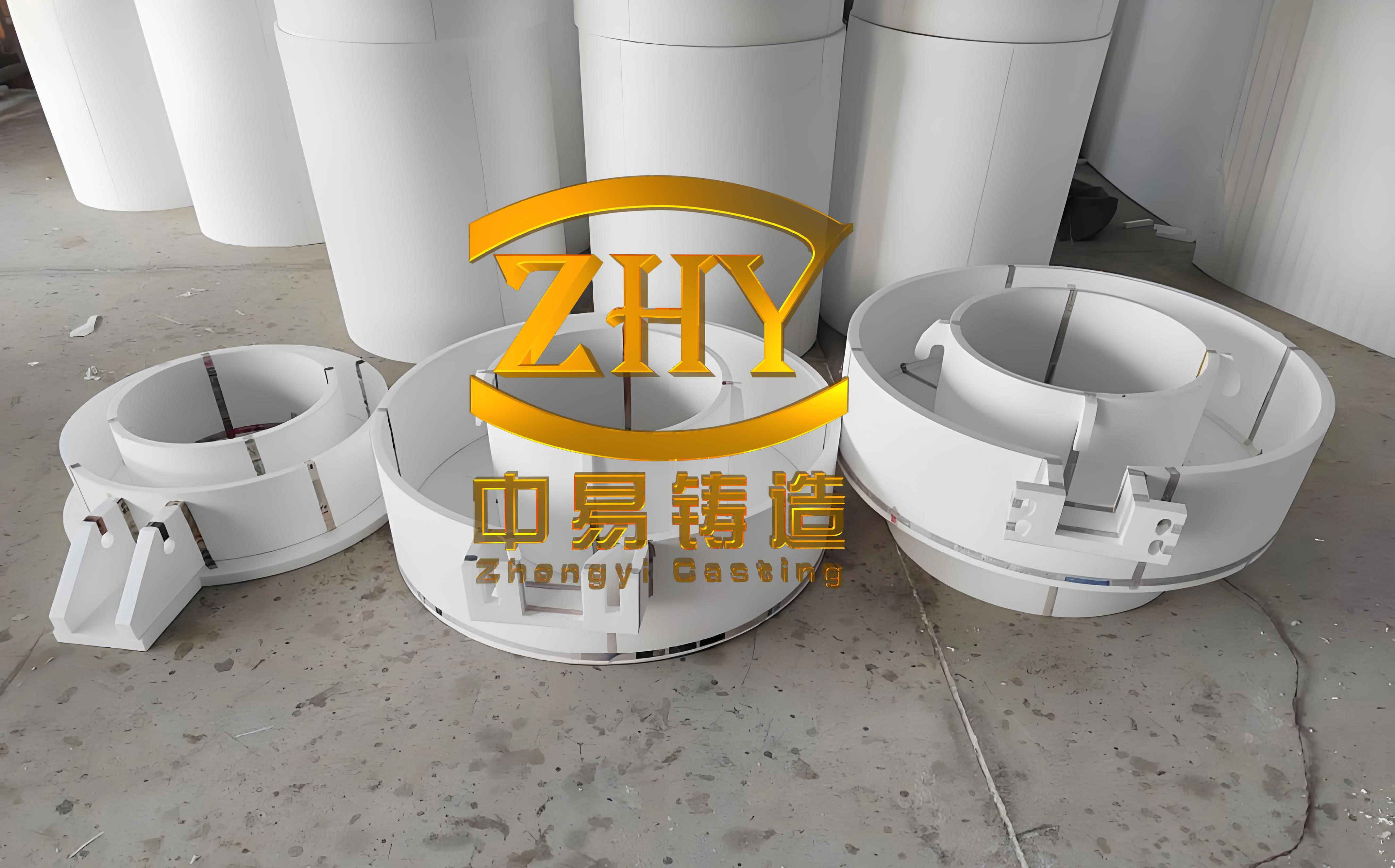
The core of the co-design challenge lies in the bidirectional physical field interactions, primarily manifesting as the Shrinkage Compensation Chain and the Load Transfer Path.
1. The Shrinkage Compensation Chain: Dimensional deviations accumulate through two primary shrinkage events. First, the wax pattern itself undergoes solidification and cooling shrinkage after 3D printing. Second, the molten metal contracts significantly upon solidification and further cooling within the mold. The ceramic mold’s dimensions must be precisely calibrated to compensate for both. If we denote the target final part dimension as $D_{target}$, the wax pattern’s printed dimension $D_{wax}$ must account for wax shrinkage $S_w$, and the mold cavity dimension $D_{mold}$ must further account for metal shrinkage $S_m$. An ideal, simplified chain (neglecting other interactions) can be represented as:
$$D_{mold} = D_{target} \times (1 + S_m)$$
$$D_{wax} = D_{mold} \times (1 + S_w) = D_{target} \times (1 + S_m)(1 + S_w)$$
In reality, $S_w$ and $S_m$ are not simple scalars but can be anisotropic functions of geometry, cooling rate, and material composition. For a typical casting wax, $S_w \approx 0.015 \pm 0.002$ (1.5% linear shrinkage), while for an aluminum alloy like A356, $S_m$ can be approximately 0.065 (6.5%). The mold design must incorporate this compounded shrinkage proactively.
2. The Load Transfer Path: During metal pouring, the mold cavity is subjected to significant dynamic pressure ($P_{metal}$) from the molten stream, which can range from 5 to 10 MPa. This pressure load is transmitted through the ceramic shell wall to the wax pattern’s locators and supports within the mold assembly. If the mold lacks sufficient stiffness or the wax pattern’s supporting structure is poorly designed, localized stress concentration can cause plastic deformation or even rupture of the wax before it is completely melted out, leading to mold cavity distortion. The constraint is to ensure the contact pressure ($\sigma_{contact}$) at the wax-mold interface remains below a critical threshold to prevent wax yielding.
The key design constraints that emerge from this coupling analysis are summarized in Table 1.
| Design Element | Wax Pattern Design Constraint | Mold Design Constraint | Co-Design Constraint Condition |
|---|---|---|---|
| Dimensional Accuracy | Print layer thickness ≤ 0.1 mm | Cavity surface roughness Ra ≤ 1.6 µm | Post-compensation mold cavity dimensional error ≤ ±0.08 mm |
| Structural Stiffness | Minimum wall thickness ≥ 0.8 mm | Cavity wall minimum thickness ≥ 3.0 mm | Wax-mold interface contact pressure $\sigma_{contact}$ ≤ 1.5 MPa |
| Demoldability / Pattern Removal | Draft angle ≥ 3° | Calculated demolding force ≤ 50 N | Wax pattern undercut depth ≤ 0.5 mm |
| Thermal Management | Uniform wall thickness to avoid sink marks | Adefficient permeability for wax removal & gas escape | Thermal gradient during dewaxing controlled to avoid shell cracking |
Constructing the Wax Pattern-Mold Co-Design Methodology
To address the aforementioned constraints holistically, a tripartite methodology is essential: parametric digital modeling, topology-driven structural optimization, and multi-objective algorithmic synthesis.
1. Foundation: Parametric Digital Modeling and Dimensional Compensation
The starting point is a fully parameterized digital twin. The final part CAD model serves as the root geometry. Critical features such as wall thicknesses ($t_w$), fillet radii ($r$), draft angles ($\theta$), and global scaling factors ($C_{comp}$) are defined as driving parameters. The process follows a digitally integrated flow:
- Wax Pattern Generation: The part model is first scaled by the total shrinkage compensation factor $C_{comp} = (1 + S_m)(1 + S_w)$ to create the nominal wax pattern geometry. This factor can be zone-dependent for complex geometries.
- Mold Cavity Derivation: The scaled wax model is used to Boolean subtract the mold core and define the cavity. Crucially, mold features like gating systems, vents, and reinforcement ribs are designed concurrently, with their parameters linked to the wax geometry. For instance, sprue diameter $D_{sprue}$ can be linked to the wax pattern’s volume $V_{wax}$ via a relation like $D_{sprue} = k \sqrt{V_{wax}}$ to ensure proper fill time.
This parametric linkage ensures that any modification to the part design or shrinkage assumptions propagates automatically through the entire tooling chain, eliminating manual error and drastically reducing iteration time.
2. Enhancement: Topology Optimization for Lightweight and Robust Structures
Topology optimization (TO) is deployed primarily on the mold structure to achieve an optimal balance between stiffness, weight, and manufacturability. The goal is to minimize mold mass (reducing material cost and thermal mass) while constraining deformation under operational loads.
The optimization problem for the mold support structure (excluding the critical cavity surface) can be formulated as:
$$
\begin{aligned}
& \underset{\rho(x)}{\text{minimize}}
& & m = \int_{\Omega} \rho(x) \gamma(x) \, d\Omega \\
& \text{subject to}
& & K(\rho) U = F \\
& & & \delta_{max} = \max(|U|) \leq 0.05 \text{ mm} \\
& & & \int_{\Omega} \rho(x) \, d\Omega \leq V_{max} \\
& & & \rho(x) \in [\rho_{min}, 1]
\end{aligned}
$$
where $\rho(x)$ is the material density at point $x$ (the design variable), $\gamma(x)$ is the material density, $K$ is the stiffness matrix, $U$ is the displacement field, $F$ is the load vector from metal static pressure and thermal stress, and $V_{max}$ is the maximum allowable volume. A similar approach can be applied to the wax pattern’s internal support lattice in the 3D printing phase, minimizing wax usage while ensuring handling strength.
3. Synthesis: Multi-Objective Optimization (MOO) for Holistic Co-Design
This is the cornerstone of true co-design. We establish a mathematical model with conflicting objectives that must be balanced. Common objectives for precision investment casting include:
- Maximize Casting Quality ($O_1$): Minimize dimensional deviation and defect probability. This can be a composite metric, e.g., $O_1 = -(\alpha \cdot \sigma_{dim} + \beta \cdot P_{defect})$, where $\sigma_{dim}$ is the standard deviation of key dimensions and $P_{defect}$ is a predicted defect index.
- Minimize Production Cost ($O_2$): Include material cost (wax, ceramic), machining time for mold tools, and energy consumption.
- Minimize Production Cycle Time ($O_3$): Include 3D printing time for the pattern, mold preparation time, and casting cycle time.
The design variables ($X$) are a vector containing parameters from both the wax pattern and mold domains: $X = [t_w, \theta, C_{comp}, D_{sprue}, r_{rib}, …]$.
The multi-objective optimization problem is then:
$$
\begin{aligned}
& \underset{X}{\text{minimize}}
& & \mathbf{F}(X) = [ -O_1(X), O_2(X), O_3(X) ] \\
& \text{subject to}
& & g_j(X) \leq 0, \quad j = 1, 2, …, m
\end{aligned}
$$
where $g_j(X)$ are the constraint functions from Table 1 (e.g., $\sigma_{contact} – 1.5 \leq 0$, demolding force $ – 50 \leq 0$).
Algorithms like NSGA-II (Non-dominated Sorting Genetic Algorithm II) are employed to find the Pareto front—a set of optimal solutions representing the best possible trade-offs. For example, an algorithm might converge to a solution where $X^*$ yields: wax wall thickness $t_w = 1.2$ mm, draft $\theta = 18^\circ$, compensation $C_{comp} = 1.016$, resulting in $O_1$ (quality) improved by 25%, $O_2$ (cost) reduced by 18%, and $O_3$ (time) shortened by 16% compared to a baseline design.
Experimental Validation and Result Analysis
To validate the co-design methodology, a controlled experiment was conducted on a complex, thin-walled aerospace component prototype.
Platform Setup:
- Additive Manufacturing: Material Jetting 3D Printer (e.g., Stratasys J750) using a proprietary casting wax.
- Mold Machining: 5-axis CNC machining center for creating precision mold inserts.
- Casting: Vacuum-assisted precision investment casting furnace.
- Materials: Standard foundry wax ($S_w \approx 0.015$), Zirconia-based ceramic slurry, ZL101A (A356) Aluminum alloy.
Experimental Design & Results:
Three design strategies were compared, as outlined in Table 2.
| Group | Design Strategy | Wax Shrinkage Comp. | Mold Structural Opt. | Key Measured Outcomes |
|---|---|---|---|---|
| A (Baseline) | Traditional Sequential Design | No (Uniform scaling) | No (Standard block) |
|
| B (Intermediate) | Compensation-Only Design | Yes (Zoned $C_{comp}$) | No (Standard block) |
|
| C (Proposed) | Full Co-Design (Parametric + TO + MOO) | Yes (Zoned $C_{comp}$) | Yes (Topology Optimized) |
|
Quantitative Analysis: The results unequivocally demonstrate the superiority of the co-design approach (Group C).
- Dimensional Precision: The maximum observed deviation reduced from ±0.32 mm (Group A) to ±0.08 mm (Group C), an improvement of 75%. The standard deviation of critical features tightened from 0.15 mm to 0.03 mm.
- Surface Quality & Integrity: The as-cast surface roughness improved by over 58%. More importantly, defect rates (including micro-porosity and mistruns) plummeted from 12% to under 3%, directly attributable to the optimized gating and venting design derived from the MOO, which ensured smoother, more complete mold filling.
- Process Efficiency: Despite the upfront computational cost, the physical manufacturing cycle benefited. The topology-optimized mold required less material and had optimized cooling channels, reducing machining time by 22.5%. The improved first-pass yield drastically reduces the need for rework iterations, compounding the time savings.
Research Insights and Practical Challenges
Implementing this co-design philosophy in real-world precision investment casting projects reveals nuanced challenges. The most profound is managing cross-scale constraints. The wax pattern operates at the meso-scale, where layer adhesion and feature resolution from 3D printing (on the order of 0.1 mm) are dominant concerns. The mold and final casting, however, are governed by macro-scale thermal-mechanics and micro-scale surface interactions (roughness on the order of microns). A successful co-design model must bridge these scales. For instance, the specified mold surface finish (Ra ≤ 1.6 µm) imposes a constraint on the minimum printable wax feature size that can be reliably replicated; attempting to print a 0.1 mm wax detail is futile if the molding process cannot preserve it.
Furthermore, the “optimal” solution from an algorithm is often a starting point for expert refinement. The Pareto front might suggest a wax pattern with a 1° draft angle to save volume, but practical experience with the specific de-waxing autoclave cycle may dictate a minimum of 3° to prevent shell damage. Therefore, the constraints ($g_j(X)$) fed into the MOO must be carefully calibrated with empirical shop-floor knowledge. This synergy between computational optimization and practitioner expertise is irreplaceable.
Conclusion
The evolution of precision investment casting through hybridization with additive manufacturing demands a commensurate evolution in design philosophy. The traditional sequential, decoupled approach to wax pattern and mold design is a significant bottleneck to achieving the full potential of this technology in terms of accuracy, quality, and efficiency. The co-design framework presented here—integrating parametric modeling for agile iteration, topology optimization for intelligent structures, and multi-objective algorithms for balancing competing goals—provides a robust pathway forward. Experimental validation confirms its tangible benefits in enhancing dimensional precision, surface quality, and overall process economy.
The journey towards perfecting this synergy is continuous. Future work will involve deeper integration of multi-physics simulation (computational fluid dynamics for filling, finite element analysis for stress) directly into the optimization loop, and the development of AI-driven surrogate models to accelerate the exploration of the vast design space. By embracing this integrated, synergistic approach to wax pattern-mold co-design, the manufacturing industry can unlock new frontiers in producing highly complex, reliable, and performance-critical components through advanced precision investment casting.