
In modern mechanical transmission systems, spiroid face gears are increasingly valued for their high precision, large single-stage transmission ratios, and flexible shaft angle configurations. These gears are commonly used in aerospace, automotive engineering, and robotics. However, traditional design approaches, which rely on virtual shaper principles, often result in line contact between mating surfaces. This leads to undesirable edge contact and heightened sensitivity to assembly errors, ultimately compromising meshing stability and longevity. To address these issues, we have developed a computer-aided topological modification method for spiroid face gears. This method enables the design of point contact double-convex tooth surfaces, significantly enhancing performance. Importantly, this design philosophy is perfectly aligned with precision investment casting technology, which allows for the economical production of complex, high-accuracy gear geometries. In this article, we detail our comprehensive design methodology, present analytical models, and demonstrate its effectiveness through simulated case studies, all while highlighting the synergistic role of precision investment casting in realizing these advanced topological surfaces.
The foundation of our work begins with the established principle of generating the spiroid face gear’s reference tooth surface using a virtual helical pinion as a shaper cutter. This process, while generating a fully conjugate gear pair, inherently produces line contact. The coordinate transformation from the cutter surface Σs to the face gear surface Σ2 is central to this derivation. We define a fixed coordinate system Sh(oh, xh, yh, zh), and moving coordinate systems Ss and S2 attached to the cutter and face gear, respectively. The coordinate transformation matrix M2s(φs) governs this relationship, where φs is the rotational angle of the virtual cutter. The surface of a left-hand helical pinion, which serves as our virtual cutter, can be described for its two flank sides (I and II) by the following vector equation and unit normal:
$$ \mathbf{r}_{s}^{I,II}(u_s, \theta_s) = \begin{bmatrix} \mp [r_{bs}\sin(\theta_{0s} + \theta_s) – u_s \sin(\lambda_{bs}) \cos(\theta_{0s} + \theta_s)] \\ – [r_{bs}\cos(\theta_{0s} + \theta_s) + u_s \cos(\lambda_{bs}) \sin(\theta_{0s} + \theta_s)] \\ \mp [u_s \sin(\lambda_{bs}) – p_s \theta_s] \end{bmatrix} $$
$$ \mathbf{n}_{s}^{I,II}(u_s, \theta_s) = \begin{bmatrix} \mp \sin(\lambda_{bs}) \cos(\theta_{0s} + \theta_s) \\ – \sin(\lambda_{bs}) \sin(\theta_{0s} + \theta_s) \\ \mp \cos(\lambda_{bs}) \end{bmatrix} $$
In these equations, us and θs are the Gaussian parameters of the cutter surface, rbs is the base radius, λbs is the lead angle on the base cylinder, ps is the spiral parameter, and θ0s is the half-angle of the space width on the base cylinder. The upper signs correspond to flank I, and the lower signs to flank II. The generated face gear surface Σ2 and the corresponding meshing equation are then given by:
$$ \mathbf{r}_{2}^{I,II}(u_s, \theta_s, \phi_s) = \mathbf{M}_{2s}(\phi_s) \mathbf{r}_{s}^{I,II}(u_s, \theta_s) $$
$$ f(u_s, \theta_s, \phi_s) = \mathbf{n}_{s}^{I,II} \cdot \mathbf{v}_{sI,II}^{(s2)} = 0 $$
Here, $\mathbf{v}_{sI,II}^{(s2)}$ is the relative velocity between the cutter surface Σs and the generated gear surface Σ2. This system defines the line-contact conjugate pair. To transition from line contact to a controlled point contact and eliminate edge contact, we introduce a two-stage topological modification process: modification along the desired contact path and modification along the contact line tangent direction.
The first stage involves prescribing a transmission error function along a predetermined contact path on the tooth surface projection plane. The transmission error Δφ2 is defined as the deviation of the output gear’s actual rotation from its theoretical position relative to the input rotation:
$$ \Delta \phi_2(\phi_s) = [\phi_2 – \phi_2^{(0)}] – \frac{N_s}{N_2} (\phi_s – \phi_s^{(0)}) $$
Where φ2(0) and φs(0) are initial angles, and Ns and N2 are the tooth numbers of the cutter and face gear, respectively. We deliberately prescribe Δφ2 as a fourth-order polynomial function of the cutter angle φs to control the meshing behavior smoothly:
$$ \Delta \phi_2(\phi_s) = b_0 + b_1 \phi_s + b_2 \phi_s^2 + b_3 \phi_s^3 + b_4 \phi_s^4 $$
The coefficients bi are determined based on the desired contact path geometry and pre-set transmission error values at specific control points (A, B, M, C, D) along the path. The contact path is defined on the projection plane (R-T plane, where R is the tooth width direction and T is the tooth height direction) with an inclination angle η relative to the tooth root line. By virtually generating the face gear with this modified kinematic relationship φ2 = m2sφs + Δφ2(φs), we obtain a modified tooth surface Σ2n. The modification amount δi at each discrete grid point on the surface, relative to the fully conjugate surface Σ2m, is calculated as the normal directional difference:
$$ \delta_i(\phi_{sm}, \theta_{sm}, \phi_{sn}, \theta_{sn}) = \mathbf{n}_{2}^{(m,i)}(\phi_{sm}, \theta_{sm}) \cdot [\mathbf{r}_{2}^{(m,i)}(\phi_{sm}, \theta_{sm}) – \mathbf{r}_{2}^{(n,i)}(\phi_{sn}, \theta_{sn})], \quad i = 1,2,…,p $$
This δi forms the profile modification surface. While this step avoids edge contact, the gear pair remains in line contact and is still sensitive to misalignments. Therefore, a second modification stage is essential.
The second stage applies a computer-aided modification along the instantaneous contact line direction to achieve point contact. For any point Q on a contact line, we define a local coordinate system centered at the theoretical contact point C, with the L-axis aligned with the tangent to the contact line (which is also the direction of the semi-major axis, a, of the desired contact ellipse). The modification amount ξ at a distance l from C along the L-axis is given by a parabolic function:
$$ \xi = \frac{\zeta}{a^2} l^2 $$
Here, ζ is a constant representing the composite deformation of the mating surfaces under load, typically set to 0.0068 mm based on empirical data. By calculating ξ for all surface grid points, we construct a modification surface along the contact line. The final three-dimensional topological modification surface is obtained by superimposing the two modification amounts onto the reference conjugate surface Σ2m:
$$ \mathbf{r}_{2}^{(c,i)}(\phi_{sc}, \theta_{sc}) = \mathbf{r}_{2}^{(n,i)}(\phi_{sn}, \theta_{sn}) + \mathbf{n}_{2}^{(m,i)}(\phi_{sm}, \theta_{sm}) \xi_i, \quad i = 1,2,…,p $$
The resulting surface Σ2c is a double-convex topological surface designed for stable point contact. This digitally defined surface geometry is the perfect candidate for manufacture via precision investment casting. The process involves creating a precise ceramic mold cavity whose surface is the inverse of this topological gear surface. Through precision investment casting, we can replicate these complex, non-standard geometries with high dimensional fidelity and excellent surface finish, which is crucial for realizing the designed contact patterns and transmission error functions.
| Design Parameter | Symbol | Value |
|---|---|---|
| Number of teeth (Helical pinion) | N1 | 7 |
| Number of teeth (Face gear) | N2 | 36 |
| Normal pressure angle | αn | 20° |
| Shaft angle | γ | 90° |
| Helix angle (Left-hand) | β | 52° |
| Center distance | E | 7 mm |
| Normal module | mn | 0.65 mm |
| Radial modification coefficient | xn | 0.277 |
| Inner radius of face gear | R1 | 11.7 mm |
| Outer radius of face gear | R2 | 14.5 mm |
To validate our computer-aided design methodology, we developed specialized software to perform the topological modification and subsequent tooth contact analysis (TCA). Two distinct design cases with different modification parameters were analyzed. The key modification parameters for both the convex and concave flanks in each case are summarized below.
| Parameter | Case 1 (Gear 1) | Case 2 (Gear 2) | ||
|---|---|---|---|---|
| Convex Flank | Concave Flank | Convex Flank | Concave Flank | |
| Preset Δφ2 at point A [arcmin] | 12 | 12 | 12 | 24 |
| Preset Δφ2 at point B [arcmin] | 4 | 4.5 | 4 | 9 |
| Preset Δφ2 at point M [arcmin] | 0 | 0.8 | 0 | 0.8 |
| Preset Δφ2 at point C [arcmin] | 3.5 | 4 | 3.5 | 9 |
| Preset Δφ2 at point D [arcmin] | 12 | 12 | 12 | 24 |
| Contact ellipse semi-major axis, a [mm] | 0.57 | 0.48 | 0.57 | 0.48 |
| Contact path inclination angle, η [°] | 51 | -41 | 63 | -41 |
The TCA simulation results confirmed the effectiveness of our design. For the convex flank meshing in Case 1, the simulated contact path on the tooth surface had an inclination angle of 51°, and the contact ellipse length (2a) was 1.14 mm, both matching the design inputs exactly. The transmission error for one meshing cycle was 5.0 arcseconds, and the contact ratio was ε1r = 1.5. For Case 2’s convex flank, the contact path angle was 63°, the ellipse size was identical (1.14 mm), the transmission error was 5.52 arcseconds, and the contact ratio was ε2r = 1.4. These results demonstrate that the designed topological surfaces successfully achieve point contact with the predefined characteristics. The modification deviation surfaces, which visually represent the difference between the conjugate and modified surfaces, clearly show the superposition of the profile and lead modifications. The magnitude of modification increases with both the preset transmission error amplitude Δφ2 and the contact path angle η.
The integration of this design with precision investment casting is a critical step towards practical application. The topological tooth surface data, defined by the coordinates and normal vectors of numerous grid points, can be directly used to program a CNC machining center for fabricating the master pattern or the mold cavity. Precision investment casting is ideal for this purpose because it can accurately reproduce these sophisticated free-form surfaces, including the subtle convex modifications, without the need for complex post-casting machining. The ability to cast near-net-shape gears with designed-in topological features significantly reduces manufacturing cost and time compared to traditional cutting or grinding methods for such specialized gears.
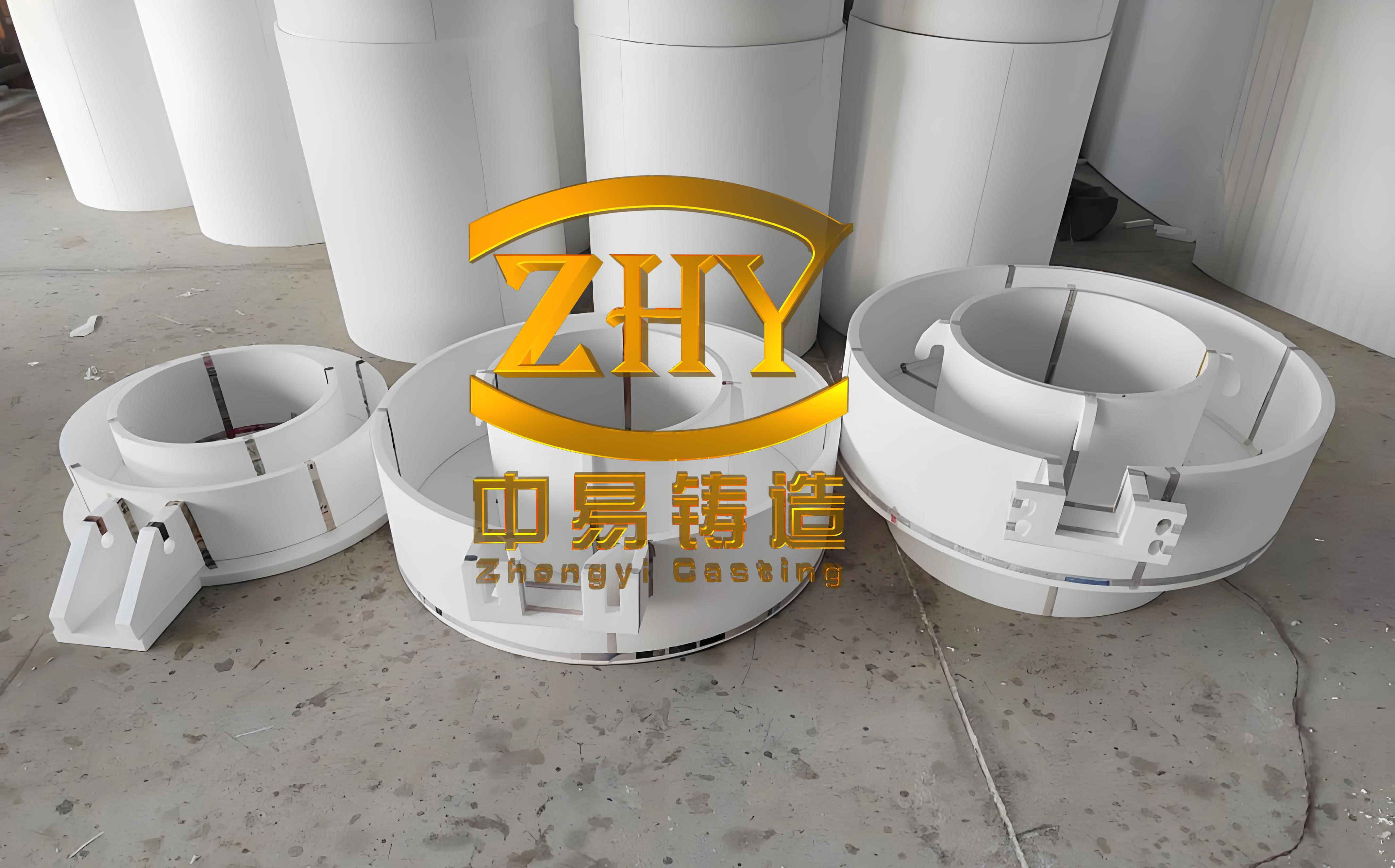
The casting process, such as the one illustrated, begins with creating a precise wax or polymer pattern of the gear. This pattern is invested (surrounded) by a ceramic slurry to form a mold. After the mold is hardened and the pattern is melted out, molten metal is poured into the cavity. Upon solidification and mold removal, a gear casting with the exact negative geometry of the mold cavity is produced. For our spiroid face gears, ensuring the mold cavity faithfully represents the computer-designed topological surface is paramount. Any deviation during the precision investment casting process could alter the contact pattern and transmission error, undermining the design intent. Therefore, close collaboration between the digital design phase and the foundry engineering for precision investment casting is essential. Process parameters like ceramic shell composition, firing temperature, and metal pouring temperature must be optimized to achieve the required dimensional accuracy and surface integrity.
Our investigation also included an analysis of the sensitivity of the design to the modification parameters. We derived generalized formulas to understand the relationships. For instance, the total normal modification Δtotal at any point can be expressed as a function of its position parameters (u, θ) and the design inputs:
$$ \Delta_{\text{total}}(u, \theta) = \delta(u, \theta; \eta, \Delta \phi_{2A}, \Delta \phi_{2B}, \Delta \phi_{2M}, \Delta \phi_{2C}, \Delta \phi_{2D}) + \xi(u, \theta; a, \zeta) $$
A more detailed sensitivity analysis can be tabulated. The following table summarizes the effect of varying key design parameters on the resulting gear meshing performance, as observed from our parametric studies.
| Varied Parameter | Direction of Change | Effect on Contact Path Length | Effect on Max Transmission Error | Effect on Contact Ellipse Size | Implication for Precision Investment Casting |
|---|---|---|---|---|---|
| Contact Path Angle (η) | Increase | Decreases | Slight Increase | Negligible | Requires tighter control on mold cavity orientation. |
| Preset Δφ2 amplitude | Increase | Negligible | Increases Proportionally | Negligible | Higher modification depths must be castable without distortion. |
| Contact Ellipse Semi-axis (a) | Increase | Negligible | Negligible | Increases | Relaxes required surface finish from casting. |
| Superposition Constant (ζ) | Increase | Negligible | Negligible | Decreases effective contact area | Affects load distribution; casting must maintain strength. |
The successful implementation of this design was further verified by machining physical prototypes via CNC milling based on the topological surface data. These prototypes, made from a Cu-Zn alloy, were paired with their mating helical pinions and tested in a fishing reel transmission mechanism. The operational tests confirmed smooth transmission and eliminated the jamming phenomena observed in previous standard designs. This practical validation provides strong support for the next step: refining the mold cavity geometry and proceeding with volume production using precision investment casting. The transition from a machined prototype to a cast component highlights the efficiency gain; while CNC machining is suitable for prototypes, precision investment casting is the economically viable route for mass production of these complex gears.
In conclusion, we have presented a comprehensive computer-aided methodology for the three-dimensional topological design of spiroid face gear tooth flanks. The method combines a preset transmission error function along a desired contact path with a parabolic modification along the contact line tangent to generate a double-convex point contact surface. Numerical simulations through tooth contact analysis confirm that the designed surfaces exhibit the intended contact patterns, controlled transmission error, and point contact behavior, effectively avoiding edge contact. The entire design framework is inherently compatible with and advantageous for precision investment casting manufacturing. The digital surface model serves as the direct input for creating the precision mold, enabling the production of high-performance spiroid face gears with pre-optimized meshing characteristics. Future work will focus on further integrating this design process with advanced simulation tools for the precision investment casting process itself, such as solidification modeling, to predict and compensate for potential casting distortions, thereby closing the loop between digital design and manufactured reality for topologically optimized gears.