
In my decades of involvement in the foundry industry, I have observed the remarkable journey of precision investment casting, a process that has revolutionized the production of complex, high-integrity components. This technique, often synonymous with lost-wax casting, enables the fabrication of parts with exceptional dimensional accuracy and surface finish, making it indispensable in sectors such as aerospace, automotive, and medical devices. The global landscape for precision investment casting has seen significant shifts, with China emerging as a pivotal player. As of 2018, the worldwide precision investment casting industry was valued at $14.2 billion, reflecting a 3.1% growth from the previous year. High-value-added products constituted 57% of this market, while automotive applications accounted for 14%, and general components made up 29%. Notably, China contributed 21% to the global total, and it dominated over 50% of the world’s precision investment casting for general components. This growth has been largely propelled by the aerospace sector, which remains a primary driver globally. However, by 2019, I noticed a turning point in China’s precision investment casting sector, marked by a decline attributed to overcapacity in general components, stringent environmental regulations, downturns in manufacturing and automotive industries, and trade frictions. Despite these challenges, China’s position as the largest automotive market and producer, coupled with its burgeoning demand for aircraft over the next two decades, underscores its continued centrality in the future of precision investment casting.
The core of precision investment casting lies in its meticulous process, which begins with the creation of a wax pattern, followed by the application of ceramic shells, dewaxing, and metal pouring. Throughout my career, I have emphasized the critical role of raw materials, particularly foundry sand, in ensuring the quality and efficiency of this process. Foundry sand, primarily silica-based, serves as a fundamental molding material. In precision investment casting, while the ceramic shell is key, sand is often used in supporting processes or for core-making in complex geometries. The characteristics of sand, such as grain size, shape, and chemical purity, directly impact the final cast part’s integrity. For instance, the use of high-purity silica sand minimizes defects like veining or metal penetration. The life cycle of foundry waste sand—a byproduct of casting operations—has garnered increasing attention due to environmental concerns. In my practice, I have explored various resource utilization pathways for waste sand, which can be summarized in the following table:
| Application Area | Specific Uses | Benefits in Precision Investment Casting Context |
|---|---|---|
| Construction Materials | Concrete aggregates, infrastructure paving and filling | Reduces disposal costs and supports sustainable foundry operations, indirectly benefiting precision investment casting by lowering overall environmental footprint. |
| Building Products | Brick manufacturing, ceramic or glass materials | Provides an alternative revenue stream and promotes circular economy principles within the foundry sector. |
| New Material Development | Advanced composites, geopolymers | Encourages innovation in material science, potentially leading to improved refractory materials for precision investment casting molds. |
Resource utilization of foundry waste sand is not merely a waste management strategy; it represents a paradigm shift towards sustainable manufacturing. For precision investment casting foundries, adopting such practices can mitigate regulatory pressures and enhance corporate social responsibility. However, I have also assessed potential environmental impacts, such as leaching of heavy metals or silica dust emissions, which necessitate careful processing and monitoring. In China, the progress in waste sand resource utilization has been uneven, with some enterprises leading in innovation while others lag due to technical or economic constraints. From my perspective, greater collaboration between industry, academia, and government is essential to standardize practices and incentivize adoption.
Turning to the material fundamentals, the development of silica sand for foundry use is integral to advancing precision investment casting. Based on mineral composition, foundry sands are classified into quartz sands and non-quartz sands, with quartz sands—commonly called silica sand—being the most widely used due to their abundance and suitable properties. Silica sand is categorized into natural and synthetic varieties, with natural silica sand being the most prevalent in casting operations. In my experience, the quality of silica sand directly influences the success of precision investment casting processes, particularly in applications requiring high thermal stability and low expansion. China boasts substantial natural silica sand resources, with over 300 mining and processing enterprises. Annually, the Chinese foundry industry consumes approximately 20 million tons of new sand, while recycled sand usage exceeds 200 million tons. The supply-demand dynamics show an oversupply of ordinary silica sand but a shortage of high-purity, ultra-pure grades, which are crucial for precision investment casting of high-value components. This disparity has driven technological upgrades in sand processing, leading to diversified products like washed, scrubbed, selected, and coated sands. The evolution can be expressed through a formula for sand performance optimization: $$ P_s = k \cdot \left( \frac{Q_p}{\rho \cdot \alpha} \right) + \beta \cdot \ln(S_g) $$ where \( P_s \) represents sand performance score, \( k \) is a process constant, \( Q_p \) denotes chemical purity, \( \rho \) is grain density, \( \alpha \) stands for thermal expansion coefficient, \( \beta \) is a shape factor, and \( S_g \) indicates grain size distribution. This equation highlights the multifaceted parameters that must be balanced in selecting sand for precision investment casting.
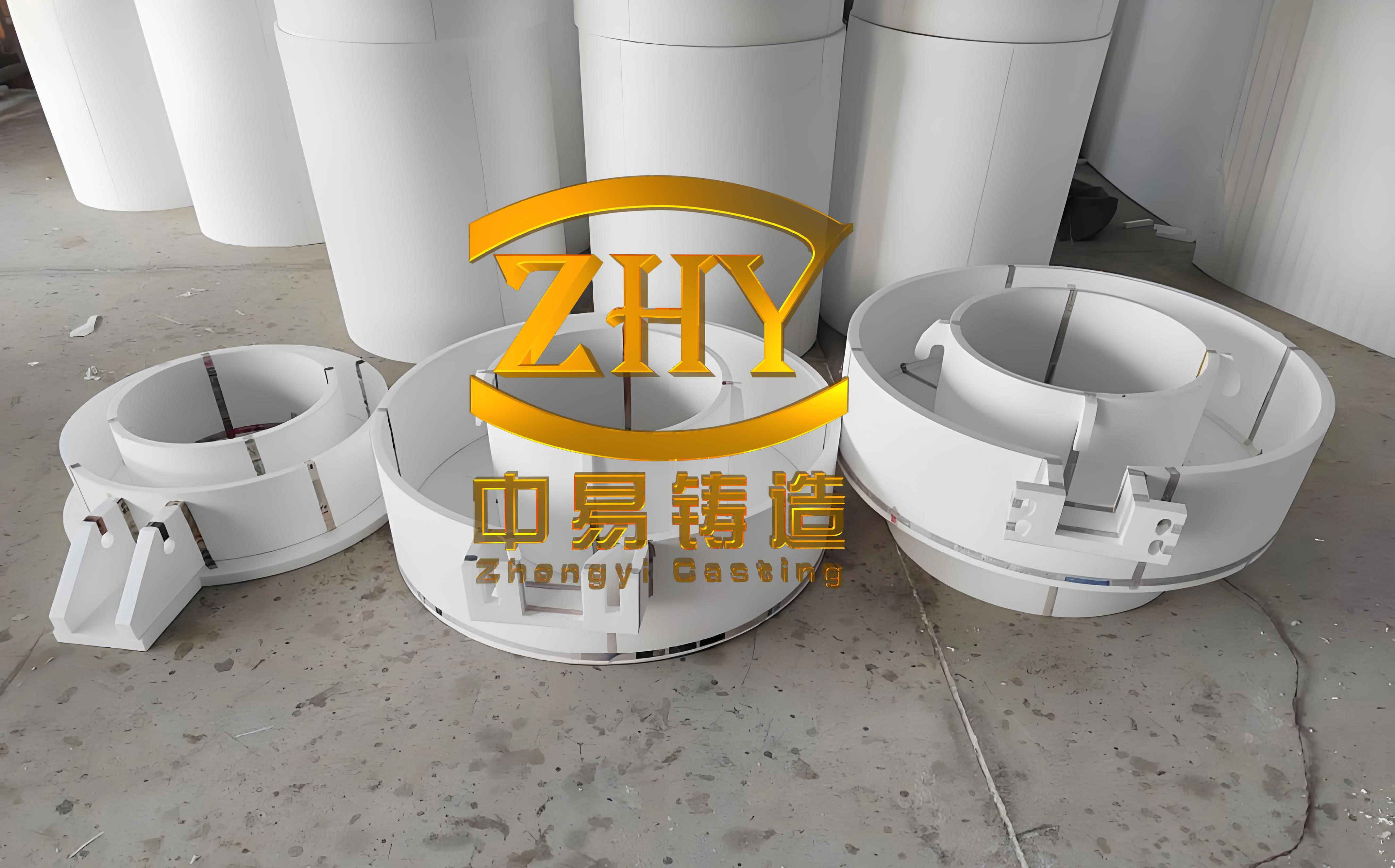
The image above illustrates a lost-foam casting process, which shares similarities with precision investment casting in its use of expendable patterns. While distinct, both methods underscore the importance of advanced molding techniques in modern foundries. In precision investment casting, the integration of such visual aids helps in understanding pattern-making and mold preparation stages, which are critical for achieving tight tolerances.
Regarding the trajectory of precision investment casting, I believe that the convergence with emerging technologies is paramount for sustaining growth. The advent of non-metallic and metallic 3D printing, for example, has transformed pattern and core production, allowing for unprecedented design freedom and rapid prototyping. High-energy beam 3D printing repair techniques extend the life of expensive tooling used in precision investment casting. Furthermore, computer simulation across the entire process chain—from fluid flow and solidification to stress analysis—has become indispensable. These simulations rely on mathematical models, such as the Navier-Stokes equations for fluid dynamics: $$ \rho \left( \frac{\partial \mathbf{v}}{\partial t} + \mathbf{v} \cdot \nabla \mathbf{v} \right) = -\nabla p + \mu \nabla^2 \mathbf{v} + \mathbf{f} $$ where \( \rho \) is density, \( \mathbf{v} \) is velocity vector, \( t \) is time, \( p \) is pressure, \( \mu \) is dynamic viscosity, and \( \mathbf{f} \) represents body forces. By applying such equations, foundries can predict and mitigate defects like porosity or shrinkage in precision investment cast components. Additionally, digital nondestructive testing (NDT) and dimensional measurement technologies enhance quality control, ensuring that each part meets stringent specifications. The synergy between these technologies and traditional precision investment casting is reshaping the industry, enabling the production of lighter, stronger, and more complex parts.
In China, the future of precision investment casting hinges on transitioning from generic components to high-value-added products. This shift requires embracing military-civil fusion initiatives, where advanced casting technologies developed for defense applications can be adapted for commercial use. From my standpoint, enterprises must proactively incorporate environmental considerations into product design and manufacturing. This involves not only waste sand recycling but also optimizing energy consumption and reducing emissions. The equation for sustainable precision investment casting can be conceptualized as: $$ \text{Core Competence} = \text{Product Technology} + \text{Environmental Technology} $$ By aligning technical excellence with ecological responsibility, foundries can secure a competitive edge. For instance, the use of reclaimed sand in secondary processes or the development of biodegradable binders for molds can significantly lower the environmental impact of precision investment casting operations.
The global market dynamics for precision investment casting are influenced by macroeconomic factors, but technological innovation remains the primary lever for progress. Below is a table summarizing key trends and their implications for precision investment casting:
| Trend | Description | Impact on Precision Investment Casting |
|---|---|---|
| Additive Manufacturing Integration | Use of 3D printing for patterns, cores, and direct part production | Reduces lead times, enables complex geometries, and complements traditional precision investment casting for hybrid manufacturing. |
| Digitalization and IoT | Real-time monitoring and data analytics in foundries | Improves process control, predictive maintenance, and quality assurance in precision investment casting lines. |
| Sustainable Material Sourcing | Emphasis on recycled sands and eco-friendly binders | Lowers costs and environmental footprint, aligning with global green manufacturing standards for precision investment casting. |
| Market Diversification | Expansion into aerospace, medical, and energy sectors | Drives demand for high-precision castings, necessitating advancements in precision investment casting techniques. |
From my perspective, the challenges facing precision investment casting are multifaceted but surmountable. The oversupply of general components in China calls for strategic repositioning towards niche, high-margin applications. Moreover, environmental regulations will continue to tighten, making resource efficiency a business imperative. In the context of silica sand, the industry must prioritize the rational exploitation of high-quality natural resources while investing in recycling technologies. The following formula models the economic and environmental trade-offs in sand utilization: $$ C_t = C_n \cdot (1 – r) + C_r \cdot r + E \cdot \delta $$ where \( C_t \) is total cost per ton of sand used, \( C_n \) is cost of new sand, \( C_r \) is cost of recycled sand, \( r \) is recycling rate, \( E \) represents environmental penalty costs, and \( \delta \) is a compliance factor. By minimizing \( C_t \) through increased \( r \) and reduced \( E \), precision investment casting foundries can achieve both profitability and sustainability.
In conclusion, precision investment casting stands at a crossroads of tradition and innovation. My experience tells me that the integration of digital tools, advanced materials, and circular economy principles will define its future. China’s market, despite recent setbacks, holds immense potential due to its industrial scale and growing demand for high-performance components. For practitioners in precision investment casting, the path forward involves continuous learning, adaptation, and a commitment to excellence in every cast part. By leveraging technologies like 3D printing and simulation, while responsibly managing resources such as silica sand and waste byproducts, the industry can thrive in an era of heightened competition and environmental consciousness. The essence of precision investment casting lies not just in crafting metal, but in shaping a sustainable and innovative future for manufacturing worldwide.