
In the realm of advanced manufacturing, precision investment casting stands as a critical process for producing complex, high-quality metal components, particularly in aerospace, automotive, and chemical industries. This method, often referred to as lost-wax casting, involves creating a wax pattern, coating it with refractory material to form a shell, dewaxing, and then pouring molten metal. The quality of the final cast part is heavily influenced by the wax pattern’s dimensional accuracy and surface integrity, with studies indicating that 20% to 70% of product defects originate from wax pattern imperfections. Traditionally, optimizing wax injection parameters relied on trial-and-error approaches, which are time-consuming and costly. However, with advancements in computational fluid dynamics (CFD), numerical simulation has emerged as a powerful tool to predict and mitigate defects in the wax injection phase of precision investment casting. In this article, I explore the numerical simulation of a large, intricate wax pattern’s forming process, emphasizing the role of non-Newtonian fluid behavior and thermal effects, and validate the findings through experimental comparisons. The focus is on enhancing the reliability of precision investment casting through simulation-driven design.
The wax pattern under investigation is a large intermediary casing structure, featuring an outer diameter of approximately 920 mm and a height of 231 mm, with two ring surfaces connected by 12支板 (ribs) and five thick flanges. Such geometries are common in precision investment casting for titanium alloy components, where dimensional precision is paramount. The gating system consists of a single injection gate, 12 uniformly distributed runners, and 36 ingates, designed to facilitate wax flow. The mold is made of aluminum with an outer轮廓 of 1100 mm in diameter and 400 mm in height. The wax material used is KC4017B modeling wax, known for its non-Newtonian characteristics and a global softening point of 64.4°C. In precision investment casting, understanding wax flow behavior is crucial to avoid defects like misruns, which can compromise the entire casting process.
To simulate the wax injection process, I employed Moldflow software, a widely used tool for polymer and wax flow analysis. The three-dimensional CAD model of the wax pattern was imported and meshed with 3D tetrahedral elements, resulting in approximately 1.2 million elements with an edge length of 4 mm. This fine mesh ensures accurate resolution of flow and thermal gradients. The analysis sequence was set to “fill + pack,” capturing the filling, solidification, and shrinkage phases. The wax material, KC4017B, exhibits temperature- and shear-rate-dependent viscosity, typical of non-Newtonian fluids. Its thermo-physical properties are summarized in Table 1.
| Property | Value | Unit |
|---|---|---|
| Melt Density | 0.86 | g/cm³ |
| Solid Density | 1.00 | g/cm³ |
| Specific Heat Capacity | 2468 | J/(kg·K) |
| Thermal Conductivity | 0.20 | W/(m·K) |
The viscosity behavior of KC4017B wax can be modeled using the Cross-WLF equation, which accounts for shear thinning and temperature dependence. The general form is:
$$ \eta(\dot{\gamma}, T) = \frac{\eta_0(T)}{1 + \left( \frac{\eta_0(T) \dot{\gamma}}{\tau^*} \right)^{1-n}} $$
where \(\eta\) is the viscosity, \(\dot{\gamma}\) is the shear rate, \(T\) is the temperature, \(\eta_0(T)\) is the zero-shear viscosity, \(\tau^*\) is the critical shear stress, and \(n\) is the power-law index. For KC4017B, \(\eta_0(T)\) decreases exponentially with temperature, as shown in Figure 2 of the reference, but here I represent it mathematically:
$$ \eta_0(T) = A \exp\left(\frac{B}{T – T_g}\right) $$
with \(A\) and \(B\) as material constants, and \(T_g\) the glass transition temperature. This non-Newtonian model is essential for accurately simulating wax flow in precision investment casting, as it influences filling patterns and defect formation.
The mold material was specified as A1 aluminum, with properties listed in Table 2. The heat transfer coefficient between the wax and mold was set to 5000 W/(m²·K), representing good thermal contact. Process parameters mirrored actual wax injection conditions: injection flow rate of 220 cm³/s, wax temperature of 65°C, mold initial temperature of 25°C, environmental temperature of 23°C, packing pressure of 1 MPa, and packing time of 300 s. Gravity and inertial effects were included to account for real-world flow dynamics. These settings ensure the simulation closely replicates the precision investment casting wax injection stage.
| Property | Value | Unit |
|---|---|---|
| Density | 2.8 | g/cm³ |
| Specific Heat Capacity | 880 | J/(kg·K) |
| Thermal Conductivity | 190 | W/(m·K) |
The simulation results for filling time are depicted in Figure 3, showing a total fill time of approximately 78 seconds. The high-viscosity wax jets from the injection gate, splits through the runners, and enters the pattern cavity via ingates, forming a convex flow front without splashing. However, a critical observation is the stagnation of flow fronts at the inner ring surface near the支板 (ribs), where wax movement halts abruptly. This leads to 12 localized misrun areas, indicated by abnormal coloring in the simulation. To understand this, I analyzed the flow front temperature distribution, as shown in Figure 4. The temperature at the inner ring regions drops to around 49°C upon arrival, which is near the glass transition temperature of the wax, causing loss of fluidity. The relationship between temperature drop and misruns can be quantified using the thermal balance equation:
$$ \rho C_p \frac{\partial T}{\partial t} = k \nabla^2 T + \eta \dot{\gamma}^2 $$
where \(\rho\) is density, \(C_p\) is specific heat, \(k\) is thermal conductivity, and \(\eta \dot{\gamma}^2\) represents viscous heating. In thin sections like the inner ring, heat loss to the mold dominates, leading to rapid cooling and premature solidification. This phenomenon is a common challenge in precision investment casting, especially for large wax patterns with varying wall thicknesses.
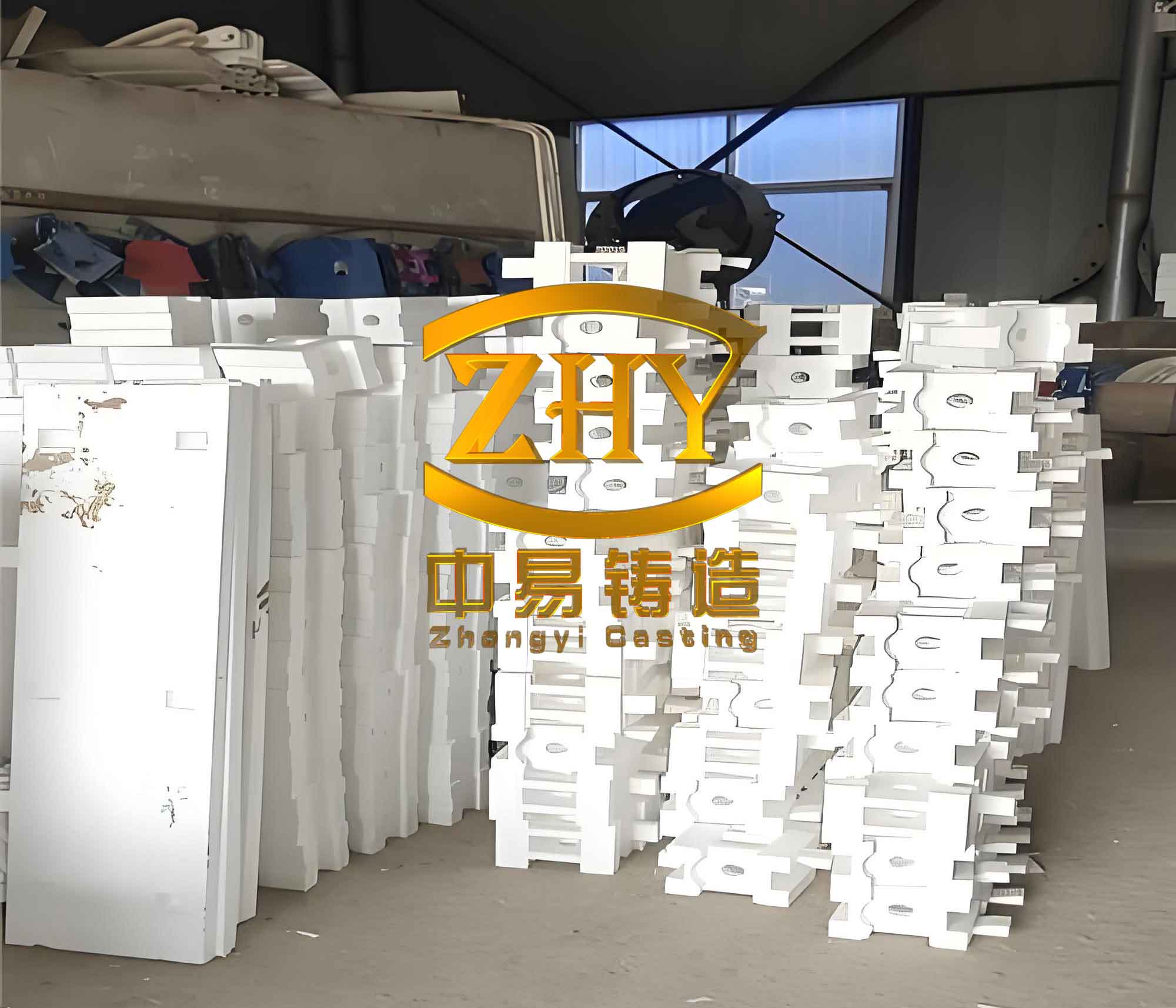
To validate the simulation accuracy, I conducted wax injection experiments under identical process conditions. The physical wax pattern exhibited misrun defects at the inner ring areas, with approximately 10孔洞 (holes) that varied in size and shape but corresponded well to the simulated locations. This congruence confirms the reliability of numerical simulation for predicting defects in precision investment casting. The experimental pattern is shown below, where the misruns are visible as voids in the inner ring region. This image illustrates the practical implications of flow stagnation in wax injection for precision investment casting.
Based on these findings, I proposed an improved injection strategy to mitigate misruns. By increasing the injection flow rate from 220 cm³/s to 470 cm³/s, the fill time reduced to 33 seconds, and the minimum flow front temperature rose to 58°C, well above the glass transition point. The enhanced flow rate reduces residence time in the cavity, minimizing heat loss. The effect can be analyzed using the Reynolds number for non-Newtonian flow:
$$ Re = \frac{\rho v L}{\eta} $$
where \(v\) is velocity and \(L\) is characteristic length. Higher \(v\) increases \(Re\), promoting turbulent-like flow that improves heat retention. However, for wax, flow remains laminar, so the primary benefit is reduced cooling. The improved simulation showed complete filling without defects, as seen in Figure 6. This optimization demonstrates how numerical simulation can guide parameter adjustments in precision investment casting to enhance wax pattern quality.
Further analysis involves the role of other process parameters in precision investment casting. Injection pressure and packing time also influence wax pattern integrity. For instance, increasing injection pressure can overcome flow resistance but may cause jetting or flash. A balance is required, which simulation can help achieve. The pressure drop during filling can be estimated using the Hagen-Poiseuille equation for non-Newtonian fluids:
$$ \Delta P = \frac{8 \eta L Q}{\pi R^4} $$
where \(Q\) is volumetric flow rate, \(L\) is flow length, and \(R\) is radius. For KC4017B wax, \(\eta\) varies with \(\dot{\gamma}\), making this relationship nonlinear. Simulation tools like Moldflow solve these equations numerically, providing insights into pressure distribution and potential overpacking. In precision investment casting, such details are vital for avoiding distortions and ensuring dimensional accuracy.
To summarize the material behavior and process effects, I developed Table 3, which correlates key parameters with outcomes in wax pattern formation for precision investment casting. This table highlights the interplay between wax properties, injection settings, and defect risks.
| Parameter | Typical Range | Effect on Wax Flow | Potential Defects |
|---|---|---|---|
| Injection Flow Rate | 200-500 cm³/s | Higher rates reduce fill time and cooling | Misruns at low rates; jetting at high rates |
| Wax Temperature | 60-70°C | Higher temperature lowers viscosity | Hot tears if too high; misruns if too low |
| Mold Temperature | 20-30°C | Higher temperature slows solidification | Long cycle times; possible wax sticking |
| Injection Pressure | 0.5-2 MPa | Higher pressure enhances filling | Flash or mold wear if excessive |
| Packing Time | 200-400 s | Compensates for shrinkage | Sink marks if insufficient; residual stress if too long |
The numerical simulation also accounts for wax shrinkage during solidification, a critical aspect of precision investment casting. The volumetric shrinkage \(\beta\) can be expressed as:
$$ \beta = \frac{\rho_{\text{melt}} – \rho_{\text{solid}}}{\rho_{\text{melt}}} \times 100\% $$
For KC4017B, using values from Table 1, \(\beta \approx 14\%\). This shrinkage must be compensated by packing pressure to avoid voids. The simulation predicts shrinkage areas, allowing for adjustments in packing parameters. In precision investment casting, such predictive capability reduces scrap rates and improves yield.
Moreover, the non-Newtonian nature of wax introduces complexities in flow front advancement. The shear-thinning behavior means viscosity decreases with increasing shear rate, which can be modeled as:
$$ \eta = K \dot{\gamma}^{n-1} $$
for power-law fluids, where \(K\) is consistency index and \(n\) is flow index. For KC4017B, \(n < 1\), indicating shear thinning. This affects how wax flows through thin sections; higher shear rates in narrow channels reduce viscosity, promoting flow, but rapid cooling can counteract this. Simulation captures these dynamics by solving the momentum and energy equations simultaneously:
$$ \rho \left( \frac{\partial \mathbf{v}}{\partial t} + \mathbf{v} \cdot \nabla \mathbf{v} \right) = -\nabla P + \nabla \cdot (\eta \nabla \mathbf{v}) + \rho \mathbf{g} $$
$$ \rho C_p \left( \frac{\partial T}{\partial t} + \mathbf{v} \cdot \nabla T \right) = \nabla \cdot (k \nabla T) + \Phi $$
where \(\mathbf{v}\) is velocity vector, \(P\) is pressure, \(\mathbf{g}\) is gravity, and \(\Phi\) is viscous dissipation. These equations form the core of the numerical simulation for precision investment casting wax injection.
In practice, the validation of simulation results through experiments is essential for building confidence in digital tools. The misrun defects observed in both simulation and experiment underscore the importance of flow front temperature monitoring. I derived a simple criterion for misrun avoidance: the flow front temperature \(T_{\text{front}}\) must remain above the wax’s no-flow temperature \(T_{\text{nf}}\), typically 5-10°C above \(T_g\). Mathematically:
$$ T_{\text{front}} \geq T_{\text{nf}} $$
If this condition fails, misruns occur. For the inner ring area, \(T_{\text{front}}\) dropped to 49°C, below \(T_{\text{nf}}\) (around 55°C for KC4017B), leading to defects. The improved injection rate raised \(T_{\text{front}}\) to 58°C, satisfying the criterion. This highlights how simulation can identify critical zones in precision investment casting patterns.
Beyond this case, numerical simulation can be extended to other aspects of precision investment casting, such as mold design optimization. For instance, adjusting runner sizes or adding vents can improve wax distribution. Simulation allows virtual testing of multiple designs, reducing physical prototyping costs. The economic benefit is significant, as precision investment casting often involves expensive materials like titanium alloys. By ensuring wax pattern quality upfront, overall casting yield improves.
Another consideration is the environmental impact of precision investment casting. Wax injection parameters affect energy consumption; for example, higher injection rates may require more pump power, but shorter cycle times reduce overall energy use. Simulation can help optimize for sustainability by balancing parameters. The energy equation can be integrated over the process:
$$ E_{\text{total}} = \int (P_{\text{injection}} + Q_{\text{heating}}) dt $$
where \(P_{\text{injection}}\) is injection power and \(Q_{\text{heating}}\) is wax heating energy. Minimizing \(E_{\text{total}}\) while maintaining quality is a goal for green manufacturing in precision investment casting.
In conclusion, numerical simulation of wax pattern formation is a transformative approach for precision investment casting. My study demonstrates that CFD tools like Moldflow can accurately predict flow-induced defects, such as misruns, by modeling non-Newtonian wax behavior and thermal interactions. The validation with experimental wax patterns confirms simulation reliability, enabling proactive optimization of injection parameters. For large, complex patterns common in precision investment casting, increasing injection flow rate proved effective in eliminating misruns by maintaining flow front temperature above critical levels. This aligns with the broader trend of digitalization in foundry processes, where simulation reduces trial-and-error, cuts costs, and enhances product quality. As precision investment casting evolves to meet demands for higher performance components, numerical simulation will remain indispensable for mastering wax injection dynamics and ensuring flawless castings.
Future work could explore advanced materials models, such as viscoelasticity for wax, or integrate simulation with machine learning for real-time process control. The synergy between numerical simulation and precision investment casting promises continued innovation in manufacturing. By leveraging these tools, engineers can push the boundaries of complexity and precision, ultimately delivering superior metal parts for critical applications.