
The evolution of aerospace propulsion and airframe structures relentlessly pushes the boundaries of material performance and manufacturing capabilities. At the heart of this advancement lies the production of hot-section components, where nickel-based superalloys are indispensable due to their exceptional mechanical strength, creep resistance, and oxidation stability at elevated temperatures. Among various manufacturing routes, precision investment casting stands out as a quintessential near-net-shape process, uniquely capable of producing components with intricate internal passages, complex geometries, and excellent surface finish. This capability has made it the primary method for fabricating critical parts such as turbine blades, vanes, and structural casings.
However, contemporary design philosophies aiming for higher thrust-to-weight ratios, improved fuel efficiency, and enhanced operational margins demand components that are larger, structurally more complex, and possess increasingly thinner walls. These requirements are birthing a new class of “ultra-limit” castings—components whose size, geometric complexity, and quality specifications progressively exceed the conventional limits of standard precision investment casting practice. The central challenges crystallize around three interdependent pillars: ensuring internal metallurgical soundness (particularly freedom from shrinkage porosity), achieving complete filling of ultra-thin sections, and maintaining stringent dimensional accuracy and surface quality throughout the entire process chain. This article, from my perspective, systematically reviews the technological landscape for tackling these challenges, encompassing process design, ceramic mold engineering, full-process dimensional control, and advanced filling techniques, before concluding with an outlook on data-driven intelligent manufacturing trends.
Internal Quality Control: Shrinkage Porosity and Process Design
The suppression of shrinkage porosity, including macro-shrinkage and dispersed microporosity, remains the foremost concern in producing high-integrity superalloy castings. The wide solidification temperature range of many superalloys exacerbates this challenge, promoting the formation of extensive mushy zones that hinder interdendritic feeding.
Defect Prediction and Criteria
The quest to predict shrinkage defects has been a long-standing focus. Empirical and semi-empirical criteria, often derived from thermal parameters calculated via numerical simulation, have been developed. The most renowned among these is the Niyama criterion, proposed for steel castings, which relates the tendency for microporosity to the thermal gradient (G) and cooling rate (R) at the end of solidification:
$$N_y = G / \sqrt{R}$$
Where a lower \(N_y\) value indicates a higher risk of shrinkage porosity. While influential, the classical Niyama criterion has limitations when applied directly to superalloys and complex geometries. Subsequent research has led to dimensionless extensions and models that incorporate additional factors like alloy shrinkage behavior, mushy zone permeability, and even local pressure drop. For instance, a more comprehensive dimensionless criterion considering material properties and process parameters can be expressed as:
$$\Delta P^* = \frac{24 \mu \beta’ n \tau^3 \rho_L g}{(\Delta T_f G)^2} \left( \frac{df_s}{dt} \right)$$
where \(\mu\) is liquid viscosity, \(\beta’\) is solidification shrinkage, \(n\) is the number of interdendritic channels, \(\tau\) is tortuosity, \(t\) is local solidification time, \(\rho_L\) is liquid density, \(\Delta T_f\) is freezing range, and \(df_s/dt\) is the solid fraction change rate. Such models move towards a more physics-based prediction but require precise material data. I believe the integration of these criteria with high-fidelity multi-physics simulation (coupled fluid flow, heat transfer, and stress) represents the most robust path forward for defect prediction in ultra-limit castings.
| Prediction Method | Key Principle/Formula | Applicability & Notes |
|---|---|---|
| Thermal Parameter-Based (Niyama) | \(N_y = G / \sqrt{R}\) | Widely used; requires calibration for different alloys/geometries. |
| Dimensionless Extensions | E.g., \(\Delta P^*\) functions | Incorporates material properties; more general but data-intensive. |
| Porous Medium Flow Models | Darcy’s law in mushy zone coupled with VOF | Mechanistic; can predict both macro and micro porosity; computationally expensive. |
| Data-Driven / Hybrid Models | Coupling simulation results with machine learning algorithms | Emerging trend; uses historical data to improve prediction accuracy and speed. |
Gating and Risering System Design
The design of the gating and risering (feeding) system is the primary engineering tool to control solidification and feeding. Traditional methods like Chvorinov’s modulus rule or Caine’s method provide a starting point. However, for large, complex thin-walled castings, these rules are often insufficient. The paradigm has shifted to computer-aided simulation-driven design. Modern simulations allow for the virtual testing of countless gating configurations to achieve directional solidification towards the risers, minimize hot spots, and ensure adequate feeding pressure.
Innovative design strategies have emerged specifically for ultra-thin-walled structures. These include:
- Conformal/Ribbed Riser Networks: Designing risers and feeders that follow the contour of the thin-walled structure to provide localized, effective feeding over large areas.
- Passive Chills and Insulators: Strategic placement of materials with high thermal diffusivity (chills) or low conductivity (insulators) within or around the mold to manipulate the local solidification sequence and eliminate isolated hot spots.
- Pressurized Feeding via Advanced Processes: Utilizing processes like pressure-assisted casting (discussed later) to actively augment feeding during solidification, which is particularly crucial for alloys with poor feeding characteristics.
The goal is to transform the gating system from merely a conduit for metal delivery into an active thermal management and pressure-feeding network. In my view, the future of gating design lies in topology optimization algorithms that can automatically generate riser and runner layouts to meet multiple objectives like minimizing porosity, maximizing yield, and reducing cycle time.
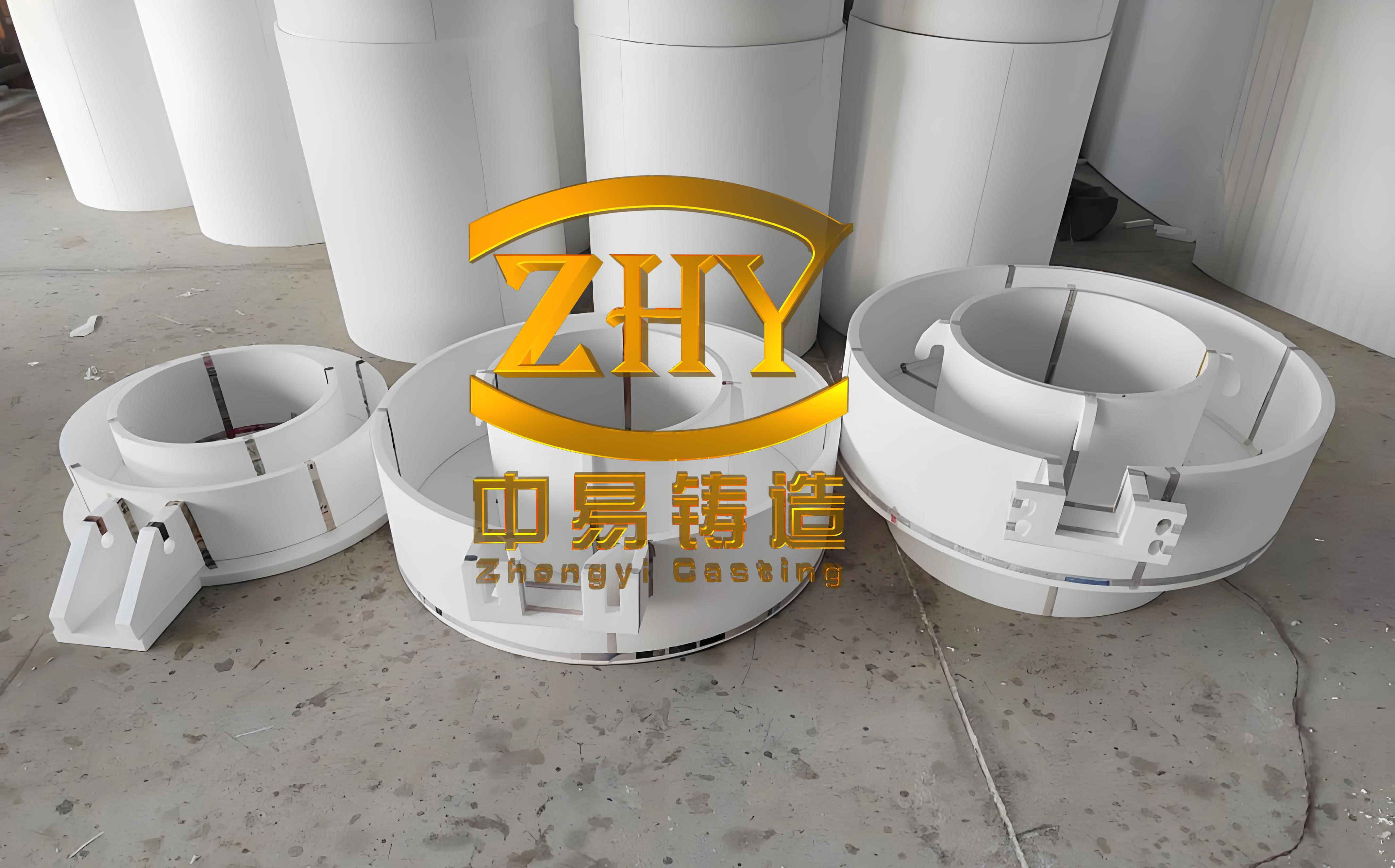
Ceramic Mold Shell: The Foundation of Quality and Precision
The ceramic shell is not a passive container but an active participant in the precision investment casting process. Its properties directly dictate the surface finish, dimensional accuracy, and the thermomechanical boundary conditions for solidification.
Interfacial Reactions and Surface Finish
Superalloy melts, rich in reactive elements like Al, Ti, and Hf, can interact chemically with the ceramic facecoat at high temperatures. This can lead to metal penetration and chemical burn-on (sand fusion), resulting in a rough, adherent surface defect that is difficult to remove. The reaction severity depends on the alloy composition, shell chemistry (especially SiO2 content from the binder), and pouring temperature. Mitigation strategies involve:
- Using inert or less reactive facecoat materials like fused yttria (Y2O3) or zirconia (ZrO2).
- Applying proprietary interface coatings or “anti-reactive” washes to the wax pattern before shell building.
- Optimizing the sintering cycle to develop a denser, less permeable facecoat layer.
High-Temperature Mechanical Behavior
During pouring and solidification, the shell must withstand significant thermal and mechanical loads without excessive deformation or cracking. Its high-temperature strength and creep resistance are governed by the microstructure: the amount and viscosity of the glassy phase formed from binder-derived silica and impurities, and the degree of crystalline bonding between refractory particles. The trend is to engineer shells with enhanced “crystal bonding” by promoting in-situ formation of high-temperature phases like mullite (3Al2O3·2SiO2) through additions of fine alumina and mineralizers. For very large castings, reinforcement with ceramic fibers (alumina or mullite) is common to boost high-temperature rigidity and prevent sagging.
It is crucial to note that the shell’s strength is a double-edged sword. While it must be sufficient to hold the liquid metal, excessive restraint on the contracting casting can induce hot tearing or high residual stress. Therefore, the shell’s thermomechanical properties must be tailored to the specific alloy and casting geometry.
Shell Permeability and Collapsibility
Shell permeability is vital for two reasons: allowing air and gases to escape during mold fill, and enabling wax to expand and drain during dewaxing without cracking the shell. Additives like polymeric fibers or carbonaceous materials are incorporated into backup slurries to create micro-channels that enhance permeability.
Collapsibility, or the ability of the spent shell to be easily removed after casting, is another critical attribute, especially for castings with complex internal features. A shell with excessively high residual strength post-solidification is difficult to remove via mechanical vibration or water jetting. Tailoring the shell’s phase composition—for instance, using materials that undergo disruptive phase transformations upon cooling (like cristobalite inversion from fused silica)—can help achieve the desired level of post-casting breakdown.
Full-Process Dimensional Accuracy Control
Dimensional deviations in precision investment casting are cumulative, arising from every step of the multi-stage process: wax pattern injection, ceramic shell build-up and firing, and metal casting and solidification. Controlling final dimensions to tight tolerances (e.g., CT5 per ASTM standards) requires understanding and compensating for each source of error.
| Process Stage | Primary Sources of Dimensional Error | Control & Compensation Strategies |
|---|---|---|
| Wax Pattern Production | 1. Wax shrinkage (thermal contraction & post-ejection viscoelastic relaxation). 2. Injection parameters (pressure, temperature, time) affecting stress and sink. 3. Core shift/deformation in hollow patterns. |
– Optimize wax rheology and PVT (Pressure-Volume-Temperature) properties. – Use simulation to optimize gating and injection cycles. – Implement stabilized aging of wax patterns before assembly. – Design robust core support and clamping. |
| Ceramic Shell Processing | 1. Dimensional change during binder gelation and drying. 2. Thermal expansion/contraction during dewaxing and sintering. 3. Creep and deformation under metal static head during pouring. |
– Control slurry viscosity and drying environment (humidity, temperature). – Characterize and account for shell firing shrinkage. – Use refractory materials with stable thermal expansion and high creep resistance. |
| Metal Casting & Solidification | 1. Alloy-specific solidification shrinkage (liquid, liquid-solid, solid-state). 2. Thermal stress-induced distortion due to non-uniform cooling. 3. Mechanical constraint from the ceramic shell. |
– Employ simulation to predict shrinkage and distortion. – Design “pre-distorted” dies to compensate for predicted warpage. – Optimize cooling conditions (e.g., controlled mold cooling) to reduce thermal gradients. |
The state-of-the-art approach is Full-Process Integrated Computational Materials Engineering (ICME). This involves creating a digital thread that links simulations of wax injection, shell firing, and metal solidification (coupled thermo-mechanical analysis). The output is a prediction of the final as-cast dimensions, which is then used to iteratively modify the initial tooling (die) geometry—a process known as “die compensation” or “reverse distortion” analysis. The compensation factor \( C_f \) for a specific dimension can be conceptually represented as a function of all contributing factors:
$$C_f = f(\alpha_w, \epsilon_w, \alpha_s, \epsilon_s, \beta_{alloy}, E_{alloy}(T), \sigma_{therm})$$
where \(\alpha\) represents thermal expansion coefficients, \(\epsilon\) represents shrinkage strains, \(\beta_{alloy}\) is solidification shrinkage, \(E_{alloy}(T)\) is the temperature-dependent elastic modulus, and \(\sigma_{therm}\) is thermal stress. Mastering this full-chain control is paramount for the successful manufacture of ultra-limit components where rework is prohibitively expensive or impossible.
Advanced Filling Technology: Counter-Gravity and Pressure-Regulated Casting
For castings with extensive thin-walled sections (often below 2 mm, targeting 1 mm), gravity pouring often reaches its limit. Turbulent filling leads to oxide entrapment, while the high surface-area-to-volume ratio causes rapid heat loss, leading to mistruns. Counter-gravity filling methods, where molten metal is pushed upward into the mold cavity, offer a superior solution.
The fundamental advantage is the controlled, laminar fill against gravity, which minimizes turbulence and oxide formation. The applied pressure head (\(P_{applied}\)) can be precisely controlled to overcome the combined resistances to flow:
$$P_{applied} \geq \rho g H + \frac{2\gamma \cos\theta}{r} + \Delta P_{viscous}$$
where \(\rho g H\) is the metal static head, \(\frac{2\gamma \cos\theta}{r}\) is the capillary pressure at the liquid front (with \(\gamma\) as surface tension, \(\theta\) as contact angle, and \(r\) as characteristic pore radius in the mold), and \(\Delta P_{viscous}\) is the pressure drop due to viscous flow. For thin sections, the capillary resistance term becomes dominant, and a sufficient applied pressure is critical.
Spectrum of Counter-Gravity Techniques
| Technique | Pressure Source | Key Characteristics | Suitability for Superalloys |
|---|---|---|---|
| Low-Pressure Casting (LPC) | Gas pressure (0.5-1 bar) applied to melt surface in sealed furnace. | Simple control; good for repetition; limited maximum pressure. | Good for medium-complexity parts; may be insufficient for ultra-thin walls. |
| Vacuum-Assisted Casting (VAC/CLV) | Vacuum drawn on mold cavity; atmospheric pressure pushes metal up. | Excellent filling for thin walls; reduces gas porosity; requires robust vacuum seals. | Excellent, widely used for aerospace castings. |
| Counter-Gravity Investment Casting (CLI) | Combination of gas pressure on melt and vacuum on mold. | Higher effective pressure differential; very clean, controlled fill. | Highly suitable for critical, high-integrity components. |
| Adjusted Pressure Casting (APC) / Differential Pressure Casting | Independent control of pressure in furnace (upper) and mold (lower) chambers. | Maximum control over fill velocity and solidification pressure. Can apply high pressure during solidification for feeding. | Ideal for ultra-thin-walled, complex superalloy castings. Mitigates microporosity effectively. |
In my assessment, Adjusted Pressure Casting represents the pinnacle for ultra-limit superalloy castings. Its independent pressure control allows for a fast fill stage to overcome capillary forces and prevent premature freezing, followed by the application of a significantly higher pressure during solidification. This sustained pressure acts directly on the mushy zone, dramatically enhancing interdendritic feeding and reducing the volume fraction of microporosity. The relationship between applied pressure \(P\) and the reduction in pore volume fraction \(f_p\) can be described by models deriving from the Darcy flow in a mushy zone, showing that \(f_p \propto 1/P^n\), where \(n\) is a positive exponent. The development of reliable high-temperature ceramic riser tubes and robust sealing systems has been key to enabling APC for nickel-based superalloys.
Future Trends: Towards Intelligent and Additive-Integrated Precision Investment Casting
The future of manufacturing ultra-limit components lies in the convergence of traditional precision investment casting with digital and additive technologies.
1. Data-Driven Intelligent Casting: The complexity of the process, with its multitude of interacting parameters, makes it an ideal candidate for big data analytics and artificial intelligence. I envision the development of “digital twin” platforms for casting. These systems would integrate real-time sensor data from production (slurry viscosity, drying rates, furnace temperatures, pressure curves) with multi-physics simulation models and historical quality data (X-ray, dimension checks). Machine learning algorithms would then:
- Predict optimal process parameters for new geometries.
- Provide real-time corrections during production to maintain quality.
- Automate root-cause analysis for defects, significantly reducing trial-and-error cycles.
The goal is to shift from experience-based, human-centric process control to a predictive, self-optimizing manufacturing system.
2. Additive Manufacturing (AM) Integration: AM is set to revolutionize two key areas:
- Shell and Core Fabrication: Binder jetting or vat photopolymerization of ceramics allows for the direct digital manufacturing of complex shell molds with integrated cores. This eliminates the need for wax patterns and soluble cores for some geometries, enabling designs previously impossible with conventional tooling (e.g., conformal cooling channels within walls, ultra-complex lattice structures). The “negative replica” method, where an AM polymer mold is used to gel-cast a monolithic ceramic shell, is a particularly promising hybrid route.
- Rapid Prototyping and Tooling: AM can quickly produce sacrificial patterns or even injection dies for low-volume production, drastically shortening lead times for prototype development.
3. Hybrid and In-Situ Controlled Solidification: Beyond pressure, other external fields will be increasingly harnessed. Electromagnetic stirring or pulsed magnetic fields applied during solidification can refine grain structure, reduce segregation, and improve mechanical properties. The integration of such in-situ conditioning within the precision investment casting cell, especially for large structural castings, is a compelling research frontier.
In conclusion, the journey of precision investment casting for superalloys is one of constant adaptation and innovation. The push towards ultra-limit components has catalyzed advancements in predictive simulation, advanced ceramic science, full-process dimensional control, and sophisticated pressure-assisted filling technologies. The path forward is unmistakably digital and intelligent. By embracing data-driven process control and integrating additive manufacturing technologies, the industry will unlock new frontiers in geometric complexity, performance, and manufacturing efficiency, ensuring that precision investment casting remains the cornerstone of advanced propulsion and aerospace systems for decades to come.