
In my extensive experience within the foundry industry, addressing defects in complex castings is a perpetual challenge. One particularly problematic component is the water-cooled cylinder block, a critical part in various engines and machinery. Its design often includes intricate internal passages, such as water-cooling chambers, which necessitate the use of complex sand cores. These cores, while enabling the desired geometry, become significant sources of defects, primarily manifesting as various forms of casting holes. This article delves deep into a detailed case study, from my personal perspective, on the analysis and resolution of severe boiling (inclusion of gas) and sand inclusion defects—both categorized under the broader umbrella of casting holes—in a specific water-cooled cylinder block casting. The journey involved systematic problem identification, theoretical analysis, iterative process modifications, and the derivation of generalized principles to prevent such casting holes.
The casting in question had external dimensions of 135 mm x 135 mm x 115 mm and a weight of approximately 4 kg. Its core feature was an internal water-cooling chamber with walls only 4 mm thick. This chamber was formed by a cold-box resin sand core, which was entirely surrounded by molten iron during pouring, leaving only minimal core prints for venting. The production used a high-pressure green sand molding line with a pattern accommodating eight castings per mold. Initial process parameters are summarized below.
| Parameter | Specification |
|---|---|
| Molding Method | Green Sand, High-Pressure Squeeze Line |
| Mold Configuration | 8 castings per mold (4×2 arrangement) |
| Sand Properties | Moisture: 3.0-3.5%, Permeability: 170-185, Green Compression Strength: 143-155 kPa |
| Pouring Temperature | 1420 – 1440 °C |
| Pouring Time per Mold | 12 – 15 seconds |
| Core Type | Cold-box Resin Sand Core for water chamber |
Despite seemingly optimal sand properties, the scrap rate for these castings was catastrophically high, ranging between 40% and 50%. The dominant failure modes were clearly identifiable as severe boiling defects and extensive sand inclusion on the upper surfaces of the castings. These casting holes not only compromised the aesthetic and dimensional integrity but, more critically, led to failures during subsequent hydrostatic pressure tests required for leak-proof performance.
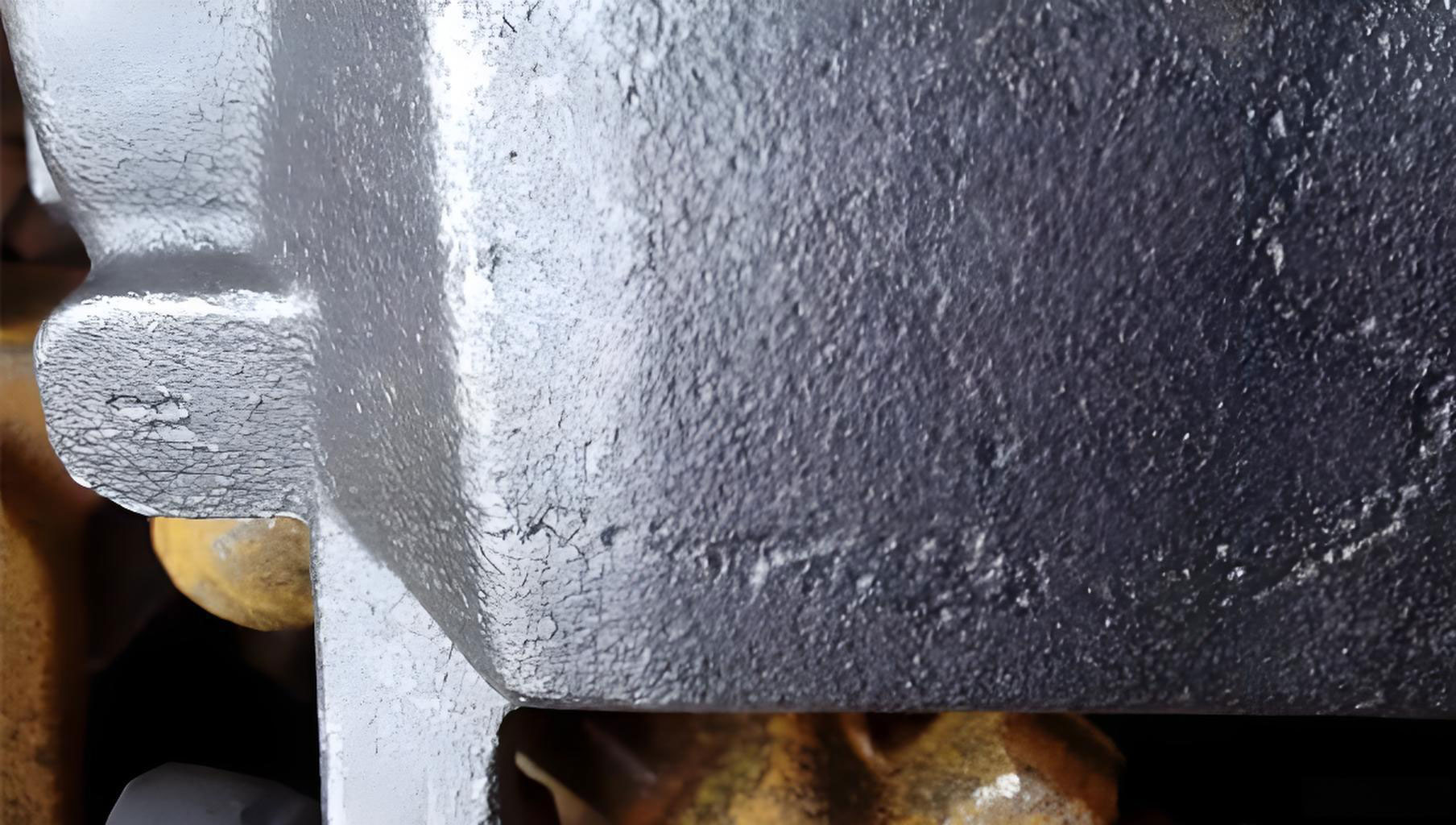
The image above provides a visual representation of the severe nature of such defects, where gas and sand have invaded the casting matrix, creating unacceptable casting holes. To solve this, a fundamental understanding of the defect formation mechanisms was necessary.
Root Cause Analysis of Casting Holes
The formation of casting holes in this context is a coupled phenomenon involving gas generation, pressure buildup, fluid dynamics, and thermal degradation of mold materials. I analyzed the two primary defects separately before understanding their synergy.
1. Boiling Defects (Gas-Induced Casting Holes)
Boiling, characterized by the violent intrusion of gas into the solidifying metal, creating subsurface or surface blowholes, was the primary defect. The root cause was traced directly to the internal sand core. The cold-box resin binder, upon contact with the hot molten iron, undergoes rapid thermal decomposition, releasing large volumes of gases. The core’s geometry meant it was almost entirely encapsulated, with only very small core prints acting as potential vents. This created a classic pressurized system.
The gas generation rate from the core can be modeled. The total gas volume, $V_{gas}$, produced by a core of mass $m_{core}$ is a function of the binder content $c_b$ (as a fraction) and the specific gas yield $Y_g$ of the binder (volume of gas per unit mass at process conditions):
$$ V_{gas} = m_{core} \cdot c_b \cdot Y_g $$
For a typical phenolic urethane cold-box resin, $Y_g$ can range from 100 to 200 cm³/g at casting temperatures. The instantaneous gas generation rate, $ \dot{V}_{gas}(t) $, is highly temperature-dependent and follows an Arrhenius-type relation after the metal front arrives:
$$ \dot{V}_{gas}(t) = A \cdot e^{-E_a / (R \cdot T(t))} $$
where $A$ is a pre-exponential factor, $E_a$ is the activation energy for decomposition, $R$ is the universal gas constant, and $T(t)$ is the temperature at the core/metal interface over time.
The core’s limited venting created a bottleneck. The pressure $P_{cavity}$ inside the cavity above the metal can be estimated using a simplified flow resistance model. The gas must escape through vents with a total effective flow area $A_{vent}$. Applying Bernoulli’s principle for compressible flow with losses, the pressure buildup relates to the gas generation rate and vent resistance:
$$ P_{cavity}(t) \approx P_{atm} + \frac{ \rho_{gas} \cdot ( \dot{V}_{gas}(t) / A_{vent} )^2 }{2 \cdot C_d^2} $$
where $P_{atm}$ is atmospheric pressure, $\rho_{gas}$ is the gas density, and $C_d$ is the discharge coefficient (typically ~0.6 for sharp-edged orifices). When $P_{cavity}$ exceeds the metallostatic pressure $P_{metal} = \rho_{metal} \cdot g \cdot h$ at any point (where $\rho_{metal}$ is iron density, $g$ is gravity, and $h$ is the height of metal above that point), gas intrusion occurs, leading to boiling-type casting holes.
In our initial setup, $A_{vent}$ was far too small for the high $\dot{V}_{gas}(t)$, causing $P_{cavity}$ to spike rapidly during pouring, well before the mold was completely filled, resulting in the observed severe boiling.
2. Sand Inclusion Defects (Solid-Induced Casting Holes)
The upper surfaces of the castings were littered with sand inclusions, another category of casting holes. While loose sand from handling could be a minor contributor, the primary mechanism was intrinsically linked to the gas problem. The high pressure and volume of gas escaping from the core-melt interface caused intense local turbulence and agitation in the molten iron adjacent to the core surface. This hydrodynamic shear stress $\tau$ acting on the core surface can be approximated by:
$$ \tau = \mu \frac{\partial u}{\partial y} $$
where $\mu$ is the dynamic viscosity of iron, $u$ is the fluid velocity parallel to the surface, and $y$ is the distance perpendicular to the surface. The gas eruption creates high velocity gradients ($\partial u / \partial y$).
Simultaneously, the thermal front from the molten iron causes the resin binder in the surface layer of the core to pyrolyze and lose its binding strength. The cohesive strength of the sand $S_{core}(t)$ decays with time and temperature:
$$ S_{core}(t) = S_0 \cdot e^{-k_s \cdot t} $$
where $S_0$ is the initial strength and $k_s$ is a thermal degradation constant. When the hydrodynamic shear stress $\tau$ exceeds the degraded cohesive strength $S_{core}(t)$, sand grains are dislodged. These grains are then carried by the buoyant gas bubbles and the rising metal flow to the upper surfaces of the casting, where they become trapped as solid inclusions—sand-type casting holes.
The synergy is clear: excessive gas generation from poor venting causes high pressure (leading to boiling casting holes) and high surface turbulence (leading to sand wash and subsequent sand-type casting holes).
| Defect Type | Primary Cause | Governing Physics/Chemistry | Resulting Casting Hole Character |
|---|---|---|---|
| Boiling (Gas Hole) | High gas pressure in cavity exceeding metallostatic head. | $P_{cavity} > \rho_{metal} g h$; Gas generation rate >> Venting capacity. | Subsurface or surface spherical/elongated cavities, often shiny walls. |
| Sand Inclusion (Sand Hole) | Erosion of thermally degraded core surface by turbulent flow. | $\tau > S_{core}(t)$; Gas agitation provides high $\tau$ and transports sand. | Irregular cavities filled with or lined with sand particles, often on upper surfaces. |
Iterative Process Improvement Campaign
Armed with this theoretical understanding, I led a series of iterative trials to eliminate these casting holes. Each iteration involved controlled changes to the process, with careful observation and analysis of outcomes.
First Iteration: Enhancing Venting Paths
The logical first step was to increase the venting capacity $A_{vent}$ to reduce $P_{cavity}$. Since modifying the core itself in the cold-box process was difficult due to small core prints, we focused on mold-level vents. We added one $\phi$14 mm overflow/vent rod on the top of each casting and one $\phi$25 mm vent pillar at each side core print location in the cope. This significantly increased the total effective vent area. Furthermore, strict discipline was enforced to blow loose sand from the mold cavity before closing.
Result: The pouring process showed visibly improved gas escape through the new vents. However, while boiling was slightly reduced, extensive sand inclusion casting holes persisted. This indicated that while pressure was somewhat lowered, the gas generation rate and associated turbulence at the core interface were still sufficient to cause sand erosion. The fundamental gas flux from the core remained too high for the conditions.
Second Iteration: Modifying Thermal Parameters (A Failed Hypothesis)
At this stage, a hypothesis was formed: perhaps allowing more time for gas to escape before solidification would help. We increased the pouring temperature to 1460 °C and deliberately slowed the pouring rate, extending the pouring time to 20-25 seconds. The idea was that higher superheat and longer fluidity would let bubbles rise and escape, reducing both types of casting holes.
Result: This change proved disastrous. Defects, both boiling and sand inclusion, became markedly worse. Analysis revealed the flaws in the hypothesis:
1. Higher temperature increased the gas generation rate $\dot{V}_{gas}(t)$ exponentially (per the Arrhenius equation), producing more gas in a shorter time.
2. Longer exposure time of the mold and core to intense heat caused more severe surface drying of the green sand and deeper thermal degradation of the core binder, reducing $S_{core}(t)$ faster.
3. The prolonged pouring time meant the core was subjected to gas-generating heat for longer, and the metal remained turbulent for an extended period.
The net effect was even higher gas pressure and more vigorous sand erosion, dramatically increasing the population of casting holes.
Third Iteration: A Holistic Approach – Fast, Cool, and Free-Flowing Venting
The lessons from the failed second iteration were pivotal. The strategy needed to simultaneously minimize gas generation, maximize gas escape, and minimize metal turbulence. The third iteration combined several changes:
1. Increased Venting: The top vent/overflow rods were increased to two per casting, further boosting $A_{vent}$.
2. Reduced Pouring Temperature: The temperature was lowered significantly to 1360-1370 °C. This directly reduced the peak $\dot{V}_{gas}(t)$ from the core by lowering the interface temperature $T(t)$.
3. Increased Pouring Speed: The pouring time was drastically shortened to 8-10 seconds. This served multiple purposes:
a. It reduced the total time during which the core was exposed to maximum heat before the cavity was full and pressure could stabilize.
b. It rapidly established a higher metallostatic head $h$, thereby increasing $P_{metal}$ to counteract $P_{cavity}$ sooner.
c. It altered the fluid dynamics. While the initial fill is turbulent, a faster fill can sometimes create a more stable, upward-moving front that minimizes retrograde flow and localized boiling at the core. The key is to fill before the gas pressure peaks.
The combined effect can be conceptualized through a modified pressure balance equation that includes filling dynamics:
$$ P_{cavity}(t) = P_{atm} + \int_0^t \left( \frac{\dot{V}_{gas}(\theta, T_{low}) – \dot{V}_{vent}(\theta, A_{vent\_large})}{V_{cavity\_air}(\theta)} \right) R_{specific} T_{gas} \cdot d\theta $$
Where $T_{low}$ signifies the lower interface temperature due to reduced pouring temperature, and $A_{vent\_large}$ is the new, larger vent area. The goal is to keep $P_{cavity}(t)$ always below $P_{metal}(t) = \rho_{metal} g h(t)$, where $h(t)$ rises very quickly due to fast pouring.
Result: This combination was immediately successful. Boiling-type casting holes were virtually eliminated. Only occasional small gas-related porosity at the roots of the vent rods remained, likely due to localized pressure pockets during the final stages of solidification. The massive sand inclusion problem was also resolved, with only sporadic, small sand spots appearing. The scrap rate plummeted. The final stable process achieved a boiling defect rate of 0%, a vent-root porosity rate of ~3%, and a minor sand inclusion rate of ~4%. These casting holes were now at an acceptably low level for production.
| Iteration | Key Changes | Theoretical Impact on Gas Pressure $P_{cavity}$ | Theoretical Impact on Sand Erosion | Result on Casting Holes |
|---|---|---|---|---|
| Initial Process | Baseline (Low venting, Med temp, Med speed) | Very High ($A_{vent}$ too small) | Very High (High $\dot{V}_{gas}$, high $\tau$) | ~45% scrap (Severe boiling & sand holes) |
| First | Increased $A_{vent}$ (Added vents) | Moderately Reduced | Still High (Gas flux still high) | Moderate reduction in boiling, sand holes persist. |
| Second | High Temp (1460°C), Slow Pour (20-25s) | Increased (Higher $\dot{V}_{gas}(T)$) | Greatly Increased (Longer exposure, lower $S_{core}(t)$) | Worsened significantly for both defect types. |
| Third | Low Temp (1360°C), Very Fast Pour (8-10s), Max $A_{vent}$ | Minimized (Low $\dot{V}_{gas}(T)$, large $A_{vent}$, fast $h(t)$ rise) | Minimized (Short exposure, lower $\dot{V}_{gas}$ reduces $\tau$) | Boiling eliminated. Minor residual holes (~7% total). |
Generalized Principles for Preventing Casting Holes in Cored Castings
From this intensive investigation, several universal principles emerge for preventing such casting holes in castings with large, enclosed cores:
1. Venting is Paramount: The design must provide ample, low-resistance paths for core gases to escape directly to the atmosphere. The required vent area $A_{vent\_req}$ can be estimated based on the core’s gas yield and desired maximum pressure:
$$ A_{vent\_req} \approx \frac{ \dot{V}_{gas\_max} }{ C_d \cdot \sqrt{ \frac{2 (P_{allowable} – P_{atm})}{\rho_{gas}} } } $$
where $P_{allowable}$ should be less than the minimum metallostatic head during filling.
2. Pouring Temperature is a Critical Lever: Lower pouring temperatures reduce the peak gas generation rate exponentially. An optimal temperature exists that balances fluidity for mold filling with minimized gas evolution. This temperature is often lower than traditional practices for thin-section castings with large cores.
3. Pouring Speed Must be Optimized, Not Just Minimized or Maximized: A very fast pour can be beneficial to quickly establish metallostatic pressure and reduce core exposure time. The ideal pouring time $t_{pour}$ should be shorter than the time it takes for core gas pressure to reach a critical level. This can be modeled as:
$$ t_{pour} < \frac{ (P_{allowable} – P_{atm}) \cdot V_{cavity\_air} }{ \bar{\dot{V}}_{gas} \cdot R_{specific} T_{gas} } $$
where $\bar{\dot{V}}_{gas}$ is an average gas generation rate during pouring.
4. The Defects are Coupled: Gas-related casting holes and sand inclusion casting holes often share a common root in excessive gas pressure and flow. Addressing the gas issue frequently mitigates both.
5. Core Design and Mold Design are Interdependent: When the core cannot be internally vented, the mold design must compensate aggressively with external vents, chills, or breathable washes to manage the gas.
Mathematical Models for Predictive Analysis
To move from empirical fixes to predictive design, integrating simple models is invaluable. Here is a consolidated set of equations to assess the risk of casting holes for a new cored casting design:
Gas Pressure Buildup Model:
$$ \frac{dP}{dt} = \frac{R T_{gas}}{V_{air}(t)} \left( \dot{V}_{gas}(t) – \dot{V}_{vent}(P(t)) \right) $$
where $V_{air}(t) = V_{cavity\_total} – V_{metal}(t)$, and $\dot{V}_{vent}(P) = A_{vent} C_d \sqrt{ \frac{2 (P – P_{atm})}{\rho_{gas}} }$.
Critical Condition for Boiling (Gas Hole Formation):
Boiling initiates at time $t$ if:
$$ P(t) > \rho_{metal} \cdot g \cdot h_{min}(t) + \frac{2 \sigma}{r_{pore}} $$
where $h_{min}(t)$ is the minimum metal head over any part of the core, $\sigma$ is the surface tension of iron, and $r_{pore}$ is the radius of a potential nucleation site. This second term is often negligible for macroscopic casting holes.
Sand Erosion Criterion:
Sand wash leading to inclusion casting holes is likely if:
$$ \mu \frac{U_{gas}}{ \delta } > S_0 \cdot e^{-k_s \cdot t_{exp}} $$
where $U_{gas}$ is the characteristic gas velocity normal to the core surface, $\delta$ is the boundary layer thickness, and $t_{exp}$ is the exposure time before the metal front covers a given area.
| Process/Material Parameter | Symbol | Effect on Gas Pressure & Boiling Holes | Effect on Sand Erosion & Inclusion Holes | Recommended Direction for Prevention |
|---|---|---|---|---|
| Core Gas Yield | $Y_g$ | Directly increases $P_{cavity}$ | Increases gas flux and turbulence | Minimize binder content; Use low-gas binders. |
| Pouring Temperature | $T_{pour}$ | Exponentially increases $\dot{V}_{gas}$ | Accelerates binder degradation ($k_s$ increases) | Use lowest temperature ensuring complete fill. |
| Total Vent Area | $A_{vent}$ | Decreases $P_{cavity}$ (inverse square relation) | Reduces gas escape velocity near core | Maximize within geometrical constraints. |
| Pouring Time | $t_{pour}$ | Complex: Short time limits total gas before full fill. | Short time limits exposure for erosion. | Optimize for fast fill without excessive turbulence. |
| Core Print Size | $d_{print}$ | Major component of initial $A_{vent}$ | Larger prints may reduce localized gas jets. | Design as large as functionally possible. |
| Metallostatic Head | $h$ | Increases resisting pressure $P_{metal}$ | Indirect effect via influencing metal flow. | Position casting to maximize head over core. |
Conclusion
The journey to eliminate severe casting holes in the water-cooled cylinder block was a profound lesson in systemic foundry problem-solving. It underscored that defects like boiling and sand inclusion are not independent but symptoms of an unbalanced system where gas generation overwhelms gas evacuation. The breakthrough came not from a single change but from a synergistic combination: aggressively increasing venting capacity to lower exit resistance, significantly reducing pouring temperature to curtail the gas source, and dramatically increasing pouring speed to shorten the core’s exposure window and quickly build defensive metallostatic pressure. This holistic approach transformed a ~45% scrap rate into a manageable ~7% rate, with boiling-type casting holes completely eradicated. The principles and models derived—emphasizing the quantitative relationship between gas generation, venting, thermal parameters, and fluid flow—provide a robust framework for preventing similar casting holes in a wide array of cored castings. Ultimately, controlling casting holes requires treating the mold-core-metal system as an integrated dynamic entity, where every parameter adjustment sends ripples through the entire process, and success lies in carefully orchestrating these ripples to cancel out the waves of defects.