
In our extensive experience within the foundry industry, particularly in the production of critical railway components such as couplers and buffers for high-speed freight wagons, we have consistently encountered the pervasive issue of casting holes. These casting holes, which manifest as internal or surface inclusions of sand particles, severely compromise the integrity and performance of cast steel parts. The advancement of high-speed rail technology and the subsequent demand for higher-performance components have exacerbated this challenge, leading to elevated welding repair rates and micro-crack-induced scrap. This article, drawn from our hands-on investigations, delves into the root causes of casting holes in steel castings produced via air impact molding with green sand, and outlines effective countermeasures. Through rigorous production application and quality tracking, we have validated these strategies, achieving a significant reduction in casting holes and associated defect rates.
The formation of casting holes is a multifactorial problem, primarily stemming from the entrainment of sand into the mold cavity during pouring or from loose sand particles present prior to casting. Our analysis reveals that the susceptibility to casting holes is influenced by a complex interplay of molding sand properties, process parameters, and operational practices. To systematically address this, we must first understand the fundamental mechanisms.
Casting holes, as we define them, are defects characterized by the presence of sand within the final casting. They originate when sand grains are dislodged from the mold or core surfaces due to the thermal and mechanical冲击 of molten steel. In our process using air impact molding with green sand for steel castings, the primary sources of these casting holes are冲砂 (sand washing) and loose sand spillage. Our focus has been on identifying and controlling the variables that lead to these events.
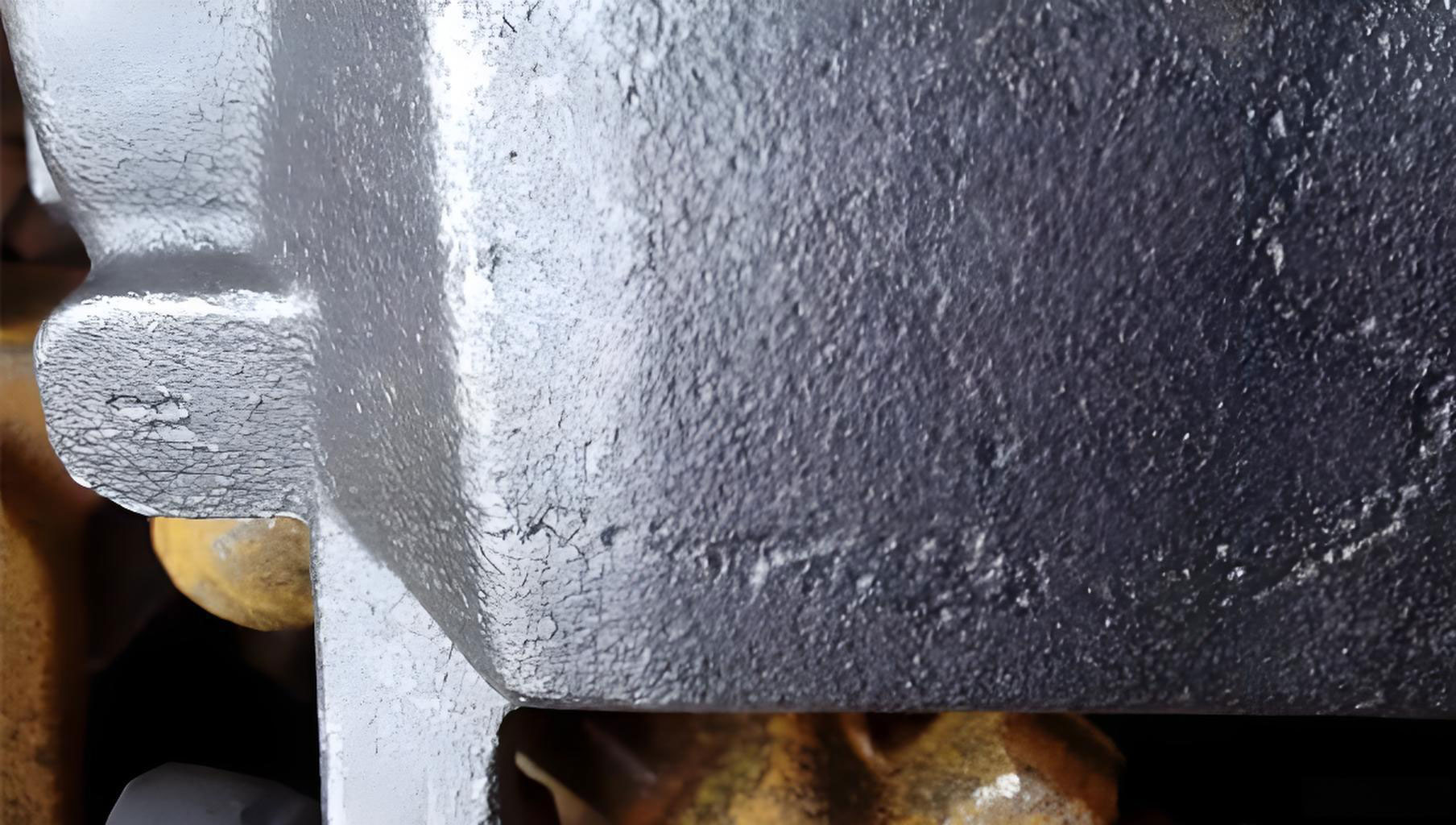
The core of the problem lies in the properties of the green sand mixture. In our initial setup, the sand exhibited inadequate strength and toughness, which directly contributed to the occurrence of casting holes. The table below summarizes the key properties of the green sand before our interventions.
| Parameter | Value Range |
|---|---|
| Moisture Content (%) | 4.1 – 4.6 |
| Compactability (%) | 40 – 55 |
| Green Compressive Strength (kPa) | 75 – 80 |
| Shatter Index (%) | < 72 |
| Permeability | 150 – 230 |
| Hot Wet Tensile Strength (kPa) | 2.1 – 3.4 |
The low green compressive strength and shatter index were critical weaknesses. The green compressive strength, $GCS$, is a measure of the sand’s resistance to deformation and erosion by molten metal. It can be conceptually related to the bonding forces between sand grains. A simplified model for the strength contributed by bentonite bonds can be expressed as:
$$ GCS \propto \frac{\sigma_b \cdot A_b}{V_g} $$
where $\sigma_b$ is the shear strength of the bentonite bond, $A_b$ is the effective bonded area between grains, and $V_g$ is the grain volume. Low $GCS$ implies insufficient resistance to冲砂, directly leading to casting holes.
Furthermore, the high content of fines (particles below 200 mesh) and dead clay (calcined bentonite) in the system was detrimental. Fines increase the specific surface area, demanding more binder for adequate coating. When the binder is insufficient, the clay films are thin, resulting in brittle, low-strength bonds. Dead clay, with its high water absorption capacity, elevates the overall moisture content without contributing to strength, reducing the effective “clay-to-water” ratio. The relationship between moisture content ($M$), clay content ($C$), and strength often follows an optimal curve. Excessive fines and dead clay shift the system away from this optimum, promoting the formation of casting holes.
We quantified the fines and clay content in various sand streams, as shown below:
| Material | Fines Content (<200 mesh, %) | Clay Content (%) |
|---|---|---|
| Raw Sand | 2.8 | 3.5 |
| Return Sand | 4.1 | 11.2 |
| Molding Sand | 3.9 | 10.5 |
The angular and rough surface morphology of the silica sand (often described as subangular to angular) further exacerbated the issue by increasing the specific surface area $S_v$:
$$ S_v = \frac{6 \cdot (1 – \epsilon)}{\phi \cdot d_{avg}} $$
where $\epsilon$ is porosity, $\phi$ is sphericity, and $d_{avg}$ is average grain diameter. Lower sphericity $\phi$ increases $S_v$, requiring higher bentonite addition for full coating. Inadequate coating leaves weak spots prone to erosion, creating sources for casting holes.
Another pivotal factor was the mold hardness. In air impact molding, the mold hardness $H_m$ is a function of the impact energy $E_i$ and the sand’s compactability:
$$ H_m = f(E_i, C_p, GCS) $$
where $C_p$ is compactability. We found that system pressure leaks due to worn flask parting surfaces reduced $E_i$, leading to lower $H_m$ than the standard specimen hardness. A soft mold has low erosion resistance, making it highly susceptible to冲砂 and the consequent creation of casting holes. The correlation between mold hardness and冲砂 potential is strong; below a critical hardness threshold, the probability of casting holes increases exponentially.
To combat these issues and eliminate casting holes, we implemented a multi-pronged strategy focused on enhancing sand properties, ensuring mold quality, and minimizing sand entrainment sources.
1. Optimization of Green Sand Properties: Our first approach was to reformulate the sand mixture. We increased the proportion of new sand to approximately 80% to dilute the accumulation of fines and dead clay, directly targeting a key cause of casting holes. We selected bentonite with higher methylene blue adsorption (a measure of active clay content) and finer, highly gelatinized α-starch. The revised formulation for facing sand is detailed below.
| Component/Property | Target Value |
|---|---|
| New Sand Addition (%) | ~80 |
| Active Bentonite Addition (%) | Optimized (similar or slightly reduced from prior) |
| α-starch Addition (%) | Optimized |
| Moisture Content (%) | 3.6 – 4.0 |
| Compactability (%) | 50 – 55 |
| Green Compressive Strength (kPa) | 101 – 135 |
| Shatter Index (%) | 80 – 87 |
| Permeability | 150 – 230 |
| Hot Wet Tensile Strength (kPa) | 3.20 – 3.57 |
The improvement in green compressive strength ($\Delta GCS \approx +20\%$) and shatter index ($\Delta SI \approx +15\%$) significantly boosted the sand’s resistance to冲砂, a primary precursor to casting holes. The reduction in moisture, while maintaining strength, indicated a more favorable clay-to-water ratio, enhancing toughness.
2. Refinement of Sand Mulling and Tempering Process: We revolutionized the mulling sequence to improve efficiency and homogeneity. Previously, dry mixing of sand and binders followed by water addition led to bentonite balling and moisture segregation. This heterogeneity created weak zones prone to generating casting holes. We adopted a “water-first” method: initially adding 75-80% of the water to the sand, mulling to pre-coat grains, then adding bentonite and starch, and finally adjusting water to achieve target compactability. This sequence promotes uniform clay dispersion and hydration. The mulling efficiency $\eta_m$ can be thought of as:
$$ \eta_m = \frac{\text{Actual Bond Strength Achieved}}{\text{Theoretical Maximum Bond Strength}} $$
The new method increased $\eta_m$, leading to higher and more consistent sand properties, thereby reducing the local weak spots that initiate casting holes.
Furthermore, we instituted a mandatory tempering (aging) period after mulling. Tempering allows for complete water diffusion and bentonite swelling. The evolution of strength with tempering time $t_t$ often follows a logarithmic relationship:
$$ GCS(t_t) = GCS_0 + k \cdot \ln(1 + t_t) $$
where $GCS_0$ is initial strength and $k$ is a constant. We ensured a tempering time exceeding 40 minutes, after which property gains plateaued. This step solidified the sand’s microstructure, making it more resilient against the thermal shock of pouring, a common trigger for sand loosening and subsequent casting holes.
3. Establishment of a Comprehensive Sand and Mold Quality Control System: To proactively manage the factors leading to casting holes, we developed a predictive quality control system. Since directly measuring the strength and permeability of a molded mold is destructive, we correlated mold hardness $H_m$ (a non-destructive test) with the green sand’s properties measured via standard specimens. By preparing specimens with varying numbers of ramming blows $N$, we generated characteristic curves. For instance, the relationship between hardness, green compressive strength, and permeability can be approximated by:
$$ H_m = a \cdot GCS^b \cdot P^c $$
where $P$ is permeability, and $a$, $b$, $c$ are empirical constants derived for our specific sand and molding machine. A sample correlation curve is conceptually shown by the function:
$$ GCS = f(H_m) \quad \text{and} \quad P = g(H_m) $$
This system allows us to monitor mold quality in real-time. If hardness drops below a setpoint, it signals potential low strength and high risk for冲砂 and casting holes, prompting immediate adjustment of sand properties or machine maintenance.
4. Enhancement of Mold Erosion Resistance: Ensuring adequate impact force during molding was paramount. We implemented strict maintenance protocols for the air impact system and flask seals to eliminate pressure leaks. The impact force $F_i$ is related to system pressure $P_s$ and valve characteristics:
$$ F_i \propto P_s \cdot A_v $$
where $A_v$ is the effective valve area. Maintaining $P_s$ at its design specification guaranteed that $F_i$ was sufficient to achieve the required mold hardness $H_m$, directly fortifying the mold against metal flow erosion and preventing the genesis of casting holes.
5. Ancillary Process Measures to Eliminate Sand Sources: In parallel, we addressed other potential sources of loose sand that could become embedded as casting holes. These included:
– Using refractory ceramic tubes for the gating system and dry sand cores with robust coatings at the sprue base to prevent冲砂 at these critical junctions.
– Carefully rounding off sharp sand edges at ingate and riser connections to the casting to reduce turbulence and shear stress.
– Ensuring complete and flawless coating on resin sand cores to avoid local binder degradation and sand release.
– Meticulously removing any thin sand layers formed around hemispherical chills, as these are thermally fragile.
– Employing vacuum extraction to remove any loose sand from the mold cavity before closing, leaving no stray particles to become trapped as casting holes.
The collective implementation of these measures yielded transformative results in production. The incidence of casting holes was reduced by over 60%. The improved sand properties, particularly the higher green compressive strength and toughness, effectively withstood the hydrodynamic forces of molten steel. The established quality control loops provided continuous monitoring, preventing drifts that could lead to casting holes. Post-cleaning inspection of castings revealed remarkably cleaner surfaces with minimal sand inclusion defects.
To quantify the improvement in the context of casting holes prevention, we can define a defect probability index $DPI_{holes}$ related to key variables:
$$ DPI_{holes} = \alpha \cdot \exp(-\beta \cdot GCS) + \gamma \cdot \exp(-\delta \cdot H_m) + \epsilon \cdot (Fines) $$
where $\alpha, \beta, \gamma, \delta, \epsilon$ are coefficients. Our interventions reduced each term: increased $GCS$, increased $H_m$, and decreased $Fines$, thereby causing a dramatic drop in $DPI_{holes}$.
In conclusion, our investigation unequivocally identifies low green sand strength, low sand toughness, and inadequate mold hardness as the principal root causes for冲砂 and the consequent formation of casting holes in air impact molded steel castings. The successful mitigation of casting holes hinged on a holistic approach: purging the sand system of excessive fines and dead clay, optimizing the mulling and tempering processes to maximize binder efficiency and sand homogeneity, and instituting a data-driven quality control system linking mold hardness to critical sand properties. Concurrently, ensuring full molding impact force and adopting rigorous ancillary cleaning and design practices eliminated other avenues for sand entrainment. This comprehensive strategy has proven highly effective in suppressing casting holes, enhancing casting quality, and reducing scrap rates, providing a reliable framework for similar foundry operations grappling with the persistent challenge of casting holes.
The battle against casting holes is ongoing, as process parameters and material supplies can vary. However, the principles established here—focusing on the fundamental interplay between sand morphology, binder chemistry, process energy, and systematic control—form a robust foundation. Future work may involve dynamic simulation of mold erosion to predict casting holes formation or the adoption of advanced binders for even greater erosion resistance. Nevertheless, the immediate and substantial reduction in casting holes achieved through these measures underscores their practical validity and importance for high-integrity casting production.