
In the daily operation of a foundry, the appearance of defects in finished castings remains one of the most significant challenges to productivity, cost-efficiency, and quality assurance. Among the myriad of potential flaws, those that manifest as cavities or voids within the metal matrix are particularly prevalent and damaging. Collectively, these can be referred to as casting holes. Through years of hands-on experience in a production environment utilizing traditional green sand molding for steel castings, I have systematically observed, analyzed, and worked to mitigate these issues. This article consolidates my understanding and practical knowledge, focusing extensively on two primary categories of casting holes: sand holes (or sand inclusions) and blowholes (gas porosity). The goal is to provide a detailed, first-person account of their characteristics, root causes, and, most importantly, the holistic prevention strategies that can be implemented on the foundry floor.
The economic impact of casting holes cannot be overstated. A single defect can render a complex, energy-intensive casting irreparably scrap, leading to substantial financial loss and delivery delays. Therefore, developing a profound, cause-and-effect understanding of their formation is not merely academic—it is a commercial imperative. My experience has shown that a methodical approach, combining control of raw materials, process parameters, and foundry practices, is essential for minimizing their occurrence.
Before delving into specifics, it is useful to visualize the typical appearance of these defects. The image below provides a clear reference for the kind of imperfections classified as casting holes.
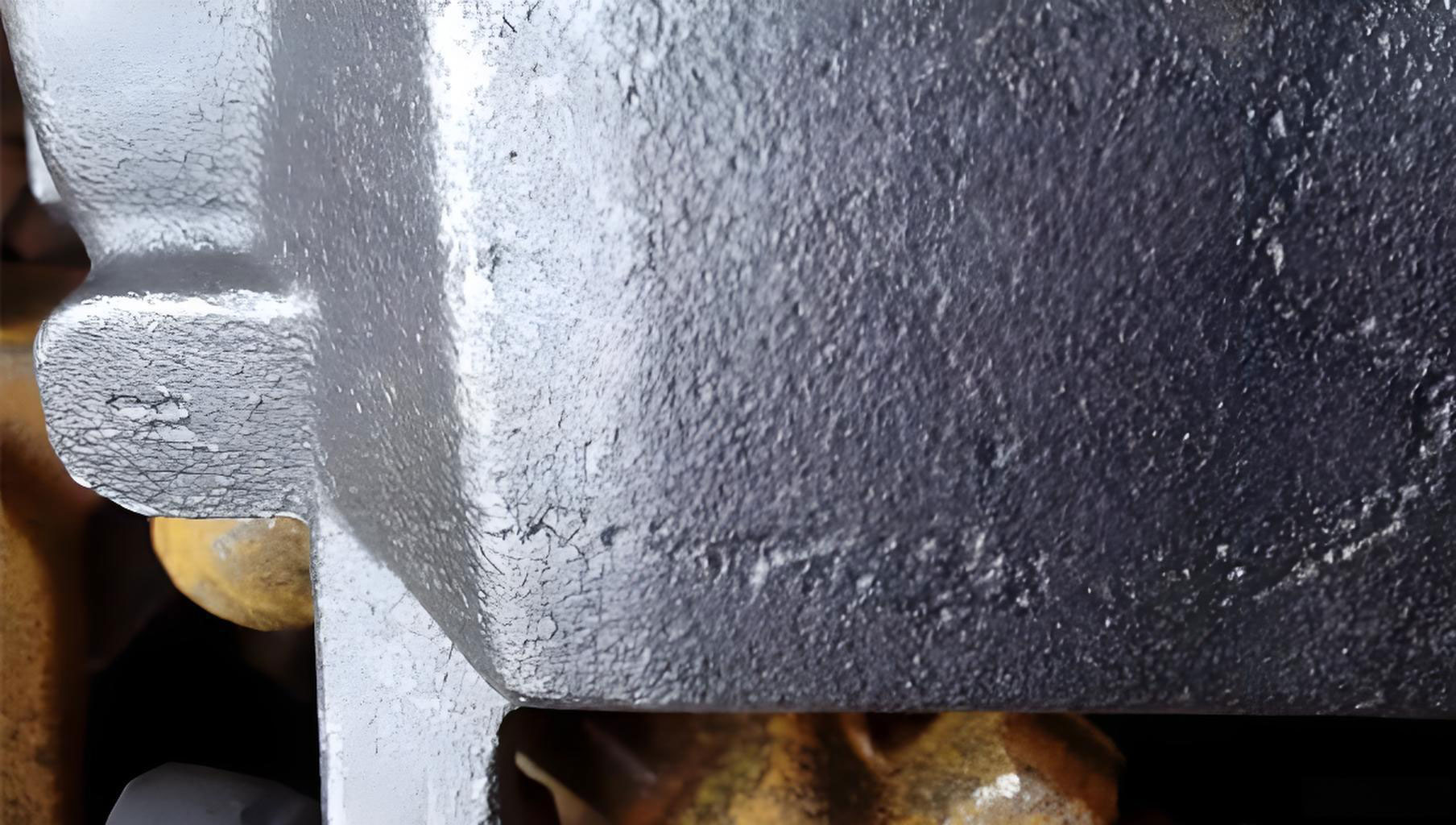
1. Sand Holes (Sand Inclusions)
Sand holes represent a classic example of exogenous casting holes—meaning their origin is external to the molten metal. They are essentially foreign bodies of molding sand entrapped within the solidifying casting.
1.1 Characteristics and Identification
The primary feature is an irregularly shaped cavity containing, or partially filled with, consolidated molding sand. These defects are frequently located on or near the upper surfaces of the casting, often in copes or vertical faces. The sand inclusion itself is usually densely packed, having been subjected to the heat and pressure of the metal. Visually, sand holes may be detectable on the as-cast surface, appearing as rough, sandy patches within the metal. In other cases, they lie just beneath the surface and are only revealed during machining operations, causing catastrophic tool damage. A tell-tale sign often associated with severe sand hole formation is the concurrent presence of scabbing or erosion on adjacent casting areas, indicating a more systemic mold surface instability.
1.2 Root Cause Analysis
The formation of sand holes is fundamentally a failure of mold integrity. The loose or weakly bonded sand must be dislodged and then transported by the flowing metal. The causes can be systematically categorized:
| Category | Specific Causes | Mechanism |
|---|---|---|
| Mold/Core Surface Failure | Inadequate surface strength, low hot strength, excessive expansion. | Flakes or chunks of sand break away from the mold wall due to thermal shock, metallostatic pressure, or mechanical abrasion from the metal stream. |
| Procedural Contamination | Loose sand falling into the cavity during molding, closing, or core setting. | Foreign sand not integral to the mold structure is introduced and not removed prior to pouring. |
| Erosion & Mechanical Damage | High-velocity metal flow (gating system design), rough handling, or mold crush during closing. | The kinetic energy of the liquid metal scours away sand (冲砂). Mechanical action physically breaks mold edges or cores. |
| Material Deficiencies | Poor sand compaction, incorrect grain distribution, low binder efficiency. | The mold lacks the cohesive strength to resist the stresses imposed during pouring and solidification. |
1.3 Prevention Strategies and Quantitative Controls
Preventing sand holes requires a multi-faceted strategy focused on creating and maintaining a robust mold cavity.
1.3.1 Optimizing Sand Properties: The first line of defense is the sand itself. Key properties must be controlled:
- Green Compression Strength: This must be high enough to resist erosion but balanced with permeability. A typical target range for steel castings might be 120-180 kPa. The strength can be approximated by the binder’s effectiveness:
$$ S_g = f(C_b, M_c, C_a) $$
where $S_g$ is green strength, $C_b$ is clay/binder content, $M_c$ is moisture content, and $C_a$ is compactability. - Mold Hardness: Uniform and adequate hardness (e.g., 75-90 on a B-scale gauge) ensures surface stability.
- Expansion Control: Additives like seacoal or cellulose can be used to buffer the silica sand expansion that leads to surface spalling.
1.3.2 Rigorous Foundry Practices:
- Thorough Cleaning: Meticulous blowing out of the mold and core assembly with dry, oil-free air before closing is non-negotiable.
- Careful Handling: Using lifters for large cores, ensuring proper core support to prevent sagging, and employing gentle, aligned mold closing.
- Prompt Pouring: Minimizing the time between mold closing and pouring reduces the chance of moisture migration and surface degradation.
1.3.3 Intelligent Gating System Design: The goal is to achieve a smooth, non-turbulent fill. Principles include:
- Using choke sections to control initial fill rate.
- Employing sprues, runners, and ingates with proper ratios (e.g., pressurized systems for steel) to maintain a full system and reduce velocity.
- Orienting gates to minimize direct impingement on mold walls or core sharp corners. The metal velocity $v$ at the gate should be controlled to avoid erosion, often related to the head pressure $h$:
$$ v = C_d \sqrt{2gh} $$
where $C_d$ is the discharge coefficient and $g$ is gravity. Keeping $v$ below a critical threshold (e.g., 0.5 m/s for vulnerable sections) is crucial.
1.3.4 Attention to Details: Ensuring pouring basins and ladles are clean and free of loose sand or slag is a simple yet vital step.
2. Blowholes and Gas Porosity
In contrast to sand holes, blowholes are endogenous casting holes formed by gases trapped within the solidifying metal. They represent a failure to manage gas generation and expulsion throughout the process chain.
2.1 Characteristics and Identification
Blowholes appear as smooth-walled cavities, which can be spherical, elongated, or irregular. They may be located subsurface (subcutaneous) or open to the surface. Their size can vary from macroscopic pits to microscopic pinholes. Color and appearance offer diagnostic clues:
- Shiny, bright walls: Often indicative of hydrogen gas in steel, as the gas does not oxidize the fresh metal surface.
- Dark blue/black or oxidized walls: Typically associated with carbon monoxide (CO) in ferrous castings or from air entrapment where oxygen has reacted.
- Distribution: Isolated, large blowholes often point to exogenous gas (e.g., from cores). Fine, uniformly dispersed pinholes suggest gas originating from the melt itself.
Distinguishing between these types is the first step in effective root-cause analysis of these particular casting holes.
2.2 Root Cause Analysis: The Sources of Gas
Gas porosity arises from three principal sources: the metal, the mold, and the pouring process.
| Gas Source | Specific Origin | Reaction/Mechanism |
|---|---|---|
| Melting & Metal Treatment | Wet/contaminated charge materials, damp refractories. | $2H_2O + [Fe] \rightarrow 2H_2 + FeO$ (Hydrogen pickup) |
| Decarburization reaction in steel. | $[C] + [O] \rightarrow CO_{(g)}$ (forms during solidification) | |
| Mold & Core Materials | High moisture content in green sand. | Water vapor forms at metal interface, pressure builds. |
| High binder or additive volatile content. | Resins, oils, or carbonaceous materials (seacoal) pyrolyze, generating $H_2$, $CO$, $CH_4$. | |
| Wet or unvented cores; high-permeability coatings. | Massive localized gas evolution that cannot escape. | |
| Pouring & Mold Physics | Turbulent filling; aspiration in gating. | Air is mechanically entrapped in the metal stream. |
| Poor mold/core permeability; inadequate venting. | Generated gases cannot escape to the atmosphere, forcing their way into the metal. |
2.3 Prevention Strategies: A Systems Approach
Eliminating gas-related casting holes requires a coordinated attack on all potential gas sources and pathways.
2.3.1 Metal Preparation and Pouring:
- Charge and Refractory Dryness: All charge materials, alloys, and ladle linings must be thoroughly dried. The solubility of hydrogen in liquid steel, for instance, is given by Sievert’s Law:
$$ [H] = K_H \sqrt{P_{H_2}} $$
where $[H]$ is dissolved hydrogen concentration, $K_H$ is the equilibrium constant, and $P_{H_2}$ is the partial pressure of hydrogen at the interface. Wet materials increase $P_{H_2}$, driving hydrogen into solution. - Deoxidation Practice: For steel, proper deoxidation (e.g., with Al) reduces the dissolved oxygen available to form CO bubbles during solidification. The reaction equilibrium shifts away from gas formation.
- Pouring Control: Maintain a quiet, full down-runner to prevent vortex formation and air aspiration. The Bernoulli principle illustrates the risk:
$$ P + \frac{1}{2}\rho v^2 + \rho gh = \text{constant} $$
High velocity ($v$) in an unpressurized gating system leads to a local pressure drop ($P$), which can fall below atmospheric pressure, drawing in air.
2.3.2 Mold and Core Gas Management:
- Material Selection: Use low-moisture, low-volatile content sands and binders. For green sand, control moisture to the optimal level (often 2.5-3.8% for steel) to balance strength and minimal gas.
- Permeability is Paramount: This is the mold’s ability to vent gases. Permeability number is a critical measured property. Ensure adequate venting via vents, permeable core prints, and vent wires in deep pockets. The gas flow rate $Q$ through a porous medium can be approximated by Darcy’s Law:
$$ Q = \frac{k A \Delta P}{\mu L} $$
where $k$ is permeability, $A$ is area, $\Delta P$ is pressure differential, $\mu$ is gas viscosity, and $L$ is flow path length. Maximizing $k$ and $A$, and minimizing $L$, facilitates gas escape. - Barrier Coatings: Apply insulating or refractory washes to core and mold surfaces. A good coating acts as a barrier, preventing metal penetration and reducing the interfacial gas generation rate by isolating the sand from the metal heat.
2.3.3 Use of Ancilliaries: Ensure all chills, chaplets, and inserts are completely clean, dry, and rust-free to prevent them from becoming localized gas sources.
3. Integrated Defect Analysis and Process Control
Effectively combating casting holes requires moving beyond isolated corrections to an integrated view of the process. When a defective casting is identified, a structured analysis should follow:
- Macro-examination: Document the size, shape, location, distribution, and internal appearance (color/texture) of the holes.
- Correlation with Process Data: Cross-reference the defect with the specific batch of metal (melt log, treatment), sand properties from that shift, mold hardness readings, and pouring temperature/time.
- Root Cause Hypothesis: Use the diagnostic clues (e.g., shiny walls = hydrogen; sand present = erosion) to form a hypothesis. Large, isolated blowholes near a core point to core gas. Widespread pinholes point to molten metal gas.
- Targeted Corrective Action: Implement changes based on the hypothesis. This is not guesswork but data-driven adjustment. For example, if hydrogen is suspected, verify charge material dryness and consider vacuum degassing or argon flushing. If core gas is the issue, review core binder formulation, baking cycles, and venting design.
The relationship between key process variables and the formation of casting holes can be conceptualized. While many factors interact, controlling the following is universally critical:
| Process Stage | Critical Control Parameters | Target Outcome for Preventing Casting Holes |
|---|---|---|
| Sand Preparation | Moisture %, Green Strength, Permeability, Loss on Ignition (LOI) | High, stable strength with minimum gas generation potential and maximum venting capacity. |
| Molding/Coring | Mold Hardness, Core Bake Time/Temp, Coating Application, Vent Placement | Dense, uniform mold surfaces; fully cured, well-vented cores; effective gas-permeable barriers. |
| Melting | Charge Dryness, Deoxidation Practice, Final Temperature, Holding Time | Metal with minimal dissolved gases (H, N) and controlled active oxygen. |
| Pouring | Pouring Temperature, Pouring Time (Fill Rate), Gating System Design | Smooth, non-turbulent fill that minimizes erosion and air entrapment. |
Ultimately, the battle against casting holes is won through consistency and vigilance. There is no single magic solution. It is the relentless daily application of sound metallurgical principles, precise sand control, disciplined foundry practices, and intelligent design. By treating the casting process as an interconnected system and using defects as feedback for continuous improvement, the incidence of these costly casting holes can be driven down to commercially acceptable levels, ensuring the production of sound, reliable castings.