
In the production of gray iron cylinder blocks, the occurrence of casting holes, often misidentified as sand inclusions, poses a significant challenge to quality control. This article details my firsthand experience in addressing such defects in a specific MR cylinder block model during low-volume production. Initially perceived as sand holes, thorough analysis revealed these casting holes to be gas porosity, a persistent issue in cylinder liners where stringent quality standards are required. The manifestation of casting holes varies under different production conditions, necessitating a systematic approach to diagnosis and mitigation. Through this case study, I aim to share insights into the root cause analysis and effective countermeasures that led to a substantial reduction in defect rates.
The cylinder block in question is a compact, thin-walled gasoline engine component with overall dimensions of 383 mm × 381 mm × 280 mm and a weight of 49 kg. It features a maximum wall thickness of 40 mm and a minimum of 3 mm, making it susceptible to casting holes due to its intricate geometry. Our foundry operates a high-pressure molding line, utilizing a 4-ton Inductotherm medium-frequency induction furnace for melting, an HWS automated high-pressure molding machine, and a Suzhou Mingzhi MLC65L automated core-making center with cold-box resin sand cores. The production capacity reaches 400,000 units annually, with a mold size of 900 mm × 700 mm × 350/300 mm. The material specification is HT250 gray iron, and the casting process employs a horizontal parting line with a bottom-gating system, as illustrated in the layout. Key cores include the main body, water jacket, and oil passage cores, all coated with water-based paint and dried.
During a small-batch production run in early 2022, the machining scrap rate for this cylinder block surged to 2.6%, with approximately 90% of defects attributed to casting holes in the cylinder liners. These casting holes were predominantly localized in the central liners, specifically cylinders 2 and 3, with 1–2 defects per block. A statistical breakdown of the defect distribution across liners and within molds is presented below to underscore the pattern.
| Defect Location | Number of Occurrences | Percentage of Total Defects |
|---|---|---|
| Cylinder 2 | 8 | 40% |
| Cylinder 3 | 10 | 50% |
| Other Liners | 2 | 10% |
| Mold Position | Defect Count (Upper Mold) | Defect Count (Lower Mold) |
|---|---|---|
| Position A | 3 | 2 |
| Position B | 5 | 4 |
To investigate these casting holes, I conducted a dissection of defective liners from both the upper and lower molds. The internal surfaces of the holes were examined at various magnifications, revealing smooth walls without embedded impurities. For instance, at 50× magnification, the holes appeared rounded and clean, while at 2000× magnification, the surface morphology confirmed the absence of sand particles or slag inclusions. This suggested that the defects were not sand holes but rather gas-related casting holes.
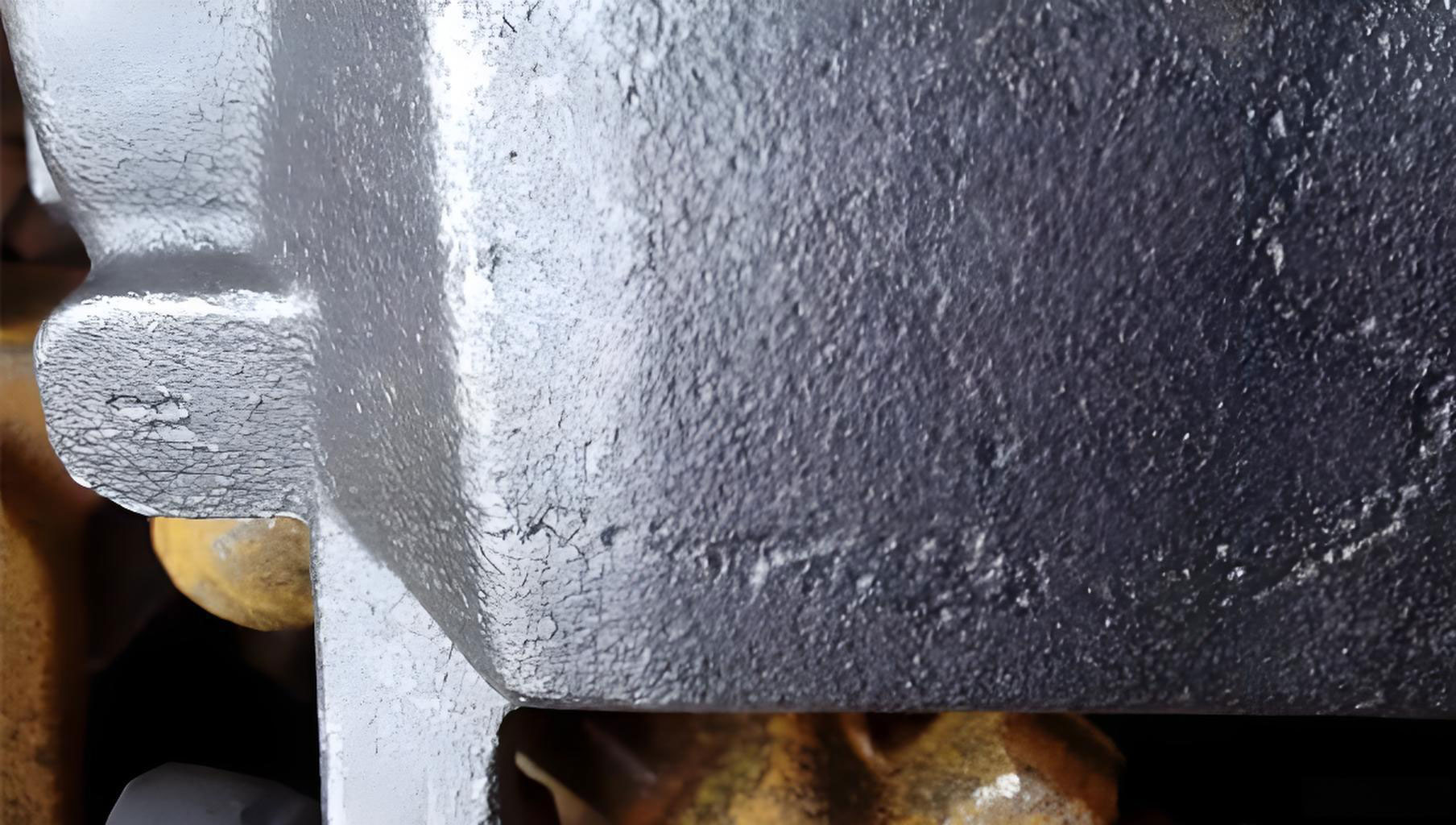
Further analysis involved scanning electron microscopy (SEM) and energy-dispersive X-ray spectroscopy (EDS) to compare the composition of the defect areas with the base metal. Multiple points were sampled within the casting holes of cylinders 2 and 3. The results indicated minimal compositional deviation, except for slightly elevated oxygen levels at a few points, likely due to minor oxidation. The table below summarizes the EDS data, highlighting that the casting holes are primarily gaseous in nature.
| Sample Point | Fe (wt%) | C (wt%) | Si (wt%) | O (wt%) | Other Elements (wt%) |
|---|---|---|---|---|---|
| P1 (Base Metal) | 93.5 | 3.2 | 2.1 | 0.1 | 1.1 |
| P2 (Cylinder 2 Defect) | 92.8 | 3.3 | 2.0 | 0.5 | 1.4 |
| P3 (Cylinder 2 Defect) | 93.0 | 3.1 | 2.2 | 0.4 | 1.3 |
| P4 (Cylinder 3 Defect) | 92.5 | 3.4 | 2.1 | 0.6 | 1.4 |
Based on this evidence, I concluded that the casting holes resulted from gas porosity, driven by excessive gas content in the molten iron and inadequate degassing during solidification. The formation of such casting holes can be modeled using the solubility of gases in iron, governed by Sieverts’ law for diatomic gases like hydrogen and nitrogen:
$$ S = k \sqrt{P} $$
where \( S \) is the solubility, \( k \) is the equilibrium constant, and \( P \) is the partial pressure of the gas. During solidification, the solubility decreases sharply, leading to gas precipitation and the creation of casting holes. The critical radius \( r_c \) for pore nucleation can be expressed as:
$$ r_c = \frac{2\gamma}{\Delta P} $$
Here, \( \gamma \) is the surface tension, and \( \Delta P \) is the pressure difference between the gas and the liquid. If the local gas concentration exceeds saturation, casting holes form, particularly in thick sections like cylinder liners where cooling rates are slower.
To address these casting holes, I implemented a multi-faceted strategy focusing on melt purity and process stability. The key measures included:
- Enhancing Charge Material Purity: I eliminated the use of machined chips from wet processing, as they contained residual cutting fluids, paints, and anti-rust agents that could introduce hydrogen and other gases. This was formalized in process documents to ensure clean charge materials.
- Improving Slag Removal: During melting, frequent slag skimming was enforced, followed by a high-temperature holding phase at 1540–1560°C for 10–15 minutes to promote slag flotation. The effectiveness of this step can be quantified by the reduction in non-metallic inclusions, which act as nucleation sites for casting holes.
- Optimizing Ladle Practices: I mandated pre-shift inspections of ladle spouts to maintain dam board heights at 30–40 mm, ensuring smooth pouring. Additionally, slag removal was intensified: after tapping, two dedicated slag skims were performed, followed by a visual confirmation by a third operator. Pouring spouts were cleaned hourly to prevent glaze buildup.
The impact of these countermeasures on casting holes was evaluated using a control chart. The scrap rate due to cylinder liner defects was monitored over successive production batches, showing a significant decline. The data is summarized in the table below.
| Production Batch | Defect Rate (Casting Holes) | Cumulative Improvement |
|---|---|---|
| Baseline (Jan 2022) | 2.0% | 0% |
| After Measure 1 | 1.2% | 40% |
| After Measure 2 | 0.5% | 75% |
| After Measure 3 | 0.05% | 97.5% |
Mathematically, the reduction in defect rate \( D \) can be modeled as an exponential decay:
$$ D(t) = D_0 e^{-kt} $$
where \( D_0 \) is the initial defect rate, \( k \) is the improvement rate constant, and \( t \) represents the implementation timeline. For our case, \( k \) was estimated at 0.15 per batch, leading to a steady-state defect rate below 0.05%.
Post-implementation, the machining合格率 soared to over 98%, with external rejections for casting holes plummeting from 1.5% to 0.05%. This stability has been maintained, demonstrating the robustness of the measures. The experience underscored the importance of data-driven diagnosis; initial assumptions about sand holes were debunked through SEM analysis, highlighting that casting holes often have gaseous origins. By systematically addressing melt quality and process parameters, we effectively mitigated the casting holes.
In conclusion, controlling casting holes in gray iron cylinder blocks requires a holistic approach. Key lessons include: (1) leveraging advanced analytical tools to accurately identify defect types, as casting holes may mimic other imperfections; (2) implementing stringent charge material controls to minimize gas sources; and (3) optimizing pouring and slag removal to enhance metal cleanliness. These principles are universally applicable to foundries grappling with similar casting holes. Future work could explore predictive models for gas porosity using computational simulations, such as coupling fluid dynamics with solidification kinetics to preempt casting holes. The formula for gas pore growth during solidification, incorporating diffusion and pressure effects, is:
$$ \frac{dr}{dt} = \frac{D}{r} \left( C – C_s \right) – \frac{\Delta P}{4\eta} r $$
where \( D \) is the diffusion coefficient, \( C \) is the gas concentration, \( C_s \) is the saturation concentration, and \( \eta \) is the viscosity. Such models can further refine strategies against casting holes, ensuring high-integrity castings for demanding applications like engine blocks.