
In my years of experience in the electroplating industry, I have consistently faced challenges related to material defects and solution chemistry. One of the most persistent issues involves casting holes in iron castings, which severely compromise the quality of electroplated coatings. These casting holes, often resulting from sand inclusions or gas porosity during the casting process, create discontinuities that lead to poor adhesion, increased porosity, and unsightly finishes after plating. This article delves into the technical aspects of electroplating bath management and the specific methods for addressing casting holes, with a focus on analytical improvements and practical remediation techniques.
The electroplating of nickel, a common process for providing corrosion resistance and aesthetic appeal, relies heavily on the precise control of bath components. Among these, nickel chloride (NiCl₂) plays a crucial role as an anode activator and conductivity enhancer. However, its concentration must be carefully monitored to avoid adverse effects. Let me first discuss the fundamental role of nickel chloride in plating baths, as this underpins many analytical challenges that indirectly affect how we handle casting holes in substrates.
Nickel chloride in a nickel plating solution serves multiple functions. Primarily, it acts as an anode activator, preventing the passivation of nickel anodes. Passivation occurs when the anode surface forms a non-conductive layer, typically NiO, which reduces the dissolution of nickel ions into the solution. This can be described by the electrochemical reaction: $$ \text{Ni} \rightarrow \text{Ni}^{2+} + 2e^- $$. When chloride ions (Cl⁻) are present, they compete with hydroxide ions (OH⁻) for adsorption on the anode surface, thereby inhibiting oxide formation. The chloride ion concentration is critical; if too low, anode passivation occurs, leading to a decrease in nickel ion concentration (e.g., from NiSO₄) and bath instability. Conversely, high chloride concentrations enhance conductivity and throwing power, but can cause excessive anode dissolution, increasing sludge formation. This sludge contributes to defects like roughness and brittleness in the deposit, which are exacerbated when plating over casting holes, as these imperfections trap contaminants.
To quantify the effects, I often use the following table to summarize the impact of nickel chloride concentration:
| Chloride Concentration Range | Effects on Plating Bath | Implications for Casting Holes |
|---|---|---|
| Low (e.g., < 5 g/L) | Anode passivation, reduced Ni²⁺ supply, poor bath stability | Inconsistent coating over casting holes, leading to exposed defects |
| Optimal (e.g., 5-15 g/L) | Good anode activation, balanced conductivity, minimal sludge | Improved coverage of casting holes, but still requires substrate preparation |
| High (e.g., > 20 g/L) | Rapid anode dissolution, high sludge, increased stress and brittleness | Aggravated defect formation around casting holes, causing cracks and peeling |
The conductivity of the bath can be modeled using the formula: $$ \kappa = \sum_i \lambda_i c_i $$ where $\kappa$ is the conductivity, $\lambda_i$ is the molar conductivity of ion $i$, and $c_i$ is its concentration. For nickel chloride, the contribution of Cl⁻ ions significantly boosts $\kappa$, enhancing throwing power—the ability to plate into recessed areas like casting holes. However, for processes like pearl nickel plating, lower throwing power is desired to achieve matte finishes, so chloride levels are kept low. In contrast, for deep-hole plating or barrel plating, higher chloride concentrations improve coverage, which is essential for penetrating casting holes.
Accurate analysis of chloride content is paramount, as it directly influences the calculation of nickel sulfate concentration. Typically, chloride is determined using the Mohr method, which involves titration with silver nitrate (AgNO₃) to form silver chloride (AgCl) precipitate, with potassium chromate (K₂CrO₄) as an indicator. The reaction is: $$ \text{Ag}^+ + \text{Cl}^- \rightarrow \text{AgCl} \downarrow $$. The endpoint is signaled by the formation of red silver chromate (Ag₂CrO₄): $$ 2\text{Ag}^+ + \text{CrO}_4^{2-} \rightarrow \text{Ag}_2\text{CrO}_4 \downarrow $$. However, in practice, I have found this method prone to errors, especially in solutions containing green Ni²⁺ ions that obscure the endpoint. The AgCl precipitate tends to adsorb excess Ag⁺, causing premature endpoint detection, while the slow conversion of Ag₂CrO₄ to AgCl leads to tailing. This results in poor reproducibility, with titration volumes varying by 0.5–1 mL, equivalent to 1–2 drops, exceeding acceptable industrial tolerances.
To address these issues, I have developed and implemented several improvements. First, vigorous shaking during titration helps release adsorbed Ag⁺ ions. Second, instead of toxic nitrobenzene, I add non-ionic surfactants like polyoxyethylene ether (e.g.,平平加 or OP-10) at a mass fraction of 0.1%. These surfactants adsorb onto AgCl particles, preventing Ag⁺ adsorption and dispersing the precipitate, thereby sharpening the endpoint. The mechanism can be described by the adsorption isotherm: $$ \Gamma = k C^{1/n} $$ where $\Gamma$ is the surface concentration of surfactant, $C$ is its bulk concentration, and $k$ and $n$ are constants. This modification has significantly enhanced precision, with relative standard deviations now below 1%. The improved accuracy indirectly benefits the treatment of casting holes, as reliable bath chemistry ensures consistent plating over defective areas.
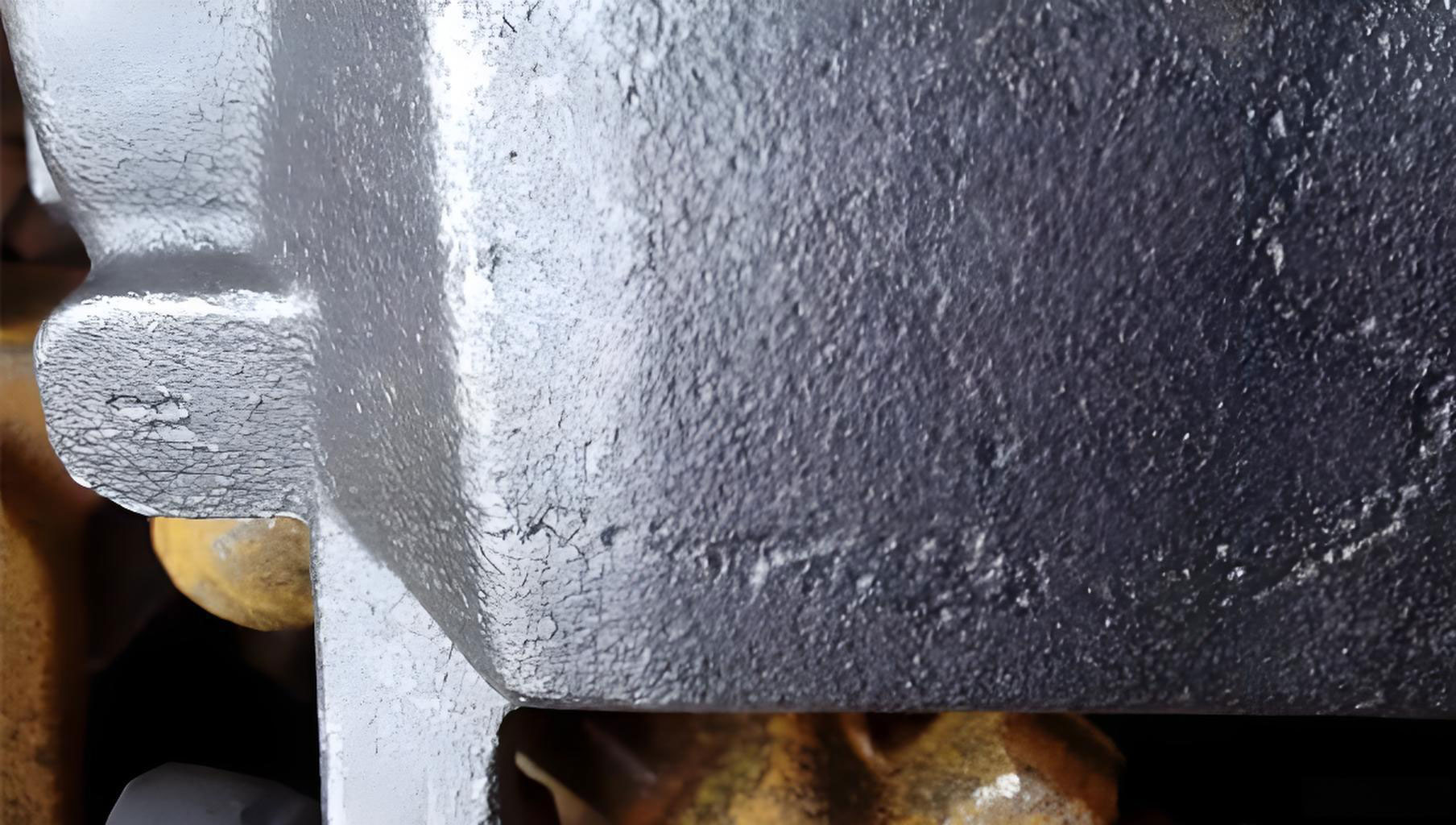
Now, turning to the core issue of casting holes in iron castings. These defects, often visible as pores or voids on the surface, pose significant challenges for electroplating. When plating over casting holes, the real surface area increases compared to the apparent area, leading to lower effective current density. This can be expressed as: $$ i_{\text{real}} = \frac{I}{A_{\text{real}}} $$ where $i_{\text{real}}$ is the real current density, $I$ is the applied current, and $A_{\text{real}}$ is the real surface area including casting holes. Since $A_{\text{real}} > A_{\text{apparent}}$, $i_{\text{real}}$ is lower, resulting in uneven deposition and pinholes in the coating. In severe cases, casting holes act as stress concentrators, promoting crack initiation and coating failure.
To mitigate these effects, I have explored various filling techniques. One effective method involves using pure lead metal to fill casting holes. The procedure is as follows: based on the size of the casting holes, select lead blocks, strips, or electrical fuse wires of appropriate dimensions. Hammer the lead into the cavities until compact, then level with a tool like a saw blade and sand with 220-grit abrasive paper. After this, the casting can be plated conventionally, such as with chromium. This approach reduces the disparity between real and apparent current density, minimizing pinholes. However, it is labor-intensive and unsuitable for numerous small casting holes.
For finer or densely distributed casting holes, I prefer electroplating lead directly into the defects. Using a lead plating solution with a steel wire anode, a thin lead layer (about 5–10 μm) is deposited over the entire casting. The lead is then abrasively removed from the surface, leaving it embedded in the casting holes. This ensures conductivity and provides a seamless base for subsequent plating. The plating process can be modeled by Faraday’s law: $$ m = \frac{QM}{nF} $$ where $m$ is the mass of lead deposited, $Q$ is the charge passed, $M$ is the molar mass of lead, $n$ is the number of electrons transferred (2 for Pb²⁺), and $F$ is Faraday’s constant. This method offers better adhesion than non-conductive fillers like metal putties, which often contain gypsum and may lead to coating delamination.
The importance of addressing casting holes cannot be overstated. In my work, I have seen that untreated casting holes lead to costly rework and product rejection. To illustrate the economic impact, consider the following table comparing different remediation methods:
| Method | Procedure | Advantages | Disadvantages | Suitability for Casting Holes |
|---|---|---|---|---|
| Lead Hammering | Manual filling and leveling | Low cost, immediate results | Labor-intensive, not for small holes | Large, visible casting holes |
| Lead Electroplating | Electrodeposition and abrasion | Precise filling, good adhesion | Requires plating setup, time-consuming | Small or numerous casting holes |
| Metal Putty | Application of conductive paste | Easy to use | Poor conductivity, risk of delamination | Temporary fixes for minor casting holes |
Beyond these methods, I have researched advanced approaches such as pulsed electroplating to improve coverage over casting holes. Pulsed currents can enhance throwing power by allowing diffusion during off-times, described by the equation: $$ i_p = i_{\text{avg}} \frac{T_{\text{on}} + T_{\text{off}}}{T_{\text{on}}} $$ where $i_p$ is the peak current density, $i_{\text{avg}}$ is the average current density, and $T_{\text{on}}$ and $T_{\text{off}}$ are the pulse on and off times. This technique can reduce the need for excessive chloride in the bath, thereby minimizing sludge-related defects around casting holes.
Another critical aspect is the interaction between bath chemistry and substrate defects. For instance, high chloride concentrations can increase internal stress in nickel deposits, as given by the formula: $$ \sigma = \frac{E \cdot \epsilon}{1 – \nu} $$ where $\sigma$ is stress, $E$ is Young’s modulus, $\epsilon$ is strain, and $\nu$ is Poisson’s ratio. This stress exacerbates cracking when plating over casting holes, as the holes act as stress risers. Therefore, optimizing chloride levels is essential not only for bath performance but also for defect management.
In practice, I recommend a holistic approach: first, analyze the plating bath precisely using improved Mohr method with surfactants; second, assess the casting holes for size and distribution; and third, select an appropriate filling technique. For critical applications, combining lead electroplating with optimized bath parameters yields the best results. Additionally, regular monitoring of casting holes in incoming castings can prevent downstream issues.
To further explore the science, let’s consider the kinetics of deposition over casting holes. The current distribution in a recessed defect can be modeled using the Wagner number (Wa): $$ \text{Wa} = \frac{\kappa RT}{nF i L} $$ where $R$ is the gas constant, $T$ is temperature, $i$ is current density, and $L$ is a characteristic length. A high Wa indicates uniform current distribution, which is desirable for plating into casting holes. Chloride ions, by increasing $\kappa$, can raise Wa, but as noted, excess chloride has downsides.
In conclusion, my experience underscores that successful electroplating on defective substrates requires both analytical rigor and practical ingenuity. The improvements in chloride analysis have enhanced bath control, while innovative filling methods for casting holes have transformed challenging castings into viable products. As technology advances, I anticipate developments like additive manufacturing for defect repair and real-time monitoring of casting holes during plating. For now, a methodical approach combining chemistry, physics, and hands-on techniques remains key to overcoming the persistent challenge of casting holes in electroplating.
Throughout this article, I have emphasized the term casting holes to highlight its significance. Whether dealing with large voids or microscopic pores, these casting holes demand attention in every step of the plating process. From bath formulation to substrate preparation, addressing casting holes is integral to achieving high-quality, durable coatings. I hope these insights inspire further innovation in our field, as we continue to tackle the complexities of casting holes and other material defects.