
In the foundry production of large, structurally complex machine tool components, such as work tables and bases, the occurrence of casting defects presents a significant challenge to product quality and economic efficiency. Among these defects, porosity in casting stands out as a particularly prevalent and costly issue. Based on firsthand experience in resolving major porosity defects in 2.5-meter work table castings, this article provides a comprehensive analysis of the root causes and presents a systematic, verified set of improvement measures. The goal is to outline a methodological approach to process design and control that ensures the production of sound castings, thereby enhancing yield and competitiveness in the demanding machine tool market.
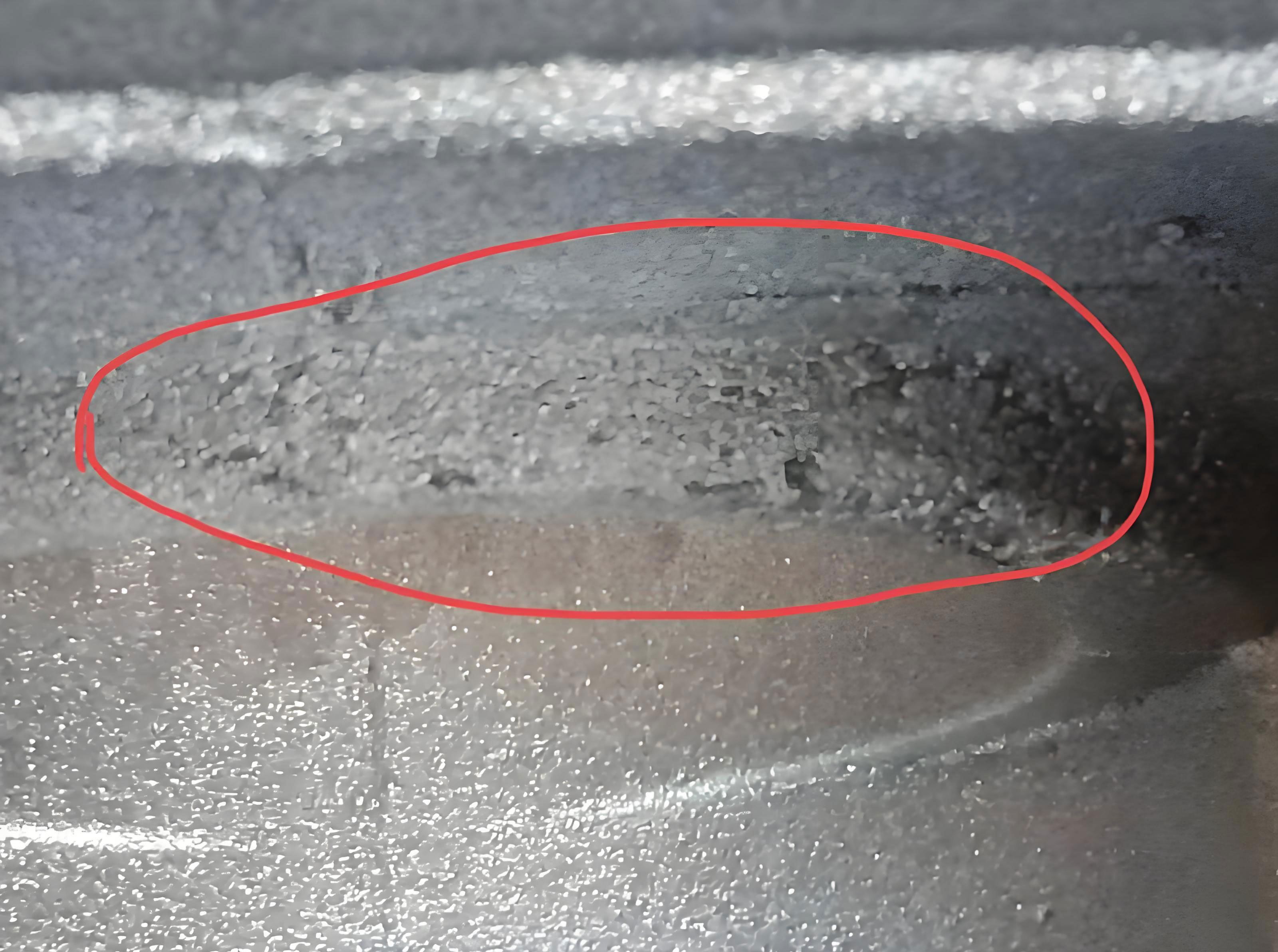
The initial scenario involved the recurring appearance of extensive porosity in casting on the large bottom plane (the functional working surface) of 2.5-meter work tables. The porosity was especially dense near the ingates. This defect led to the scrapping of castings, resulting in notable financial losses. The casting process employed resin-bonded sand molds and cores, with alcohol-based refractory coatings. The initial gating system consisted of two vertical sprue (ø70 mm), a horizontal runner, and six ingates, designed with a ratio of 1:1.18:1.18. The pouring temperature was set between 1310°C and 1330°C.
1. Classification and Formation Mechanisms of Porosity
Understanding the specific type of porosity in casting is crucial for identifying its source. The defects observed in this case were primarily macroscopic, rounded or elongated cavities located on or near the casting surface. The mechanisms can be categorized as follows:
| Type of Porosity | Primary Source | Typical Morphology | Key Contributing Factors |
|---|---|---|---|
| Injected (Entrained) Gas Porosity | Gas from mold/core materials (resin decomposition). | Large, spherical or elongated voids, often subsurface. | Inadequate core/mold ventilation, high gas pressure. |
| Reaction Gas Porosity | Gas from metal-mold reaction (e.g., moisture, coatings). | Small, often pinhole-sized, near the casting surface. | Wet/damp molds, reactive chill materials, high pouring temp. |
| Shrinkage Porosity (often confused with gas) | Insufficient liquid metal feed during solidification. | Irregular, dendritic cavities, often in thermal centers. | Poor feeding design, low pouring temperature. |
The defects in the work tables exhibited characteristics of injected gas porosity, potentially exacerbated by local reactions. The core and mold gases, generated from the thermal breakdown of the resin binder and other organic materials, must escape freely. If venting is obstructed or insufficient, gas pressure builds up within the mold cavity. When the local gas pressure exceeds the metallostatic pressure of the liquid metal at that point, the gas can be forced into the solidifying metal, resulting in porosity in casting. The fundamental pressure balance can be expressed as:
$$ P_{gas} > P_{metal} + P_{atm} + \frac{2\sigma}{r} $$
Where \( P_{gas} \) is the pressure in the gas pocket, \( P_{metal} = \rho g h \) is the metallostatic head pressure, \( P_{atm} \) is atmospheric pressure, \( \sigma \) is the surface tension of the metal, and \( r \) is the pore radius.
2. Root Cause Analysis of the Initial Porosity Problem
A systematic deconstruction of the original process revealed several interrelated factors that collectively created the conditions for severe porosity in casting.
| Process Element | Initial Design/State | Problem/Consequence |
|---|---|---|
| Core Support & Venting | Cores were seated on cast iron supports (“stools”). Venting was solely through side core prints. | Metal inflow could displace cores, blocking vent paths. Side vents could be sealed off early. This trapped gas inside large cores with no escape route, leading to high-pressure gas injection into the metal. |
| Chill Design | The entire bottom plane was covered with reused HT200 cast iron chills. | Repeated use caused micro-cracking. These cracks trapped air/gas, which was violently expelled upon contact with hot metal, injecting gas directly into the solidifying skin. This contributed significantly to surface porosity in casting. |
| Gating & Venting System | Ingates located on the bottom plane. Vent risers were undersized or absent on the cope. | Bottom gating directs the first, often cooler metal to the chills, promoting rapid solidification that can trap gas. The total cross-sectional area of vent risers was insufficient to handle the volume of gas generated by the large resin sand mass. |
| Pouring Parameters | Pouring temperature: 1310-1330°C. | At the lower end of this range, metal fluidity and gas-bubble buoyancy are reduced. Gas bubbles have less time to float out before the metal freezes, especially in areas quickly chilled by the iron chills. |
The confluence of these factors created a perfect storm: massive gas generation from resin-bonded sand, obstructed escape paths due to core design, an active source of injected gas from cracked chills, a gating system that localized cooler metal in problematic areas, and insufficient venting capacity. The result was unavoidable, widespread porosity in casting on the critical working surface.
3. A Systematic Approach to Improvement: Corrective Measures
The solution required a holistic redesign targeting each identified root cause. The implemented improvements focused on ensuring unimpeded gas evacuation, eliminating internal gas sources, and optimizing filling and solidification conditions.
3.1 Core Design and Support: Ensuring Unobstructed Venting
The most critical change was re-engineering the core assembly. The seated core design was abandoned in favor of a suspended core design.
- Method: Cores were hung from the cope (upper mold half) using strong, reinforced core prints. This eliminated the need for numerous internal cast iron supports (chills), which themselves could be sources of gas and imperfections.
- Venting: Primary venting was re-routed vertically through the top core prints into the cope mold section. This path remains open until the very end of the pour, as the cope is the last part to fill. Supplemental venting via side prints was retained but became secondary.
- Benefit: This created a direct, reliable, and high-capacity escape route for core gases, fundamentally reducing the risk of gas pressure buildup and subsequent injection. Removing many internal supports also reduced potential sources of chill-induced porosity in casting.
3.2 Chill Material Replacement: Eliminating a Gas Source
The cast iron (HT200) chills were identified as a direct contributor to surface gas defects.
- Action: All cast iron chills on the critical bottom plane were replaced with graphite chills.
- Rationale: Graphite has excellent thermal conductivity (similar to or better than iron) but is non-wetting and has a very low gas content. It does not develop micro-cracks that trap air. Its use eliminates the violent outgassing associated with cracked iron chills, thereby removing a major source of injected gas responsible for near-surface porosity in casting.
3.3 Gating and Venting System Optimization
The gating system was modified to work in harmony with the new core venting strategy.
- Vent Riser Design: Adequate vent risers were explicitly added to the highest points of the mold cavity in the cope. A fundamental rule of thumb was applied: the total cross-sectional area of the vent risers should be greater than the total cross-sectional area of the sprue(s). This ensures the vents have adequate capacity to handle the displaced air and core gases. For example:
$$ \sum A_{vents} > \sum A_{sprues} $$
If using two ø70 mm sprues, the total sprue area is \( 2 \times \pi \times (35)^2 \approx 7697 \, mm^2 \). The total vent area should exceed this value. - Pouring Practice: During pouring, operators were instructed to “light” the vents (ensure gas is visibly escaping) to confirm the system is functioning.
3.4 Precise Control of Pouring Parameters
Thermal management was fine-tuned to aid in gas elimination.
- Pouring Temperature: The target range was increased to 1330-1350°C. The higher superheat provides:
- Longer fluid life, allowing more time for entrapped gas bubbles to float to the vent risers or the cope surface.
- Reduced thermal shock to coatings and chills, moderating gas generation rates.
- Better metal fluidity to fill the mold smoothly, reducing turbulence that can entrap air.
- Pouring Time Calculation: A more scientific approach was adopted to determine the optimal pour time, balancing mold filling speed against erosion and turbulence. A common formula based on weight and empirical coefficients was used:
$$ t = k \cdot \sqrt{W} $$
Where \( t \) is the pouring time in seconds, \( W \) is the casting weight in kg, and \( k \) is an empirical coefficient dependent on casting thickness and material (typically 0.8-1.5 for medium-section iron castings). For a 29,000 kg casting with a chosen \( k \) of 1.4, the calculated pour time would be approximately \( 1.4 \times \sqrt{29000} \approx 75 \) seconds. This was used as a guideline to size the gating system accordingly.
4. Integrated Process Flow and Results
The following table summarizes the systemic changes made, contrasting the old and new approaches to mitigate porosity in casting:
| Aspect | Initial Problematic Process | Improved, Verified Process | Mechanism of Improvement |
|---|---|---|---|
| Core Assembly | Seated on stools, side-vented. | Suspended from cope, top-vented. | Creates direct, unobstructed gas escape path; eliminates core movement. |
| Chill Material | Reused Cast Iron (HT200). | New/Reused Graphite. | Eliminates gas source from micro-cracks; provides clean chilling. |
| Mold Venting | Undersized or absent top vents. | Dedicated vent risers with \( \sum A_{vents} > \sum A_{sprues} \). | Provides sufficient volumetric capacity for all mold and core gases. |
| Pouring Temperature | 1310-1330°C. | 1330-1350°C. | Increases gas solubility gradient and bubble floatation time. |
| Process Control | Standard procedure. | Mandatory vent lighting check during pour. | Real-time verification of venting system functionality. |
The implementation of this integrated set of measures proved completely effective. Subsequent production runs of the 2.5-meter work tables and bases were entirely free from the previously crippling porosity in casting defect on the working surface. All castings were inspected and qualified for shipment. This success not only recovered potential losses but also validated a robust technical framework for producing other large, complex, resin sand castings.
5. Theoretical Underpinnings and Generalized Principles
The success of these measures is grounded in fundamental foundry principles related to gas behavior. To generalize the solution for preventing porosity in casting, the following models are critical:
5.1 The Gas Solubility Gradient: The solubility of gases like hydrogen and nitrogen in molten iron decreases sharply as the metal solidifies. Gas rejected from the solution can form pores. Higher pouring temperatures can initially increase solubility, but the critical factor is the gradient during cooling. The key is to allow gas to escape before being trapped. The velocity of a gas bubble rising in a liquid metal is given by Stokes’ law (for small, spherical bubbles in laminar flow):
$$ v = \frac{2 g r^2 ( \rho_{metal} – \rho_{gas})}{9 \eta} $$
Where \( v \) is the terminal velocity, \( g \) is gravity, \( r \) is the bubble radius, \( \rho \) are densities, and \( \eta \) is the dynamic viscosity of the metal. Higher temperature reduces \( \eta \), increasing \( v \), thus aiding bubble removal.
5.2 The Pressure Balance Model (Revisited): The condition for gas injection can be expanded to consider the rate of gas generation \( \dot{G} \) from the mold/core. To prevent porosity in casting, the venting system must be capable of removing this gas at a rate that keeps cavity pressure below the critical injection pressure.
$$ P_{cavity}(t) = P_{atm} + \frac{\dot{G}(t) \cdot R \cdot T}{V_{vent} \cdot t} < \rho g h(t) + P_{atm} + \frac{2\sigma}{r} $$
Where \( \dot{G}(t) \) is the gas generation rate (a function of temperature/time), \( R \) is the gas constant, \( T \) is gas temperature, and \( V_{vent} \) is the volumetric flow capacity of the vents. This model underscores why both reducing gas generation (using graphite chills) and maximizing vent capacity (large top vents) are essential.
5.3 The Solidification Gradient: While primarily a feeding issue, solidification direction impacts gas pore distribution. A gradient that solidifies from the bottom (chill) up towards the vents is ideal for allowing gas bubbles to float into the still-liquid upper regions and out through the vents. The original bottom-gating with heavy chills created a rapid, unidirectional freeze that could trap gas at the chill interface.
6. Conclusion
The resolution of severe porosity in casting defects in large work table castings demonstrates that this challenge is not insurmountable but requires a systematic, root-cause-based engineering approach. The problem is rarely due to a single factor; it is typically the synergistic result of multiple process deficiencies. The successful strategy hinged on four pillars: (1) guaranteeing unimpeded core and mold gas evacuation through redesigned suspension and ample top venting, (2) eliminating active internal gas sources by substituting graphite for cast iron chills, (3) optimizing thermal parameters like pouring temperature to favor gas expulsion, and (4) implementing rigorous process controls for verification. This comprehensive methodology, backed by fundamental principles of fluid dynamics and gas behavior in metals, forms a reliable template for diagnosing and eliminating porosity in casting across a wide range of large, complex castings produced in chemically-bonded sand molds, thereby ensuring high-integrity products and sustainable foundry operations.