
In my extensive experience within the precision foundry, the persistent challenge of porosity defects has been a focal point of technical analysis and process refinement. The specific issue of porosity in casting components made from AISI 202 stainless steel, often adopted as a cost-effective alternative to AISI 304, presents a particularly intricate case study. This material substitution, driven by raw material economics, frequently introduces severe, clustered porosity that jeopardizes product integrity and delivery schedules. The following treatise is a comprehensive, first-person exploration of the root causes, underlying metallurgical and physical mechanisms, and the systematic countermeasures developed to mitigate this defect, expanding significantly on foundational observations.
The fundamental shift from 304 to 202 (or 201) stainless steel alters the solidification dynamics and gas solubility behavior of the alloy. The core of the problem, porosity in casting, manifests not as isolated voids but as dense congregations, typically localized in regions that experience prolonged liquid state and slow cooling, such as gates, runners, and thermal centers of castings. This non-random distribution immediately points away from random nucleation and towards process-dependent causative factors.
1. Fundamental Mechanisms and Classification of Porosity
To effectively combat porosity in casting, one must first understand its genesis. Porosity fundamentally arises from the entrapment of gas within the solidifying metal or from inadequate liquid metal feeding to compensate for solidification shrinkage. In investment casting of austenitic stainless steels like 202, these mechanisms often interact.
1.1 Gas Porosity
Gas porosity results from the precipitation of dissolved gases as the metal solubility decreases during cooling and solidification. The solubility of diatomic gases like hydrogen and nitrogen in liquid steel is described by Sieverts’ Law:
$$ C_s = k \sqrt{P} $$
where $C_s$ is the solubility of the gas, $k$ is the Sieverts’ constant (temperature-dependent), and $P$ is the partial pressure of the gas above the melt. Upon solidification, solubility can drop precipitously. For hydrogen in steel, the ratio of solubility in liquid to solid is particularly high, making it a prime culprit for gas-induced porosity in casting. The driving force for pore nucleation and growth is the supersaturation of gas:
$$ \Delta C = C_l – C_s $$
where $\Delta C$ is the supersaturation, $C_l$ is the gas concentration in the liquid, and $C_s$ is the equilibrium solubility at the solidification interface.
1.2 Shrinkage Porosity
Shrinkage porosity forms due to the inability of feed metal to reach isolated liquid pools during the final stages of solidification. The volumetric shrinkage for austenitic stainless steels is significant, typically around 4-6%. The pressure drop in a mushy zone can be approximated by Darcy’s law for flow through a porous medium:
$$ \nabla P = -\frac{\mu}{K} v_l $$
where $\nabla P$ is the pressure gradient, $\mu$ is the dynamic viscosity of the liquid, $K$ is the permeability of the mushy zone (a function of the fraction of liquid and dendrite arm spacing), and $v_l$ is the superficial velocity of the liquid. When the pressure in a isolated liquid pocket falls below a critical value, a pore can nucleate, often aided by the presence of dissolved gases.
1.3 Interaction and Pore Initiation
In practice, porosity in casting is rarely purely gaseous or purely shrinkage-based; it is often synergistic. A small amount of dissolved gas can dramatically lower the nucleation threshold for a shrinkage pore. The critical radius $r^*$ for the heterogeneous nucleation of a pore on a substrate is given by:
$$ r^* = -\frac{2 \gamma_{lg}}{\Delta G_v} $$
where $\gamma_{lg}$ is the liquid-gas surface energy and $\Delta G_v$ is the volumetric free energy change, which is a function of both gas supersaturation and pressure drop due to shrinkage. The presence of inclusions or bifilms (entrained oxide films) can act as potent nucleation sites, further aggravating the tendency for porosity in casting.
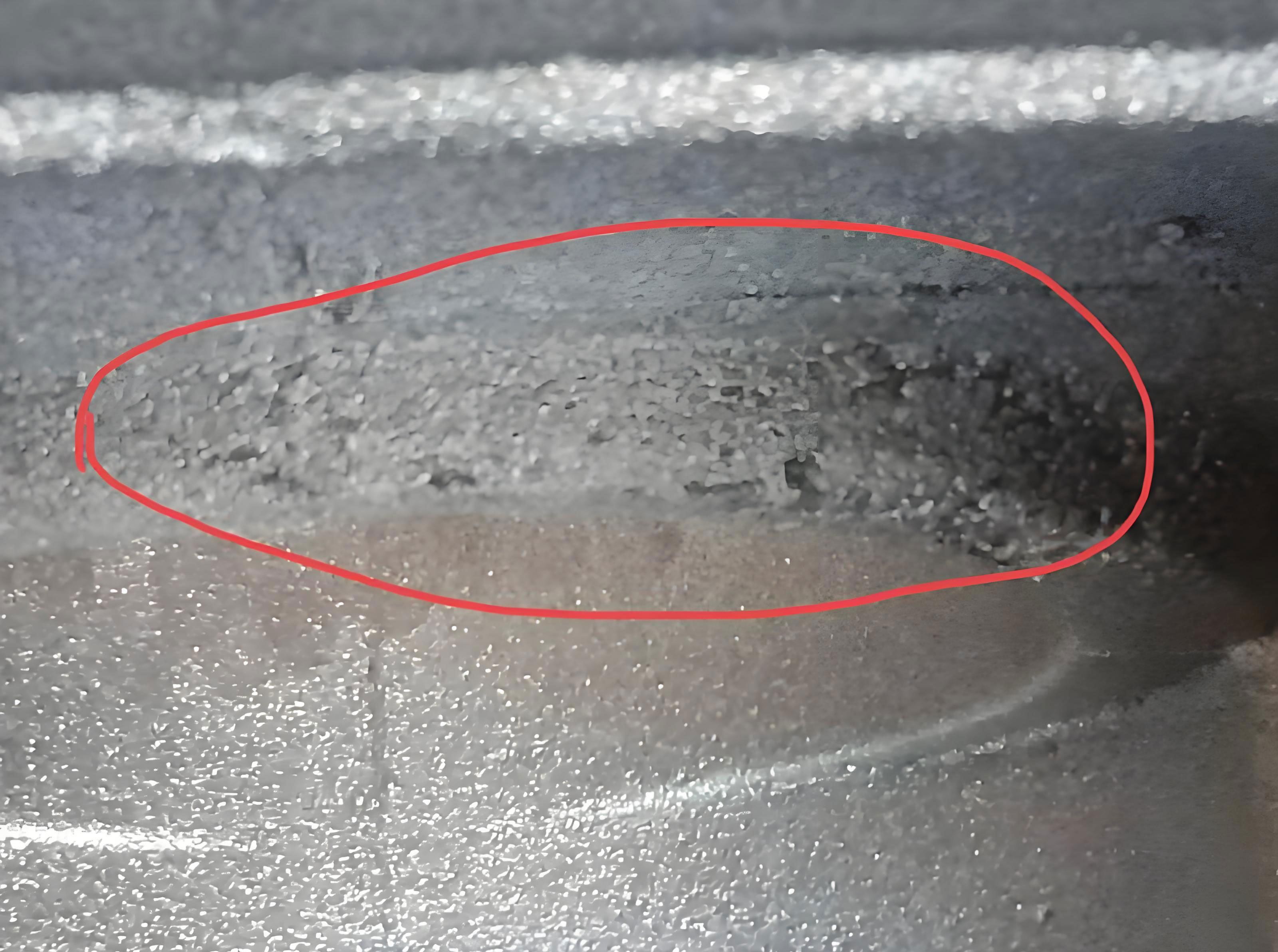
The image above typically illustrates the severe, clustered nature of this defect. In 202 stainless steel, the higher manganese and nitrogen content compared to 304 alters the alloy’s solidification range and gas solubility, making it inherently more susceptible to this form of defect under non-optimal pouring and cooling conditions.
2. Detailed Analysis of Causative Factors in 202 Steel Castings
Initial troubleshooting often focuses on standard foundry practices. Our investigations meticulously evaluated and ruled out several common suspects before identifying the primary drivers.
| Suspected Cause | Standard Countermeasure Applied | Observed Effect on Porosity in 202 Castings |
|---|---|---|
| Inadequate Shell Firing | Increase temperature to 1200°C, extend hold time to 50 min. | No significant reduction in defect rate. |
| Poor Melt Deoxidation / Excess Al | Strict control and staged addition of aluminum. | Minor improvement in general cleanness, but clustered porosity persisted. |
| Delayed Lid Covering or Damp Exothermic Materials | Use fully dried exothermic compounds and ensure prompt covering. | No measurable impact on the specific clustered defect pattern. |
The failure of these standard remedies was a pivotal moment. It directed attention towards the unique thermal history of the metal during and after pouring. A clear pattern emerged from metallographic and macro-examination:
- The most severe porosity in casting clusters were invariably found at the sprue cup and the sprue base—regions subjected to the hottest metal and the slowest cooling.
- The defect propagated along the path of hot metal flow (gates, initial impingement areas in the cavity) and was concentrated in thick sections (thermal centers).
- Thin sections and areas at the end of filling were consistently free of this defect.
- A direct correlation was established: higher pouring temperatures led to a dramatically higher incidence and severity of porosity in casting.
This pattern is not consistent with uniformly distributed gas entrapment from the melt. Instead, it points to a time- and temperature-dependent process occurring within the ceramic mold after the metal is poured. The key factors are Excessive Superheat and Insufficient Cooling Rate.
2.1 The Role of Excessive Pouring Temperature
A high pouring temperature provides excessive superheat, which must be removed before solidification can begin. This prolongs the liquidus duration, especially in insulated parts of the system like the sprue cup. During this extended liquid period, two critical phenomena are amplified:
1. Mold-Metal Interface Reactions: Prolonged contact between the high-temperature steel and the ceramic shell can promote interfacial reactions. While silica in the shell is generally stable, trace impurities, binders, or moisture in the shell’s primary layers can lead to local gas generation (e.g., from residual carbon). The reaction rate follows an Arrhenius-type relationship:
$$ k = A e^{-E_a/(RT)} $$
where $k$ is the rate constant, $A$ is the pre-exponential factor, $E_a$ is the activation energy, $R$ is the gas constant, and $T$ is the absolute temperature. A small increase in metal temperature $T$ can cause an exponential increase in the gas-generating reaction rate $k$ at the interface.
2. Growth of Pre-nucleated Pores: Any tiny gas bubble or entrained bifilm present in the metal stream will have vastly more time to grow by diffusion of dissolved gases (principally hydrogen and nitrogen) in the superheated liquid. The diffusion-controlled growth radius $r$ can be related to time $t$ by:
$$ r \propto \sqrt{D \cdot t} $$
where $D$ is the diffusion coefficient of the gas in liquid steel. Extended liquid time $t$ allows bubbles to grow to visible sizes before being trapped by solidifying dendrites.
2.2 The Criticality of Post-Pour Cooling Rate
This proved to be the most influential factor. Traditional investment casting practice often involves placing a hot, filled mold into an insulated container or covering it with an exothermic blanket to promote directional solidification and prevent mistruns. For 202 steel, this practice is detrimental. The slow cooling it induces allows the detrimental processes mentioned above to proceed to completion.
Rapid cooling, achieved by omitting the insulating cover (or using a chilling medium), achieves two vital outcomes:
1. It shortens the total solidification time $t_f$. According to Chvorinov’s rule:
$$ t_f = B \left( \frac{V}{A} \right)^n $$
where $V$ is volume, $A$ is surface area, $B$ is the mold constant, and $n$ is an exponent (usually ~2). By increasing the effective heat transfer coefficient (removing insulation), we increase the mold constant $B$, thereby reducing $t_f$ for a given casting modulus $(V/A)$. This drastically reduces the time available for gas diffusion and bubble growth.
2. It promotes a finer dendritic structure. The secondary dendrite arm spacing (SDAS), $\lambda_2$, is related to the local solidification time $t_{LS}$ by:
$$ \lambda_2 = k \cdot (t_{LS})^n $$
where $k$ and $n$ are material constants. Faster cooling reduces $t_{LS}$, yielding a finer $\lambda_2$. A finer dendritic network increases the permeability $K$ of the mushy zone earlier in solidification, improving interdendritic feeding and reducing the pressure drop $\nabla P$. This actively suppresses shrinkage pore formation. Furthermore, a finer structure can more effectively trap and distribute tiny gas pores at a sub-critical, non-damaging size.
| Process Parameter | Effect on Gas Solubility & Reaction Kinetics | Effect on Solidification Time & Structure | Net Effect on Porosity |
|---|---|---|---|
| High Pour Temperature | Decreases initial gas solubility, increases interface reaction rate exponentially. | Greatly extends liquidus duration, coarsens structure. | Strongly Promotes |
| Slow Cooling (Covered Mold) | Allows maximum time for gas diffusion to and growth of pores. | Maximizes local solidification time, coarsens dendrites, worsens feeding. | Strongly Promotes |
| Low Pour Temperature | Higher initial gas solubility, slower interface reactions. | Reduces liquidus duration, promotes finer structure. | Suppresses |
| Rapid Cooling (Uncovered Mold) | Minimizes time for gas diffusion and pore growth. | Minimizes solidification time, refines dendrites, improves feeding. | Strongly Suppresses |
3. Developed Countermeasures and Optimized Process Window
The conclusive solution emerged from systematically applying the insights gained from the failure of traditional methods. The strategy pivots from trying to prevent gas sources (which may be intrinsic or from subtle interfaces) to managing the thermal regime to render their effects harmless.
3.1 Pouring Temperature Optimization
The goal is to find the minimum temperature that ensures complete mold filling without mistruns or cold shuts. This requires careful consideration of the alloy’s fluidity, which is a function of temperature and composition. The fluidity length $L_f$ can be modeled as:
$$ L_f \propto \frac{\Delta H_f + c_p \Delta T_{sup}}{\eta} $$
where $\Delta H_f$ is the latent heat of fusion, $c_p$ is the specific heat, $\Delta T_{sup}$ is the superheat, and $\eta$ is the dynamic viscosity. For a given mold and alloy, a minimum $L_f$ is required. We establish this through fluidity spiral tests or similar methods for the specific 202 alloy batch and shell system. The pouring temperature is then set at:
$$ T_{pour} = T_{liquidus} + \Delta T_{sup(min)} + \Delta T_{safety} $$
where $\Delta T_{sup(min)}$ is the superheat needed for adequate fluidity and $\Delta T_{safety}$ is a small buffer (typically 10-25°C). This disciplined approach minimizes the superheat energy that must be extracted, directly attacking the root cause of prolonged high-temperature exposure that fosters porosity in casting.
3.2 Mandatory Rapid Cooling Protocol
This is the non-negotiable element for success with 202 alloys. Immediately after pour-off, the mold is not placed in an insulating container. Instead, it is allowed to cool in ambient air or placed on a conductive grate to accelerate heat loss. In some cases for very heavy sections, targeted fan cooling is applied. This practice must be validated for each casting geometry to ensure it does not induce problematic thermal stresses or cracks, but for most 202 castings, the benefit in eliminating porosity in casting far outweighs this risk.
3.3 Complementary Process Controls
While not the primary cause, secondary factors are tightened to provide a robust process:
- Shell Quality: While full firing may not be the critical fix, consistent shell permeability is vital to allow any generated gases to escape from the mold metal interface. We monitor shell thickness and stucco application to ensure uniformity.
- Melt Practice: Although not the main culprit, good practice is maintained. Vacuum melting or Argon-Oxygen Decarburization (AOD) for primary melt stock is ideal to minimize initial gas content. In air melting, careful deoxidation control (using Ca-Si or other complex deoxidizers alongside limited Al) helps reduce the population of oxide nuclei that can stabilize pores.
- Gating Design: Systems are designed to minimize turbulent entrainment of air and oxides (which can create bubble nucleation sites) and to facilitate directional solidification towards feeders, even under rapid overall cooling.
| Process Stage | Traditional Approach (Prone to Porosity) | Modified Approach (Porosity-Suppressing) | Rationale |
|---|---|---|---|
| Pouring Temperature | High, often 100-150°C above liquidus for “safety”. | Minimized, typically 30-70°C above liquidus, precisely determined. | Reduces superheat, shortens high-temperature duration. |
| Post-Pour Handling | Mold placed in insulated box or covered with exothermic material. | Mold left uncovered in ambient air or actively cooled. | Maximizes heat extraction rate, refines structure, suppresses pore growth. |
| Primary Focus | Preventing gas sources, ensuring feeding via slow solidification. | Managing thermal regime to negate the effects of inherent gas/reactions. | Addresses the specific sensitivity of 202 alloy. |
| Typical Result | Severe clustered porosity in gates and thermal centers. | Significant reduction to elimination of clustered porosity. | Validated by production trials and microstructure analysis. |
4. Quality Assurance and Preventive Framework
Sustaining the solution requires integrating these parameters into a controlled process framework. We implement Statistical Process Control (SPC) charts for pouring temperature for each casting family. Additionally, the cooling method (covered/uncovered) is a formalized, documented step on the shop traveler. Regular metallographic audits of sample castings, particularly sectioning through gate areas and thick sections, are performed to monitor dendrite arm spacing and the absence of porosity in casting. The key process capability indices (Cpk) are tracked for pouring temperature.
In conclusion, the vexing problem of severe porosity in casting for AISI 202 stainless steel investment castings is decisively addressed not by conventional wisdom, but by a paradigm shift in thermal management. The alloy’s inherent susceptibility is controlled by minimizing the pouring superheat to the functional limit and, most critically, by enforcing a rapid post-pour cooling cycle. This combination dramatically shortens the time window available for gas-related pore nucleation and growth while refining the as-cast structure to improve feeding. This methodology, born from systematic failure analysis and empirical validation, has proven robust in transitioning this challenging material from a problematic substitute to a reliable and cost-effective casting alloy. The principles of controlling superheat and maximizing cooling rate to suppress porosity in casting are universally valuable tools in the foundry engineer’s arsenal, particularly for alloys with narrow processing windows.