
In my experience within the foundry industry, addressing defects is a constant pursuit of quality and efficiency. One of the most persistent and challenging issues we face is the formation of porosity in casting. This article delves into a detailed examination of a specific case involving porosity defects in machine tool guideways, exploring the types, root causes, and systematic solutions. The goal is to provide a comprehensive, first-person perspective on diagnosing and mitigating porosity in casting, utilizing data summaries in tables and fundamental principles expressed through formulas. The insights shared here stem from practical investigations and process optimizations conducted to eliminate a recurring problem of clustered surface porosity.
The subject of this analysis was a series of bed castings for machining centers. The castings, with dimensions of approximately 2500mm x 1240mm x 1270mm and a weight of 4800kg, were made of gray iron (FC300). The critical issue manifested as a concentrated zone of porosity in the guide rail section, appearing after rough machining. The defects were characterized as a dense, honeycomb-like network of holes, ranging from 1 to 8mm in diameter and 1 to 10mm in depth, with smooth internal walls. This specific morphology immediately directed our investigation towards understanding the mechanisms of gas entrainment and reaction that lead to porosity in casting.
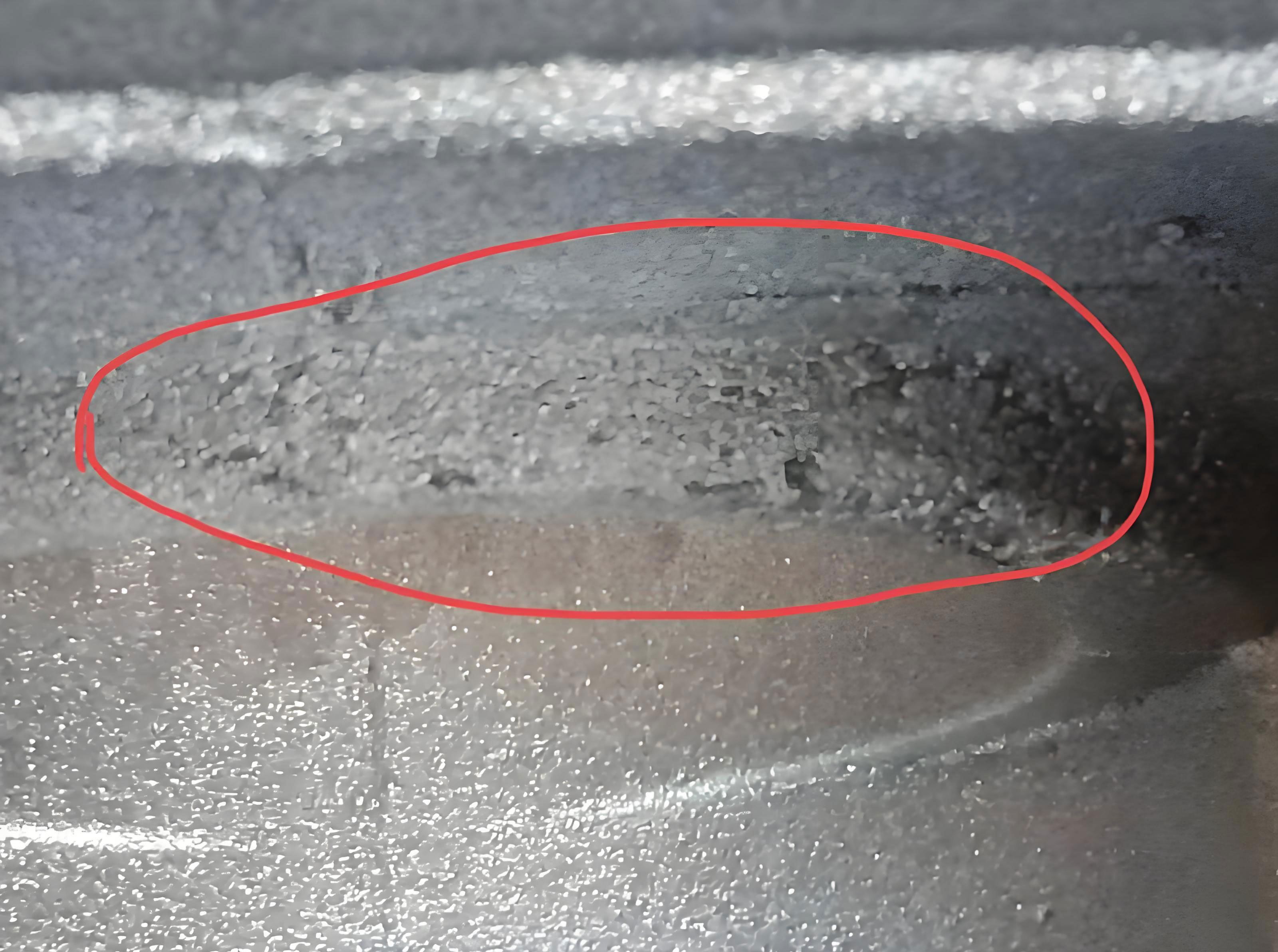
To effectively combat porosity in casting, one must first understand its various classifications and formation mechanisms. Based on the source and formation process, porosity in casting in gray iron can be categorized into four primary types: precipitative, invasive, entrapped, and reactive. Each type has distinct features and root causes.
| Type of Porosity | Formation Mechanism | Typical Morphology & Location | Primary Contributing Factors |
|---|---|---|---|
| Precipitative (or Dissolved Gas) Porosity | Gases dissolved in the molten metal (e.g., hydrogen) precipitate out during solidification as solubility drops. | Fine, spherical or elliptical pores distributed uniformly or in localized zones throughout the casting cross-section. Hydrogen pores have smooth walls. | High gas content in charge materials (damp, rusty, oily); high humidity; improper melting practice. |
| Invasive Porosity | Gases generated from molds, cores, coatings, or chills invade the metal surface before solidification. | Larger, pear-shaped or elliptical pores near the casting surface with smooth, often oxidized walls. A key contributor to subsurface porosity in casting. | Insufficient drying of molds/cores; high gas evolution from binders, coatings; low permeability of molding sand. |
| Entrapped Porosity | Air or mold gases are mechanically entrapped due to turbulent metal flow during mold filling. | Isolated, large spherical or elongated pores, often located in the upper sections of the casting. | Unoptimal gating system design; excessively high pouring velocity; interrupted pour causing vortexing. |
| Reactive Porosity | Chemical reactions at the metal-mold interface or within the metal itself generate gases (e.g., hydrogen from moisture reduction). | Often appears as pinholes or small, elongated pores just beneath the casting surface, sometimes in a honeycomb pattern. A common source of problematic porosity in casting. | Moisture in mold/core; presence of certain elements (Al, Ti) that catalyze water vapor reduction; high nitrogen from binders. |
The defects observed in our guide rails exhibited characteristics of both invasive and reactive porosity in casting. They were subsurface, concentrated, and had smooth walls, pointing towards gas generation at the mold-metal interface. Our initial production process involved using furan no-bake sand with acid catalyst. The gating was a bottom-gated, pressurized system with four ceramic tubes (ø40mm) introducing metal from one end of the guide rail. This setup, while common, presented a potential risk for thermal gradients and prolonged metal front exposure to the sand interface.
The fundamental condition for gas invasion into the molten metal can be described by a pressure balance equation. For a gas bubble to form at the mold-wall interface and penetrate the liquid metal, the following inequality must hold:
$$ p_A > p_0 + p_m + p_z $$
Where:
- $p_A$ is the gas pressure at the mold-wall interface,
- $p_0$ is the atmospheric pressure within the mold cavity,
- $p_m$ is the metallostatic pressure from the liquid metal column,
- $p_z$ is the resistance pressure due to the metal’s surface tension and viscosity.
A high $p_A$, driven by rapid gas evolution from the mold materials, coupled with a low $p_m$ (in thin sections) and factors reducing $p_z$, promotes the formation of invasive porosity in casting.
Upon pouring, the furan resin sand decomposes, generating a complex mixture of gases. Typical volumetric composition of the mold atmosphere post-pouring includes:
| H₂ | CO | CO₂ | Hydrocarbons | O₂ | N₂ |
|---|---|---|---|---|---|
| 50-55 | 30-35 | ~1.7 | ~5.3 | ~6.9 | ~3.4 |
This sudden gas generation creates a high-pressure zone at the interface. Furthermore, a moisture condensation zone forms in the sand adjacent to the hot metal, triggering reduction reactions:
$$ \text{Fe} + \text{H}_2\text{O} \rightarrow \text{FeO} + 2\text{H} \uparrow $$
$$ 2\text{Al} + 3\text{H}_2\text{O} \rightarrow \text{Al}_2\text{O}_3 + 6\text{H} \uparrow $$
$$ 2\text{NH}_3 \rightarrow \text{N}_2 + 3\text{H}_2 \uparrow $$
The aluminum often originates from inoculants. The atomic hydrogen ($\text{H} \uparrow$) generated can diffuse into the metal. During solidification, the solubility of hydrogen in iron drops sharply according to Sieverts’ law:
$$ S_{\text{H}} = k_{\text{H}} \sqrt{P_{\text{H}_2}} $$
where $S_{\text{H}}$ is the solubility of hydrogen, $k_{\text{H}}$ is the equilibrium constant, and $P_{\text{H}_2}$ is the partial pressure of hydrogen. The precipitated hydrogen bubbles, nucleating on existing substrates like non-metallic inclusions or the mold wall, lead to reactive subsurface porosity in casting. Elements like Al, Ti, and S are surface-active and can lower the metal’s surface tension, reducing $p_z$ and making bubble formation and growth easier, thereby increasing susceptibility to this type of defect.
Our investigation systematically ruled in or out various potential causes. First, we analyzed the gating design. A long flow path from one end could result in excessive temperature loss of the metal front before it reaches the far end. Cooler metal has higher viscosity, which increases $p_z$ and hinders bubble escape, but it also solidifies faster, trapping gases more easily. This thermal condition can exacerbate porosity in casting at the distant, cooler sections. Second, we reviewed melting and pouring parameters. A statistical comparison between sound castings and defective ones showed no significant deviation in key parameters, as summarized below:
| Cast Status | Pouring Temp. (°C) | Pouring Time (s) | C (%) | Si (%) | Mn (%) | P (%) | S (%) | Ti (%) | N (ppm) | Al (%) |
|---|---|---|---|---|---|---|---|---|---|---|
| Sound Casting | 1390 | 77 | 3.09 | 1.83 | 0.86 | 0.03 | 0.089 | 0.0189 | 73 | 0.0064 |
| Defective Casting | 1385 | 77 | 3.05 | 1.89 | 0.87 | 0.03 | 0.093 | 0.0202 | 72 | 0.0063 |
This data indicated that the base metal quality and pouring operation were not the primary root causes of the porosity in casting in this instance.
The focus then shifted to the mold interface materials, specifically the coating applied to the sand mold. We suspected that moisture content and hygroscopicity of the alcohol-based coatings could be significant contributors to gas generation. An experiment was designed to evaluate three different coatings (labeled A, B, C). Standard sand test blocks were weighed, coated, ignited, and weighed again to find the coating weight applied. They were then oven-dried at 105°C, cooled in a desiccator, and weighed to determine water loss. Finally, they were exposed to ambient conditions for 15 hours to measure moisture re-absorption. The results were critical for understanding a potential source for porosity in casting.
| Coating ID | Sample ID | Coating Weight Gain (g) | Coating Weight Gain (%) | Water Loss After Drying (g) | Water Loss (%) | Weight Gain After 15h (g) | Moisture Re-absorption (%) |
|---|---|---|---|---|---|---|---|
| A | 1 | 6.9 | 9.02 | 0.07 | 0.01 | 0.11 | 1.60 |
| 2 | 6.0 | 7.89 | 0.07 | 0.01 | 0.11 | 1.89 | |
| 3 | 10.2 | 12.81 | 0.04 | 0.00 | 0.11 | 1.11 | |
| B | 4 | 6.6 | 8.37 | 0.08 | 0.01 | 0.12 | 1.79 |
| 5 | 7.4 | 9.44 | 0.04 | 0.01 | 0.11 | 1.54 | |
| 6 | 10.2 | 12.80 | 0.04 | 0.00 | 0.11 | 1.11 | |
| C | 7 | 6.8 | 9.20 | 0.07 | 0.01 | 0.10 | 1.48 |
| 8 | 6.4 | 8.60 | 0.06 | 0.01 | 0.10 | 1.63 | |
| 9 | 11.6 | 14.37 | 0.04 | 0.00 | 0.11 | 0.95 |
The analysis of this data revealed that Coating A had the highest inherent water content and the highest tendency to re-absorb moisture from the atmosphere, followed by Coating C and then Coating B. This hygroscopic nature meant that even after ignition, the coating could reintroduce moisture into the mold wall environment, providing a continuous source for hydrogen-generating reactions and directly promoting the conditions for reactive porosity in casting.
Based on the multi-faceted root cause analysis, we implemented a comprehensive set of corrective actions targeting the specific mechanisms of porosity in casting we identified. The measures were designed to lower interfacial gas pressure ($p_A$), improve gas venting, and minimize factors that reduce metal surface tension or promote reactions.
| Target Area | Specific Improvement Action | Intended Effect on Porosity Mechanism |
|---|---|---|
| Mold Coatings | Switch to a coating with lower inherent moisture content and lower hygroscopicity (e.g., Coating B from our test). | Reduces direct source of water vapor for hydrogen-generating reactions, lowering $p_A$. |
| Charge Materials | Strictly prohibit the use of rusted, damp, or oily scrap and alloys in the furnace charge. | Minimizes hydrogen and nitrogen sources in the melt, reducing precipitative porosity in casting potential. |
| Gating & Feeding Design | 1. Increase the total cross-sectional area of the ingates to reduce flow velocity. 2. Introduce strategic overflow wells at the suspected defect locations (far end of rail). 3. Use ceramic tubes to deliver hotter metal directly to critical areas. |
1. Reduces turbulence, minimizing entrapped air. 2. Captures cooler, oxide-laden first metal that may have higher gas content. 3. Maintains higher local $p_m$ and temperature, hindering gas invasion and bubble entrapment. |
| Mold/Core Drying | Ensure thorough and uniform baking of all molds and cores. Re-bake any areas where coating is touched up after initial drying. | Drives off residual moisture and volatile compounds, drastically reducing initial $p_A$ upon pouring. |
| Mold Venting | Increase the number and size of vent channels (core prints, vents) within the mold and core. Ensure total vent area exceeds 1.5 times the choke area of the gating system. | Provides easy escape paths for generated gases, preventing pressure build-up ($p_A$). |
| Pouring Practice | Maintain a steady, non-turbulent pour. Keep the pouring basin full to prevent vortex formation and air aspiration. | Prevents mechanical entrapment of air, a cause of macro-scale porosity in casting. |
The effectiveness of these combined measures was significant. After implementation, we produced a batch of twenty consecutive castings. All twenty were free from the previously observed clustered porosity in the guide rail sections. This success confirmed that the porosity in casting was indeed a result of synergistic factors: a gating design that led to a cool metal front at the rail’s end, combined with a mold coating that introduced and retained sufficient moisture to fuel hydrogen-generating reactions at the interface. The cooler, more viscous metal at that location then trapped these gases just beneath the surface.
In conclusion, tackling porosity in casting requires a methodical approach that blends understanding of fundamental physical and chemical principles with rigorous process control. The case of the guide rail porosity underscores that it is often a combination of factors—design, material properties, and process execution—that leads to the defect. Key takeaways include the critical importance of controlling interfacial gas generation, which is a paramount factor in both invasive and reactive porosity in casting. This involves selecting low-moisture, low-hygroscopicity coatings and ensuring perfect mold dryness. Furthermore, thermal management through gating design is crucial; strategies like using hotter metal injections and overflow wells can effectively manage the temperature and quality of the metal front. Finally, robust venting and consistent pouring practices form the essential backbone of a process resistant to gas-related defects. By systematically applying pressure balance principles, solubility laws, and empirical testing—as summarized in the tables and formulas herein—foundries can effectively diagnose, address, and prevent the various forms of porosity in casting, leading to more reliable and high-integrity cast components.