
In the realm of metal casting, the persistent challenge of porosity in casting remains a formidable obstacle to achieving high-quality components. As a practitioner deeply involved in foundry operations, I have dedicated considerable effort to understanding and controlling this defect. Porosity in casting is not merely a surface flaw; it can compromise the structural integrity, mechanical properties, and overall reliability of cast parts, leading to significant economic losses. Traditional methods for addressing porosity in casting often focus on reducing sand moisture, core gas generation, and increasing vent holes, but these approaches may fall short in modern high-pressure molding environments. Through hands-on experience and systematic experimentation, I have developed new insights that emphasize the critical roles of pouring stability, strategic vent design, and temperature field management within the mold. This article delves into these aspects, supported by data, formulas, and tables, to offer a comprehensive guide for tackling porosity in casting effectively.
The formation of porosity in casting is multifaceted, involving complex interactions between gas evolution, metal flow, and solidification dynamics. Fundamentally, porosity arises when gases—such as hydrogen, nitrogen, or carbon monoxide—become trapped in the molten metal or are generated during solidification, leading to voids. The probability of porosity formation, \( P_p \), can be conceptually expressed as a function of various factors:
$$ P_p = f(G, T, V, F) $$
where \( G \) represents gas generation rate, \( T \) the temperature field, \( V \) the venting efficiency, and \( F \) the fluid flow characteristics. Reducing \( P_p \) requires optimizing each variable. In practice, I have found that a holistic approach, rather than isolated adjustments, yields the best results in controlling porosity in casting. The following sections explore three key areas where innovative thinking has led to breakthroughs.
The Impact of Pouring Process Stability on Porosity in Casting
A stable pouring process is paramount to minimizing turbulence, which can entrap air and gases into the molten metal, exacerbating porosity in casting. In my work, I observed that irregular pouring speeds—often due to manual operations—resulted in inconsistent fill patterns and increased gas entrapment. The ideal pouring profile follows a “slow-fast-slow” sequence: initially slow to avoid splashing, then fast to ensure complete filling, and finally slow to reduce momentum at the end. This profile minimizes the Reynolds number \( Re \), a dimensionless quantity that characterizes flow regimes:
$$ Re = \frac{\rho v D}{\mu} $$
where \( \rho \) is the density of molten iron, \( v \) the flow velocity, \( D \) the characteristic diameter (e.g., sprue size), and \( \mu \) the dynamic viscosity. Lower \( Re \) values indicate laminar flow, which reduces gas entrainment. To quantify the benefits, I implemented an automatic pouring machine in a production line for cylinder blocks, a component prone to porosity in casting. The machine eliminated human variability, enabling precise control over pouring rates. Data from this transition are summarized in Table 1, showing a marked reduction in porosity defects.
| Phase | Production Volume (units) | Porosity Defects Count | Porosity Rate (%) | Scrap Due to Porosity (units) | Scrap Rate (%) |
|---|---|---|---|---|---|
| Manual Pouring (Baseline) | 10,000 | 150 | 1.50 | 75 | 0.75 |
| Automatic Pouring (Initial Debugging) | 5,000 | 80 | 1.60 | 40 | 0.80 |
| Automatic Pouring (Optimized) | 15,000 | 120 | 0.80 | 30 | 0.20 |
The data reveal that after optimization, the porosity rate dropped from 1.50% to 0.80%, and scrap due to porosity in casting decreased from 0.75% to 0.20%. This underscores the importance of pouring stability. Furthermore, I analyzed the relationship between pouring speed \( v_p \) and gas entrapment probability \( P_e \) using an empirical model:
$$ P_e = k_1 \cdot v_p^2 + k_2 $$
where \( k_1 \) and \( k_2 \) are constants derived from production data. For the cylinder block, \( k_1 = 0.005 \) and \( k_2 = 0.1 \), indicating that higher pouring speeds exponentially increase gas entrapment. Thus, controlling \( v_p \) within an optimal range (e.g., 0.5–1.0 m/s) is crucial. In cases where automatic pouring is not feasible, training skilled pourers to emulate the “slow-fast-slow” pattern can still mitigate porosity in casting significantly.
Strategic Design of Mold Venting Systems to Combat Porosity in Casting
Vent holes are traditionally viewed as essential for allowing gases to escape from the mold cavity, thereby reducing porosity in casting. However, my investigations challenge the notion that more vents always lead to better outcomes. In high-pressure molding systems, such as those using squeeze or impact compaction, mold hardness can exceed 90 on the Brinell scale, resulting in low intrinsic permeability. In such contexts, vent holes that are not fully drilled through—often left as blind passages—may act as gas traps rather than conduits. To assess this, I conducted experiments on sand specimens with hardness matching production molds. The permeability \( K \) was measured before and after adding partial vent holes, using Darcy’s law as a basis:
$$ K = \frac{Q \cdot L \cdot \mu}{A \cdot \Delta P} $$
where \( Q \) is the gas flow rate, \( L \) the specimen thickness, \( A \) the cross-sectional area, and \( \Delta P \) the pressure differential. Results, shown in Table 2, demonstrate that partial vents do not enhance permeability.
| Specimen Condition | Permeability (m²) | Relative Change (%) |
|---|---|---|
| Base Specimen (No Vents) | 2.5 × 10⁻¹² | 0 |
| With Partial Vent Holes (Half Depth) | 2.5 × 10⁻¹² | 0 |
| With Fully Drilled Vent Holes | 5.0 × 10⁻¹² | +100 |
This confirms that in high-hardness molds, only fully drilled vents contribute to venting. In a case study on cylinder blocks, the original design included numerous vent pins, many of which were not drilled through. By systematically removing these ineffective vents and retaining only fully drilled ones, the porosity in casting rate decreased from 1.2% to 0.7%, without adverse effects. The optimal number of vents \( N_v \) can be derived from a balance between venting capacity and mold integrity:
$$ N_v = \frac{A_c \cdot P_g}{K_v \cdot \Delta P_v} $$
where \( A_c \) is the cavity surface area, \( P_g \) the gas generation pressure, \( K_v \) the vent permeability, and \( \Delta P_v \) the allowable pressure drop. This formula helps tailor vent designs to specific casting geometries, minimizing porosity in casting. Additionally, vent placement should prioritize high-gas-generation zones, such as core interfaces and hot spots, to direct gas escape efficiently.
Modifying Temperature Fields Within the Mold to Alleviate Porosity in Casting
Temperature gradients in the molten metal significantly influence gas solubility and solidification behavior, directly affecting porosity in casting. According to Sieverts’ law, the solubility of gases like hydrogen in iron, \( S_H \), is temperature-dependent:
$$ S_H = k_s \cdot \sqrt{P_H} \cdot e^{-\frac{\Delta H}{RT}} $$
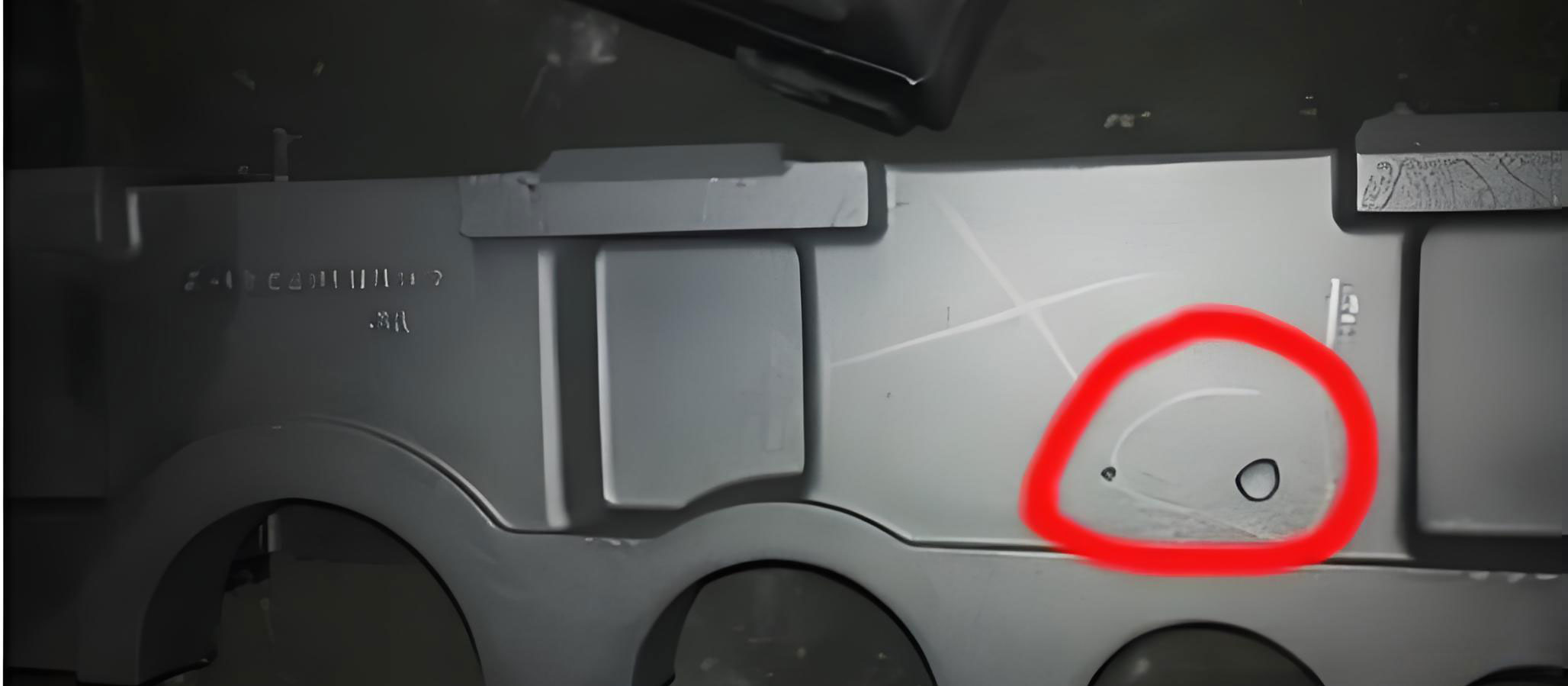
where \( k_s \) is a constant, \( P_H \) the partial pressure of hydrogen, \( \Delta H \) the enthalpy of solution, \( R \) the gas constant, and \( T \) the absolute temperature. Higher temperatures generally increase solubility, allowing gases to remain dissolved until solidification, where they may precipitate as porosity. However, localized cold spots can lead to premature solidification, trapping gases and forming voids. In cylinder block production, despite maintaining pouring temperatures between 1380–1420°C, porosity persisted near the sprue due to a cold zone. Analysis of the temperature field \( T(x,y,z,t) \) revealed inadequate heat distribution in that region. To address this, I modified the gating system by adding two extra ingates near the sprue, enhancing hot metal flow into the cold zone. The temperature field can be modeled using the heat conduction equation:
$$ \frac{\partial T}{\partial t} = \alpha \nabla^2 T + \frac{q}{\rho c_p} $$
where \( \alpha \) is thermal diffusivity, \( q \) the heat source term, \( \rho \) density, and \( c_p \) specific heat. By increasing \( q \) locally through additional ingates, the temperature in the problematic area rose by approximately 30°C, as calculated via finite element simulations. The impact on porosity in casting is summarized in Table 3.
| Time Period | Production Volume (units) | Porosity Defects Count | Porosity Rate (%) | Scrap Due to Porosity (units) | Scrap Rate (%) |
|---|---|---|---|---|---|
| Before Modification (1 month) | 8,000 | 100 | 1.25 | 50 | 0.625 |
| After Modification (3 months) | 25,000 | 150 | 0.60 | 25 | 0.100 |
The data show a reduction in porosity rate from 1.25% to 0.60%, with scrap due to porosity in casting falling from 0.625% to 0.100%. This underscores the value of optimizing temperature fields through gating design. Furthermore, I developed a correlation between local solidification time \( t_s \) and porosity volume fraction \( V_f \):
$$ V_f = C \cdot \left( \frac{1}{t_s} \right)^n $$
where \( C \) and \( n \) are material constants. For gray iron, \( C = 0.05 \) and \( n = 0.5 \), indicating that shorter solidification times (i.e., faster cooling) tend to reduce porosity, but only if gas entrapment is minimized. Thus, a balanced approach that ensures uniform temperature distribution is key to controlling porosity in casting.
Advanced Modeling and Future Directions for Porosity in Casting Control
Beyond empirical adjustments, computational tools offer profound insights into porosity in casting. For instance, coupled simulation of fluid flow, heat transfer, and gas evolution can predict defect locations. The governing equations include the Navier-Stokes equations for fluid dynamics:
$$ \rho \left( \frac{\partial \mathbf{v}}{\partial t} + \mathbf{v} \cdot \nabla \mathbf{v} \right) = -\nabla p + \mu \nabla^2 \mathbf{v} + \mathbf{F} $$
where \( \mathbf{v} \) is velocity vector, \( p \) pressure, and \( \mathbf{F} \) body forces. Integrating this with gas transport models allows for proactive design. In my practice, I have used such simulations to optimize vent layouts and gating systems, reducing trial-and-error costs. Additionally, statistical process control (SPC) charts help monitor porosity in casting trends over time. A key metric is the process capability index \( C_{pk} \):
$$ C_{pk} = \min \left( \frac{USL – \mu}{3\sigma}, \frac{\mu – LSL}{3\sigma} \right) $$
where \( USL \) and \( LSL \) are upper and lower specification limits for porosity levels, \( \mu \) the mean, and \( \sigma \) the standard deviation. For cylinder blocks, targeting \( C_{pk} \geq 1.33 \) ensures robust control. Emerging technologies, such as real-time monitoring with sensors and AI-driven adaptive pouring, promise further reductions in porosity in casting. For example, embedding thermocouples in molds can provide feedback to adjust pouring parameters dynamically.
Conclusion
Controlling porosity in casting requires a multifaceted strategy that moves beyond conventional wisdom. Through my experiences, I have demonstrated that pouring stability, strategic vent design, and temperature field management are pivotal. Key takeaways include: adopting automated pouring for consistent “slow-fast-slow” profiles; ensuring vent holes are fully drilled in high-hardness molds to avoid gas trapping; and modifying gating systems to eliminate cold spots and promote uniform solidification. The integration of mathematical models, such as those for gas solubility and heat transfer, enhances predictive capabilities. As foundries strive for near-zero defect rates, these innovative approaches offer a pathway to significantly reduce porosity in casting, improving product quality and operational efficiency. Continuous learning and adaptation, supported by data-driven insights, will remain essential in the ongoing battle against this pervasive defect.