
As a practitioner in the foundry industry, I have frequently encountered the persistent and costly challenge of porosity in casting. These defects, manifesting as voids or holes within the solidified metal, compromise the structural integrity, pressure tightness, and machinability of components, leading to high scrap rates and significant financial loss. Traditional problem-solving often relies on trial-and-error or experience-based adjustments, which can be time-consuming and ineffective for novel or complex issues. In this detailed account, I will describe how the systematic application of TRIZ (Theory of Inventive Problem Solving) provided a structured and highly effective pathway to diagnose and eliminate a specific instance of porosity in casting. This narrative will elucidate the TRIZ process, demonstrate key tools, and incorporate analytical models to fully explain the journey from problem to ideal solution.
1. Problem Definition and Systemic Analysis
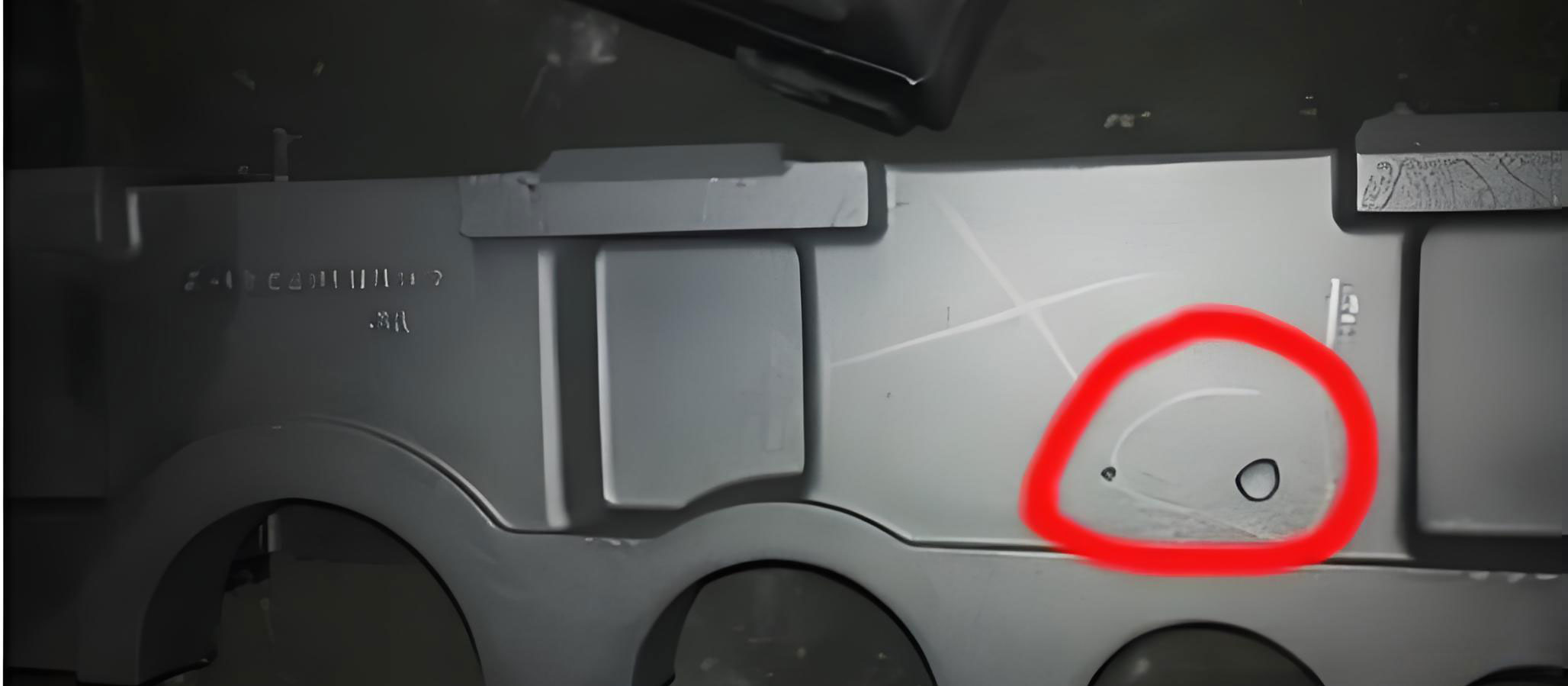
The component in question was a critical aluminum alloy casting produced via a low-pressure casting process. The geometry featured an L-shaped upright plate section, which represented a significant thermal mass or “hot spot.” During the machining phase of this L-section, a high frequency of subsurface porosity in casting was revealed, as shown in the representative image. This defect level was unacceptable for the component’s stringent quality class, which required a high integrity level on radiographic inspection.
Initial causal analysis pointed towards gas entrapment during solidification. The L-section was formed against a sand core, and an L-shaped chill (metal insert) was embedded in the mold atop this section to promote directional solidification and reduce shrinkage porosity. However, this very solution appeared to be contributing to the problem of gas porosity in casting. The core, while made from permeable resin-bonded sand, was essentially a blind cavity. The chill plate sat directly on top of this cavity, creating a sealed volume where gases from the decomposition of the sand binder or from the chill itself (e.g., moisture, contaminants) could become trapped by the advancing solidification front.
To move beyond symptomatic fixes, we employed the TRIZ “9 Windows” (or System Operator) tool to broaden our perspective on the porosity in casting problem. This tool forces analysis across three dimensions: time (past, present, future) and system hierarchy (sub-system, system, super-system).
| Time / System Level | Sub-System (Chill, Core, Local Metal) | System (The Casting & Mold) | Super-System (Foundry Line, Product Assembly) |
|---|---|---|---|
| Past | Chill fabrication. Core shooting and curing. Mold assembly. | Pattern and gating design. Alloy melting and treatment. | Component design specification. Procurement of raw materials. |
| Present | Metal fills blind cavity. Chill extracts heat. Gases evolve from core and chill surfaces, trapped beneath the chill. | Low-pressure filling. Solidification sequence initiates. Overall mold atmosphere. | Casting production cycle. Energy consumption. Process parameter monitoring. |
| Future | Solidification completes, trapping gas as porosity in casting. Chill is removed during shakeout. | Casting is cooled, cleaned, and inspected. Defect is found during machining. | Scrap part is recycled. Delivery delays occur. Root cause analysis is triggered. |
This analysis clarified that the critical conflict occurred in the “Present” at the “Sub-System” level: the chill was necessary for heat extraction (a useful function) but simultaneously acted as a barrier preventing gas escape (a harmful function), directly causing the porosity in casting. We had defined a classic TRIZ technical contradiction.
2. Applying TRIZ Tools to Model and Resolve the Contradiction
2.1 Modeling with the “Little Men” Method
The “Little Men” method is a powerful tool for breaking psychological inertia. We model the problematic situation using groups of “little men” representing different elements, allowing us to visualize interactions in a non-standard way. For the area under the chill where porosity in casting forms:
- Chill Men: Solid, rigid, and cold. They want to stay in close contact to draw heat away.
- Gas Men: Energetic, small, and desperate to move upward and escape.
- Sand Core Men: Porous and stationary, allowing some gas passage but not enough.
- Liquid Metal Men: Flowing, then becoming rigid and trapping everyone.
The initial model showed Gas Men being generated at the interface, trying to float up, but being blocked by the solid wall of Chill Men. The first “smart” model solution was to make the Sand Core Men more active or porous to absorb or transport the Gas Men away. This led to conventional ideas like using coarser sand or lower core density.
The second, more inventive “smart” model reconceived the Chill Men themselves. Could some Chill Men become “gatekeepers” or have passages? Perhaps the group of Chill Men could reorganize to form a structure that still extracts heat but has channels for the Gas Men to pass through. This mental image was pivotal—it directly suggested modifying the chill to incorporate permeable features. This abstraction moved us away from seeing the chill as a monolithic, immutable object.
2.2 Defining and Solving the Physical Contradiction
The core of the problem was a Physical Contradiction: The chill in that specific area needed to be SOLID to conduct heat effectively, and it needed to be NOT SOLID (permeable) to allow gas to escape. TRIZ provides separation principles to resolve such contradictions.
| Separation Principle | Conceptual Application | Inventive Ideas Generated | Evaluation |
|---|---|---|---|
| Separation in Space | The chill’s surface in contact with the molten metal must have contradictory properties in different locations. | Create localized holes or channels in the chill surface facing the sand core. The bulk remains solid for heat transfer, but specific spots allow venting. | Highly promising. Simple to implement. |
| Separation in Time | The chill must have different properties at different times during the process. | Use a chill material that is solid during heat extraction but sublimates or becomes porous later to release gas. Or, use a temporary chill that retracts. | Complex, risky for process stability, potential contamination. |
| Separation upon Condition | The property (solidity) changes based on conditions (pressure, temperature). | Use a chill coated with a material that burns away to create vents when contacted by hot metal. Or, design the core with integral vents that bypass the chill entirely. | Unreliable coating performance. Bypass vents may not reach the critical trapped volume. |
The principle of Separation in Space was clearly the most direct and controllable. It aligned perfectly with the “Little Men” model of a chill with passages.
2.3 Quantifying Solutions with the Ideal Final Result (IFR) and Ideality
TRIZ encourages striving for the Ideal Final Result (IFR): The system itself, without complicating the system or causing harmful effects, eliminates the porosity in casting. The “ideal” chill would perfectly extract heat and also perfectly vent gas without any added cost or complexity. While not fully achievable, it sets a direction.
We evaluated the shortlisted concepts using the Ideality equation, a heuristic for comparing solutions:
$$ Ideality (I) = \frac{\Sigma U_F}{\Sigma C + \Sigma H_F} $$
Where:
$\Sigma U_F$ = Sum of Useful Functions (e.g., heat extraction, gas venting)
$\Sigma C$ = Sum of Costs (implementation, machining, maintenance)
$\Sigma H_F$ = Sum of Harmful Functions (risk of new defects, complexity)
| Solution Concept | Useful Functions (UF) Weight (1-100) | Cost (C) Weight (1-100) | Harmful Functions (HF) Weight (1-100) | Calculated Ideality (I) |
|---|---|---|---|---|
| 1. Coarser Core Sand | 40 (Improves gas permeability) | 20 (New sand logistics) | 70 (Risk of core erosion/metal penetration, lower surface finish) | 40/(20+70) = 0.44 |
| 2. Drill Vent Holes in Core | 50 (Direct gas path) | 50 (Precise drilling, core weakness) | 60 (Holes may fill with metal, creating fins) | 50/(50+60) = 0.45 |
| 3. Chill Surface with Drilled Holes (Separation in Space) | 85 (Excellent heat extraction + dedicated vent path) | 30 (One-time machining of chill) | 20 (Potential for slight local slow-down of solidification) | 85/(30+20) = 1.70 |
| 4. New Complex Chill Design | 90 (Theoretically optimal) | 200 (High design & fabrication cost) | 50 (Unproven, difficult to maintain) | 90/(200+50) = 0.36 |
The analysis quantitatively confirmed our qualitative insight: modifying the existing chill by adding holes (Solution 3) offered the highest ideality. It delivered significant useful functions (resolving the porosity in casting issue while maintaining cooling) at a relatively low cost and with minimal new harmful effects.
3. Implementation, Optimization, and Results
The chosen solution was to machine vent holes through the thickness of the L-shaped chill plate. The initial hypothesis was that these holes would provide a direct escape route for gases evolving from the core and the chill interface up into the overflow or the upper mold atmosphere, thus preventing the formation of porosity in casting.
First Trial: We machined three Ø20 mm holes in the chill. Subsequent castings showed improvement, but intermittent porosity in casting was still observed. Analysis suggested that the holes were either insufficient in total venting area or were being sealed too early by solidifying metal, or that gas generation was more prolific in certain regions of the interface.
Root Cause Analysis & Optimization: We reconsidered the dynamics. Gas generation is not uniform; it is often most intense at the hottest, longest-liquid areas. Furthermore, the venting effectiveness $V_{eff}$ can be crudely modeled as being proportional to the total vent area $A_v$ and inversely proportional to the solidification time $t_s$ of the metal plugging the vent:
$$ V_{eff} \propto \frac{A_v}{t_s} $$
To increase $V_{eff}$, we needed to increase $A_v$ and ensure the vents remained open longer ($t_s$ maximized). We also needed to place vents where gas accumulation was highest.
Final Solution: We increased the hole diameter to Ø30 mm to increase $A_v$. More critically, we repositioned the holes to be located closer to the internal corner of the L-section—the very last area to solidify and the most likely zone for gas accumulation. This positioning aimed to maximize $t_s$, the time before the vent sealed. The modified chill is represented schematically by the following parameters:
| Parameter | Initial Design | Optimized Design | Rationale |
|---|---|---|---|
| Hole Diameter | 20 mm | 30 mm | Increase vent area $A_v$ by 125%. |
| Number of Holes | 3 | 3 | Maintain structural integrity of chill. |
| Distance from Inner Wall | ~15 mm | 5 mm | Position at the thermal “hot spot” to delay vent freeze-off (increase $t_s$). |
| Vent Area Ratio | $A_{v1} = 3 \times \pi (10^2) \approx 942 mm^2$ | $A_{v2} = 3 \times \pi (15^2) \approx 2120 mm^2$ | Significantly improved gas flux capacity. |
This optimized design was implemented across all production molds. The result was the complete elimination of the recurring porosity in casting defect in the L-section. Radiographic inspection levels consistently met the stringent requirement, and machining scrap due to this issue fell to zero.
4. Conclusion and Theoretical Insights
The successful resolution of this porosity in casting problem underscores the profound utility of TRIZ as a structured innovation methodology for manufacturing. It facilitated a shift from a narrow focus on material properties or process parameters to a systems-level analysis of functional conflicts.
The journey followed a clear TRIZ trajectory: from identifying a technical contradiction (cooling vs. venting) to modeling it with Little Men, then reformulating it into a physical contradiction (solid vs. permeable chill), and finally applying Separation Principles to find a high-ideality solution. The Ideality analysis provided a rational framework for selecting the best concept among several alternatives.
This case demonstrates that many instances of porosity in casting are not merely random process fluctuations but are often the result of inherent design conflicts within the mold-casting system. TRIZ provides the tools to expose and resolve these conflicts inventively. The solution—perforating the chill—was simple, low-cost, and highly effective because it used an existing system resource (the chill) in a new way to provide the missing function (venting), closely approximating the Ideal Final Result. The methodology has since been applied to other defect patterns, proving its generalizability and cementing its value as a core problem-solving discipline in the modern foundry.