
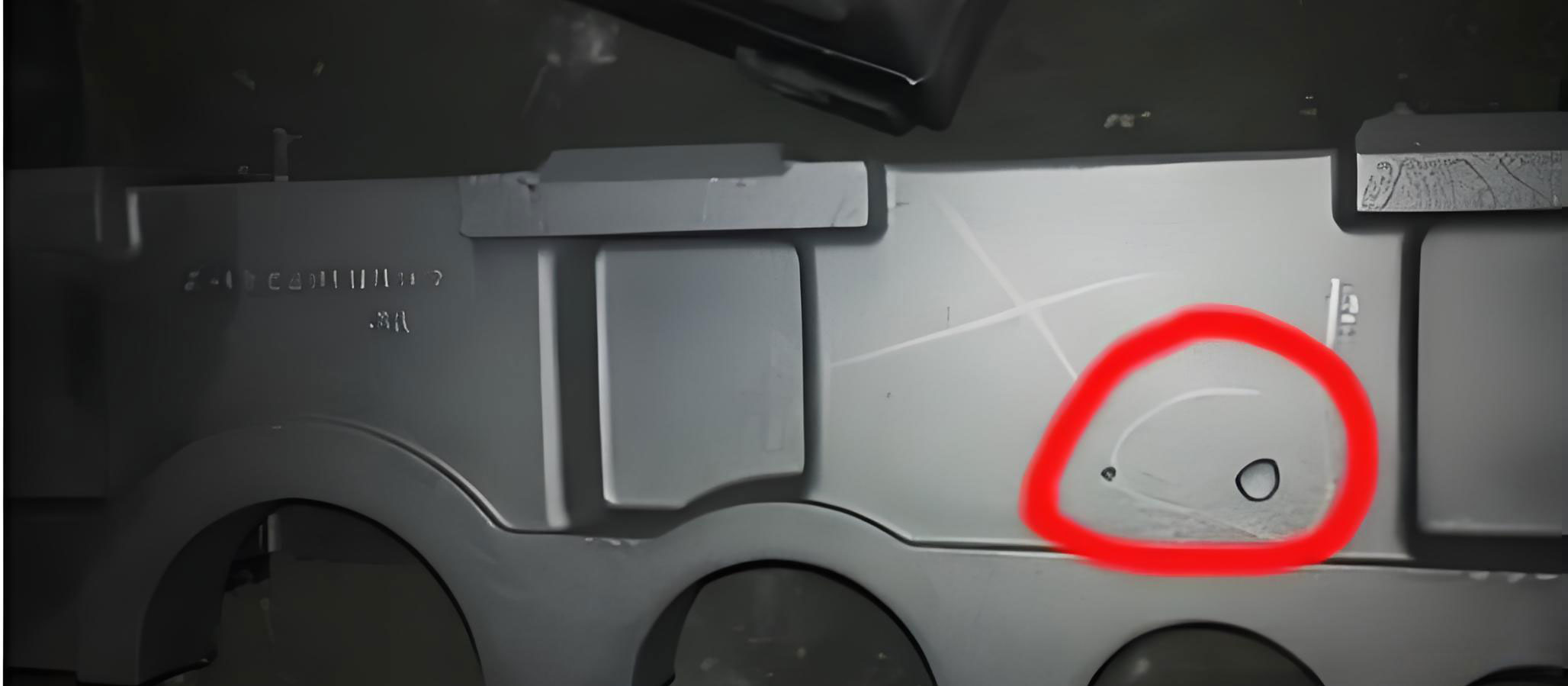
In my experience within a large-scale foundry specializing in machine tool components, the demand for high-quality castings, particularly for critical parts like machine beds, has escalated significantly. Among these, the production of oblique guide bed castings, such as the CKS series, presents a unique and persistent challenge: the formation of gas porosity defects, especially in the crucial guide rail sections. The **porosity in casting** not only compromises the structural integrity but also leads to substantial financial losses due to the high cost and low batch volume characteristic of these large, heavy castings. Ensuring a high first-pass yield by eliminating such defects is paramount. This article details a first-hand analysis of the root causes of **porosity in casting** in these components and the systematic engineering measures implemented to resolve the issue.
The foundational problem stems from the manufacturing process itself. The molds and cores for these bed castings are produced using furan resin-bonded sand. While offering excellent dimensional stability and surface finish, this sand system has a high gas evolution potential during metal pouring. If the generated gases are not vented efficiently from the mold cavity and the cores, they can intrude into the solidifying metal, leading to the formation of undesirable cavities known as porosity. The guide rails, being the most functionally critical surfaces, must be entirely free from such **porosity in casting**. Any defect here essentially renders the entire casting scrap, underscoring the severity of the problem.
Classification and Mechanisms of Porosity Formation
Understanding the specific types of **porosity in casting** is essential for diagnosing the problem. The defects encountered in the guide rails were primarily of two types, each with a distinct formation mechanism.
| Type of Porosity | Formation Mechanism | Key Characteristics in Our Case |
|---|---|---|
| Entrapped Gas / Invasive Porosity | Gas generated from molds/cores (e.g., from resin decomposition) enters the metal stream or accumulated metal pool before solidification. | Linked to inadequate core venting and insufficient mold cavity venting. |
| Precipitation (or Dissolved Gas) Porosity | Gases (e.g., H2, N2) dissolved in the molten metal precipitate out as solubility drops during cooling and solidification. | Linked to local “cold spots” in the metal, often aggravated by poor flow patterns. |
The solubility of gases like hydrogen in molten iron is temperature-dependent. The relationship can be approximated by Sieverts’ law:
$$ C = k \sqrt{P} $$
where \( C \) is the dissolved gas concentration, \( P \) is the partial pressure of the gas above the melt, and \( k \) is an equilibrium constant that is highly temperature-sensitive:
$$ k \propto e^{(-\Delta H / RT)} $$
Here, \( \Delta H \) is the heat of solution, \( R \) is the gas constant, and \( T \) is the absolute temperature. A localized drop in metal temperature (\( T \)) drastically reduces gas solubility (\( C \)), forcing the excess gas to nucleate and form bubbles, leading to **porosity in casting**.
Analysis of Root Causes in the Initial Process
The original casting process for the oblique guide bed was meticulously designed but contained several latent vulnerabilities that promoted **porosity in casting**. A detailed Failure Mode and Effects Analysis (FMEA) of the process revealed the following critical issues:
| Process Stage | Identified Vulnerability | Consequence Leading to Porosity |
|---|---|---|
| Gating & Metal Flow | Long flow path with a physical barrier (a core) between the bed head and the guide rail end. | Metal flow受阻, creating a cold spot at the guide rail end. This localized temperature drop triggered precipitation **porosity in casting**. |
| Core Assembly & Venting | Cores were fixed with chaplets. Potential core movement could block pre-defined vent channels. | Vent paths from deep within the core assembly became sealed. Trapped gas pressure built up until it forcibly invaded the metal, causing invasive **porosity in casting**. |
| Mold Cavity Venting | Insufficient total cross-sectional area of atmospheric vents (risers) on the top of the mold. | Gases displaced by rising metal and core-generated gases could not escape fast enough, increasing back-pressure and gas entrapment within the casting. |
| Ancillary Materials & Practice | Potential use of damp/rusty chaplets, high-nitrogen resin, or damaged core coatings. | Introduced extra hydrogen and nitrogen sources, significantly increasing the total gas load and propensity for both invasive and precipitation **porosity in casting**. |
The physics of gas invasion can be modeled by considering the pressure balance at the metal-core interface. For a gas bubble to nucleate and invade the liquid metal, the internal gas pressure \( P_{gas} \) must overcome the sum of the metallostatic pressure \( P_{metal} \) and the pressure due to surface tension at the pore initiation site \( P_{\sigma} \):
$$ P_{gas} > P_{metal} + P_{\sigma} $$
where \( P_{metal} = \rho g h \) (ρ is metal density, g is gravity, h is depth) and \( P_{\sigma} = 2\sigma / r \) (σ is surface tension, r is pore radius). Ineffective venting allows \( P_{gas} \) to build up within cores, making this inequality true and causing **porosity in casting**.
Systematic Improvement Measures and Their Implementation
To combat the multifaceted issue of **porosity in casting**, a holistic set of corrective actions was deployed, targeting each root cause identified in the analysis.
1. Optimizing Metal Flow and Thermal Management
The primary goal was to eliminate cold spots and ensure smooth, rapid filling. The key modification was the introduction of a “thermal flow channel” within the obstructive core separating the bed head and guide rail end. This channel allowed the molten metal to flow continuously rather than pooling and stagnating. The improvement in thermal uniformity can be conceptualized by comparing the temperature gradient. Initially, a steep gradient existed at the barrier:
$$ \frac{\partial T}{\partial x}_{barrier} \text{ was very high} $$
After creating the flow channel, the gradient was minimized:
$$ \frac{\partial T}{\partial x}_{channel} \approx 0 $$
This maintained a more uniform temperature field, keeping local gas solubility higher and preventing the conditions ripe for precipitation **porosity in casting**.
2. Guaranteeing Uninterrupted Core and Mold Venting
This was the most critical intervention to prevent invasive **porosity in casting**. A multi-layered venting strategy was adopted:
- Enhanced Core Venting: Vent channels within cores were made more robust by embedding materials like coke, vent ropes, or ceramic tubes. Crucially, the seal at the core print was modified. Instead of a hard seal susceptible to blockage by intruding metal, a compressible ceramic fiber rope was placed around the core print. This acted as a filter, allowing gas to escape even if minor misalignment or metal penetration occurred.
- Atmospheric Vent (Riser) Sizing: The total cross-sectional area of atmospheric vents on the top of the mold was increased significantly. A rule of thumb successfully applied was:
$$ \Sigma A_{vents} \geq 1.2 \times \Sigma A_{sprue} $$
This ensured the capacity to handle the large volume of gas generated from the resin sand, allowing it to escape freely rather than being forced back into the metal.
3. Control of Gas Sources and Process Hygiene
Parallel measures were taken to reduce the total gas generation, thereby lowering the driving force for **porosity in casting**.
| Factor | Control Measure | Impact on Porosity Risk |
|---|---|---|
| Charge Materials | Strict use of clean, dry, rust-free pig iron, scrap, and alloys. | Minimized hydrogen and nitrogen introduction at melt stage. |
| Chaplets & Supports | Mandatory pre-heating and inspection to ensure dryness and lack of rust. | Eliminated a localized source of hydrogen gas from surface contaminants. |
| Core Coating | Application of a uniform, fire-resistant alcohol-based coating. Strict inspection for cracks. | Created a barrier, reducing gas evolution from the core surface and preventing sand erosion. |
| Pouring Temperature | Tight control within an optimal range (e.g., 1360-1380°C). | Balanced fluidity (needs higher T) with gas solubility (higher at lower T, but premature solidification is worse). |
Results and Generalized Principles
The implementation of this integrated set of measures completely eliminated the **porosity in casting** defect in the CKS6145 oblique guide bed and related variants. The guide rails were sound upon machining, validating the effectiveness of the approach. The success of this project highlights several universal principles for preventing **porosity in casting** in large, complex resin sand castings:
- Thermal Management is Key: The casting process must be designed to promote uniform cooling and avoid isolated cold zones, which are nucleation sites for precipitation porosity.
- Venting is Non-Negotiable: Venting design must be robust, redundant, and fault-tolerant. Assume cores will generate high gas pressure and design vent paths that remain open even under minor process variations.
- Total Gas Load Reduction: Every potential source of gas—from charge materials to binders to ancillary items—must be controlled. The governing equation for total gas volume \( V_{total} \) in the system is essentially a sum of contributions:
$$ V_{total} = V_{melt} + V_{sand\_decomp} + V_{coating} + V_{contaminants} $$
The strategy must aim to minimize every term on the right-hand side. - Holistic Process View: **Porosity in casting** is rarely caused by a single factor. A systemic review of gating, venting, materials, and practice is required for a effective and permanent solution.
In conclusion, tackling **porosity in casting**, especially in critical components like machine tool guide beds, requires a transition from a trial-and-error approach to a principles-based engineering methodology. By understanding the underlying physical and chemical mechanisms—gas solubility, pressure dynamics, and thermal transport—and implementing correlated, verified controls across the entire process chain, it is possible to achieve consistently sound castings with high yield and reliability.