
In the die casting industry, addressing defects such as porosity in casting is a critical challenge that directly impacts product integrity and performance. As a practitioner in this field, I have encountered numerous cases where porosity in casting leads to significant quality issues, particularly in automotive components like crankshaft housings. This article details a comprehensive quality improvement project focused on reducing porosity in casting for a specific crankshaft housing produced on a 1600-ton die casting machine. The initial production process yielded a high rate of internal gas pores, especially after machining, resulting in leakage problems. Through systematic analysis and targeted interventions, we achieved a remarkable reduction in porosity-related defects. The following sections elaborate on the problem, root causes, solutions, and outcomes, with an emphasis on using tables and formulas to encapsulate key insights. Throughout this discussion, the term ‘porosity in casting’ will be repeatedly highlighted to underscore its centrality in die casting quality management.
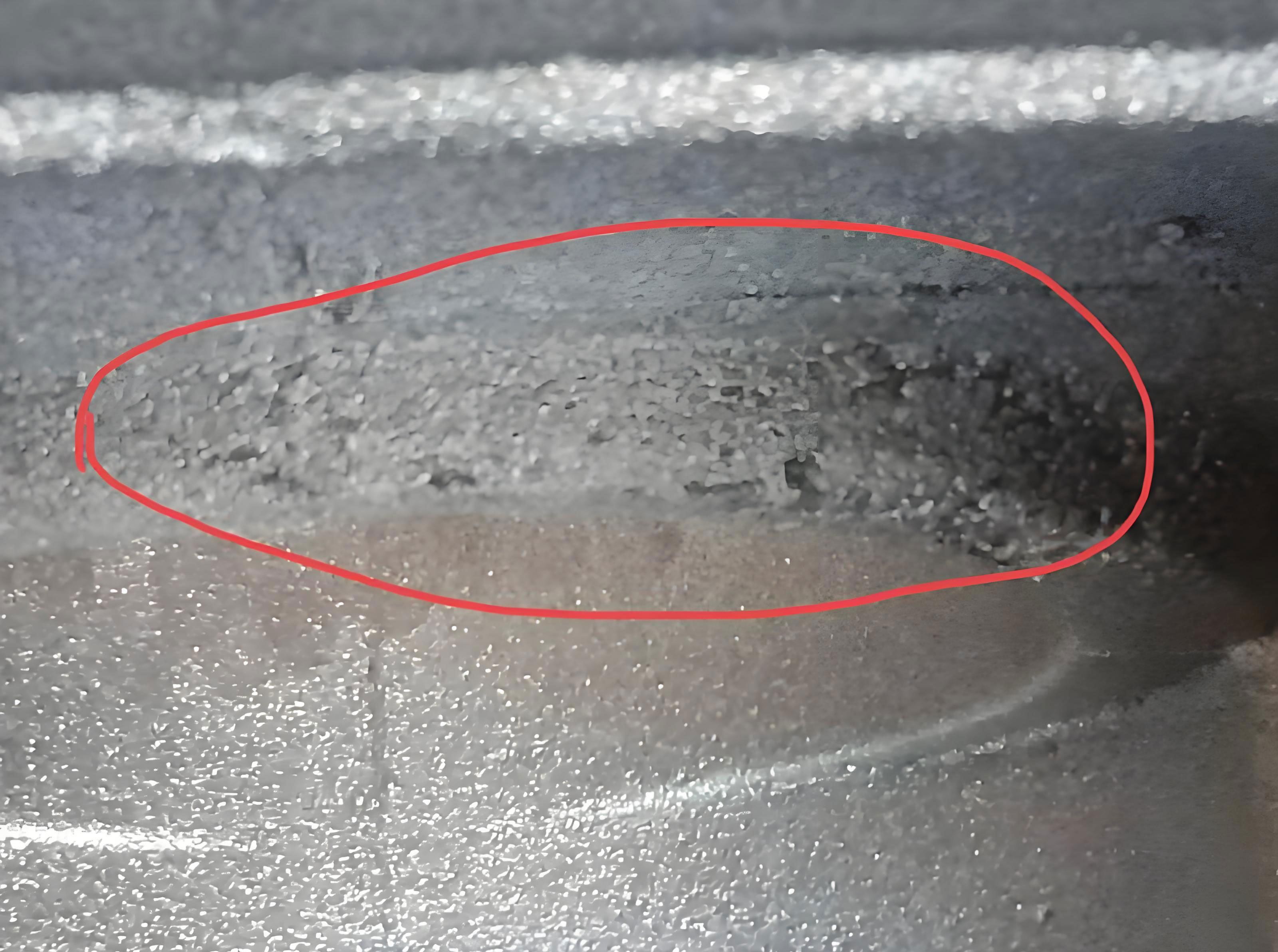
The primary issue involved the appearance of numerous gas pores on the machined oil pan joint surface of the crankshaft housing. These pores, ranging from 0.8 to 1.5 mm in size and numbering between 5 to 15 per part, led to a leakage failure rate of approximately 20%. This level of porosity in casting not only compromised the component’s sealing ability but also increased scrap rates and production costs. To visually represent the typical manifestation of such defects, consider the following illustration of porosity in casting:
The product, a crankshaft housing, features a complex geometry with varying wall thicknesses. Using 3D software analysis, I determined that the maximum wall thickness is 8 mm, while the general thickness averages around 4 mm. The oil pan joint area, where porosity in casting was most prevalent, exhibited the thickest section. The initial mold design utilized two main gates on opposite sides of the part, facilitating metal flow that converged in the problematic zone. This configuration, while intended to ensure complete filling, inadvertently contributed to gas entrapment due to flow impingement. The mold lacked dedicated venting channels in critical areas, exacerbating the issue. Below is a summary of the product and mold characteristics:
| Feature | Specification |
|---|---|
| Maximum Wall Thickness | 8 mm |
| Average Wall Thickness | 4 mm |
| Machining Allowance (Initial) | 1.2 mm |
| Gate Configuration | Two main gates on sides |
| Venting in Critical Zone | None |
To systematically identify the root causes of porosity in casting, I employed a cause-and-effect analysis framework encompassing man, machine, material, method, and environment (4M1E). However, for brevity and focus, the investigation narrowed down to four primary technical factors: excessive wall thickness, suboptimal mold design, inappropriate process parameters, and inadequate mold spray and blow-off timing. Each factor contributes to gas entrapment or inadequate gas expulsion during the die casting process. The relationship between these factors and porosity formation can be modeled using fundamental principles of fluid dynamics and solidification. For instance, the velocity of molten metal affects gas entrainment, as described by the following equation for critical velocity to avoid turbulence:
$$ v_c = \frac{\mu}{\rho \cdot d} $$
where \( v_c \) is the critical velocity, \( \mu \) is the dynamic viscosity, \( \rho \) is the density, and \( d \) is the characteristic length. Exceeding this velocity promotes air entrapment, leading to porosity in casting. Additionally, solidification time \( t_s \) for a thick section can be estimated using Chvorinov’s rule:
$$ t_s = k \left( \frac{V}{A} \right)^n $$
where \( V \) is volume, \( A \) is surface area, and \( k \) and \( n \) are constants. Longer solidification times in thick sections allow gas bubbles to coalesce and form larger pores. The table below summarizes the root causes and their mechanisms related to porosity in casting:
| Root Cause | Description | Impact on Porosity in Casting |
|---|---|---|
| Excessive Wall Thickness | Oil pan joint area thickness of 8 mm with 1.2 mm machining allowance | Prolonged solidification traps gas; machining exposes subsurface pores |
| Mold Design Flaws | Two-gate system causing flow collision; lack of vents in collision zone | Flow impingement entraps air; no escape path for gases |
| Incorrect Process Parameters | First-phase injection speed set too high at 0.3 m/s | Rapid filling entrains air from shot sleeve into cavity |
| Improper Spray/Blow-off Timing | Spray time 3 s, blow-off time 1 s leaving moisture | Water vaporizes during injection, creating gas pores |
Addressing these root causes required a multi-faceted approach. For the excessive wall thickness, we modified the mold structure in the oil pan joint area by implementing a grid pattern of inserts. This reduced the effective wall thickness and decreased the machining allowance from 1.2 mm to 0.7 mm. The grid design also facilitated better heat dissipation, shortening solidification time and reducing porosity in casting. The modification can be quantified by the change in volume-to-surface area ratio \( \frac{V}{A} \), which directly influences solidification time. Assuming the grid divides the volume into smaller segments, the new ratio becomes:
$$ \left( \frac{V}{A} \right)_{\text{new}} = \frac{V_{\text{total}}}{A_{\text{total}} + A_{\text{grid}}} $$
where \( A_{\text{grid}} \) is the additional surface area from the grid, leading to a smaller ratio and faster solidification.
To rectify the mold design, we blocked one of the main gates (left side) to eliminate flow collision. Simultaneously, the oil pan joint area was fitted with multiple grid inserts arranged with intentional gaps. These gaps served as venting channels, allowing trapped air to escape. This design change aligns with principles of fluid flow, where reducing flow velocity at junctions minimizes turbulence. The pressure drop \( \Delta P \) across a vent can be approximated by:
$$ \Delta P = \frac{1}{2} \rho v^2 f \frac{L}{D} $$
where \( v \) is flow velocity, \( f \) is friction factor, \( L \) is length, and \( D \) is diameter. By providing vents, we reduced backpressure, facilitating gas expulsion and mitigating porosity in casting.
Process parameters were optimized by adjusting the first-phase injection speed from 0.3 m/s to 0.2 m/s. This slower initial speed allows more time for air in the shot sleeve to be purged before the cavity fills, reducing gas entrainment. The relationship between injection speed \( v \) and gas entrapment probability \( P_g \) can be expressed as:
$$ P_g = k_1 \cdot v^2 $$
where \( k_1 \) is a constant. Thus, reducing speed significantly lowers \( P_g \), thereby decreasing porosity in casting. Additionally, we revised the spray and blow-off times for mold lubrication: spray time was shortened from 3 s to 1 s, and blow-off time was extended from 1 s to 2 s. This ensured thorough drying of the mold surface, minimizing water vapor formation during injection. The effectiveness of drying can be modeled using evaporation rate equations, but practically, it reduces moisture-related gas generation.
The table below summarizes the implemented solutions and their theoretical basis:
| Solution Category | Specific Action | Theoretical Justification |
|---|---|---|
| Wall Thickness Reduction | Implement grid inserts; reduce machining allowance to 0.7 mm | Decreases \( V/A \) ratio, shortening solidification time per Chvorinov’s rule |
| Mold Design Optimization | Block one gate; add grid inserts with venting gaps | Prevents flow collision; provides gas escape paths, reducing pressure buildup |
| Process Parameter Adjustment | Lower first-phase speed to 0.2 m/s | Reduces gas entrainment probability proportional to \( v^2 \) |
| Spray/Blow-off Timing Revision | Spray: 1 s, Blow-off: 2 s | Minimizes residual moisture, lowering vapor-induced porosity in casting |
After implementing these measures, the quality of the crankshaft housings improved dramatically. The leakage failure rate due to porosity in casting dropped from 20% to 0.5%, as confirmed by post-machining inspections. The reduction in pore size and frequency was evident in comparative analyses. For instance, the average number of pores per part decreased from 10 to less than 1, and the maximum pore size reduced to below 0.5 mm. The table below quantifies the improvement:
| Metric | Before Improvement | After Improvement | Improvement Percentage |
|---|---|---|---|
| Leakage Failure Rate | 20% | 0.5% | 97.5% reduction |
| Average Pore Count per Part | 10 | 0.8 | 92% reduction |
| Maximum Pore Size (mm) | 1.5 | 0.5 | 66.7% reduction |
| Machining Rejection Rate | High | Negligible | Near elimination |
The success of this project underscores the importance of a holistic approach to mitigating porosity in casting. Key takeaways include the necessity of integrating product design with mold engineering, the critical role of process parameter fine-tuning, and the value of empirical data in guiding decisions. Porosity in casting is often a multifaceted problem requiring solutions that address both design and process variables. For example, the interplay between wall thickness, flow dynamics, and solidification can be modeled using simulation software to predict and prevent defects. The general formula for gas pore formation probability \( P \) might combine several factors:
$$ P = \alpha \cdot \left( \frac{V}{A} \right) + \beta \cdot v^2 + \gamma \cdot M $$
where \( \alpha, \beta, \gamma \) are coefficients, \( \frac{V}{A} \) is volume-to-surface area ratio, \( v \) is injection speed, and \( M \) represents moisture content. Minimizing each term reduces porosity in casting.
In conclusion, this case study demonstrates that through systematic analysis and targeted improvements, significant gains in quality can be achieved. Porosity in casting remains a pervasive issue in die casting, but by leveraging engineering principles, statistical methods, and continuous improvement mindset, it can be effectively controlled. Future work could involve advanced simulations to optimize gate and vent designs, or real-time monitoring of process parameters to dynamically adjust for variations. Ultimately, reducing porosity in casting enhances product reliability, reduces waste, and strengthens competitiveness in the manufacturing sector.