
In our precision casting foundry, which specializes in manufacturing small to medium-sized steel castings for automotive and tractor applications, we have long grappled with the persistent and costly defect of porosity in casting. Our process employs a low-melting-point wax pattern material composed of paraffin wax and stearic acid, with water glass as the binder and ammonium chloride as the hardening agent. We utilize hot water for dewaxing, an贯通式 gas-fired furnace for mold shell firing, and medium-frequency as well as工频 furnaces for alloy melting. While our overall reject rate typically remains below 5%, external rejects—primarily due to porosity in casting—account for a significant portion, leading to substantial financial losses in compensation for machining costs. This article details our first-hand investigation into the root causes of this porosity, the experimental approaches undertaken, and the multifaceted measures implemented to mitigate this defect, resulting in notable economic benefits.
The manifestation of porosity in casting within our products is predominantly in the form of subsurface blowholes, which become apparent only after machining. These pores vary in size, generally ranging from 1 to 2 mm in diameter, with some exceeding 5 mm. They are frequently located in the upper sections of castings, near the gating system. Statistical analysis over several years consistently shows that within a浇注 cluster, the lower-tier castings exhibit a higher incidence and larger size of porosity compared to those in the upper tiers. This spatial distribution hinted at process-related factors, particularly concerning the mold shell preparation and firing stages. The following table summarizes the reject data for three representative castings, illustrating the prevalence of porosity-related defects.
| Year | Part Identifier | Total Rejects (pieces) | Rejects due to Porosity (pieces) |
|---|---|---|---|
| 1984 | A | 150 | 120 |
| 1984 | B | 200 | 170 |
| 1985 | C | 180 | 150 |
Initial assessments confirmed that the porosity in casting was primarily of the侵入 type, where gases originate from the mold shell or core rather than from the molten metal itself. Given our stringent control over metal raw materials and melting conditions, we focused our investigative efforts on the quality of the fired mold shells. The core issue revolves around the vol atile residues remaining within the shell after dewaxing and subsequent firing. These residues stem from incomplete removal of the wax pattern and chemical by-products from the binder system. The wax composition, primarily hydrocarbons, decomposes at high temperatures, releasing gases such as CO, CO₂, and H₂. Simultaneously, the water glass binder reacts with the ammonium chloride hardener, producing NaCl, NH₃, and H₂O. The firing process aims to eliminate these carbonaceous compounds, ammonia, and crystall ine water. However, complete removal is challenging, and residual salts like NaCl and carbon deposits can become significant gas sources during pouring, leading to porosity in casting.
We quantitatively evaluated shell firing quality by measuring its gas evolution potential. The residual content of volatile matter, particularly carbon and salts, directly correlates with the shell’s tendency to generate gases. Experiments established that when the residual content is below 0.5%, shell strength is high, and gas evolution is minimal. The relationship between firing temperature and residual content can be expressed by an empirical formula:
$$ R(T) = R_0 \cdot e^{-kT} $$
where \( R(T) \) is the residual content at temperature \( T \), \( R_0 \) is the initial residual content, and \( k \) is a decay constant specific to the shell material. Our data indicated that at temperatures around 850°C, the residual content drops significantly. Furthermore, the gas evolution volume \( G \) as a function of firing time \( t \) at a constant temperature follows a diminishing trend:
$$ G(t) = G_{\infty} + (G_0 – G_{\infty})e^{-\alpha t} $$
Here, \( G_0 \) is the initial gas volume, \( G_{\infty} \) is the asymptotic minimum gas volume, and \( \alpha \) is a rate constant. Prolonged firing reduces gas evolution, underscoring the importance of sufficient dwell time. The following table presents measured gas evolution values (in arbitrary units from a recorder’s millivolt output) from different regions of a typical mold shell after firing, highlighting the non-uniformity in firing quality.
| Shell Region Sampled | Average Gas Evolution (mV) | Standard Deviation (mV) |
|---|---|---|
| Upper Section | 12.5 | 1.2 |
| Core Region | 18.3 | 1.8 |
| Lower Section | 25.6 | 2.5 |
The data clearly shows that the lower section of the shell exhibits the highest gas evolution, making it the most probable source for gas入侵 leading to porosity in casting. This non-uniformity is a direct consequence of the firing furnace’s thermal characteristics. Our furnace was a through-type gas-fired unit with a movable hearth. Measurements revealed poor sealing and low thermal efficiency. Temperature profiling using thermocouples placed at the top and bottom of a shell cluster during firing showed a substantial gradient. The temperature differential between the upper and lower sections could reach 100–150°C, as illustrated in the conceptual diagram below. This gradient impedes the complete volatilization of salts and carbon from the lower regions.
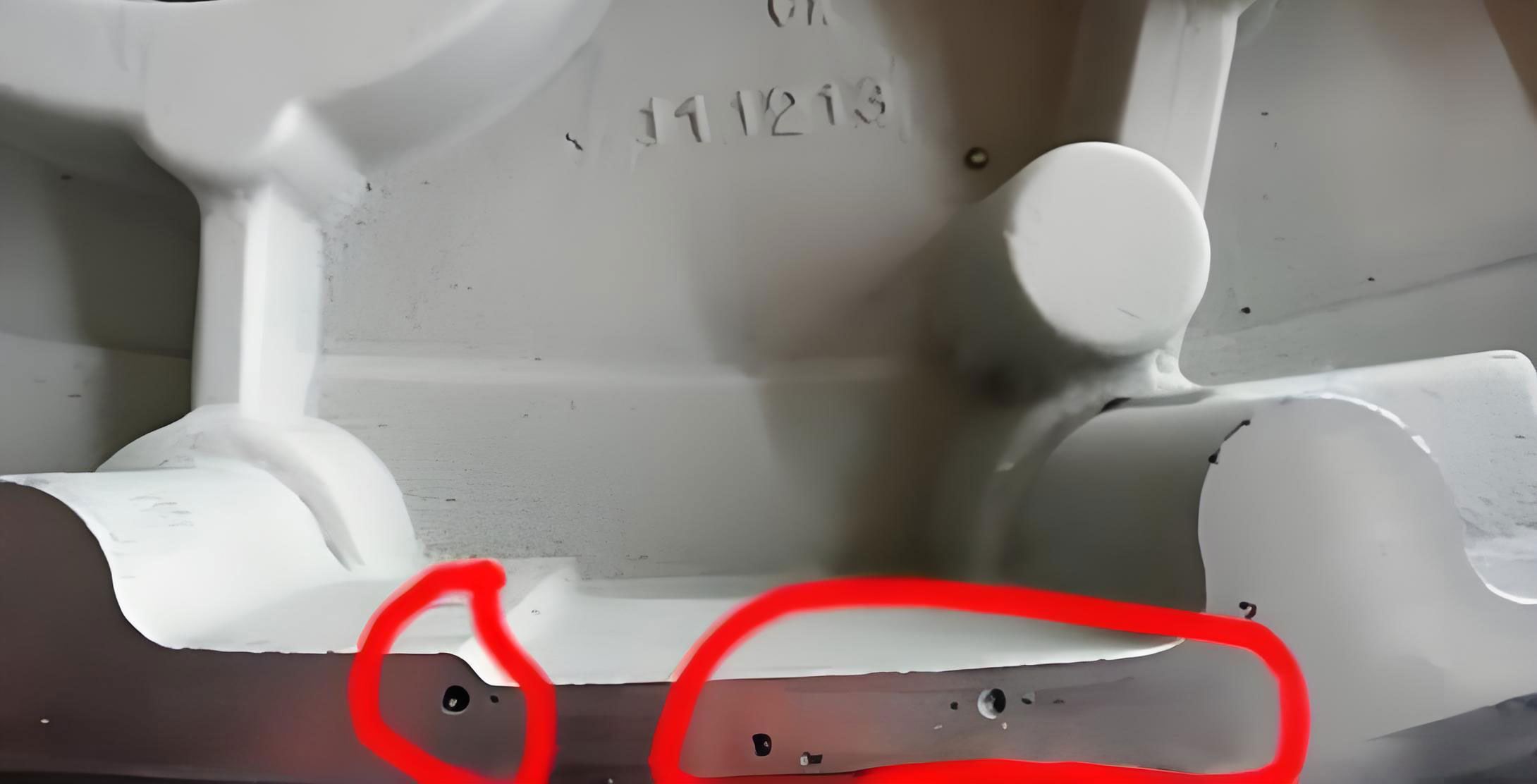
Visual inspection of shells fired per standard procedure confirmed these findings. Carbon soot was present on both internal and external surfaces, having penetrated the shell’s capillary network. Moreover, salt deposits, evident as fine, glistening particles, were concentrated on the internal surfaces, particularly at the bottom of the sprue. These residues act as potent gas sources during metal pouring. The furnace’s design contributed to this: the gas burners were positioned too close to the shell clusters, creating a high-pressure zone near the pouring cup that trapped evolving gases. Concurrently, cold air ingress through gaps between the hearth and walls cooled the lower furnace zone, while the flue location further exacerbated the temperature imbalance, preventing effective salt removal from the shell bottoms.
The chemical reactions involved in gas generation are critical to understanding porosity in casting. The decomposition of residual wax can be represented by:
$$ \text{C}_n\text{H}_{2n+2} \xrightarrow{\Delta} n\text{C} + (n+1)\text{H}_2 $$
$$ \text{C} + \frac{1}{2}\text{O}_2 \rightarrow \text{CO} \quad \text{or} \quad \text{C} + \text{O}_2 \rightarrow \text{CO}_2 $$
The binder system reactions during hardening and firing produce:
$$ \text{Na}_2\text{O} \cdot m\text{SiO}_2 \cdot n\text{H}_2\text{O} + 2\text{NH}_4\text{Cl} \rightarrow 2\text{NaCl} + 2\text{NH}_3 \uparrow + m\text{SiO}_2 + (n+1)\text{H}_2\text{O} $$
During firing, NaCl and other salts must volatilize, but inadequate temperature and time lead to retention. The retained salts can dissociate or react at casting temperatures, releasing chlorine or other gases that contribute to porosity in casting. The total gas pressure \( P_g \) generated within the shell interface can be modeled as a function of temperature \( T \) and residue concentration \( C \):
$$ P_g(T, C) = \sum_i n_i R T \cdot f_i(C) $$
where \( n_i \) is the moles of gas species \( i \), \( R \) is the gas constant, and \( f_i(C) \) is a function relating residue concentration to gas generation rate for species \( i \).
To systematically address porosity in casting, we conducted a series of plant trials. One key experiment involved varying the firing time while holding temperature constant at 850°C. The results, plotted below, demonstrate a clear logarithmic reduction in gas evolution with extended firing.
| Firing Time (minutes) | Measured Gas Evolution (mV) | Calculated Residual Carbon (%) |
|---|---|---|
| 60 | 45.2 | 0.85 |
| 90 | 32.1 | 0.62 |
| 120 | 24.5 | 0.48 |
| 150 | 18.9 | 0.38 |
| 180 | 15.3 | 0.32 |
Mathematically, the trend can be fitted to: $$ G = a \cdot \ln(t) + b $$ where \( a \) and \( b \) are constants. This confirmed that extending firing beyond 120 minutes significantly lowers the risk of porosity in casting. Another experiment examined the effect of pouring parameters. By controlling pour time and ensuring smooth, continuous metal flow, turbulence-induced gas entrapment was minimized. For typical castings, a pour time of approximately 10 seconds proved optimal. Furthermore, modifying cluster assembly to prioritize directional solidification and venting of mold cavities reduced gas entrapment in lower sections.
Based on these analyses, we implemented several corrective measures targeting the root causes of porosity in casting. The first major intervention was modifying the firing furnace. Initially, we introduced forced air to improve combustion efficiency, which reduced carbon soot formation. Subsequently, we extended the furnace length by three meters and added an auxiliary chimney to enhance flue gas extraction and promote more uniform temperature distribution. This modification reduced the top-bottom temperature gradient to within 50°C. Later, we retrofitted one furnace with喷射-type flat-flame burners, which provided better heat distribution and reduced gas consumption by approximately 15%. The improved thermal profile ensured more complete removal of volatiles from all shell regions, directly combating one source of porosity in casting.
Parallel to equipment upgrades, we revised several process parameters. The firing cycle was standardized to ensure a minimum dwell time of 180 minutes at 850–900°C. The relationship between firing time \( t \) and the allowable residual content \( R_{allow} \) for acceptable casting quality can be derived from our data:
$$ t_{min} = -\frac{1}{k} \ln\left(\frac{R_{allow}}{R_0}\right) $$
For our shells, with \( R_0 \approx 1.2\% \) and \( R_{allow} = 0.35\% \), \( t_{min} \) calculates to approximately 170 minutes, validating our new standard. Additionally, we optimized the cluster configuration. By strategically orienting parts to facilitate gas escape through vents or upper sections and ensuring adequate gating for rapid mold filling, we reduced the prevalence of subsurface porosity in casting. The following table compares reject rates before and after implementing these comprehensive measures for a batch of high-volume castings.
| Process Phase | Average Reject Rate due to Porosity (%) | Estimated Monthly Cost Saving (USD) |
|---|---|---|
| Pre-Improvement | 3.8 | 0 |
| Post-Improvement | 1.2 | ~16,000 |
The economic impact was substantial, with a reduction in external reject赔偿 translating to significant annual savings. Furthermore, the consistency in casting quality improved, enhancing customer satisfaction. Our ongoing monitoring involves regular measurement of shell gas evolution using a standardized test, where a shell sample is heated in a controlled atmosphere and the evolved gases are quantified. This data feeds into a statistical process control (SPC) chart to ensure the firing process remains within limits, preemptively addressing potential excursions that could lead to porosity in casting.
In conclusion, the defect of porosity in casting, particularly the侵入 type stemming from mold shell residues, is a multifaceted challenge that requires a holistic approach. Through detailed investigation, we identified non-uniform shell firing as a primary contributor, driven by furnace design limitations and suboptimal process parameters. By implementing furnace modifications to achieve better thermal uniformity, extending firing times based on empirical kinetics, and optimizing pouring and clustering practices, we successfully reduced the incidence of porosity in casting. The key takeaway is that controlling the shell’s gas generation potential through precise thermal management is paramount. The measures adopted have not only curtailed quality losses but also underscored the importance of continuous process refinement in precision foundry operations. Future work may explore advanced binder systems with lower gas evolution or real-time monitoring of shell firing using spectroscopic techniques to further eradicate porosity in casting.