
The presence of internal voids, collectively termed porosity in casting, represents one of the most prevalent and detrimental defects in metal casting processes. As a researcher deeply involved in materials engineering, I have observed firsthand how these imperfections compromise the structural integrity, mechanical properties, and functional reliability of cast components. Porosity in casting acts as a stress concentrator, significantly reducing fatigue life, tensile strength, and pressure tightness. This article synthesizes current understanding, exploring the fundamental mechanisms behind pore formation, the complex interplay of influencing factors, and the practical strategies employed to minimize this pervasive issue.
At its core, porosity in casting arises from the entrapment of gas or the shrinkage of metal during solidification. These two primary sources give rise to distinct pore types with characteristic morphologies. Gas porosity typically results from gases like hydrogen (dissolved from moisture or hydrocarbons), nitrogen, or air (entrapped during turbulent filling) becoming trapped within the solidifying metal. These pores are often spherical or elliptical with smooth, shiny internal surfaces. Shrinkage porosity, conversely, forms due to the volumetric contraction of the metal as it transitions from liquid to solid. If liquid metal feed is insufficient to compensate for this contraction, voids develop in the last-solidifying regions. These pores exhibit irregular, dendritic shapes with rough, dark surfaces. A third common type is the gas-shrinkage pore, a hybrid where an initial gas bubble expands into the surrounding liquid due to solidification shrinkage, resulting in a spherical base with elongated tails.
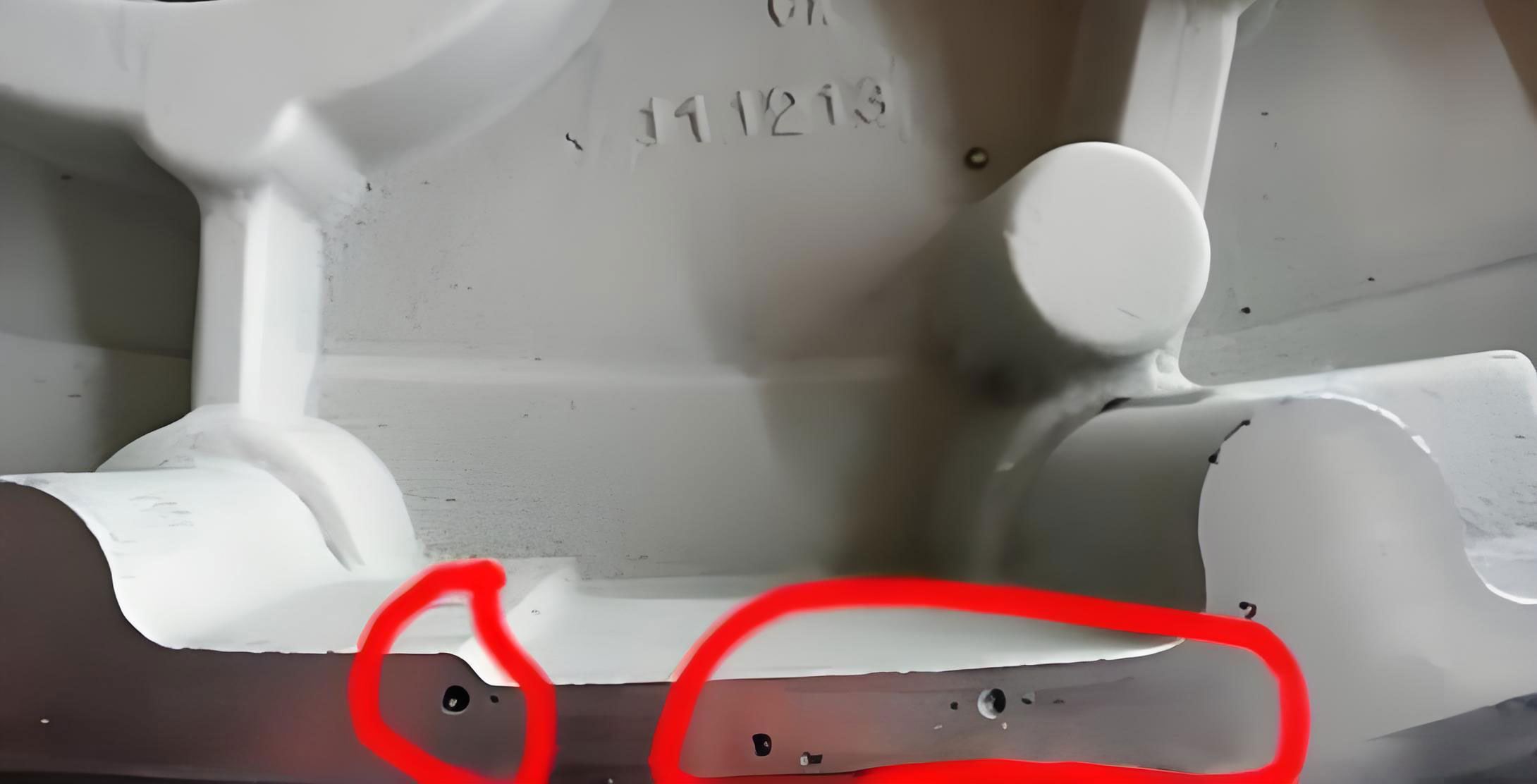
The nucleation and growth of these pores are governed by thermodynamic and kinetic principles. For a gas bubble to form and be stable within a liquid metal, the internal gas pressure ($p_g$) must overcome the summation of the metallostatic pressure ($p_h$), the atmospheric/external pressure ($p_a$), and the pressure due to surface tension ($p_\sigma$). The critical condition for pore formation can be expressed as:
$$p_g \geq p_h + p_a + \frac{2\sigma}{r}$$
where $\sigma$ is the surface tension of the liquid metal and $r$ is the radius of the bubble. The term $\frac{2\sigma}{r}$ highlights the significant challenge of nucleating a small pore; a very high gas pressure is required to overcome the surface tension force for a small radius $r$. This often leads to heterogeneous nucleation on existing inclusions or mold walls. Once nucleated, pore growth is influenced by diffusion of gas atoms and the pressure conditions in the solidifying mush, described by Darcy’s law for fluid flow through a porous medium:
$$\vec{v} = -\frac{K}{\mu f_l} \nabla P$$
Here, $\vec{v}$ is the fluid velocity, $K$ is the permeability of the mushy zone, $\mu$ is the dynamic viscosity, $f_l$ is the liquid fraction, and $\nabla P$ is the pressure gradient. A negative pressure gradient can lead to pore expansion.
The extent and morphology of porosity in casting are not dictated by a single factor but are the result of a complex interaction between alloy characteristics, process parameters, and geometric design. The following table categorizes and summarizes the primary influencing factors.
| Category | Factor | General Effect on Porosity | Mechanism/Rationale |
|---|---|---|---|
| Alloy Properties | Solidification Range | Wider range increases susceptibility. | Extended mushy zone hinders interdendritic feeding, promoting shrinkage porosity in casting. |
| Gas Solubility Gradient | Larger ΔS (Sliquid – Ssolid) increases risk. | Greater rejection of gas (e.g., H2) during solidification provides driving force for pore formation. | |
| Surface Tension & Viscosity | Lower values can increase porosity. | Reduces the pressure ($2\sigma/r$) needed for pore nucleation; higher viscosity impedes bubble floatation. | |
| Process Parameters | Pouring/Metal Temperature | Optimum exists; too high or too low increases porosity. | High temp increases gas dissolution and shrinkage. Low temp increases viscosity, impeding degassing and feeding. |
| Solidification/Cooling Rate | Faster cooling generally reduces pore size. | Restricts time for gas diffusion and pore growth, but may increase number of nucleation sites. | |
| Mold/Metal Pressure | Increased pressure decreases porosity. | Increases the external pressure term ($p_a$ or $p_h$) in the pore formation equation, suppressing nucleation and growth. | |
| Degassing Practice | Effective degassing is critical. | Reduces the initial dissolved gas content ($p_g$), directly lowering the driving force for gas porosity in casting. | |
| Design & Feeding | Riser/Gating Design | Poor design is a major cause. | Inadequate feeding leads to shrinkage pores. Turbulent gating entraps air, causing gas porosity. |
| Section Thickness & Geometry | Thick sections and hot spots are prone. | Create thermal gradients and isolated pools of late-freezing liquid, ideal for shrinkage and gas pore formation. |
To quantify and analyze porosity in casting, various characterization techniques are employed. The overall pore volume fraction, or porosity percentage ($P$), is often determined using density measurements based on Archimedes’ principle:
$$\rho_p = \frac{m_1}{m_1 – m_2} \cdot \rho_w$$
$$P = \left(1 – \frac{\rho_p}{\rho_{th}}\right) \times 100\%$$
where $\rho_p$ is the measured density of the sample, $m_1$ and $m_2$ are its mass in air and water respectively, $\rho_w$ is the density of water, and $\rho_{th}$ is the theoretical density of the pore-free alloy. More detailed analysis involves microscopic examination (optical/SEM) and image analysis to determine pore size distribution, morphology, and location. Advanced techniques like X-ray computed tomography (CT) provide non-destructive 3D maps of the internal pore network.
Controlling porosity in casting requires a multi-faceted approach targeting its root causes. Effective melt treatment is the first line of defense. Degassing using rotary impellers with inert gases (Ar, N2) or reactive gases (Cl2, Freon) is standard practice to reduce dissolved hydrogen. The kinetics of degassing can be related to first-order principles. Inclusion control through filtration and fluxing also reduces potent nucleation sites for pores. Process optimization is equally critical. In high-pressure die casting (HPDC), the application of vacuum, known as vacuum-assisted HPDC, drastically reduces air entrapment. Studies show that reducing the absolute cavity pressure from 50 kPa to 10 kPa can decrease average pore size by over 35% and increase tensile strength significantly. Proper gating and risering, guided by solidification simulation software, ensure directional solidification and adequate feeding to combat shrinkage. Pressurization during solidification, as in squeeze casting, applies an external force that compresses any forming pores, dramatically reducing porosity in casting.
The detrimental impact of porosity in casting on mechanical properties is well-established and can be modeled. Pores act as internal notches, creating stress concentrations. The stress concentration factor ($K_t$) for a spherical pore can be approximated, and its presence effectively reduces the load-bearing cross-sectional area ($A_{eff}$) of the material:
$$\sigma_{net} = \sigma_{applied} \cdot \frac{A_{total}}{A_{eff}} = \frac{\sigma_{applied}}{1 – P}$$
where $P$ is the volume fraction porosity. More critically, pores are primary sites for fatigue crack initiation. The relationship between pore size and fatigue life is often described by models linking the stress intensity factor range ($\Delta K$) to the initiating pore size ($\sqrt{area}_{pore}$). The Kitagawa-Takahashi diagram effectively illustrates how the fatigue limit decreases in the presence of pores, especially when the pore size exceeds a critical threshold. Furthermore, the morphology of the pore matters; irregular, sharp-edged shrinkage pores are far more damaging than round gas pores of the same volume, as they induce higher stress concentrations. This directly links process control—which influences pore type and shape—to final component performance.
My research and experience affirm that managing porosity in casting is not about achieving absolute zero, which is often economically impractical, but about understanding and controlling it to predictable and acceptable levels for the intended application. This requires an integrated methodology: selecting suitable alloys, implementing rigorous melt quality controls, designing processes and tooling with solidification science in mind, and employing advanced monitoring and inspection techniques. As casting technologies evolve towards producing higher-integrity components for demanding sectors like aerospace and automotive, the precision with which we can predict, quantify, and minimize porosity in casting will remain a cornerstone of quality and innovation in the foundry industry. The pursuit of denser, more reliable castings continues to drive research in novel process variants, advanced simulation tools, and real-time defect detection systems.