
In the field of cast steel production for chemical machinery, the challenge of porosity in casting has long been a critical issue affecting product quality and yield. As an engineer deeply involved in foundry operations, I have focused on addressing this defect in low carbon chromium-manganese-nitrogen (Cr-Mn-N) steel castings. These steels are economically advantageous as they replace expensive nickel with manganese and nitrogen, while offering superior strength and corrosion resistance in certain environments, often outperforming Cr18Ni12Mo-type stainless steels in stress-corrosion applications. However, the occurrence of porosity in casting, particularly blowholes, has led to high rejection rates for components like valve seats, covers, and housings. This article delves into the root causes and presents comprehensive工艺 measures, with an emphasis on vibration-assisted solidification, to mitigate porosity in casting effectively.
The fundamental issue stems from the inherent nature of Cr-Mn-N steels. Their chemical composition, typically as shown in Table 1, promotes segregation during solidification, leading to non-uniform microstructures and gas entrapment. Porosity in casting manifests as dispersed or concentrated blowholes, often at the edges of cross-sections, such as the A-A profile of a valve seat casting. Analysis reveals that this is primarily driven by nitrogen and hydrogen gas evolution due to solubility changes and偏析.
| C | Mn | Si | S | P | Cr | Mo | N |
|---|---|---|---|---|---|---|---|
| ≤0.08 | 13-15 | <0.8 | <0.030 | <0.045 | 16.5-18.5 | 1.8-2.2 | 0.24-0.31 |
To understand the mechanism, consider the solubility of gases in steel. Nitrogen and hydrogen solubility decreases significantly during solidification, and their distribution is influenced by elemental segregation. Chromium, manganese, and molybdenum tend to segregate, resulting in a higher ferrite content in the central regions of the casting compared to the edges. Since the solubility of nitrogen and hydrogen is much lower in ferrite than in austenite, these gases accumulate in the edge regions, leading to supersaturation and bubble formation. This phenomenon is quantified by nitrogen distribution curves; for instance, in a non-treated casting, nitrogen content can vary from 0.25% at the center to 0.31-0.32% at the edges, exacerbating porosity in casting.
The relationship between nitrogen solubility and alloying elements can be expressed using empirical formulas. One common approximation for nitrogen solubility in austenitic steels is:
$$ N_{sol} = k \cdot (\%Cr + \%Mn) $$
where \( N_{sol} \) is the nitrogen solubility (in wt.%), and \( k \) is a temperature-dependent constant. During solidification, local variations in Cr and Mn content due to segregation alter \( N_{sol} \), leading to nitrogen rejection and pore nucleation. Additionally, the total gas pressure in the melt, contributing to porosity in casting, is governed by partial pressures of nitrogen, hydrogen, and oxygen. The equilibrium for nitrogen dissolution is:
$$ \frac{1}{2} N_{2(g)} \rightleftharpoons N_{[in\ melt]} $$
with the equilibrium constant \( K_N = \frac{a_N}{\sqrt{P_{N_2}}} \), where \( a_N \) is the activity of nitrogen and \( P_{N_2} \) is the partial pressure. Hydrogen behaves similarly, and its presence can catalyze nitrogen bubble formation. Thus, controlling these factors is paramount to reducing porosity in casting.
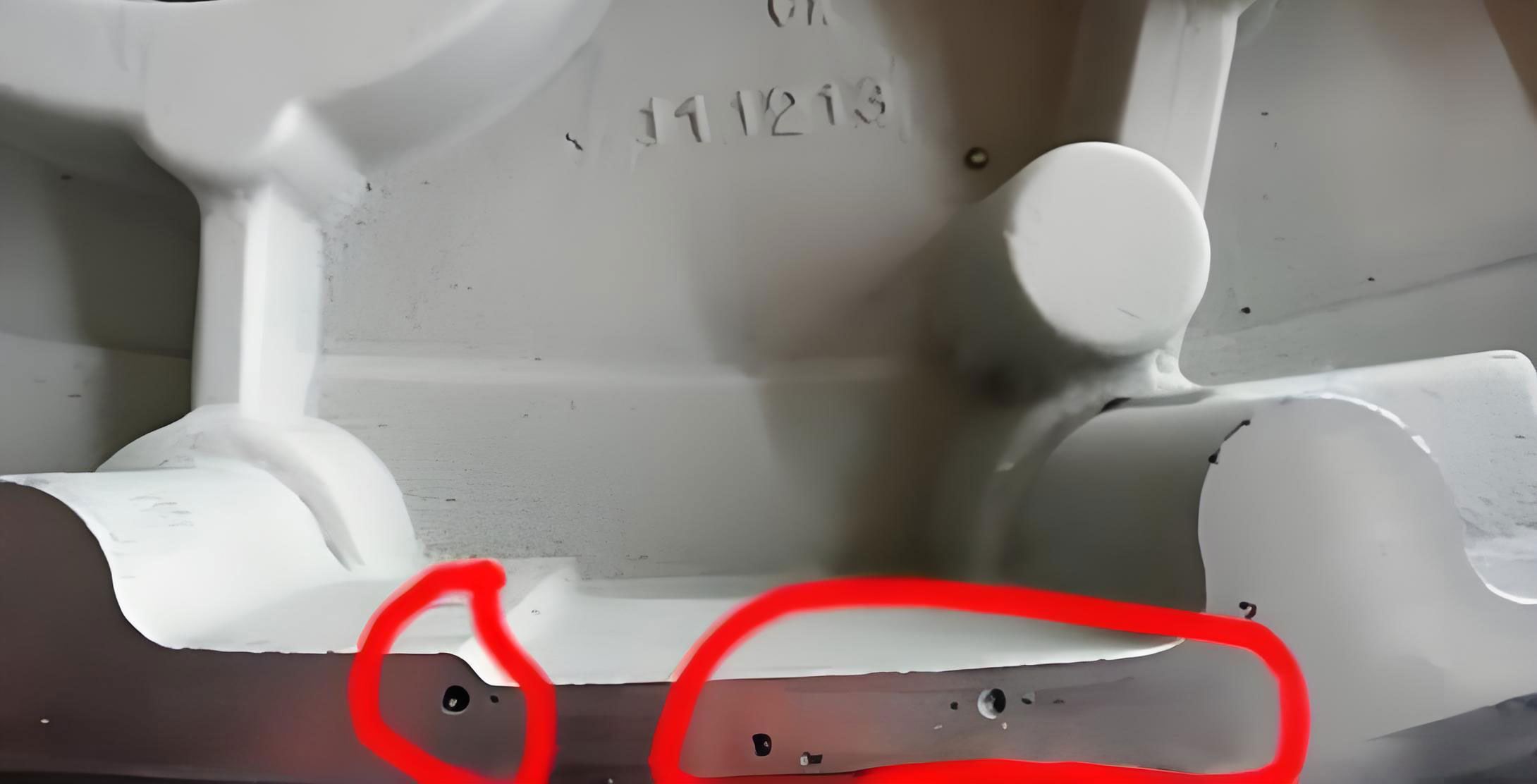
In our practice, we have implemented a multi-faceted approach to eliminate porosity in casting. First, precise control of nitrogen during melting is essential. Initially, electrolytic manganese was used, but it introduced high hydrogen levels (200-250 ppm) and exhibited nitrogen absorption during baking, as detailed in Table 2. This non-uniform nitrogen uptake complicated nitrogen management, so we switched to low-carbon metallic manganese, which offers more consistent properties.
| Baking Time | Baking Temperature | Nitrogen Before Baking (%) | Nitrogen After Baking (Internal Sample, %) | Nitrogen After Baking (External Sample, %) |
|---|---|---|---|---|
| 2 hours | 850°C | 0.063 | 0.52 | 0.91 |
| 3 hours | 850°C | 0.054 | 2.58 | 5.50 |
To minimize porosity in casting, we aim to keep nitrogen at the mid-to-lower specification range while maintaining chromium and manganese at mid-to-upper levels to ensure adequate solubility. The melting process in induction furnaces includes a de-gassing step: before adding nitrogen carriers like chromium nitride, power is switched off, and argon is purged through the melt. This reduces hydrogen content, as argon flushing removes dissolved gases by reducing their partial pressures. The efficiency of hydrogen removal can be estimated using Sieverts’ law:
$$ [H] = K_H \sqrt{P_{H_2}} $$
where \( [H] \) is the hydrogen concentration, \( K_H \) is the equilibrium constant, and \( P_{H_2} \) is the hydrogen partial pressure. By lowering \( P_{H_2} \) via argon purging, \( [H] \) decreases, mitigating one contributor to porosity in casting.
Second, reducing oxygen and hydrogen is critical. Complete deoxidation is achieved using aluminum or silicon-based deoxidizers, ensuring low oxygen activity to prevent reaction with carbon or hydrogen to form CO or H2O bubbles. Mold drying is rigorously enforced; for investment shell molds used in valve seat castings, they are baked at high temperatures, and after assembly with sand-type risers, the entire mold is re-baked at 300°C and poured promptly to avoid moisture reabsorption. This minimizes hydrogen from mold gases, a common source of porosity in casting.
Third, and most innovatively, we employ vibration-assisted solidification. After pouring, the mold is placed on a steel plate with a vibrator bolted to it—one vibrator for every two castings. Vibration commences immediately after riser filling, with a release valve opened to allow gas escape. The vibrator design, as previously described, features a copper piston inside a steel sleeve, driven by compressed air and a return spring. Key parameters are: frequency of 1600 cycles per minute, amplitude of 1-2.5 mm, air pressure of 0.5-0.8 MPa, and duration of 5-6 minutes. This mechanical agitation transmits through the plate to the mold, influencing solidification dynamics.
The efficacy of vibration in reducing porosity in casting is profound. It enhances feeding efficiency by disrupting dendritic networks, allowing better riser action to compensate for shrinkage. More importantly, it reduces nitrogen偏析. In vibrated castings, nitrogen distribution becomes more uniform, as shown by comparative curves: the difference between center and edge nitrogen content drops to 0.01-0.02 percentage points, versus 0.06-0.07 in non-vibrated cases. This homogeneity prevents local supersaturation and bubble nucleation, directly addressing porosity in casting. Additionally, vibration alters the riser profile, shifting the porous zone upward and increasing the sound height, indicative of improved feeding.
To quantify the impact, we conducted experiments measuring gas content and mechanical properties. Table 3 summarizes results from valve seat castings with and without vibration. The data clearly shows reduced nitrogen偏析 and lower incidence of porosity in casting under vibration.
| Condition | Nitrogen at Center (%) | Nitrogen at Edge (%) | Nitrogen Difference (%) | Porosity Rating (Visual Inspection) | Riser Sound Height Increase (%) |
|---|---|---|---|---|---|
| Without Vibration | 0.25 | 0.31-0.32 | 0.06-0.07 | High (Defects Present) | Baseline |
| With Vibration | 0.26 | 0.27-0.28 | 0.01-0.02 | Low (Defects Eliminated) | 15-20% |
The underlying physics of vibration-assisted solidification involves several mechanisms. Vibration induces fluid flow in the mushy zone, breaking dendrites and promoting equiaxed grain formation. This reduces microsegregation, as described by the modified Scheil equation accounting for convective mixing:
$$ C_s = k C_0 (1 – f_s)^{(k-1)(1 – \alpha)} $$
where \( C_s \) is the solute concentration in the solid, \( C_0 \) is the initial concentration, \( k \) is the partition coefficient, \( f_s \) is the solid fraction, and \( \alpha \) is a mixing parameter enhanced by vibration. For nitrogen, with \( k < 1 \) for ferrite, vibration lowers \( \alpha \), reducing segregation. Additionally, vibration facilitates gas bubble detachment and escape by lowering the energy barrier for nucleation and providing kinetic energy for bubble movement through the melt. The Stokes’ law for bubble rise velocity is modified under vibration:
$$ v_b = \frac{2 (\rho_m – \rho_b) g r^2}{9 \eta} + A \omega \cos(\omega t) $$
where \( v_b \) is velocity, \( \rho_m \) and \( \rho_b \) are melt and bubble densities, \( g \) is gravity, \( r \) is bubble radius, \( \eta \) is viscosity, \( A \) is amplitude, and \( \omega \) is angular frequency. The oscillatory term aids in detaching bubbles from solidification fronts, preventing entrapment and thus porosity in casting.
Further, we explored the interplay between vibration parameters and porosity reduction. Empirical models suggest an optimal frequency-amplitude combination for minimizing porosity in casting. For our steel, at 1600 cycles/min (≈26.7 Hz) and 1-2.5 mm amplitude, the vibration intensity \( I = A^2 f^3 \) (where \( A \) is amplitude in meters and \( f \) is frequency in Hz) falls within a range that effectively disrupts segregation without causing mold damage. Excessive vibration can erode molds, so we ensure high dry strength for our investment shells.
In terms of冶炼 adjustments, we also monitor hydrogen levels using hot extraction methods. By combining argon purging with controlled mold drying, hydrogen content is kept below 2 ppm, significantly reducing its contribution to porosity in casting. The total gas pressure \( P_{total} \) in the melt, which drives pore formation, is given by:
$$ P_{total} = P_{N_2} + P_{H_2} + P_{CO} + \ldots $$
Through deoxidation, \( P_{CO} \) is minimized; through de-gassing, \( P_{H_2} \) and \( P_{N_2} \) are reduced. This holistic approach ensures that \( P_{total} \) remains below the critical threshold for pore nucleation during solidification.
The application of vibration is particularly effective for thicker sections of Cr-Mn-N steel castings, where solidification times are longer and segregation is more pronounced. For thin-walled castings, natural convection might suffice, but for components like valve seats with substantial cross-sections, vibration is indispensable to combat porosity in casting. We have extended this method to other Cr-Mn-N castings, such as pump housings, with consistent success in eliminating blowholes.
To summarize the工艺 protocol, we present a step-by-step guide in Table 4, emphasizing measures against porosity in casting.
| Step | Action | Key Parameters | Effect on Porosity |
|---|---|---|---|
| 1. Melting | Use low-carbon metallic manganese; control Cr and Mn at mid-upper range, N at mid-lower range. | Mn: 13-15%, Cr: 16.5-18.5%, N: 0.24-0.31% | Reduces nitrogen variability and supersaturation. |
| 2. De-gassing | Pause induction furnace; purge with argon before adding nitrogen alloys. | Argon flow rate: 10-15 L/min, duration: 3-5 min | Lowers hydrogen content, decreasing gas pressure. |
| 3. Deoxidation | Add aluminum or ferrosilicon for complete oxygen removal. | Al addition: 0.02-0.05% | Prevents CO bubble formation. |
| 4. Mold Preparation | Bake investment shells at high temperature; assemble with risers and re-bake at 300°C. | Baking time: 2-4 hours, temperature: 300°C | Eliminates mold moisture, reducing hydrogen source. |
| 5. Pouring | Pour quickly after mold removal from oven; maintain melt temperature at 1550-1600°C. | Pouring temperature: ~1580°C | Minimizes gas absorption during transfer. |
| 6. Vibration | Start vibration immediately after riser filling; use mechanical vibrator on steel plate. | Frequency: 1600 cycles/min, amplitude: 1-2.5 mm, duration: 5-6 min | Reduces nitrogen segregation, enhances feeding, eliminates porosity. |
| 7. Solidification | Allow casting to cool in mold under vibration; then remove and inspect. | Cooling rate: controlled by mold design | Ensures sound casting with minimal internal defects. |
In conclusion, porosity in casting for low carbon chromium-manganese-nitrogen steel is a multifaceted problem rooted in gas solubility changes and elemental segregation. Through meticulous control of nitrogen sources, rigorous de-gassing and deoxidation, and the innovative application of vibration during solidification, we have successfully eliminated blowhole defects. Vibration not only homogenizes nitrogen distribution but also improves riser efficiency, making it a cornerstone technique for thick-section castings. The integration of these measures into standard foundry practice has significantly reduced scrap rates, enhanced product reliability, and underscored the importance of a holistic approach to mitigating porosity in casting. Future work may explore optimizing vibration parameters via computational modeling or extending this method to other high-alloy steels prone to similar defects.
Ultimately, the battle against porosity in casting is ongoing, but with these strategies, we have turned a persistent challenge into a manageable process, ensuring that Cr-Mn-N steel castings meet the demanding standards of chemical machinery without compromise.