
The transition to resin sand molding in our foundry operations, while offering significant advantages in dimensional accuracy and surface finish, introduced a persistent and costly challenge: the frequent occurrence of gas porosity defects in castings. A substantial portion of production was classified as non-conforming due to various forms of porosity. This issue stemmed from a dual root cause: firstly, an incomplete understanding of the specific mechanisms leading to porosity in resin sand systems, and secondly, the lack of a targeted, classification-based prevention strategy in production. This article consolidates extensive analysis and practical trials to present a comprehensive methodology for understanding and preventing porosity in casting.
The Nature and Peril of Porosity in Casting
Porosity in casting refers to cavities or holes formed within a solidified metal casting due to trapped gas bubbles during the solidification process. It is a smooth-walled discontinuity. The manifestations of porosity are varied:
- Morphology: Spherical, pear-shaped, teardrop-shaped, worm-like, elongated needle-shaped, or irregular interconnected pores resembling wormholes or interdendritic networks.
- Surface Appearance: The pore walls are typically smooth. Their color can range from bright metallic to bluish or dark, indicating varying degrees of surface oxidation.
- Size: Ranges from extremely fine pinholes (around 0.1 mm) often called “pinhole porosity,” to larger cavities several millimeters in diameter. Needle-shaped pores can be 1-3 mm in length.
- Location:
- Subsurface Porosity: Clusters of small pores (0.5-3 mm) located 1-3 mm beneath the casting surface, often revealed only after shot blasting, heat treatment, or machining.
- Internal Porosity: Pores located within the cross-section, detectable by non-destructive testing like radiography.
- Distribution:
- Dispersed Porosity: Numerous pores scattered throughout the casting’s cross-section. Pinhole porosity is a classic example of this弥散性分布.
- Localized/Cluster Porosity: Aggregations of pores in specific areas, sometimes forming a honeycomb-like structure.
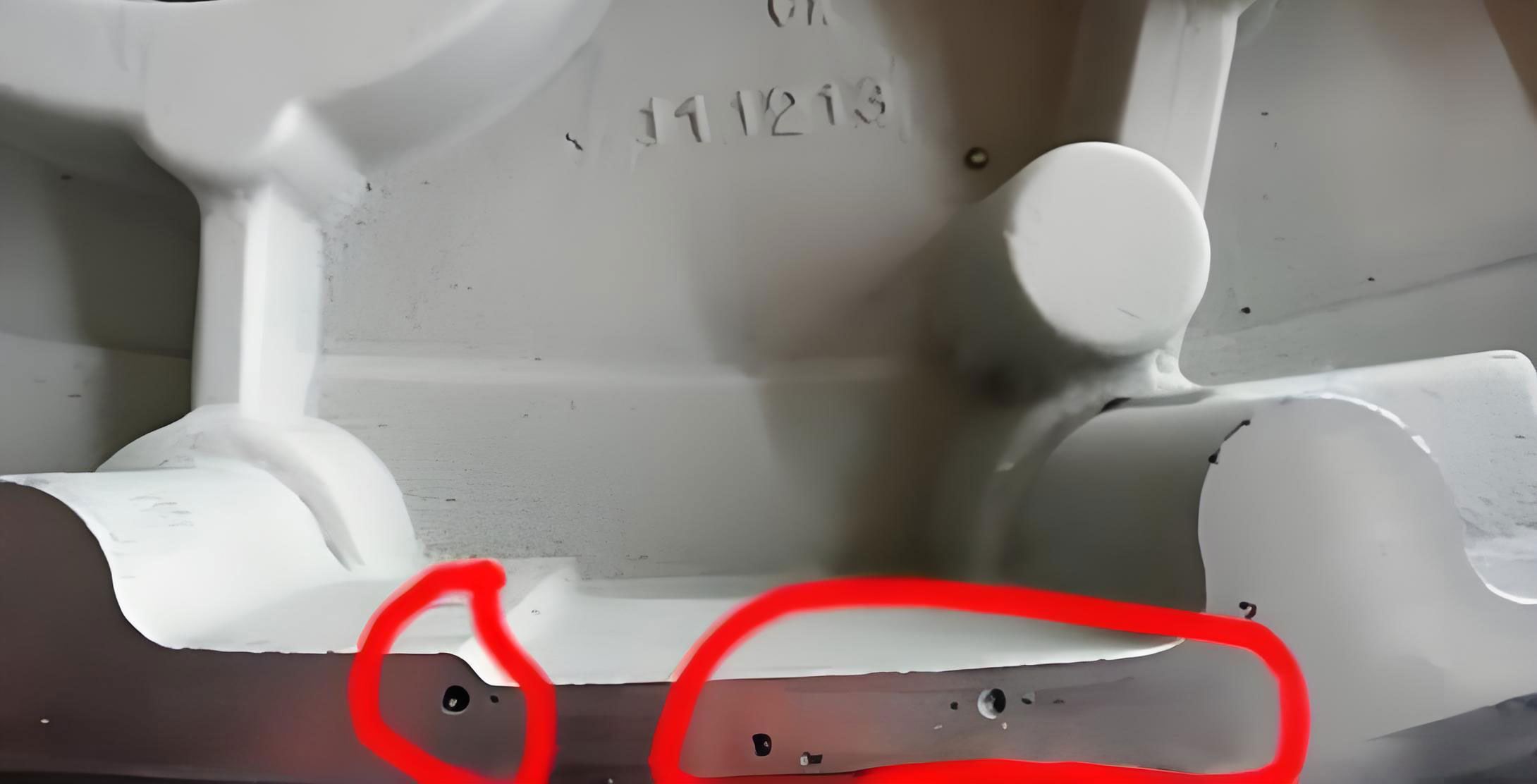
The detrimental effects of porosity in casting are severe. It reduces the effective load-bearing area and creates stress concentration points, significantly degrading mechanical properties—especially ductility, toughness, and fatigue resistance. Subsurface or internal porosity can lead to catastrophic, unexpected failures. Porosity exposed during machining ruins surface finish, leading to scrapping of the part. For pressure-tight components, it compromises leak-proof integrity. Furthermore, subsurface porosity can cause defects in subsequent processes like enameling or electroplating. Gases like hydrogen and nitrogen are prime contributors to pinhole porosity in steel castings; these gases in their nascent atomic state are highly active. Additions of elements like titanium can suppress their formation.
Systematic Classification and Mechanisms of Porosity
Based on morphology and location on the rough casting, porosity can be classified into two primary categories: open blowholes and subsurface porosity. Open blowholes can be further divided into shallow surface pores and large-area penetrating blows. Subsurface porosity, when exposed by machining, appears as pebble-like, raindrop-like, or honeycomb-shaped pores.
From a formation mechanism perspective, the fundamental classification is as follows:
| Type | Mechanism | Primary Gas Source |
|---|---|---|
| 1. Invasive Porosity | Gas generated from external sources (mold, core) invades the molten metal during pouring or before a solid skin forms. | External (Sand/Mold) |
| 2. Entrapped Porosity | Air or gas is trapped during turbulent filling of the mold cavity. | Air from Gating System/Cavity |
| 3. Precipitation Porosity | Dissolved gas in the molten metal precipitates out as the metal solidifies and its solubility drops sharply. | Internal (Metal Melt) |
| 4. Endogenous Reaction Porosity | Gas forms inside the metal from internal chemical reactions (e.g., C + O → CO in steels). | Internal Chemical Reaction |
| 5. Exogenous Reaction Porosity | Gas forms at the metal-mold interface from chemical reactions (e.g., metal-mold moisture reaction). | Interface Chemical Reaction |
For resin sand castings, invasive porosity is often the dominant issue. The pressure driving gas invasion ($P_{inv}$) can be modeled by considering the gas generation from the sand ($G$), the permeability of the mold ($k$), and the capillary pressure in the sand pores. Prevention hinges on reducing the gas pressure in the sand capillaries below the metallostatic pressure. This is achieved by: (a) enhancing mold/core venting to increase permeability, and (b) reducing and controlling the actual gas evolution from the sand.
The gas evolution volume from a resin-bonded sand can be approximated by:
$$ V_{gas}(T) = \rho_s \cdot \text{LOI} \cdot f(T, t) $$
where $V_{gas}$ is the gas volume generated per unit volume of sand at temperature $T$, $\rho_s$ is the sand bulk density, LOI is the Loss on Ignition of the sand (a critical measure of combustibles), and $f(T, t)$ is a function dependent on temperature and time representing the decomposition kinetics of the resin/binders.
Analysis of Porosity Defects in Production: A Statistical Approach
A systematic review of scrap castings, categorized by the weight of the defective part, revealed the following distribution of porosity types:
| Rank | Porosity Type | Approx. Frequency |
|---|---|---|
| 1 | Large-area Penetrating Blows | ~40% |
| 2 | Pebble-shaped Subsurface | ~25% |
| 3 | Raindrop-shaped Subsurface | ~20% |
| 4 | Shallow Surface Blows | ~10% |
| 5 | Honeycomb Porosity | ~5% |
Observations linked specific porosity types to production conditions and casting features:
| Porosity Type | Typical Location | Associated Production Conditions |
|---|---|---|
| Shallow Surface | Top or bottom surfaces of the casting. | Non-specific. |
| Pebble-shaped | Top surfaces, near riser necks. | Non-specific. |
| Large-area Blows | Castings with deep, non-strippable cavities (e.g., gear hubs, housings). | Poor new sand quality, high LOI (>3%) in reclaimed sand. |
| Raindrop-shaped | — | Rainy season, incomplete drying of coatings. |
| Honeycomb | — | New product trial phase, poor metal quality. |
This patterned occurrence was key. It indicated that different root causes dominated different porosity types, allowing for targeted countermeasures. The efficacy of these measures was validated through extensive plant trials.
A Targeted Prevention Strategy for Porosity in Casting
1. Prevention of Poor Sand Quality-Induced Porosity
This category stems from high gas evolution and reduced strength of the sand, leading to gas invasion during mold filling. The core control is over the reclaimed sand parameters and material management.
- Control Reclaimed Sand LOI and Fines: This is the most critical factor. LOI represents the residual combustibles (resin, etc.) in the sand. A higher LOI directly increases potential gas volume. Fines reduce permeability. The relationship between casting porosity rate and sand LOI is strongly correlated, as trials showed a sharp increase in defects above 3% LOI.
$$ \text{Porosity Risk} \propto \text{LOI} \cdot \frac{1}{\text{Permeability}} $$ - Minimize Resin Addition: Use the minimum resin and catalyst required to achieve necessary strength, typically within 0.8-1.2%.
- Control Auxiliary Materials: Ensure furan resin water content, alcohol-based coatings, and dried new sand moisture are within strict limits (<0.2%). Core supports must be free of rust and oil. Bonding agents must not contaminate mold cavities.
2. Prevention of Insufficiently Dried Mold-Induced Porosity
This defect is caused by residual moisture, alcohols, or other volatiles on the mold/core surface vaporizing upon contact with hot metal. The goal is to ensure the mold surface is completely dry and cured.
- Ensure Complete Curing: Allow adequate time for the resin-catalyst reaction to complete before stripping or coating.
- Use Fast-Igniting Coatings: Alcohol-based coatings must ignite within 30 seconds of application and burn completely, leaving a dry, non-tacky surface.
- Implement Mold Drying/Baking: Actively drying molds, especially in cold, humid conditions, is highly effective. Using an electric hot air blower to heat the mold cavity for 20-30 minutes before pouring dramatically reduces porosity from this cause. This practice is particularly crucial during rainy seasons.
3. Prevention through Gating and Venting System Design
Poor design can cause turbulence (entrapping air) or create areas of high pressure that impede gas escape.
- Improve Gating Systems: Design gating to promote laminar, non-turbulent filling. This reduces entrapped air and minimizes erosion of the mold surface, which can clog pores with sand and increase local gas generation.
- Optimize Venting Pathways: Ensure vent channels from deep cores and mold pockets are adequately sized, unobstructed, and lead to the atmosphere. Venting capacity must be commensurate with the volume of gas generated.
4. Prevention via Metal Quality Control
Certain porosity types, like the honeycomb structure, are often linked to high gas content in the molten metal.
- Control Melt Gas Content: Implement proper degassing practices for the alloy being cast. Control hydrogen and nitrogen pickup. The solubility of diatomic gases follows Sieverts’ Law: $$ S = k \sqrt{P} $$ where $S$ is solubility, $k$ is a temperature-dependent constant, and $P$ is the partial pressure of the gas. During solidification, the solubility plummets, leading to gas precipitation if initial levels are high.
- Use Inoculants/Additives: As indicated in foundational studies, additions like titanium or controlled amounts of iron oxide can modify solidification behavior or surface reactions to suppress specific pore formation mechanisms.
5. Integrated Measures Summary
The trial results showed that each primary countermeasure had a dominant effect on specific porosity types, forming a complete defense strategy:
| Preventive Action | Primary Impact on Porosity Type |
|---|---|
| Improving Sand Quality (LOI < 3%) | Virtually eliminates shallow surface blows; reduces large-area blows. |
| Active Mold Drying/Baking | Virtually eliminates raindrop-shaped porosity; reduces large-area blows. |
| Optimizing Gating System Design | Greatly reduces large-area blows and pebble-shaped porosity; reduces honeycomb porosity. |
| Ensuring Effective Core/Mold Venting | Reduces large-area blows and pebble-shaped porosity. |
| Enhancing Molten Metal Quality | Eliminates honeycomb-type porosity. |
Conclusion
The battle against porosity in resin sand castings is won through understanding and segmentation. It is not a single defect with a single cure, but a family of defects—invasive blows, subsurface pinholes, reaction porosity—each with distinct dominant causes. A systematic approach, beginning with precise classification of the observed porosity, guides the application of targeted countermeasures. Key to success is the rigorous control of reclaimed sand quality, specifically maintaining Loss on Ignition below 3%, coupled with practices that ensure complete mold/core dryness. Augmenting this with sound gating design, effective venting, and high-quality molten metal creates a robust, multi-layered defense system. By implementing this classification-based prevention strategy, foundries can transform porosity in casting from a prevalent source of scrap into a well-controlled and manageable aspect of resin sand production, significantly improving yield and product reliability.