
My journey into the intricate world of heavy-section steel casting has been profoundly shaped by the challenges posed by advanced materials for next-generation power generation. The transition from producing conventional low-alloy steels to manufacturing critical components from grades like GX-12CrMoVNbN marked a significant technological leap. This high-alloy martensitic stainless steel is a cornerstone material for key components in ultra-supercritical (USC) steam turbines operating at 1,000 MW, where extreme temperatures and pressures demand exceptional creep strength and microstructural stability. However, our initial production runs, beginning in 2007, were met with a pervasive and costly defect: severe gas porosity. Unlike our experience with low-alloy steels, where porosity was a sporadic issue, porosity in casting of GX-12CrMoVNbN was rampant, particularly in components weighing around 1,000 kg. It became starkly clear that our standard foundry practices were insufficient. This narrative details our systematic analysis of the root causes and the comprehensive set of countermeasures we developed to reliably eliminate this defect, transforming a major production hurdle into a mastered process.
1. The Multifaceted Nature of Porosity Formation in Steel Castings
To tackle the specific problem in GX-12CrMoVNbN, one must first understand the fundamental mechanisms that lead to porosity in casting in general. Porosity defects are essentially voids trapped within the solidified metal, and they originate from gases that become entrapped or generated during the melting, pouring, and solidification processes. We categorize them based on their source and formation mechanism.
1.1 Entrapped (or Engulfment) Porosity
This type of defect originates from the physical incorporation of air or mold gases into the molten metal stream. The pouring process is inherently turbulent. We can analyze this using fluid dynamics principles. The flow regime is characterized by the Reynolds number (Re), a dimensionless quantity:
$$Re = \frac{\rho V d}{\mu}$$
where $\rho$ is the fluid density, $V$ is the average flow velocity, $d$ is the characteristic diameter (e.g., of the sprue), and $\mu$ is the dynamic viscosity. In gating systems, especially during initial fill, Re values typically range from $10^4$ to $10^6$, far exceeding the critical threshold of ~2,300 for laminar flow. Consequently, molten steel enters the mold in a highly turbulent state. This turbulence creates vortices that can trap air packets. Furthermore, the impact of the falling stream on the sprue base and the metal surface in the mold cavity causes splashing and further air entrainment. Studies suggest that pouring alone can introduce up to 0.07 m³ of air per tonne of steel. If these bubbles cannot float out before solidification, they remain as spherical or elongated voids often found in the upper sections of the casting or just below the cope surface.
1.2 Invasive (or Mold-Gas) Porosity
This form of porosity in casting is generated from the mold or core itself. As the hot metal fills the cavity, it rapidly heats the sand-binder mix. Moisture vaporizes, organic binders decompose, and carbonates break down, releasing large volumes of gas (primarily H₂, CO, CO₂, N₂). The pressure at the metal-mold interface ($P_{interface}$) builds up. For a gas bubble to invade the liquid metal, this pressure must overcome the opposing metallostatic pressure ($P_{metal}$) and the capillary pressure required to form a bubble nucleus at the pore ($\frac{2\gamma}{r}$, where $\gamma$ is surface tension and $r$ is pore radius). The condition can be simplified as:
$$P_{interface} > P_{metal} + \frac{2\gamma}{r}$$
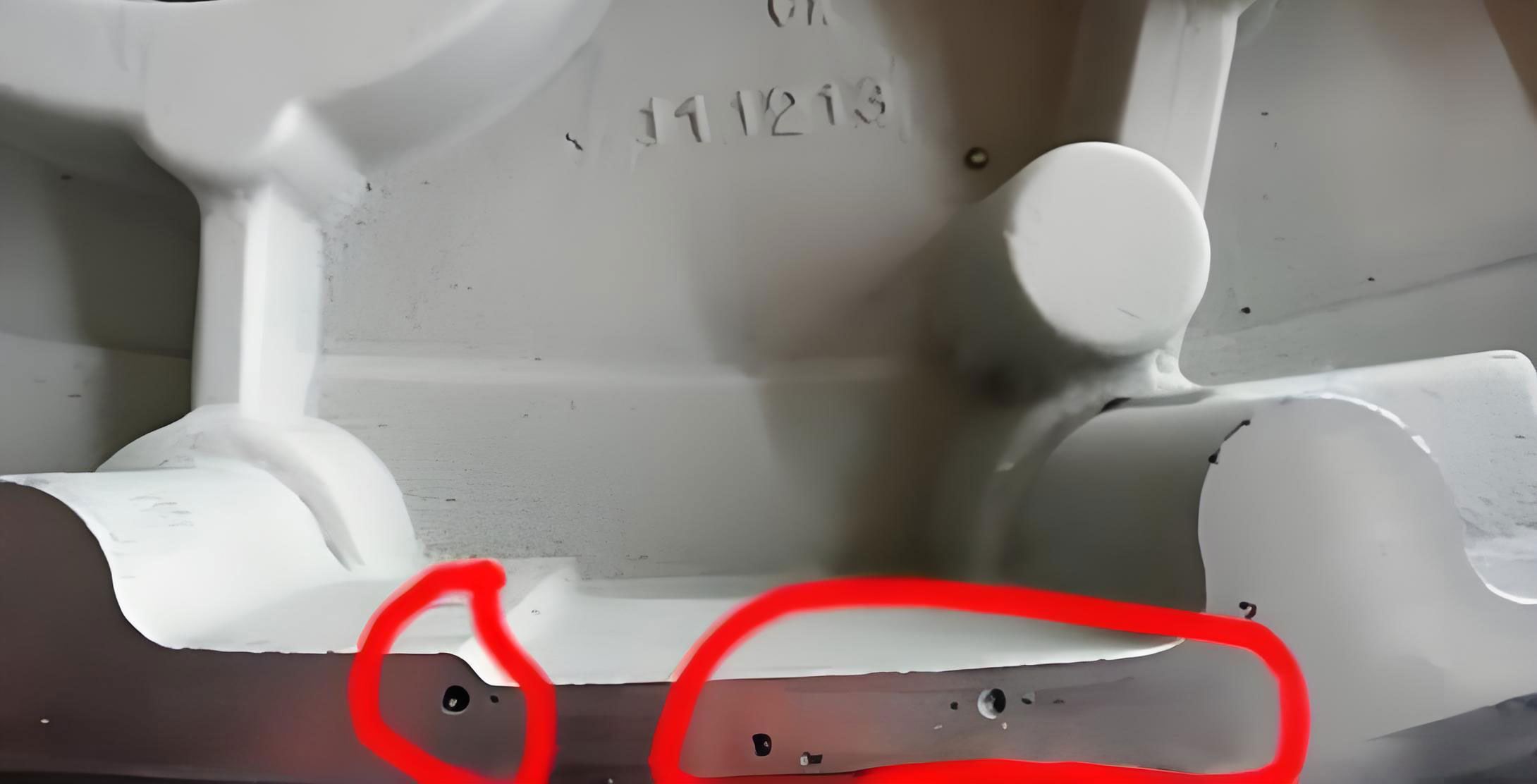
If this condition is met, gas bubbles penetrate the solidifying metal skin. These pores are often located just beneath the casting surface, are somewhat irregular in shape, and may have an oxidized interior if connected to the atmosphere. Their distribution can correlate with areas of poor mold venting or high local gas generation.
1.3 Precipitation (or Micro-) Porosity
This type is subtler and stems from the decreasing solubility of gases in the metal as it cools and solidifies. Hydrogen and nitrogen are the primary culprits. Their solubility in liquid iron is significantly higher than in solid iron. The solubility relationship with temperature is often described by Sieverts’ law for diatomic gases:
$$S = k \sqrt{P}$$
where $S$ is the solubility, $k$ is a temperature-dependent equilibrium constant, and $P$ is the partial pressure of the gas. As solidification progresses, the dissolved gases are rejected at the solid-liquid interface. If the local concentration exceeds a critical supersaturation level, they nucleate as microscopic bubbles. These bubbles, trapped between dendrite arms, create a fine, often inter-dendritic network of pores. This form of porosity in casting is heavily influenced by the initial gas content of the melt and the local solidification rate.
1.4 Reaction Porosity
Chemical reactions during or after pouring can generate gases internally. Common examples include the “carbon-oxygen” reaction:
$$[C] + [FeO] \rightarrow [Fe] + CO_{(g)}$$
This reaction can occur if the steel contains excess dissolved oxygen and carbon. It is particularly problematic because the reaction is promoted as temperature falls during solidification, disrupting the local equilibrium. The generated CO gas forms pores, often with a shiny, non-oxidized interior. Another source is the reaction between steel and moisture from the mold: $[Fe] + H_2O \rightarrow [FeO] + 2[H]$, which increases both oxide content and hydrogen pickup, potentially leading to subsequent precipitation or reaction porosity in casting.
1.5 Key Factors Governing Gas Escape
Not all gas present in the liquid metal results in a defect. The final incidence of porosity in casting depends on the race between bubble flotation and casting solidification. Several critical factors determine the outcome:
1.5.1 Metal Viscosity and Composition: Higher viscosity impedes bubble rise. Alloying elements like chromium, molybdenum, and vanadium significantly increase the viscosity of molten steel, directly hampering degasification.
1.5.2 Pouring Temperature: Higher superheat lowers viscosity and increases the time available for flotation (the “floatable time” $t_f$), which is roughly the interval between the end of pouring and the local solidification time.
1.5.3 Pouring Rate: A faster fill rate means the metal level in the mold rises quickly ($V_{rise}$). For a bubble to escape, its upward Stokes velocity ($V_{bubble}$) must exceed $V_{rise}$. If $V_{bubble} \leq V_{rise}$, the bubble is “captured” by the advancing solidification front.
1.5.4 Casting Geometry and Risering: Thicker sections have longer solidification times, offering a longer $t_f$. Effective risers, especially hot-topped ones, act as sinks for both shrinkage and floating gas bubbles, provided they remain molten long enough.
2. Root Cause Analysis for GX-12CrMoVNbN Castings
Armed with the general theory, we focused our investigation on the specific case of GX-12CrMoVNbN. Initial failures were dramatic. For instance, a set of high-pressure valve casings (3,200 kg each) all exhibited severe surface and subsurface porosity, leading to 100% scrap. Sectioning and analysis of defective castings revealed pores with distinct directional patterns extending from the surface inward, and spectroscopic analysis confirmed the presence of oxygen within the pores, pointing strongly towards invasive porosity in casting. Our analysis converged on three primary, interconnected reasons why this steel was exceptionally prone to porosity.
| Element | Range | Primary Effect Relevant to Porosity |
|---|---|---|
| C | 0.11 – 0.14 | Influences carbon-oxygen reaction potential. |
| Cr | 8.00 – 9.50 | Dramatically increases molten metal viscosity. |
| Mo | 0.90 – 1.10 | Increases viscosity and contributes to hardenability. |
| V | 0.18 – 0.25 | Increases viscosity, strong carbide former. |
| Nb | 0.05 – 0.08 | Strong carbide/nitride former, pins grain boundaries. |
| N | 0.04 – 0.06 | Critical: Alters gas solubility balance (H, N, O), increases porosity sensitivity. |
| Al | ≤ 0.020 | Kept very low to avoid harmful AlN formation; limits traditional deoxidation power. |
2.1 Elevated Molten Metal Viscosity: As Table 1 shows, the alloy contains substantial amounts of Cr, Mo, and V. These elements significantly raise the viscosity of the liquid steel compared to standard low-alloy grades like Cr-Mo-V. A higher viscosity $\mu$ directly reduces the bubble rise velocity according to a simplified Stokes’ law adjustment for non-ideal conditions: $V_{bubble} \propto \frac{g d^2 (\rho_{metal} – \rho_{gas})}{\mu}$. This makes it far more difficult for both entrapped and invasive gas bubbles to float out before being trapped by solidification, directly promoting porosity in casting.
2.2 Mushy (Pasty) Solidification Mode: Unlike low-carbon steels that solidify with a well-defined, strong solid shell, high-alloy martensitic stainless steels like GX-12CrMoVNbN exhibit a pasty or mushy solidification. The initial solid forms as a fragile, semi-continuous network of dendrites rather than a robust skin. This weak initial solid has limited strength to resist the pressure of gases generated at the mold interface. Consequently, gas bubbles can invade more easily through the inter-dendritic channels during the extended mushy stage, leading to the characteristic subsurface invasive pores we observed.
2.3 The Critical Role of Nitrogen and Gas Solubility Balance: The intentional addition of nitrogen (0.04-0.06%) is crucial for solid solution strengthening and creep resistance. However, nitrogen profoundly affects the solubility interplay between hydrogen, oxygen, and itself in the steel melt. The presence of N can reduce the solubility of H and O, increasing the driving force for their precipitation as the temperature drops. Furthermore, to prevent the formation of coarse AlN inclusions detrimental to toughness, the aluminum content is strictly limited to ≤0.020%. This restriction severely curtails the use of aluminum as a powerful deoxidizer, making it harder to achieve a very low oxygen activity in the melt, which in turn elevates the risk of reaction porosity in casting via the C-O reaction. Experience also indicated that high nitrogen levels, especially if not balanced correctly with aluminum (a ratio of N/Al ≥ 3 is often targeted), could lead to subsurface blowholes in subsequent forging operations, highlighting its inherent gas-related risks.
2.4 Inadequate Process Adaptation: Our initial failures stemmed from applying a “low-alloy steel” process to a “high-alloy” problem. Key mismatches included using overly large gating systems designed for fast fills (exacerbating turbulence and entrapment), pouring small castings at the end of a sequence when the metal temperature had dropped (reducing $t_f$), and insufficient mold gas permeability. A stark example was the simultaneous pouring of a large valve (25,000 kg) and a small part (1,250 kg) from the same ladle using a large sprue. The small casting suffered catastrophic porosity, requiring over 10% of its weight in weld repair, while the large casting was sound. This highlighted the differential sensitivity and the need for tailored pouring rules.
| Factor | Typical Low-Alloy Cr-Mo-V Steel | GX-12CrMoVNbN High-Alloy Steel | Impact on Porosity |
|---|---|---|---|
| Molten Metal Viscosity | Relatively Low | Very High (due to Cr, Mo, V) | Severely impedes bubble flotation in GX-12CrMoVNbN. |
| Solidification Mode | Columnar/Dendritic with strong skin | Mushy/Pasty with weak initial solid | Weak skin in GX-12CrMoVNbN allows easier gas invasion. |
| Primary Deoxidizer | Aluminum (unrestricted) | Aluminum strictly limited (≤0.020%) | Harder to achieve low oxygen activity in GX-12CrMoVNbN, raising reaction porosity risk. |
| Nitrogen Content | Low (tramp element) | High & Intentional (0.04-0.06%) | Alters H/N/O solubility balance, increasing gas precipitation tendency in GX-12CrMoVNbN. |
| Process Sensitivity | Moderate | Extremely High | Standard gating/pouring leads to severe porosity in GX-12CrMoVNbN. |
3. The Integrated Countermeasure Strategy
Solving this required a holistic approach, attacking the problem from melting through to mold design. We moved from a standard practice to a controlled, precision process tailored for high-viscosity, nitrogen-containing steels.
3.1 Enhanced Melting and Refining Practice
The goal was to produce a cleaner, lower-gas steel from the start. Key steps included:
Intensive Oxidizing Stage: A higher “boil” temperature and greater carbon drop were enforced to promote a vigorous carbon monoxide boil, effectively stripping hydrogen and nitrogen from the melt.
Powerful Slag Deoxidation: Immediately after the oxidising stage, calcium carbide (CaC₂) was used directly to create a highly reducing slag. The “white slag” condition was maintained for an extended period, with strict control of FeO and MnO content (typically ≤0.5%).
Effective Ladle Furnace (LF) Refining: Prolonged argon stirring through porous plugs in the ladle was employed for homogenization and inclusion flotation. Target gas levels before pouring were driven down to approximately [H] ≤ 5 ppm and [O] ≤ 90 ppm.
3.2 Revised Pouring Philosophy and Practice
This was the most crucial operational change. We abandoned the one-size-fits-all pouring method.
Pouring Technique: A “slow-fast-slow” sequence was mandated. The initial slow opening minimizes sprue base impact and initial air entrainment.
Differentiated Pouring Strategies:
- For Large Castings (>~5000 kg): “Low Temperature, Fast Pour.” The superheat was controlled to 50-80°C above liquidus. A relatively fast pour was used. The long solidification time of a large mass provides ample $t_f$ for bubbles to float to the riser, and the faster fill helps prevent mistuns in thick sections.
- For Small Castings (~500-2000 kg): “High Temperature, Slow Pour.” The superheat was increased to 80-100°C above liquidus, while the pouring rate was deliberately slowed. The higher temperature lowers viscosity, increasing $V_{bubble}$. The slower pour reduces $V_{rise}$, making the condition $V_{bubble} > V_{rise}$ easier to achieve. The increased superheat also extends the local $t_f$ in the thinner section.
Pouring Sequence Management: We avoided coupling large and small castings in the same ladle. Small castings were grouped and poured from a dedicated ladle or an early portion of a ladle using downsized gating. If a mix was unavoidable, small castings were poured first with their dedicated gating system, and the remaining metal was returned to the LF furnace to be combined with another heat for the large castings.
3.3 Optimized Casting and Gating Design
We redesigned our methods to aid gas escape at every stage.
Gating Design: Sprue and runner sizes were carefully calculated to control fill velocity without excessive turbulence. Well-proportioned, tapered sprues and properly designed sprue well/runner junctions were used to minimize splashing.
Mold and Core Venting: Venting was massively augmented. The number and diameter of vent holes were increased substantially. The permeability of the molding sand was maximized within strength constraints.
Riser Design and Placement: Riser necks were designed to ensure proper feed paths while also allowing gases from the casting to channel into the riser. The use of hot-topping exothermic compounds on risers was standardized to extend their liquid life, ensuring they remained active as effective gas sinks for the maximum time. Special attention was paid to the “inter-riser” zones on cope surfaces, which are prone to gas accumulation; additional venting or chill placement was used in these areas.
4. Results and Implementation Success
The implementation of this integrated strategy yielded transformative results. The melt quality consistently improved, with final hydrogen contents reliably below 5 ppm. Non-metallic inclusion ratings were predominantly at or below 2.0 on standard scales, indicating a clean steel. Most importantly, the incidence of porosity in casting defects plummeted.
| Casting Product (GX-12CrMoVNbN) | Scrap Rate Before Measures | Scrap Rate After Measures | Key Improvement |
|---|---|---|---|
| 1,000 MW USC Turbine Cylinder Sleeves | 18.8% | 0% | Virtual elimination of surface porosity. |
| 660/1,000 MW USC Turbine Support Brackets | ~10% | 0% | Consistent soundness achieved. |
| USC Valve Disks, Diffusers, Inner Covers (Small Castings) | Very High (Frequent Scrap) | Negligible | “High Temp, Slow Pour” strategy validated. |
| High-Pressure Valve Casings & Assemblies | ~100% (Initial Batches) | Controlled to acceptable QA levels | Holistic process control enabled production. |
The reduction in porosity directly translated to a dramatic decrease in labor-intensive grinding and welding repairs, improving throughput, cost efficiency, and metallurgical consistency. The successful production of a wide range of critical components, from complex valve casings and cylinder sleeves to intricate brackets, demonstrated the robustness of the approach. All castings met the stringent material specification requirements (equivalent to German TLV standards) and have been deployed in over twenty 1,000 MW ultra-supercritical power units operating reliably in the field.
5. Conclusion
The challenge of porosity in casting with high-alloy martensitic stainless steels like GX-12CrMoVNbN is fundamentally distinct from that with conventional low-alloy steels. The combination of high molten metal viscosity, a pasty solidification mode, and the delicate gas solubility balance imposed by intentional nitrogen alloying creates a perfect storm for gas defect formation. Conquering this challenge required moving beyond standard foundry practice. Success was achieved through a synergistic strategy: first, producing a clean, low-gas melt via intensified refining; second, implementing a disciplined and differentiated pouring practice centered on the “low-temp/fast for large, high-temp/slow for small” principle; and third, optimizing mold and gating design to maximize gas escape. This comprehensive, physics-based approach transformed a major production obstacle into a controlled process, enabling the reliable manufacture of some of the most demanding cast components in modern thermal power generation. The lessons learned underscore the critical importance of tailoring every aspect of the casting process to the unique physical and metallurgical characteristics of the material being poured.