
In my years of experience in the die casting industry, I have consistently observed that porosity in casting is one of the most pervasive and challenging defects affecting product quality, structural integrity, and pressure tightness. The formation of gas pockets within a casting not only weakens mechanical properties but also leads to significant scrap rates, impacting profitability. Through extensive practice and analysis, I have identified that mitigating porosity in casting requires a holistic approach, focusing on several interconnected factors. In this article, I will share my insights and methodologies, emphasizing first-principles understanding and practical adjustments. I will delve deeply into mold design, process parameters, and auxiliary factors, utilizing tables and mathematical formulations to summarize key concepts. The goal is to provide a detailed, actionable framework for minimizing porosity in casting, ultimately enhancing yield and performance.
The fundamental mechanism behind porosity in casting involves the entrapment of air or gases during the molten metal injection process. This can originate from the melt itself, the lubrication system, or, most critically, from the turbulent flow that incorporates air into the metal stream. Therefore, the core strategy revolves around controlling the flow behavior and ensuring efficient venting of gases from the cavity and shot sleeve. My approach systematically addresses the following areas: Mold (Die) Design, Process Parameters (especially shot profile and sleeve conditions), Melting and Metal Treatment, and Die Lubricant (Release Agent) application. Among these, mold design and shot parameters are the most dynamic and influential levers for controlling porosity in casting.
1. The Paramount Role of Mold Design in Controlling Porosity
From my perspective, the gating and venting system is the decisive factor in determining the final quality of a die casting, especially regarding porosity. It is a complete system designed not just to deliver metal but to manage the flow state for minimal gas entrapment. The primary objective is to achieve a “favorable flow state”—a fill pattern that proceeds smoothly, avoids liquid metal impingement and turbulence, and allows gases to be pushed ahead of the flow toward vents. When the flow is disordered, even the best venting system becomes ineffective as gases are trapped internally.
The key elements I consider include gate location, gate direction, runner geometry, and overflow and vent placement. A critical principle is to ensure that the metal enters the cavity along the die walls, promoting sequential filling and venting. The direction of gate entry is crucial. For example, gates should be oriented to direct the flow along longer walls rather than directly into deep pockets, which can cause premature sealing of vents. The distribution of gates must promote a unidirectional fill front to avoid gas entrapment at converging flow fronts.
I often use the following table to summarize the design principles aimed at reducing porosity in casting through gating system optimization:
| Design Element | Optimal Practice | Effect on Porosity in Casting |
|---|---|---|
| Gate Location | Place at thick sections, avoid impinging cores. | Reduces turbulence and air entrainment at the flow front. |
| Gate Direction | Direct flow along die walls, not into cavity center. | Promotes laminar flow and guides air to vents. |
| Gate Cross-Sectional Area | Sufficient to achieve target fill time; avoid excessive velocity. | High velocity causes jetting and air entrainment; low velocity causes cold flows. |
| Runner Geometry | Use tapered runners with smooth transitions (large radii). | Maintains steady flow, reduces flow separation and vortex formation. |
| Overflow Wells | Place at last areas to fill, with adequate volume. | Traps cold, contaminated metal and entrained gases, preventing backflow into cavity. |
| Vent Design | Thin and wide vents at the end of fill, connected to atmosphere. | Provides low-resistance escape path for air, preventing pressurization and gas entrapment. |
The flow behavior can be analyzed using fluid dynamics principles. The Reynolds number ($Re$) is a useful dimensionless parameter to assess flow regime:
$$Re = \frac{\rho v D}{\mu}$$
where $\rho$ is the fluid density, $v$ is the velocity, $D$ is the hydraulic diameter, and $\mu$ is the dynamic viscosity. In die casting, we aim to keep the flow in a transitional or lower turbulent regime to minimize porosity in casting. A more practical metric I use is the gate velocity ($v_g$), which must be balanced. Excessive velocity leads to jetting and air entrainment, while insufficient velocity causes mist runs. The fill time ($t_f$) is related to gate area ($A_g$) and volume ($V$):
$$t_f \approx \frac{V}{A_g \cdot v_g}$$
This relationship guides initial gate sizing, but final optimization always requires empirical validation or advanced simulation.
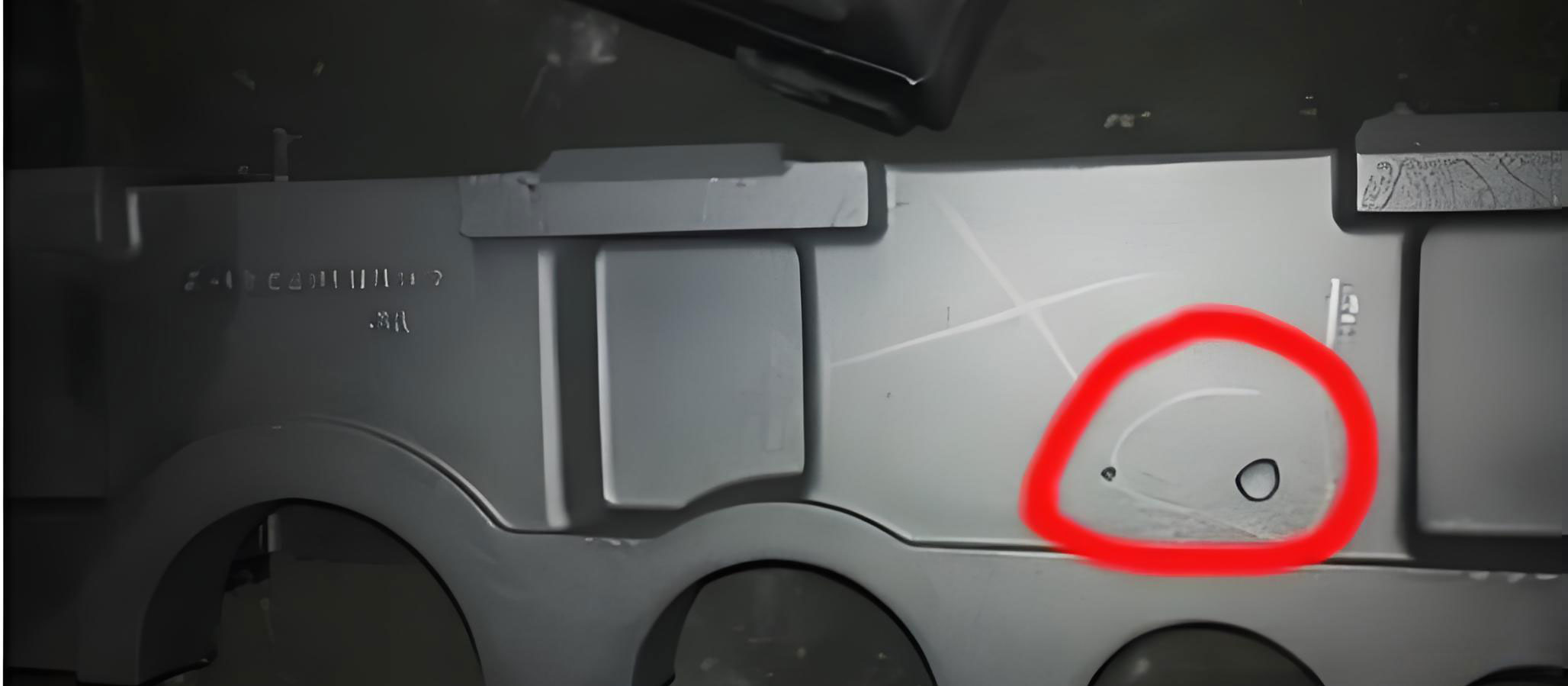
Modern computer simulation software (CFD) is an invaluable tool for visualizing fill patterns and predicting areas prone to porosity in casting. However, interpreting results and modifying designs still relies heavily on experience. The software output shows potential problems, but the engineer must devise solutions—such as changing gate angles, adding overflows, or adjusting runner sizes. For instance, a common issue is flow convergence creating isolated gas pockets. The solution often involves redirecting one gate or adding a flow leader to alter the fill sequence.
2. Mastering Process Parameters to Minimize Gas Entrapment
While the mold provides the pathway, the process parameters govern the dynamics of how metal travels that pathway. Two parameters are exceptionally critical for controlling porosity in casting but are often overlooked: the shot sleeve filling percentage (or “sleeve fullness”) and the switchover point from slow to fast shot phase. In my practice, fine-tuning these has yielded dramatic reductions in porosity defects.
2.1 Shot Sleeve Filling Percentage (Sleeve Fullness)
The shot sleeve is the first location where air can be entrained into the metal. The filling percentage, defined as the volume of molten metal divided by the total sleeve volume ahead of the plunger, directly impacts the amount of air present. A low filling percentage means a large air volume in the sleeve that must be compressed and pushed into the die, significantly contributing to porosity in casting. A higher filling percentage reduces this air volume. The relationship can be expressed as:
$$\text{Sleeve Fullness} = \frac{V_{metal}}{V_{sleeve}} \times 100\%$$
where $V_{metal}$ is the volume of metal injected and $V_{sleeve}$ is the volume of the sleeve from the plunger tip to the die face.
I advocate for using the smallest practical sleeve diameter to achieve high fullness without compromising the required metal flow rate. The flow rate $Q$ is given by:
$$Q = A_p \cdot v_p$$
where $A_p$ is the plunger cross-sectional area and $v_p$ is the plunger velocity. Reducing sleeve diameter ($D_s$) decreases $A_p$, which for a constant $Q$ requires an increase in $v_p$. However, the benefits of reduced air volume often outweigh the challenges of higher plunger speeds in the initial phase. The trend toward “short shot sleeves” is a direct response to this need—they allow for high fullness while maintaining a sufficient gate velocity by enabling a faster plunger acceleration profile.
The following table summarizes the effects of sleeve fullness on porosity in casting:
| Sleeve Fullness Range | Consequences for Porosity in Casting | Recommendations |
|---|---|---|
| Low ( 30-50%) | High air volume in sleeve; severe air entrainment during slow shot; high gas content in final part. | Avoid if possible. Use only for very large parts requiring large sleeve diameter. Optimize slow shot speed carefully. |
| Medium (50-70%) | Moderate air volume. Standard for many applications. Porosity control depends heavily on slow shot profile. | Typical target range. Focus on optimizing slow shot speed and switchover. |
| High ( 70%) | Low air volume in sleeve. Minimal gas from this source. Significantly reduces overall porosity potential. | Ideal. Use short sleeve or small diameter. Ensures most gas originates only from cavity air. |
2.2 Slow Shot Phase and Switchover Point
The slow shot phase is designed to move the molten metal forward in the sleeve without turbulence, allowing air to escape back over the plunger tip or through vents. The speed during this phase must be below a “critical velocity” to avoid wave formation and air entrainment. This critical velocity ($v_{crit}$) is related to the sleeve fullness and geometry. I often estimate it based on empirical data, but a theoretical model considers the gravity wave speed in a partially filled channel. An approximate formula is:
$$v_{crit} \propto \sqrt{g \cdot h}$$
where $g$ is gravity and $h$ is the metal height in the sleeve. Practically, for a given sleeve diameter and fullness, there is a maximum slow shot speed that avoids “swirling” or “wave overtopping” that traps air.
The switchover point (the position where the plunger transitions from slow to high speed) is equally vital. If switchover occurs too early—before the metal has completely filled the sleeve’s runner end and just entered the gates—the remaining air in the sleeve is compressed and injected into the die at high speed, causing massive porosity in casting. If switchover is too late, the metal front may have progressed too far into the cavity at low speed, leading to premature freezing (cold flakes, mist runs) and again trapping air in isolated sections.
The optimal switchover point is typically when the metal has just filled the entire runner system and is at the gate entrance, ready to fill the cavity. This ensures the sleeve air is largely expelled and the cavity fill occurs rapidly. The position can be calculated based on volumes:
$$X_{switch} = L_{sleeve} – \frac{V_{runner} + V_{biscuit}}{A_p}$$
where $L_{sleeve}$ is the sleeve length, $V_{runner}$ is the runner volume, $V_{biscuit}$ is the biscuit volume, and $A_p$ is the plunger area. This calculated point is a starting value and must be fine-tuned based on casting quality.
To encapsulate the interactions, I developed a combined formula for the total gas volume ($V_{gas}$) potentially entrapped, which relates to porosity in casting severity:
$$V_{gas} \approx V_{air,sleeve} \cdot \left(1 – \eta_{slow}\right) + V_{air,cavity} \cdot \left(1 – \eta_{vent}\right)$$
where $V_{air,sleeve}$ is the initial air volume in the shot sleeve, $\eta_{slow}$ is the efficiency of air expulsion during the slow shot (dependent on $v_{slow}$ and fullness), $V_{air,cavity}$ is the cavity volume to be displaced, and $\eta_{vent}$ is the venting efficiency (dependent on vent design and fill pattern). Our process controls aim to minimize $V_{air,sleeve}$ (via high fullness) and maximize both $\eta_{slow}$ and $\eta_{vent}$.
3. Additional Factors Influencing Porosity in Casting
While mold and shot parameters are primary, other factors contribute significantly to the overall gas content and thus porosity in casting.
3.1 Melting and Metal Treatment
Hydrogen dissolution in aluminum alloys is a major contributor to microporosity. Hydrogen comes from moisture in charge materials, furnace atmosphere, or tools. Implementing proper degassing procedures is essential. The equilibrium hydrogen solubility follows Sievert’s law:
$$[H] \propto \sqrt{P_{H_2O}}$$
where $[H]$ is the dissolved hydrogen concentration and $P_{H_2O}$ is the partial pressure of water vapor. Using rotary degassing with inert gas (argon or nitrogen) reduces hydrogen to acceptable levels (e.g., below 0.15 ml/100g Al). I recommend regular monitoring with reduced pressure test (RPT) or similar techniques. The table below outlines key melting practices to reduce porosity in casting:
| Practice | Procedure | Impact on Porosity in Casting |
|---|---|---|
| Charge Material Drying | Pre-dry ingots, returns, and alloying elements to remove surface moisture. | Reduces hydrogen source at melt surface. |
| Cover Fluxes | Use dry, non-hygroscopic covering fluxes to protect melt surface. | Minimizes reaction with atmospheric moisture. |
| Degassing | Rotary impeller degassing for 10-15 minutes with inert gas. | Removes dissolved hydrogen effectively; reduces microporosity. |
| Temperature Control | Maintain pouring temperature within a narrow optimum range (e.g., 680-710°C for Al-Si). | High temp increases gas solubility and oxidation; low temp increases viscosity and flow issues. |
| Holding Time | Minimize time between degassing and casting. | Prevents hydrogen reabsorption from atmosphere. |
3.2 Die Lubricant (Release Agent)
Water-based die lubricants can be a significant source of gas if not applied and evaporated correctly. When sprayed onto a hot die, the water flashes to steam, which can be trapped by incoming metal. To minimize this, I optimize the lubricant concentration, spray pattern, dwell time, and blow-off air. The goal is to leave a thin, uniform film of lubricant without residual moisture. The amount of steam generated ($m_{steam}$) can be approximated from the water volume sprayed:
$$m_{steam} = \frac{V_{water} \cdot \rho_{water}}{R_v}$$
where $R_v$ is a factor accounting for evaporation efficiency. Excessive spray directly increases porosity in casting. Using lubricants with higher solid content and lower water content, or switching to semi-permanent coatings for certain applications, can help.
4. Integrated Analysis and Case Study Perspective
In my experience, solving chronic porosity problems requires a systematic investigation of all factors. I follow a diagnostic flowchart: First, inspect the casting for porosity location (surface vs. internal, near gates vs. end of fill). This gives clues. Surface porosity near gates often indicates sleeve air entrainment or turbulent gate entry. Internal porosity at the last-to-fill areas points to insufficient venting or late switchover. I then review the gating design and process parameters in that order.
Let me discuss a generalized case that mirrors a common challenge. A thin-walled aluminum housing casting (approx. 1 kg, wall thickness ~3mm) suffered from high scrap rates due to porosity in casting, failing pressure tightness tests. Initial setup used a sleeve with 30% fullness and a gating design where one gate directed flow directly into a deep pocket, while another caused flow convergence in the center. This created two problems: 1) The low sleeve fullness introduced excessive air, and 2) The flow pattern caused premature sealing of the parting line vents, trapping air in the cavity. The result was a porosity defect rate over 70%.
The solution involved two key changes: 1) The gating was redesigned. The problematic gate causing central convergence was removed. The remaining gates were re-angled to direct flow along the side walls, promoting a more sequential fill from one end to the other, allowing air to escape through vents at the far end. Runner transitions were smoothed with larger radii. 2) The shot sleeve was changed to a smaller diameter, increasing sleeve fullness to over 40%. The slow shot speed was adjusted based on the critical velocity concept, and the switchover point was precisely set using volume calculations. The outcome was a dramatic reduction in porosity in casting, achieving 100% pressure tightness and eliminating the need for secondary impregnation processes. This case underscores that both mold design and process parameters must be optimized in concert to defeat porosity.
To quantify the improvement, one can define a Porosity Index ($PI$) as a measure of defect severity, perhaps based on radiograph density or leak rate. The change can be modeled as:
$$\Delta PI = k_1 \Delta F + k_2 \Delta G + k_3 \Delta S$$
where $\Delta F$ is the change in sleeve fullness factor, $\Delta G$ is a factor representing gating optimization (e.g., reduction in flow convergence), $\Delta S$ is the optimization in switchover accuracy, and $k_i$ are weighting coefficients determined from process data.
5. Advanced Techniques and Future Directions for Porosity Mitigation
The battle against porosity in casting continues to evolve with technology. Vacuum-assisted die casting is a powerful method where air is evacuated from the cavity and shot sleeve before and during injection. This can reduce the partial pressure of air to very low levels, dramatically decreasing gas porosity. The effectiveness can be described by the ideal gas law; the mass of air entrapped is proportional to the absolute pressure:
$$m_{air} \propto P_{cavity}$$
Thus, reducing cavity pressure from atmospheric (~101 kPa) to, say, 10 kPa reduces potential air mass by 90%. However, vacuum systems require excellent sealing and maintenance.
Another promising area is real-time process monitoring and control. Using sensors like plunger position transducers and pressure sensors in the cavity, adaptive control systems can dynamically adjust the shot profile based on actual conditions, compensating for variations in melt temperature, lubricant amount, or die temperature. This closed-loop control aims to maintain the optimal fill pattern consistently, further reducing variability in porosity in casting.
Furthermore, the use of machine learning algorithms to analyze historical process data and casting quality results can help identify complex, non-linear interactions between parameters that influence porosity. These models can predict optimal parameter sets for new mold designs, accelerating the try-out phase.
6. Conclusion
In summary, reducing porosity in casting is a multifaceted challenge that demands a deep understanding of both the tooling and the process dynamics. From my extensive work, I conclude that the most significant gains come from a meticulously designed gating system that promotes laminar, sequential filling and efficient venting, coupled with precise control over the shot profile—specifically achieving high shot sleeve fullness and optimizing the slow-shot speed and switchover point. Secondary factors like melt quality and lubricant application must not be neglected. By treating the die casting system holistically and employing both theoretical principles and empirical validation, foundries can achieve substantial reductions in porosity defects, leading to higher quality castings, reduced scrap, and improved economic returns. The continuous integration of simulation, advanced process controls, and data analytics promises even greater mastery over porosity in casting in the future.
To encapsulate the core relationships, I present a final summary equation that conceptually ties the key variables to the probability of significant porosity ($P_{porosity}$):
$$P_{porosity} \approx f\left(\frac{1}{\text{Fullness}}, \frac{v_{slow}}{v_{crit}}, \frac{1}{\eta_{vent}}, [H], \text{Turbulence Index}\right)$$
where the function $f$ increases with each argument. Our goal is to minimize every term inside the parentheses through diligent design and process control, thereby driving $P_{porosity}$ toward zero. The journey to eliminate porosity in casting is continuous, but with a systematic approach, it is a highly achievable goal.