
In the production of complex cast components like cylinder heads, gas porosity remains one of the most persistent and challenging defects. Porosity in casting not only compromises the pressure tightness required for coolant and combustion chambers but also significantly impacts the mechanical integrity and machinability of the final part. My experience in tackling these issues within a high-volume foundry environment, specifically for a six-cylinder cylinder head produced via a cored vertical pouring process, has provided deep insights into the multifaceted nature of this defect. This article details the systematic investigation and resolution of chronic gas porosity in casting, focusing on the interplay between sand core properties, gating and venting system design, and process control parameters.
The subject cylinder head, with a casting weight of approximately 75 kg, is manufactured from Grade HT300 gray iron. The production employs a cored, vertical pouring technique within green sand molds using high-pressure squeeze molding. Each mold contains two castings. The core assembly is complex, utilizing cold-box amine process cores for most sections, with the critical water jacket core made from shell mold (resin-coated sand). Molten iron is melted in a medium-frequency induction furnace and poured at a temperature range of 1380-1420°C, with a target filling time of 16-20 seconds. Despite established procedures, the scrap rate due to gas porosity in casting, primarily on the exhaust manifold side, exhibited unacceptable volatility, fluctuating between 2% and 20%. A dedicated cross-functional team was formed to address this issue fundamentally.
Classification and Root Cause Analysis of Porosity
Effective remediation begins with accurate classification. Porosity in casting can generally be categorized into three types, each with distinct formation mechanisms, as summarized in the table below:
| Type of Porosity | Primary Cause | Typical Characteristics | Relevance to Case Study |
|---|---|---|---|
| 1. Entrapped (or Mold) Gas Porosity | Gas from mold/core decomposition entrained during filling. | Irregular shape, often near mold surface or core prints. | Low. Associated with turbulent filling. |
| 2. Precipitation (or Shrinkage) Porosity | Gas solubility change during solidification (e.g., hydrogen, nitrogen). | Small, spherical, often distributed uniformly. | Low. Less common in well-controlled gray iron melts. |
| 3. Blowhole (or Invasive) Porosity | Gas from mold/core materials invading the solidifying metal. | Large, smooth-walled cavities, often located near hot spots or top surfaces. | HIGH. Primary defect identified. |
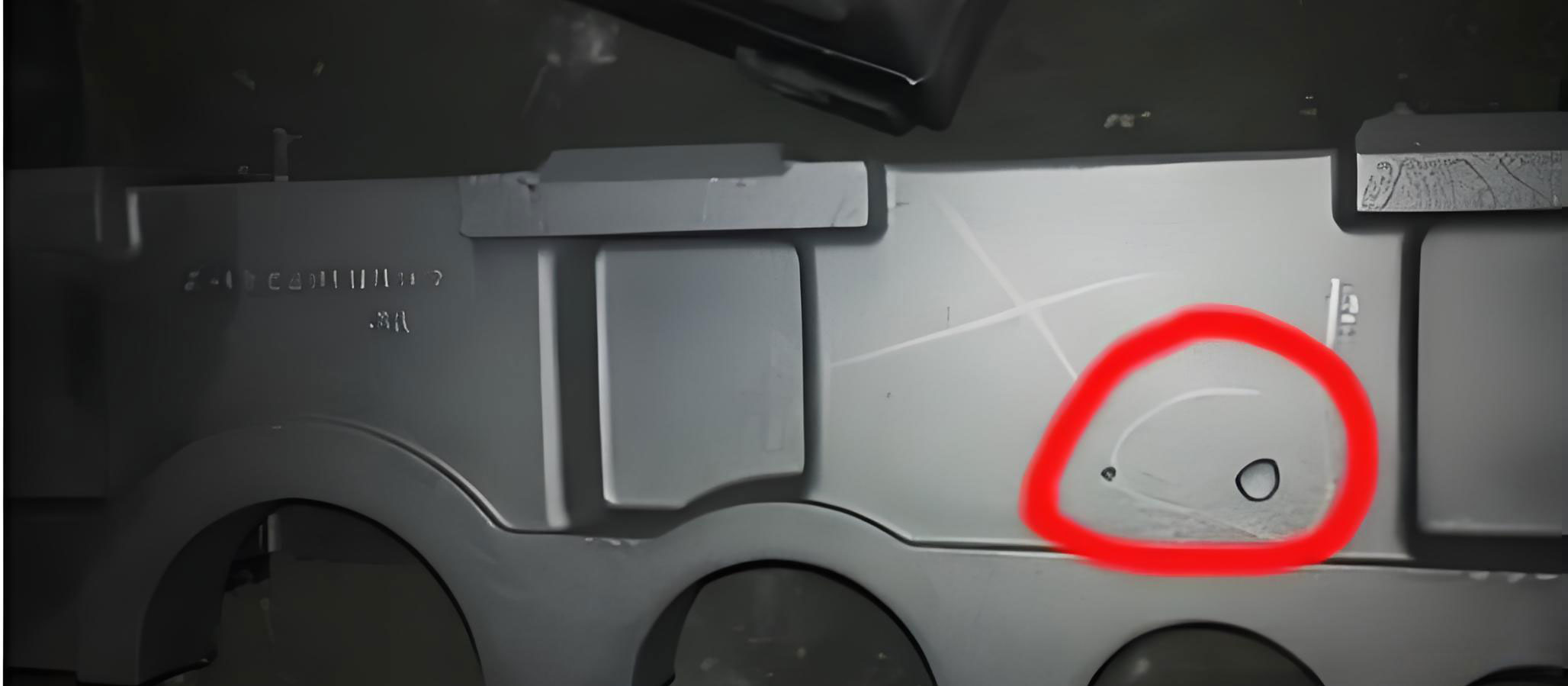
The defects in our cylinder heads were consistently identified as invasive blowholes. They were located at the highest points of the casting cavity on the exhaust side, particularly in isolated, relatively thick boss sections. These defects were sometimes visible after shakeout and shot blasting as surface blowholes, or revealed as subsurface porosity in casting after machining. The fundamental physical condition for the formation of an invasive blowhole is well established: gas pressure at the metal-mold interface must exceed the local metallostatic pressure plus any opposing pressures from surface tension or metal viscosity.
The governing inequality can be expressed as:
$$ P_{gas} \ge P_{metal-static} + P_{resistance} + P_{capillary} $$
Where:
- $P_{gas}$ is the pressure generated by gas evolution from the sand core/mold binder system.
- $ P_{metal-static} = \rho g h $ is the metallostatic pressure ($\rho$: metal density, $g$: gravity, $h$: height of metal above the point).
- $P_{resistance}$ represents the pressure required to overcome viscous resistance for gas bubble movement through the liquid metal.
- $P_{capillary}$ is the pressure due to surface tension at the gas-liquid interface, given by $ \frac{2\gamma}{r} $ for a spherical bubble of radius $r$ ($\gamma$: surface tension).
A defect forms when $P_{gas}$ dominates. Our analysis focused on the factors influencing each term in this inequality for the problematic locations.
Systematic Investigation of Contributing Factors
We conducted a root cause analysis, evaluating each potential contributor against the blowhole formation model.
1. Core Sand Gas Generation: High gas evolution from cores, especially the shell mold water jacket core, directly increases $P_{gas}$. We verified that our raw material specifications were already stringent: cold-box resin addition was 0.6-0.65%, shell sand hot gas evolution at 1000°C was <20%, and coating gas evolution was ~30%. These were comparable to industry benchmarks, so this was not initially considered the primary variable, though it sets a baseline gas load.
2. Inadequate Core Drying: Moisture in cores violently vaporizes, spiking local $P_{gas}$ and can promote reaction gas (e.g., $Fe + H_2O \rightarrow FeO + H_2$). Rigorous audits of the core drying process confirmed cores were properly cured and coated. This factor was ruled out.
3. Pouring Temperature and Speed: Low temperature increases metal viscosity, raising $P_{resistance}$ and making it harder for bubbles to escape. Slow pouring extends the time cores are heated before being fully submerged, increasing total gas evolution. Our process data showed stable pouring at 1400-1430°C with a consistent fill time of 16-18 seconds, which was within the acceptable window for this alloy and geometry.
4. Metallostatic Pressure ($P_{metal-static}$): The vertical height from the casting’s top to the sprue base was 270 mm, providing a theoretical $P_{metal-static}$ of ~0.19 atm for iron. While seemingly sufficient, effective pressure at the end of filling can be lower if the gating system is not optimally pressurized. Initial observation did not show obvious issues like unfilled pouring cups.
5. Venting System Efficacy: This emerged as the most critical area. Venting must efficiently remove evolved gas, preventing $P_{gas}$ from building up to critical levels. We identified two major shortcomings:
- Lack of Local Venting at High Points: The exhaust-side bosses were the highest, isolated points in the mold. The original design, constrained by product geometry, had no dedicated vent or overflow riser at these locations. This trapped gas exactly where $P_{metal-static}$ was at its minimum.
- Blocked Core Print Vents: While core prints were designed as vent paths, the clearance between the core print and the mold cavity was excessive in some cases. During pouring, molten iron penetrated this gap, sealing off the vent passages completely. This transformed designed vents into sealed chambers, causing a rapid buildup of $P_{gas}$ that was forced into the solidifying metal.
The convergence of high gas generation (especially from the large water jacket core), insufficient local venting at critical points, and blocked escape paths created a perfect storm for severe invasive porosity in casting.
Corrective Actions and Implementation
The improvement strategy targeted the venting system and core assembly integrity to tip the pressure balance back in favor of sound castings.
Action 1: Modification of Casting Geometry and Addition of Overflow Riser. We engaged with the product engineering team to request a minor but crucial design change. The isolated round boss on the exhaust side was modified to a square shape. This change, which did not affect the part’s function or assembly, allowed us to attach a small “pencil” or overflow riser at the top of this boss.
- Function: This riser serves a dual purpose. First, it acts as an excellent vent, providing a direct escape path for gases accumulating at the highest point. Second, it acts as a receiver for the first, cooler, and possibly oxidized metal that enters this remote cavity, effectively “purging” the area before the hotter, cleaner metal fills it. The improvement in effective venting reduces the local $P_{gas}$.
Action 2: Optimization of Core Print Clearances. We meticulously reviewed and adjusted the fit between all core prints and their corresponding mold cavities. The goal was to find the minimum clearance that allowed for core placement without damage but prevented metal penetration.
- Implementation: This involved slight modifications to core box and mold tooling. The new clearance was tight enough to allow gases to pass through the permeable sand of the core print while using the core’s geometry to choke off the metal flow. Post-implementation inspection of shaken-out castings confirmed clean core prints without metal fins, indicating vents remained open.
The combined effect of these actions can be modeled by revisiting the pressure inequality. The overflow riser increases the effective $h$ in $P_{metal-static}$ at the last point to solidify and ensures atmospheric pressure at the vent exit, maximizing the pressure differential for gas expulsion. Simultaneously, clearing the vent paths drastically reduces the steady-state value of $P_{gas}$ by providing a low-resistance escape route. The modified condition for a sound casting becomes easier to satisfy:
$$ P_{gas (vented)} < \rho g h_{effective} + P_{capillary} $$
Where $P_{gas (vented)}$ is the much-reduced gas pressure due to efficient venting.
Results and Quantitative Analysis
The implementation of these corrective measures led to a dramatic and sustained improvement. The scrap rate due to exhaust-side blowhole porosity in casting dropped from the highly variable 3-20% range to a stable level below 0.3%. The table below summarizes the key parameters before and after the improvement, highlighting the systemic changes.
| Parameter / Feature | Initial State (Problematic) | Improved State | Impact on Porosity Formation |
|---|---|---|---|
| Exhaust Boss Geometry | Isolated round boss, no vent. | Modified square boss with integrated overflow riser. | Provided direct vent path; trapped cold/oxidized metal. |
| Core Print Vent Status | Often blocked by metal penetration due to excessive clearance. | Clearance optimized; vents remain open throughout pour. | Enabled continuous gas evacuation, lowering $P_{gas}$. |
| Effective Metallostatic Head at Boss | $h$ = height to top of casting. | $h_{effective}$ ≈ height to top of overflow riser (increased). | Increased $P_{metal-static}$ at critical location. |
| Scrap Rate (Blowhole) | 2% – 20% (unstable) | < 0.3% (stable) | Direct measure of success. |
Comprehensive Framework for Preventing Gas Porosity
Based on this case study and foundational principles, preventing gas porosity in casting, particularly in complex cored work, requires a holistic approach targeting all variables in the pressure balance equation. The following framework outlines key strategies:
1. Minimize Gas Generation ($\downarrow P_{gas}$):
- Core Sand Binders: Use the lowest possible resin addition consistent with required core strength. Evaluate low-gas generation binder systems (e.g., phenolic urethane, alkaline phenolic).
- Coatings: Select refractory coatings with low gas evolution properties. Ensure they are applied evenly and dried thoroughly.
- Core Process Control: Maintain strict control over core shooter parameters, catalyst levels, and curing to ensure complete polymerization and avoid uncured “wet” sections that are high gas generators.
2. Maximize Venting Efficiency ($\downarrow P_{gas}$, Facilitate Escape):
- Mold Cavity Venting: Strategically place vent slots, porous vent plugs, or sand spikes at the highest points and isolated sections of the mold cavity, especially in the cope (top mold half).
- Core Internal Venting: Design sand cores with integral vent channels, using vent wires during core shooting or designing self-venting core prints. For large cores, consider permeable ceramic rods as dedicated vent channels.
- Overflow Risers: Employ small overflow risers at cavity extremities. They act as efficient gas vents and dirt traps. Their size can be optimized using modulus calculations to ensure they solidify after the casting section.
$$ M_{riser} \ge 1.2 \times M_{casting-section} $$
Where $M = \frac{Volume}{Surface Area}$ is the geometric modulus. - Seal Vents from Metal Intrusion: This is critical. Use core seals, proper print clearances, or blind vents packed with loose sand/stop-off material to prevent metal from flooding the vent network.
3. Optimize Pouring Parameters ($\uparrow P_{metal-static}$, $\downarrow P_{resistance}$):
- Pouring Temperature: Maintain an adequately high pouring temperature to keep metal fluidity high, reducing $P_{resistance}$. Balance this against other defects like penetration or expansion defects. For gray iron cylinder heads, 1380-1420°C is a typical target.
- Pouring Speed/Time: A controlled, moderately fast pour minimizes the time cores are exposed to radiant heat before being submerged, reducing total gas evolution before the metal head provides pressure. It also maintains thermal gradient. Pouring time $t_p$ can be estimated via Bernoulli’s equation and should be validated through simulation.
$$ t_p \approx \frac{W}{\rho A_{choke} \sqrt{2gh}} $$
Where $W$ is casting weight, $A_{choke}$ is the choke area, and $h$ is the sprue height. - Gating Design: Use a pressurized, bottom-gated system for vertical pouring to ensure a calm, rising metal front that pushes gases ahead of it towards the vents. Avoid turbulent impingement on cores.
4. Ensure Process Consistency:
- Metal Treatment: Control hydrogen and nitrogen pick-up during melting and holding. Use clean, dry charge materials and avoid excessive moisture in inoculation alloys.
- Mold and Core Hardness: Maintain consistent, high mold hardness to reduce mold wall movement and potential “breathing” that can draw gas into the casting.
Conclusion
The successful resolution of chronic gas porosity in casting in a vertically poured cylinder head underscores that this defect is rarely due to a single cause. It is the consequence of a system where gas generation, venting capacity, and metal pressure are in imbalance. Our investigation confirmed that while factors like raw material quality and pouring parameters form the necessary baseline, the sufficiency condition for defect elimination often lies in the meticulous design and maintenance of the venting system. The integration of strategic overflow risers at isolated high points and the precise control of core print clearances to ensure open vents were the decisive actions that transformed the process from unpredictably defective to robustly reliable. This case study provides a validated, systematic framework—centered on the fundamental pressure balance model—for diagnosing and eliminating invasive blowhole porosity in casting across a wide range of complex, cored cast components.