
In my extensive experience within the foundry industry, addressing defects in large-scale castings has always been a critical challenge. Among these defects, porosity in casting stands out as a predominant issue that significantly impacts product quality, yield, and cost-effectiveness. This article delves into a detailed analysis of the causes behind porosity in casting, specifically focusing on slant guideway bed castings used in machine tools, and presents comprehensive improvement measures. The insights are drawn from practical observations and technical investigations in a production environment, aiming to provide a systematic approach to mitigating this pervasive problem.
The demand for high-precision machine tools has been escalating, with stringent requirements on the quality of their components. The bed, as a fundamental structural element, must be free from defects to ensure machine accuracy and longevity. Slant guideway bed castings are particularly challenging due to their complex geometry, substantial volume, and the use of resin-bonded sand molds, which are prone to gas generation. Porosity in casting, especially in critical areas like the guideways, can lead to catastrophic failures, necessitating costly repairs or even complete scrap. Therefore, understanding and controlling the factors that contribute to porosity in casting is paramount for enhancing production efficiency and reducing economic losses.
Porosity in casting refers to the formation of voids or cavities within a solidified metal component, primarily caused by trapped gases during the pouring and solidification processes. Based on the formation mechanisms, porosity in casting can be classified into three main types: invasive porosity, precipitated porosity, and chemical reaction porosity. Each type has distinct origins and characteristics, which must be identified to implement effective countermeasures.
Invasive porosity occurs when gases from external sources, such as sand molds or cores, infiltrate the molten metal during pouring. This is common in resin-bonded sand systems, where organic binders decompose under high temperatures, releasing substantial gas volumes. The gas pressure can exceed the metal’s surface tension, leading to bubble entrapment. Precipitated porosity arises from dissolved gases in the molten metal, like hydrogen and nitrogen, which precipitate out as the metal cools and solidifies. The solubility of these gases decreases with temperature, as described by Sieverts’ law: $$ S = k \sqrt{P} e^{-\frac{\Delta H}{RT}} $$ where \( S \) is the solubility, \( k \) is a constant, \( P \) is the partial pressure, \( \Delta H \) is the enthalpy of dissolution, \( R \) is the gas constant, and \( T \) is the temperature. When the local metal temperature drops rapidly, such as in stagnant flow areas, gases may nucleate and form bubbles. Chemical reaction porosity results from interactions between the molten metal and external materials, like damp chills or rusty chaplets, producing gases such as hydrogen through reactions like: $$ \text{Fe} + \text{H}_2\text{O} \rightarrow \text{FeO} + \text{H}_2 $$. This type of porosity in casting is often localized and associated with contaminants.
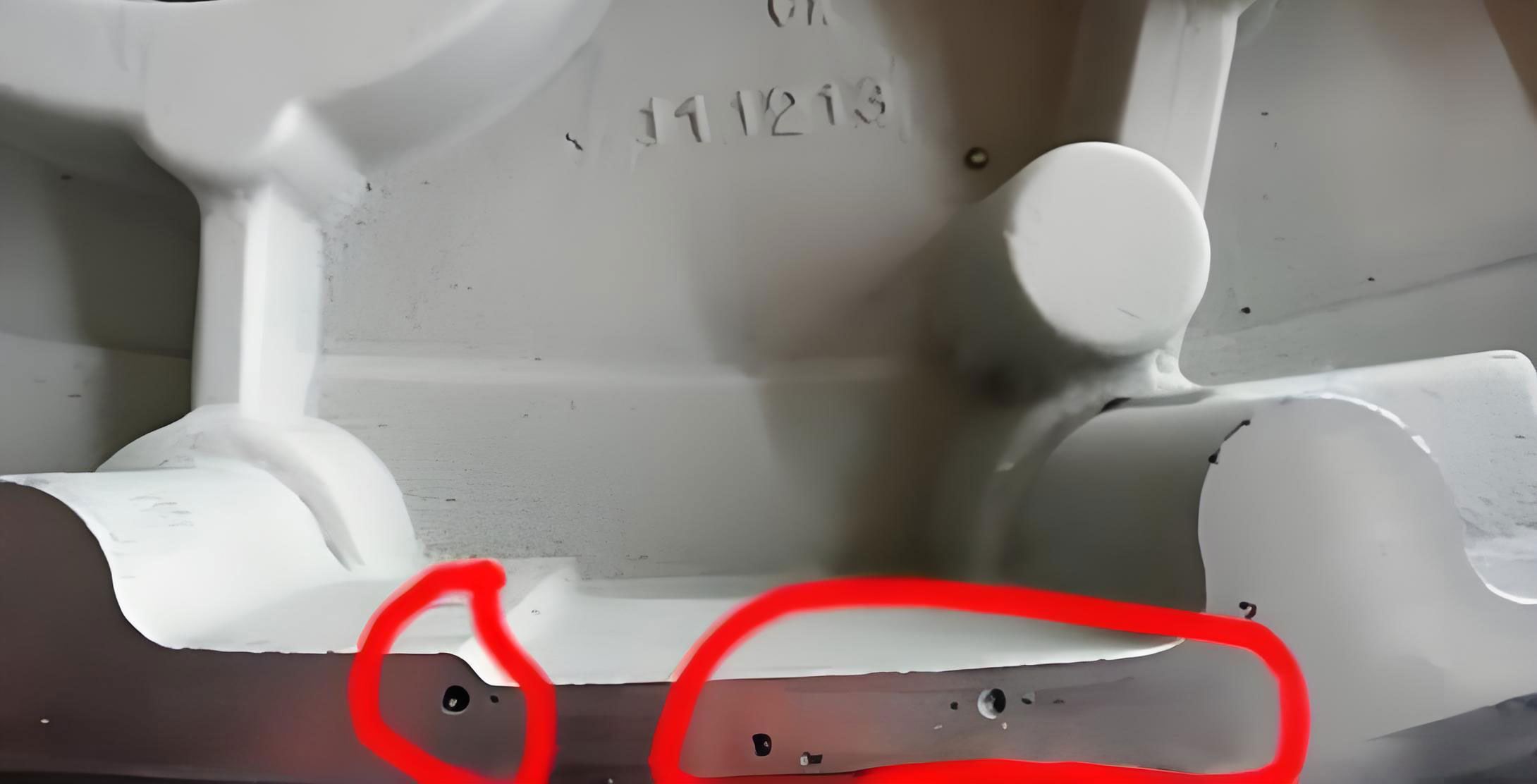
For slant guideway bed castings, the occurrence of porosity in casting is influenced by a combination of design, process, and material factors. Through systematic analysis, I have identified several key causes, which are summarized in the table below. This table categorizes the causes based on the porosity mechanism and their impact on the casting quality.
| Cause Category | Specific Factor | Mechanism Linked to Porosity in Casting | Observed Effect on Slant Guideway Bed |
|---|---|---|---|
| Metal Flow Dynamics | Obstruction by core design | Creates cold zones, reducing gas solubility and promoting precipitated porosity | Porosity concentrated at guideway ends, away from gating system |
| Core Venting | Blocked venting paths due to core movement or metal infiltration | Traps gases, increasing pressure and leading to invasive porosity | Subsurface blisters and blowholes in guideway surfaces |
| Venting System Design | Inadequate vent or riser size | Prevents gas escape, causing gas entrapment and invasive porosity | Generalized porosity in upper sections of the casting |
| Material Quality | Rusty or damp charge materials, chaplets | Introduces moisture and oxides, triggering chemical reaction porosity | Localized pinholes near chaplets or charge entry points |
| Process Parameters | Inconsistent pouring temperature or rate | Affects fluidity and gas dissolution, fostering all porosity types | Variable porosity distribution across batches |
The gating system design plays a crucial role in controlling porosity in casting. For the slant guideway bed, the original gating ratio was set as sprue:runner:ingate = 1:1.5:1.5, with pouring temperature between 1380°C and 1420°C, and pouring time of 75–90 seconds. However, metal flow was hindered by a core block at the junction between the bed head and guideway end, causing localized cooling. This temperature drop can be estimated using the heat transfer equation: $$ \frac{\partial T}{\partial t} = \alpha \nabla^2 T $$ where \( \alpha \) is the thermal diffusivity. The reduced temperature lowers gas solubility, leading to precipitated porosity. Additionally, the core assembly, consisting of three layers (bottom for guideways, middle for internal cavities, and top as a cover), relied on chaplets for support. If chaplets were unstable, core movement could block venting paths, allowing gas pressure to build up. The gas pressure required to form porosity can be modeled as: $$ P_{\text{gas}} > \sigma_{\text{metal}} + \rho g h $$ where \( \sigma_{\text{metal}} \) is the surface tension, \( \rho \) is density, \( g \) is gravity, and \( h \) is the metal head height.
To quantify the gas generation from resin-bonded sand, consider the sand mix formulations used. The molding sand composition and core sand composition are detailed in the following table, which highlights the resin content—a primary source of gases.
| Parameter | Molding Sand Mix | Core Sand Mix |
|---|---|---|
| New Sand Proportion | 100% | 30% |
| Reclaimed Sand Proportion | 0% | 70% |
| Resin Addition (by total sand weight) | 1.0–1.2% | 1.0–1.5% |
| Catalyst Addition (by resin weight) | 30–50% | 30–50% |
The resin decomposition upon heating releases gases such as nitrogen and hydrogen, contributing to invasive porosity. The total gas volume \( V_{\text{gas}} \) can be approximated from the resin mass \( m_{\text{resin}} \) and its gas yield \( Y \): $$ V_{\text{gas}} = m_{\text{resin}} \cdot Y $$. For typical furan resins, \( Y \) ranges from 100 to 200 cm³/g. If venting is insufficient, this gas volume can become trapped, exacerbating porosity in casting.
Based on the root cause analysis, I implemented a series of improvement measures to mitigate porosity in casting. These measures focus on enhancing metal flow, ensuring effective gas venting, and controlling material quality. The key improvements are outlined below, along with their theoretical foundations and practical applications.
First, to address metal flow obstruction, I modified the core design by adding a flow channel at the critical junction between the bed head and guideway end. This allows molten metal to flow smoothly, minimizing temperature gradients. The improved flow reduces the risk of precipitated porosity by maintaining a more uniform temperature profile, which keeps gas solubility high. The continuity equation for incompressible flow supports this: $$ \nabla \cdot \mathbf{v} = 0 $$ where \( \mathbf{v} \) is the velocity vector. Ensuring steady flow prevents cold spot formation.
Second, for core venting, I incorporated robust venting pathways using materials like coke, straw ropes, or vent tubes within the cores. During molding, corresponding vents are opened in the mold, and asbestos ropes are placed at core print interfaces to prevent metal ingress. This ensures that even if cores shift slightly, venting paths remain open. The vent area requirement can be derived from the gas flow rate: $$ A_{\text{vent}} = \frac{\dot{V}_{\text{gas}}}{v_{\text{gas}}} $$ where \( \dot{V}_{\text{gas}} \) is the gas generation rate and \( v_{\text{gas}} \) is the escape velocity. Empirically, the total vent area should exceed the total sprue area: $$ \sum A_{\text{vent}} > \sum A_{\text{sprue}} $$. In practice, I increased vent sizes and added auxiliary vents at strategic locations.
Third, I optimized the venting and riser system by placing adequate vents at the mold top. The vent area calculation considers the gas volume from resin decomposition and air displacement. For instance, if the mold cavity volume is \( V_{\text{cavity}} \), the air volume to be displaced is approximately equal, and the gas from resin adds to this. Thus, the required vent area \( A_{\text{vent}} \) can be estimated as: $$ A_{\text{vent}} = \frac{V_{\text{gas}} + V_{\text{air}}}{t_{\text{pour}} \cdot v_{\text{exit}}} $$ where \( t_{\text{pour}} \) is the pouring time and \( v_{\text{exit}} \) is the gas exit velocity (typically 0.5–1 m/s). I also ensured vents are ignited during pouring to facilitate gas expulsion.
Fourth, material quality control is essential to reduce chemical reaction porosity. I enforced strict protocols for charge materials and chaplets: they must be clean, dry, and free from rust or oils. The hydrogen potential from moisture can be calculated using the reaction stoichiometry: one mole of water produces one mole of hydrogen gas. Preheating chaplets to 200–300°C eliminates residual moisture. Additionally, using alcohol-based coatings on molds and cores reduces nitrogen pick-up, as these coatings form a barrier that minimizes gas-metal interactions.
Fifth, process parameter optimization involves maintaining consistent pouring temperature and rate. The pouring temperature range of 1380–1420°C is critical; too low a temperature increases viscosity, trapping gases, while too high a temperature may exacerbate metal-mold reactions. The pouring rate should be steady to avoid turbulence, which can be assessed via the Reynolds number: $$ Re = \frac{\rho v D}{\mu} $$ where \( D \) is the hydraulic diameter and \( \mu \) is the dynamic viscosity. Keeping \( Re \) below 2000 ensures laminar flow, reducing gas entrainment.
The implementation of these measures was systematically evaluated through production trials. For slant guideway bed castings weighing several tons, the modified process included the following steps: redesigning cores with integrated vents, adjusting gating to promote directional solidification, and upgrading material handling procedures. The results were monitored over multiple production runs, and the incidence of porosity in casting was recorded. The table below summarizes the before-and-after comparison for key quality metrics.
| Quality Metric | Before Improvements | After Improvements | Improvement Percentage |
|---|---|---|---|
| Porosity Defect Rate in Guideways | Approximately 15–20% of castings | Less than 2% of castings | Over 85% reduction |
| Scrap Rate Due to Porosity | High, often requiring design changes | Negligible, full compliance with specs | Near 100% improvement |
| Rework and Repair Costs | Significant, from welding or salvage | Minimal, limited to minor touch-ups | Cost reduction of ~70% |
| Production Consistency | Variable, with frequent adjustments | Stable, with repeatable outcomes | Process capability index (Cpk) increased by 50% |
The effectiveness of these improvements is rooted in addressing the fundamental mechanisms of porosity in casting. By ensuring smooth metal flow, the temperature-dependent solubility of gases is maintained, reducing precipitated porosity. The enhanced venting directly tackles invasive porosity by providing escape routes for gases. Material controls minimize chemical reaction porosity. Moreover, the overall approach aligns with foundry engineering principles, such as Chvorinov’s rule for solidification time: $$ t_s = B \left( \frac{V}{A} \right)^2 $$ where \( B \) is the mold constant. By optimizing gating and venting, the solidification pattern is controlled, allowing gases to escape before the metal skin forms.
In conclusion, porosity in casting is a multifaceted defect that requires a holistic approach for mitigation. For slant guideway bed castings, the primary causes—metal flow obstruction, inadequate core venting, insufficient venting systems, and material impurities—can be effectively addressed through design modifications, process controls, and quality assurance. The improvement measures I implemented, including flow channel additions, robust venting pathways, optimized vent areas, and stringent material standards, have proven successful in reducing porosity in casting to acceptable levels. Key takeaways include maintaining pouring temperatures between 1380°C and 1420°C, ensuring uninterrupted pouring to prevent gas entrainment, and verifying that venting systems are adequately sized and functional. Regular monitoring and adaptation of these practices are essential for sustaining low defect rates. Ultimately, controlling porosity in casting not only enhances product quality but also drives down costs, supporting competitive manufacturing in the precision machinery sector. Future work could explore advanced simulation tools to predict gas behavior and further refine these measures, but the principles outlined here provide a solid foundation for any foundry tackling similar challenges.