
In the sophisticated production realm of lost wax casting, the interaction between molten metal and the ceramic shell cavity is a complex interplay of physics and chemistry. This interaction, if not meticulously controlled, gives rise to various casting defects that compromise quality and increase cost. Among these, sand adhesion defects, where a layer of fused metal and shell material tenaciously bonds to the casting surface, are particularly prevalent and troublesome. This article provides a detailed, first-person perspective on the analysis, mechanisms, and practical solutions for chemical and mechanical sand adhesion in lost wax casting, incorporating formulas and tables to summarize key concepts for clarity and depth.
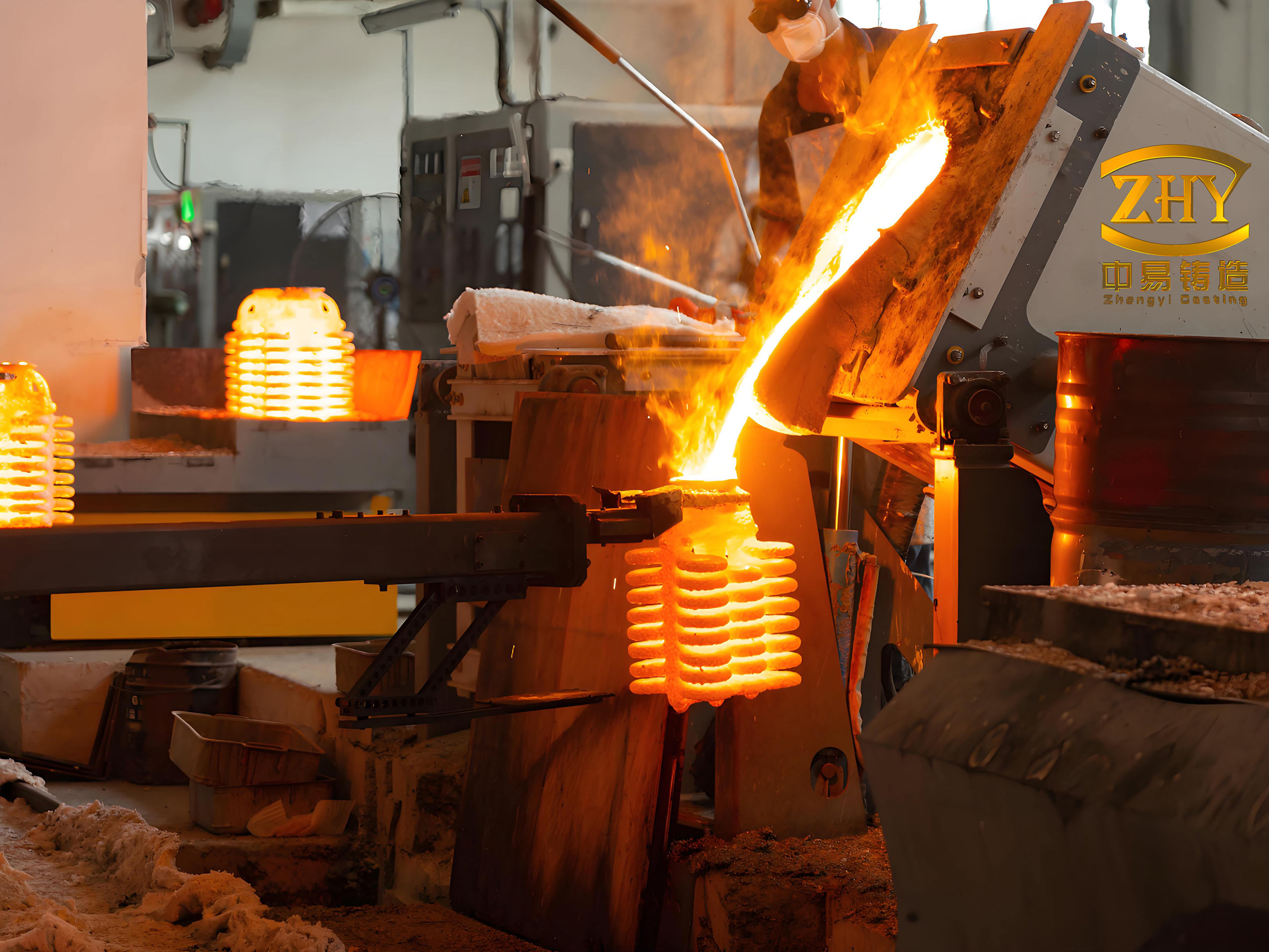
The presence of adhered sand necessitates extensive and laborious cleaning operations, mars the aesthetic finish of the component, and poses significant challenges during subsequent machining processes. Ultimately, it drives up production costs and reduces yield. Therefore, a profound understanding and effective control of these defects are paramount for any successful lost wax casting operation. While classifications may vary, a fundamental distinction between two primary types—Chemical Adhesion and Mechanical Adhesion—provides the clearest framework for diagnosis and remediation.
Fundamentals of the Lost Wax Casting Process
To contextualize the defects, it’s essential to recall the core steps of lost wax casting. The process begins with the creation of a wax pattern, which is then assembled into a cluster and repeatedly dipped into ceramic slurries and stuccoed with refractory grains to build a robust shell. The wax is subsequently melted out (de-waxed), and the shell is fired at high temperature to develop strength and remove volatiles. Finally, molten metal is poured into the preheated shell. It is during this final stage of pouring and solidification that the conditions for sand adhesion are created, based on the thermal, chemical, and physical interactions at the metal-shell interface.
Chemical Sand Adhesion (Burning-On)
Chemical sand adhesion, often termed “burning-on,” results from high-temperature chemical reactions between the molten metal (or its oxides) and the refractory material of the shell.
Characteristics and Manifestation
This defect presents as a layer of sintered material firmly bonded to the casting surface, often with a glazed or slag-like appearance. It is typically difficult to remove by mechanical means like blasting and may require grinding. Chemically adhered sand is frequently found in specific areas of the casting:
- Thick sections and hot spots.
- Regions adjacent to gates and risers.
- The lower sections of the casting in the drag position.
- Areas with poor thermal dissipation.
Formation Mechanism and Chemical Basis
The formation is a multi-step chemical process, primarily driven by the oxidation of metal and subsequent reaction with silica ($SiO_2$), a common refractory in lost wax casting shells.
Step 1: Oxidation of Iron. Upon contact with the shell atmosphere (containing residual moisture or air), molten iron oxidizes:
$$2Fe + O_2 \rightarrow 2FeO$$
This iron(II) oxide (FeO, wüstite) has a relatively low melting point (around 1370°C) and high fluidity.
Step 2: Formation of Low-Melting Silicates. The FeO reacts aggressively with the silica in the shell to form iron silicate (fayalite):
$$2FeO + SiO_2 \rightarrow 2FeO \cdot SiO_2$$
Fayalite has an even lower melting point (approximately 1205°C), is highly fluid, and wets silica grains exceptionally well. This liquid silicate readily penetrates shell pores and, upon cooling, forms a strong, glassy bond that cements refractory grains to the casting.
For alloys like manganese steel, a similar reaction occurs, forming low-manganese silicates:
$$2Mn + O_2 \rightarrow 2MnO$$
$$2MnO + SiO_2 \rightarrow 2MnO \cdot SiO_2$$
These compounds also have low melting points, promoting adhesion.
Primary Contributing Factors
| Factor Category | Specific Cause | Effect on Chemical Adhesion |
|---|---|---|
| Shell Preparation | Insufficient firing (low temp/short time) | Leaves moisture/organics; promotes metal oxidation and reaction. |
| Shell rehydration before pouring | Introduces moisture, leading to steam and oxidation at the interface. | |
| Shell Material | Low-refractoriness materials or high impurity content (e.g., high R2O, RO) | Lowers the reaction temperature; basic oxides flux silica, accelerating silicate formation. |
| Metal Chemistry & Handling | High oxygen content in melt; inadequate deoxidation; excessive superheat | Increases the availability of metal oxides (FeO, Cr2O3, etc.) to react with the shell. |
| Thermal Conditions | Excessive pouring temperature and/or shell preheat temperature | Prolongs liquid metal/slag contact time, intensifies chemical interaction and penetration. |
Practical Mitigation Strategies for Chemical Adhesion
Based on the mechanisms, the countermeasures focus on breaking the chain of chemical reaction.
1. Optimize Shell Firing Practice: A complete, consistent firing cycle is non-negotiable. For silica-based shells, firing between 850-950°C for 2-4 hours (depending on load) is typical. A properly fired shell should appear white, light pink, or浅蓝色. Dark grey shells indicate residual carbon and insufficient firing. Fired shells should be poured promptly; if delayed, a brief re-firing is advised.
2. Select Appropriate, High-Quality Refractories: The choice of shell facecoat material is critical. While silica is common, its use with reactive alloys (e.g., high Mn, high Ti steels) is problematic.
| Refractory Material | Chemical Formula | Melting Point (~°C) | Key Advantage for Preventing Chemical Adhesion |
|---|---|---|---|
| Fused Silica | $SiO_2$ | ~1713 | Low thermal expansion, good for non-ferrous alloys. |
| Alumina | $Al_2O_3$ | ~2050 | High refractoriness, chemically more inert than silica. |
| Zircon | $ZrSiO_4$ | ~2550 | Excellent chemical inertness, especially against basic slags (FeO, MnO). |
| Alumino-Silicates (Mullite) | $3Al_2O_3 \cdot 2SiO_2$ | ~1850 | Good thermal stability and resistance. |
Practical Example: A foundry using a water glass-silica shell system for stainless steel castings experienced chemical adhesion scrap rates of 50-60%. Switching to a zircon flour facecoat with a silica sol binder dramatically reduced the defect to below 15%, primarily by eliminating the silica-metal oxide reaction.
3. Control Metal Oxidation and Temperature:
- Employ effective deoxidation practices (e.g., using Al, CaSi).
- Minimize turbulence during pouring to reduce oxide film entrainment.
- Use the lowest practical pouring temperature that ensures complete filling and feeding.
4. Improve Thermal Management of the Casting: Design the gating system to place hot spots away from critical surfaces. Ensure adequate spacing between patterns in the cluster to facilitate shell cooling. Modify part design, where possible, to avoid extreme section thickness variations.
Mechanical Sand Adhesion (Metal Penetration)
Mechanical adhesion, or metal penetration, is a physical phenomenon where molten metal infiltrates the macroscopic pores between refractory grains without necessarily forming extensive chemical bonds.
Characteristics and Manifestation
This defect appears as a rough, granular layer of metal interlocked with sand grains. It often occurs in areas where the metal pressure is high or the local shell surface is coarse:
- Internal corners and undercuts.
- Narrow channels and small holes.
- Surfaces near gates or below the pouring cup.
- Lower sections of tall castings (higher metallostatic pressure).
Formation Mechanism and Physical Principles
Penetration occurs when the metallostatic pressure ($P_m$) overcomes the opposing capillary pressure ($P_c$) within the shell pores. The critical condition for penetration is given by:
$$P_m > P_c = \frac{2\sigma \cos\theta}{r}$$
Where:
- $P_c$ is the capillary (back) pressure resisting penetration.
- $\sigma$ is the surface tension of the molten metal.
- $\theta$ is the contact angle (wettability) between the metal and the refractory.
- $r$ is the effective pore radius between refractory grains.
Penetration is favored by low $\sigma$, low $\cos\theta$ (good wettability, often linked to chemical reactions), and most significantly, a large pore radius $r$. The depth of penetration ($h$) can be approximated by considering pressure balance and solidification time, often related by:
$$h \propto \sqrt{\frac{P \cdot t_s}{\eta}}$$
where $P$ is the effective driving pressure, $t_s$ is the local solidification time of the metal skin, and $\eta$ is the metal viscosity.
Primary Contributing Factors
| Factor Category | Specific Cause | Effect on Mechanical Adhesion |
|---|---|---|
| Shell Facecoat Quality | Low slurry viscosity; coarse stucco sand; inadequate coating thickness | Increases effective pore size ($r$), drastically reducing $P_c$ and facilitating metal entry. |
| Thermal Conditions | Excessive metal pouring temperature and/or shell preheat temperature | Lowers metal $\sigma$ and $\eta$; delays solidification ($\uparrow t_s$), allowing more time for penetration. |
| Pressure Head | High effective metallostatic head ($H$) | Directly increases the driving pressure $P_m = \rho g H$, forcing metal into pores. |
| Alloy Properties | Alloys with inherently low surface tension | Reduces $P_c$, making penetration easier from a physical standpoint. |
The interplay between temperature and grain size is crucial. While finer grains offer smaller initial pores, excessively high temperatures can sinter them, creating even larger, consolidated pores that are deeply penetrated.
Practical Mitigation Strategies for Mechanical Adhesion
The strategies aim to minimize pore size, reduce driving pressure, and shorten the time window for penetration.
1. Engineer a Dense Facecoat:
- Use a well-controlled slurry with adequate viscosity and refractory flour content (e.g., 200-325 mesh zircon or silica flour).
- Apply a fine primary stucco (e.g., 80-120 mesh or finer) to create a tight surface layer.
- Ensure sufficient number of coating layers to bridge stucco grains and eliminate continuous porosity.
2. Control Thermal Parameters:
- Pouring Temperature: Use the lowest temperature that ensures clean filling and adequate feeding. For carbon steels, this often lies in the range of 1540-1600°C.
- Shell Preheat Temperature: A balance is needed. While a hot shell improves fluidity, it can promote penetration. A typical range is 700-900°C, often optimized towards the lower end for dense, thin-section castings prone to adhesion.
3. Optimize Gating Design for Pressure: Minimize the effective metallostatic head on susceptible areas of the casting. This must be balanced against the need for sufficient pressure to prevent mistruns and shrinkage. Strategic use of vents can help manage pressure in deep cavities.
4. Utilize Non-Wetting Coatings: Applying a wash or paint containing materials like graphite or zirconia to the fired shell face can increase the contact angle $\theta$, thereby increasing $P_c$ and providing a physical barrier to penetration.
The Interplay and Unified Approach to Defect Control
In practice, chemical and mechanical adhesion are not mutually exclusive. A defect often starts as mechanical penetration, which then provides an intimate interface for chemical reactions to occur, or vice-versa. The contributing factors—high temperature, poor shell refractoriness, excessive pressure—are common to both. Therefore, a holistic process control strategy is essential for high-quality lost wax casting.
A unified approach checklist for preventing sand adhesion defects includes:
- Material Selection: Choose a refractory system (binder + flour + stucco) chemically compatible with the alloy being cast. Zircon is often the premium choice for reactive alloys.
- Shell Process Control: Maintain precise control over slurry parameters, stucco application, drying, and firing to produce a shell with high hot strength, low porosity, and minimal residual volatiles.
- Thermal Management: Rigorously control both metal superheat and shell preheat temperatures based on the specific casting geometry and alloy.
- Metal Quality and Handling: Implement robust melting, deoxidation, and pouring practices to deliver clean, calm metal into the cavity.
- Design for Manufacturability: Collaborate on part and tooling design to minimize isolated hot spots, thick sections, and high-pressure areas on critical surfaces.
By understanding the distinct yet intertwined mechanisms of chemical and mechanical sand adhesion, foundry engineers can move from reactive problem-solving to proactive process design. Systematic attention to shell chemistry, structural integrity, and thermal dynamics is the key to suppressing these costly defects. The goal in lost wax casting is not merely to make a shape, but to reveal a flawless surface directly from the mold. Achieving this requires treating the ceramic shell not just as a container, but as a critical, engineered component in the metallurgical system, whose interaction with the molten metal must be meticulously managed from pattern to pour.