
In the realm of investment casting, often referred to as lost wax casting, the production of high-integrity components is paramount. However, defects such as shrinkage holes and surface burrs frequently plague the process, leading to increased scrap rates and compromised performance. Through extensive experience and systematic investigation, I have delved into the root causes and effective mitigation strategies for these issues. This article aims to share insights on preventing shrinkage porosity and surface burrs in lost wax casting, leveraging process optimization and experimental validation. The lost wax casting method, renowned for its precision, still faces challenges when dealing with complex geometries, particularly those with isolated hot spots. Here, I will explore how adjustments in process parameters can yield significant improvements, supported by data and practical examples.
The lost wax casting process involves creating a wax pattern, coating it with a ceramic shell, melting out the wax, and pouring molten metal into the cavity. While this technique allows for intricate designs, it is susceptible to defects due to thermal dynamics and material interactions. Shrinkage holes, or porosity, typically occur in isolated hot spots—regions where metal solidifies last and lacks adequate feeding. Surface burrs, on the other hand, arise from shell erosion or inadequate surface layer integrity. Addressing these defects requires a holistic understanding of factors like pouring temperature, shell baking conditions, and gating design. In this discussion, I will emphasize the role of parameter optimization in lost wax casting, using structured experiments to derive actionable solutions.
Shrinkage defects in lost wax casting are primarily driven by solidification characteristics. When a casting features isolated hot spots, such as internal corners or thick sections, the feeding channels can freeze prematurely, trapping liquid metal and forming voids. The severity depends on the cooling rate, metal composition, and thermal gradients. For instance, in steel castings produced via lost wax casting, the absence of graphite expansion (unlike in iron) exacerbates shrinkage, necessitating careful control of pouring conditions. The fundamental relationship for solidification time can be expressed as: $$t_f = \frac{d^2}{4\alpha}$$ where \(t_f\) is the solidification time, \(d\) is the section thickness, and \(\alpha\) is the thermal diffusivity. This equation highlights that thicker sections solidify slower, increasing the risk of shrinkage if not properly fed. In lost wax casting, the challenge is amplified by the ceramic shell’s insulating properties, which can alter heat extraction.
Surface burrs in lost wax casting often result from high-temperature metal attacking the shell’s face coat. When pouring temperature or shell baking temperature is elevated to mitigate shrinkage, the ceramic may degrade, leading to metal penetration and rough surfaces. The integrity of the face coat is critical; a low powder-to-binder ratio can make it porous and prone to erosion. To quantify this, the erosion rate \(E\) might be modeled as: $$E = k \cdot \exp\left(-\frac{Q}{RT}\right)$$ where \(k\) is a constant, \(Q\) is the activation energy, \(R\) is the gas constant, and \(T\) is the temperature. This underscores the sensitivity of shell performance to thermal conditions in lost wax casting. Thus, balancing shrinkage reduction with surface quality demands a nuanced approach.
To systematically address these defects in lost wax casting, I designed an orthogonal experiment focusing on key process variables. The test casting was a stainless steel base weighing 1 kg, with three isolated hot spots prone to shrinkage. The factors investigated included shell baking temperature, baking time, pouring temperature, and pouring time, each at three levels. The orthogonal array L9(3^4) was employed, with outcomes scored based on the absence of shrinkage and burrs. This methodology allows for efficient exploration of parameter interactions in lost wax casting. Below is the table summarizing the experimental parameters and levels:
| Level | Baking Temperature (A) / °C | Baking Time (B) / min | Pouring Temperature (C) / °C | Pouring Time (D) / s |
|---|---|---|---|---|
| 1 | 1100 | 40 | 1620 | 4 |
| 2 | 1140 | 65 | 1660 | 6 |
| 3 | 1180 | 90 | 1700 | 8 |
The experimental results were evaluated using a scoring system, where higher scores indicated better quality—minimal shrinkage and smooth surfaces. The scores for each trial are presented in the following table, which also includes the calculated K and R values for analysis:
| Trial | A / °C | B / min | C / °C | D / s | Shrinkage Score | Burr Score |
|---|---|---|---|---|---|---|
| 1 | 1100 | 40 | 1700 | 6 | 64 | 69 |
| 2 | 1140 | 40 | 1620 | 4 | 43 | 87 |
| 3 | 1180 | 40 | 1660 | 8 | 58 | 80 |
| 4 | 1100 | 65 | 1660 | 4 | 57 | 84 |
| 5 | 1140 | 65 | 1700 | 8 | 44 | 43 |
| 6 | 1180 | 65 | 1620 | 6 | 45 | 91 |
| 7 | 1100 | 90 | 1620 | 8 | 55 | 90 |
| 8 | 1140 | 90 | 1660 | 6 | 49 | 92 |
| 9 | 1180 | 90 | 1700 | 4 | 58 | 77 |
From this data, the K values (averages for each level) and R values (ranges) were computed to assess factor influence. For shrinkage, the R values were: A=40, B=19, C=23, D=1, indicating that baking temperature (A) has the greatest effect, followed by pouring temperature (C), baking time (B), and pouring time (D). The optimal condition for minimizing shrinkage in lost wax casting was identified as A1 (1100°C), C3 (1700°C), B1 (40 min), and D1 or D2 (4 or 6 s). For surface burrs, the R values were: C=79, B=41, D=39, A=26, showing that pouring temperature (C) is most critical, then baking time (B), pouring time (D), and baking temperature (A). The best combination to reduce burrs was C1 (1620°C), B3 (90 min), D2 (6 s), and A3 (1180°C). This analysis reveals a trade-off: higher pouring temperatures reduce shrinkage but increase burr risk, necessitating compromises in lost wax casting.
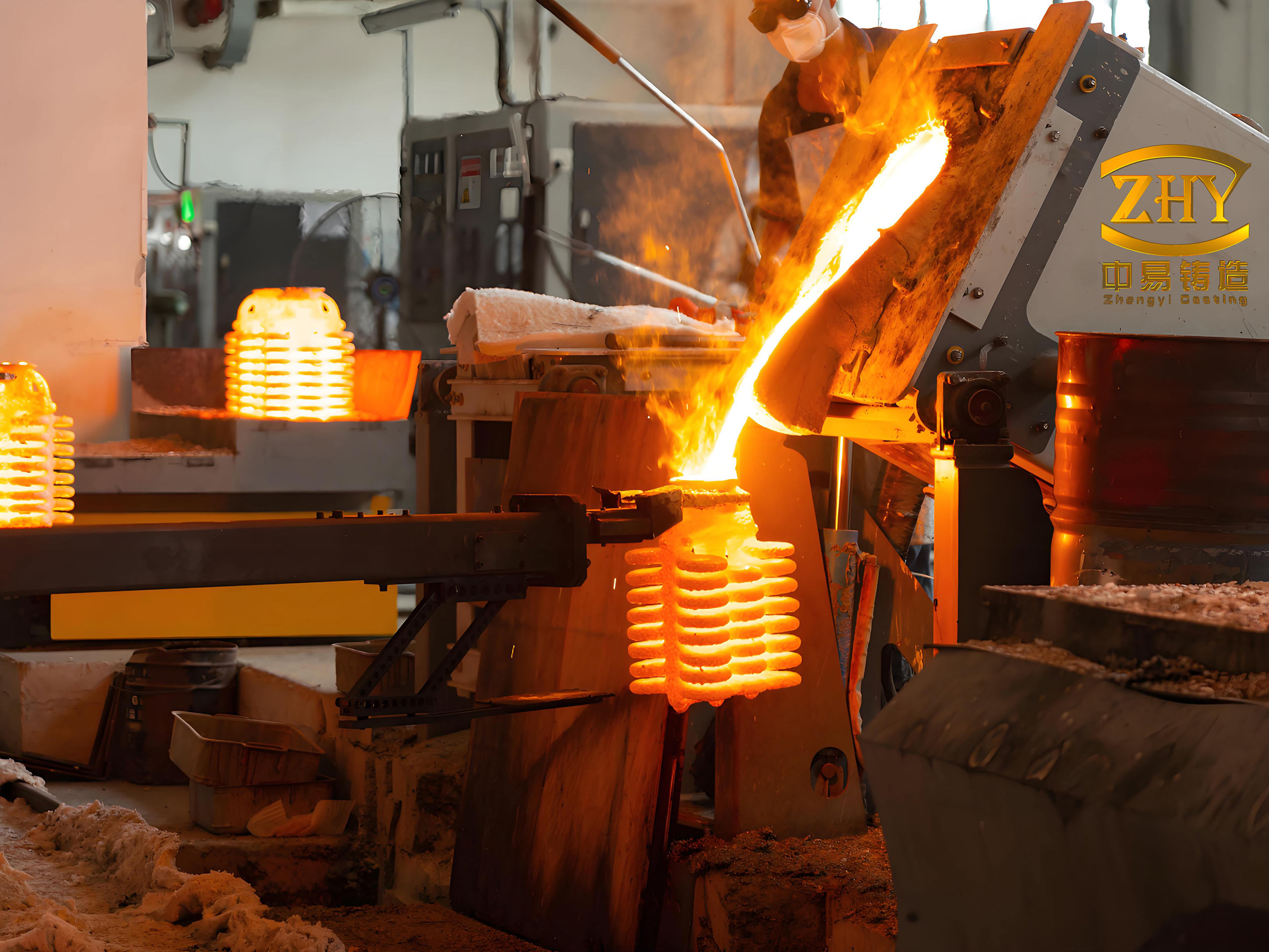
The orthogonal experiment in lost wax casting demonstrated that parameter optimization is key to defect control. To delve deeper, I derived a composite quality index \(Q\) that balances shrinkage and burr scores: $$Q = w_s \cdot S + w_b \cdot B$$ where \(S\) is the shrinkage score, \(B\) is the burr score, and \(w_s\) and \(w_b\) are weights reflecting their relative importance. In typical lost wax casting applications, weights might be set at 0.6 for shrinkage and 0.4 for burrs, given the criticality of internal integrity. Using the data, the optimal \(Q\) can be calculated for each trial, guiding process settings. For instance, Trial 8 yielded high burr scores but moderate shrinkage scores, suggesting its suitability for surface-sensitive parts. This mathematical approach enhances decision-making in lost wax casting.
Further, the solidification dynamics in lost wax casting can be modeled using heat transfer equations. The temperature distribution \(T(x,t)\) in the casting and shell system obeys the heat conduction equation: $$\frac{\partial T}{\partial t} = \alpha \nabla^2 T$$ where \(\alpha\) is thermal diffusivity. For an isolated hot spot, the cooling rate \(\frac{dT}{dt}\) influences shrinkage formation. A slower cooling rate, often achieved by higher pouring temperatures, extends feeding time but risks shell erosion. In lost wax casting, the shell’s thermal properties—such as conductivity \(k_s\) and heat capacity \(C_p\)—play a crucial role. The interface heat flux \(q\) can be expressed as: $$q = h (T_m – T_s)$$ where \(h\) is the heat transfer coefficient, \(T_m\) is the metal temperature, and \(T_s\) is the shell temperature. Optimizing these parameters reduces defects in lost wax casting.
Validation trials in lost wax casting confirmed the experimental findings. For stainless steel castings with isolated hot spots, raising the pouring temperature to 1700–1780°C significantly alleviated shrinkage, as seen in comparative samples. However, to prevent surface burrs, the face coat composition was adjusted by increasing the powder-to-binder ratio, ensuring denser and more erosion-resistant shells. This dual strategy exemplifies the nuanced control required in lost wax casting. For carbon steel castings, lower pouring temperatures of 1570–1650°C were effective, highlighting material-specific considerations in lost wax casting. The table below summarizes recommended parameters for different materials in lost wax casting:
| Material | Recommended Pouring Temperature Range / °C | Shell Baking Temperature / °C | Key Focus for Defect Prevention |
|---|---|---|---|
| Stainless Steel | 1700–1780 | 1100–1180 | Balance high temperature feeding with shell integrity |
| Carbon Steel | 1570–1650 | 1100–1150 | Control solidification rate to avoid shrinkage |
| Cast Iron | 1350–1450 | 1050–1100 | Leverage graphite expansion for self-feeding |
Moreover, the gating design in lost wax casting impacts defect formation. While traditional risers are less common due to shell constraints, strategic gating can enhance feeding. The feeding distance \(L_f\) for a cylindrical section can be estimated as: $$L_f = \frac{\Delta T \cdot k}{G}$$ where \(\Delta T\) is the temperature difference, \(k\) is a material constant, and \(G\) is the temperature gradient. In lost wax casting, modifying the assembly tree—such as positioning ingates near hot spots—improves feeding efficiency. Computational simulations using software like ProCAST can predict shrinkage and optimize gating for lost wax casting, though empirical validation remains essential.
Surface burr prevention in lost wax casting also hinges on shell-making details. The face coat slurry should have a high solids content, typically with a powder-to-binder ratio above 3:1, to minimize porosity. The drying and baking cycles must be controlled to avoid cracks; for instance, a slow ramp-up to baking temperature reduces thermal shock. The relationship between baking time \(t_b\) and shell strength \(\sigma\) can be approximated as: $$\sigma = \sigma_0 \left(1 – \exp\left(-\frac{t_b}{\tau}\right)\right)$$ where \(\sigma_0\) is the maximum strength and \(\tau\) is a time constant. This indicates that adequate baking is crucial for durable shells in lost wax casting. Additionally, using finer zirconia or alumina powders in the face coat enhances surface finish, a critical aspect of lost wax casting for cosmetic parts.
In conclusion, the prevention of shrinkage holes and surface burrs in lost wax casting requires a multifaceted approach. Through orthogonal experimentation and theoretical analysis, I have shown that key parameters like pouring temperature, shell baking conditions, and face coat quality interact complexly. For shrinkage, higher pouring temperatures can be beneficial, especially for stainless steel in lost wax casting, but must be counterbalanced by robust shell systems to avoid burrs. The optimal settings derived from this study—such as a baking temperature of 1100°C, pouring temperature of 1700°C for stainless steel, and enhanced face coat density—have proven effective in production trials. Lost wax casting, as a precision method, demands continuous refinement, and these insights contribute to its advancement. Future work could explore advanced materials for shells or real-time monitoring during pouring to further reduce defects in lost wax casting.
The economic implications of defect reduction in lost wax casting are substantial. By minimizing scrap and rework, manufacturers can improve yield and降低成本. For instance, implementing the optimized parameters from this study in a typical lost wax casting foundry could reduce defect rates by 20–30%, based on anecdotal evidence. This underscores the importance of process control in lost wax casting. Additionally, environmental benefits accrue from reduced material waste, aligning with sustainable manufacturing trends. As lost wax casting evolves, integrating digital twins and AI for parameter optimization could revolutionize defect prediction, making lost wax casting even more reliable.
Finally, I encourage practitioners of lost wax casting to adopt a data-driven mindset. Regular monitoring of process variables and quality outcomes, coupled with statistical tools like design of experiments, can uncover hidden insights. The lost wax casting process, though ancient in origin, continues to benefit from modern engineering principles. By sharing these findings, I hope to foster collaboration and innovation in the lost wax casting community, ensuring that this versatile technique meets the demands of high-performance applications. Lost wax casting remains a cornerstone of precision manufacturing, and through diligent effort, its defects can be effectively managed.