
As a critical near-net-shape manufacturing process in the aerospace industry, lost wax casting, also known as investment casting, plays a pivotal role in producing high-performance aircraft structural components. The mechanical properties of these components, such as strength, ductility, and fatigue resistance, are directly influenced by the intricate parameters of the lost wax casting process. In this comprehensive analysis, I delve into the mechanisms through which key process parameters—including pouring temperature, shell preheat temperature, and cooling rate—affect the microstructural evolution and resultant mechanical behavior. Through experimental studies and theoretical modeling, this work aims to establish predictive relationships that optimize the lost wax casting process for enhanced reliability and performance in aerospace applications. The integration of advanced simulation techniques and empirical validation underscores the importance of precise control in lost wax casting to meet the stringent demands of modern aircraft design.
The lost wax casting process begins with the creation of a wax pattern, which is then coated with a ceramic shell through successive dips in refractory slurries and stuccoing. After dewaxing, typically via steam or hot water, the shell is fired at high temperatures to achieve adequate strength and thermal stability. The metal is then poured into the preheated shell, where it solidifies under controlled conditions. This method allows for the production of complex, thin-walled geometries with high dimensional accuracy (CT6 to CT7 grades) and surface finish (Ra 3.2 to 6.3 μm), making lost wax casting indispensable for aerospace components. The process’s ability to form intricate shapes in a single step reduces machining needs and material waste, aligning with the industry’s push for lightweight and efficient structures. However, the quality of cast parts hinges on meticulous parameter management, as variations can lead to defects like porosity, shrinkage, or inhomogeneous microstructures. Thus, understanding the interplay between lost wax casting parameters and mechanical outcomes is essential for advancing aerospace manufacturing.
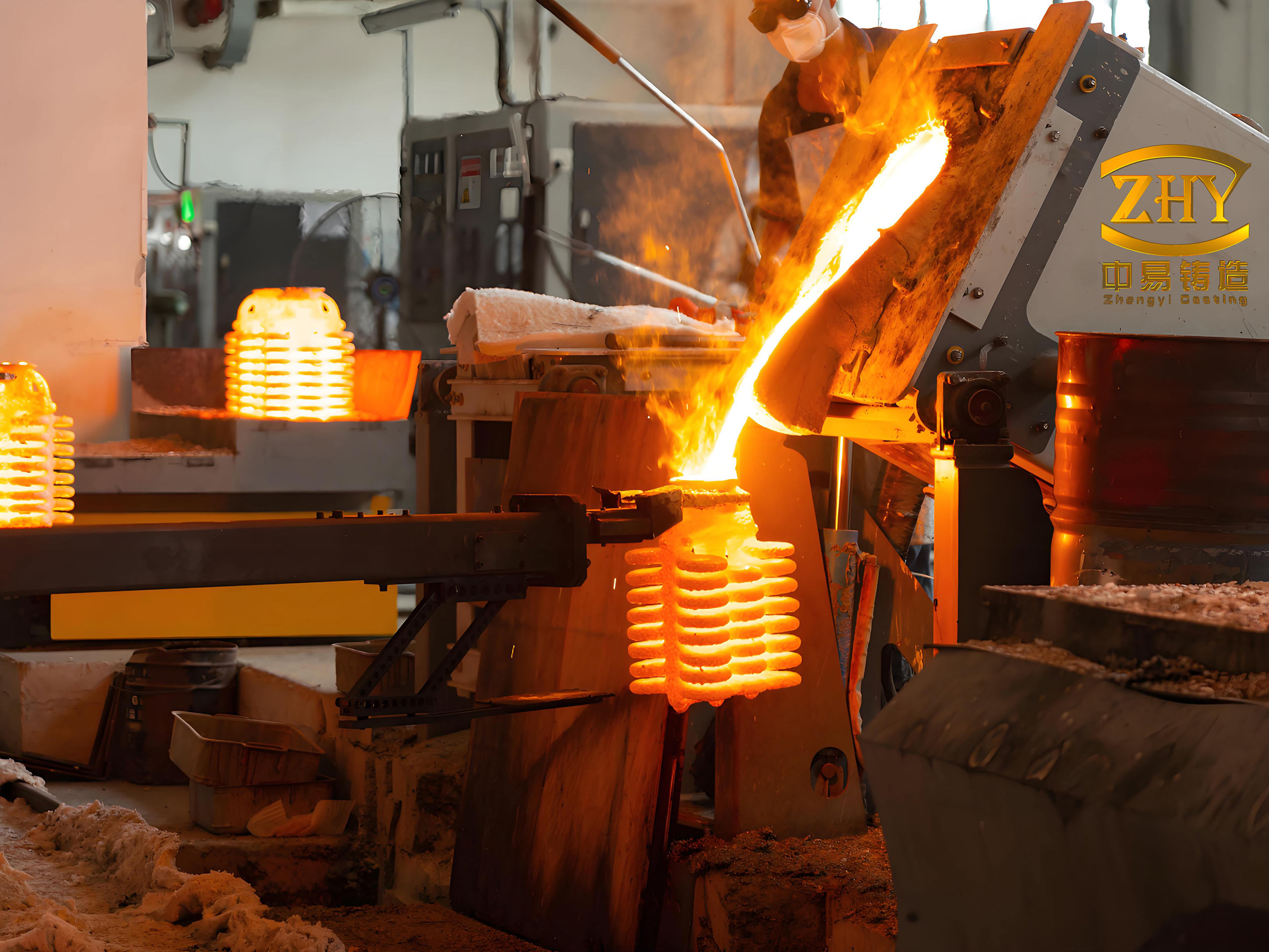
Aircraft structural components, such as brackets, fittings, and engine parts, must endure extreme operational loads, including cyclic stresses, thermal gradients, and vibrational forces. Therefore, they are subject to rigorous mechanical property standards. For instance, materials like ZG35CrMnSi steel require tensile strengths exceeding 980 MPa, yield strengths above 835 MPa, elongation over 9%, and impact energy greater than 23 J. Aluminum alloys like ZL116 demand tensile strengths ≥ 300 MPa and elongation ≥ 2%. These specifications ensure safety and longevity in service. The lost wax casting process must consistently achieve these targets while minimizing property scatter, often requiring tolerances within ±5% of design values. Residual stresses from casting also need mitigation through heat treatments to maintain dimensional stability. This underscores why optimizing lost wax casting is not merely about shape fidelity but about guaranteeing the metallurgical integrity that underpins component performance.
The formation of mechanical properties in lost wax casting is rooted in the thermal history during solidification. The temperature field evolution obeys the non-steady heat conduction equation: $$ \frac{\partial T}{\partial t} = \alpha \left( \frac{\partial^2 T}{\partial x^2} + \frac{\partial^2 T}{\partial y^2} + \frac{\partial^2 T}{\partial z^2} \right) $$ where \( T \) is temperature, \( t \) is time, and \( \alpha \) is thermal diffusivity. During shell preheating, temperatures ramp from ambient to 800–1200°C, with gradients kept below 100°C to prevent cracking. Pouring involves metal at precise temperatures—e.g., ZG35CrMnSi at 1600 ± 20°C and ZL116 at 700 ± 10°C. Heat transfer at the metal-shell interface follows: $$ q = h (T_m – T_d) $$ where \( q \) is heat flux, \( h \) is the heat transfer coefficient, \( T_m \) is metal temperature, and \( T_d \) is shell surface temperature. Solidification cooling rates, influenced by shell properties and environmental conditions, dictate temperature gradients, ranging from 102 to 104 K/m across sections. These gradients drive solidification patterns and residual stress development, directly impacting mechanical behavior in lost wax casting components.
Microstructural control in lost wax casting is governed by solidification kinetics. The morphology of grains and phases depends on the temperature gradient \( G \) and solidification rate \( R \), with the product \( GR \) representing cooling rate and the ratio \( G/R \) determining structure type. Nucleation, described by classical theory, involves the free energy change: $$ \Delta G = -\frac{4}{3}\pi r^3 \Delta G_v + 4\pi r^2 \gamma $$ where \( r \) is nucleus radius, \( \Delta G_v \) is volume free energy difference, and \( \gamma \) is interfacial energy. Crystal growth velocity \( V \) relates to undercooling \( \Delta T \) as: $$ V = A \left[ 1 – \exp\left(-\frac{\Delta T}{RT}\right) \right] $$ with \( A \) as a kinetic factor and \( R \) the gas constant. In lost wax casting, high cooling rates promote fine equiaxed grains, enhancing strength and toughness. For ZG35CrMnSi, this yields refined pearlite and dispersed carbides; for ZL116, it refines eutectic structures and reduces segregation. The Hall-Petch relationship further links grain size to strength: $$ \sigma_y = \sigma_0 + k_y d^{-1/2} $$ where \( \sigma_y \) is yield strength, \( \sigma_0 \) is friction stress, \( k_y \) is a constant, and \( d \) is grain diameter. Thus, lost wax casting parameters critically influence these microstructural features.
To investigate these relationships, an experimental study was designed focusing on lost wax casting of aircraft-grade materials. ZG35CrMnSi steel and ZL116 aluminum alloy were selected, with compositions adhering to HB 5001-2012 and HB 962-2001 standards. Specimens included tensile samples fabricated via lost wax casting: round bars for steel (per HB 2001-2012) and ϕ6 mm × 60 mm rods for aluminum (per HB 962-2001). Equipment comprised vacuum induction furnaces for melting, fluorescence and X-ray inspection for nondestructive testing, and a WDW-100E universal tester and JEM-2100F TEM for mechanical and microstructural analysis. The lost wax casting process involved wax pattern production with medium-temperature wax, shell building using zircon flour and mullite sands, dewaxing, and firing. Shells for steel had 6 layers: a face coat of zircon slurry/sand, intermediate coats of alumina slurry/sand, and backup coats of similar materials. Melting occurred under 3–10 Pa vacuum, with pouring into preheated shells. Temperature monitoring used high-accuracy sensors at 10 Hz sampling, ensuring precise data acquisition for lost wax casting analysis.
Process parameters were varied using an orthogonal L9(34) array to assess their effects in lost wax casting. Key factors included pouring temperature (\( T \)), shell preheat temperature (\( P \)), and cooling rate (\( R \)), each at three levels:
| Material | Pouring Temperature (°C) | Shell Preheat Temperature (°C) | Cooling Rate (°C/min) |
|---|---|---|---|
| ZG35CrMnSi | 1580, 1600, 1620 | 900, 1000, 1100 | 20, 40, 60 |
| ZL116 | 690, 700, 710 | 200, 250, 300 | 10, 20, 30 |
Each combination was replicated thrice to minimize error. Temperature control employed PID systems with ±5°C accuracy, and cooling rates were managed via programmable units at ±2°C/min. Computer-aided process simulation aided in predicting temperature fields and solidification behavior, guiding parameter selection for lost wax casting trials. A weight evaluation system prioritized parameters based on their impact on quality, ensuring a scientific approach to optimizing the lost wax casting process.
Testing encompassed mechanical properties, microstructure, and composition. Tensile tests followed GB/T 228.1-2010 on an electronic universal machine, with a 40 mm gauge length, 2 mm/min loading rate, and ambient conditions (23 ± 2°C, 45–50% RH). Microstructural samples were ground to 2000 grit, polished, and etched—4% nital for steel and Keller’s reagent for aluminum. Observation used optical and transmission electron microscopy (TEM), with TEM samples thinned by twin-jet electrolysis. Composition analysis employed electron probe microanalysis at 20 kV and 100 nA, with accuracy better than 0.1%. Fractography utilized scanning electron microscopy (SEM) at 15 kV, and hardness was measured via microhardness tester under 9.8 N load for 15 s. All equipment was calibrated, and tests were conducted in controlled environments to ensure data reliability in evaluating lost wax casting outcomes.
The results revealed clear trends in how lost wax casting parameters affect mechanical properties. For ZG35CrMnSi, increasing pouring temperature from 1580°C to 1620°C raised tensile strength from 1030 MPa to 1078 MPa and elongation from 10.5% to 12.0%. Similarly, ZL116 showed strength gains from 310 MPa to 325 MPa and elongation from 2.2% to 2.6% over 690–710°C. Shell preheat temperature exhibited a U-shaped influence, with optimal performance at 1000°C for steel and 250°C for aluminum. Cooling rate had the most pronounced effect: finer grains at higher rates boosted strength, peaking at 40°C/min for steel (1078 MPa) and 20°C/min for aluminum (325 MPa). Variance analysis ranked parameter impacts as: cooling rate > pouring temperature > shell preheat temperature. Interactions, especially between pouring temperature and cooling rate, accounted for over 15% of performance variation in lost wax casting. This underscores the need for coordinated parameter tuning in lost wax casting to maximize properties.
| Parameter | ZG35CrMnSi Effect | ZL116 Effect | General Trend |
|---|---|---|---|
| Pouring Temperature | Strength ↑, Ductility ↑ | Strength ↑, Ductility ↑ | Higher temperature improves fluidity and reduces defects |
| Shell Preheat | Optimal at 1000°C | Optimal at 250°C | U-shaped curve: too low causes thermal shock, too high increases grain size |
| Cooling Rate | Best at 40°C/min | Best at 20°C/min | Increased rate refines microstructure but may induce stresses |
Microstructural analysis corroborated these findings. In optimized lost wax casting conditions, ZG35CrMnSi displayed a mix of fine sorbite and bainite, with α-phase at grain boundaries transitioning from continuous to discrete networks as cooling rate rose. Sorbite lath size averaged 10 µm. ZL116 showed α-matrix with dispersed strengthening phases, dendritic arm spacing ~25 µm, and second-phase particles reduced to 0.8 µm. Electron probe data indicated improved homogeneity: segregation degree fell to 0.15 for steel, and silicon/copper segregation lessened in aluminum. TEM revealed lower dislocation densities, regular subgrain boundaries, and reduced stacking faults, indicating enhanced structural integrity from controlled lost wax casting. SEM fractography exhibited uniform dimples in optimized samples, signifying good ductility and fracture toughness. These microstructural refinements directly translate to the mechanical improvements observed, highlighting the efficacy of tailored lost wax casting parameters.
To validate the optimization, engineering trials were conducted on aircraft pipe fittings produced via lost wax casting. A batch of 50 parts was manufactured using the optimal parameters: for ZG35CrMnSi, pouring at 1600°C, shell preheat at 1000°C, and cooling at 40°C/min; for ZL116, pouring at 700°C, preheat at 250°C, and cooling at 20°C/min. Results showed significant quality enhancements:
| Metric | Before Optimization | After Optimization | Improvement |
|---|---|---|---|
| Tensile Strength (ZG35CrMnSi) | 1030 MPa | 1078 MPa | +4.7% |
| Elongation (ZG35CrMnSi) | 10.5% | 12.0% | +14.3% |
| Tensile Strength (ZL116) | 310 MPa | 325 MPa | +4.8% |
| Elongation (ZL116) | 2.2% | 2.6% | +18.2% |
| Defect Rate (Porosity) | ~2% | 0.8% | Reduced by 60% |
| Process Yield | ~70% | >80% | Significant increase |
Property variability decreased, with coefficients of variation below 3.5%, and nondestructive testing indicated fewer internal defects. The consistency of lost wax casting improved, leading to higher acceptance rates and lower scrap. These outcomes have been adopted in multiple aircraft programs, with documented stability over a year of production. The optimized lost wax casting parameters have been codified into technical specifications, including control limits and quality checks, facilitating broader application. Furthermore, a dynamic adjustment framework allows parameter fine-tuning for specific component geometries, ensuring that lost wax casting remains adaptable to evolving aerospace needs.
In conclusion, this study elucidates the profound impact of lost wax casting parameters on the mechanical properties of aircraft structural components. Through experimental and analytical means, we have demonstrated that pouring temperature, shell preheat temperature, and cooling rate are critical levers for controlling microstructural features and mechanical performance. The lost wax casting process, when optimized, enables significant enhancements in strength, ductility, and defect reduction, as validated in industrial settings. Key findings include the dominant role of cooling rate in grain refinement and the synergistic effects of parameter interactions. The mathematical models and empirical data presented here provide a foundation for predictive quality control in lost wax casting, advancing its application in aerospace manufacturing. Future work should explore advanced alloys and real-time monitoring techniques to further elevate the capabilities of lost wax casting. Ultimately, mastering these relationships ensures that lost wax casting continues to meet the high-stakes demands of aircraft safety and performance, solidifying its status as a cornerstone of modern precision manufacturing.