
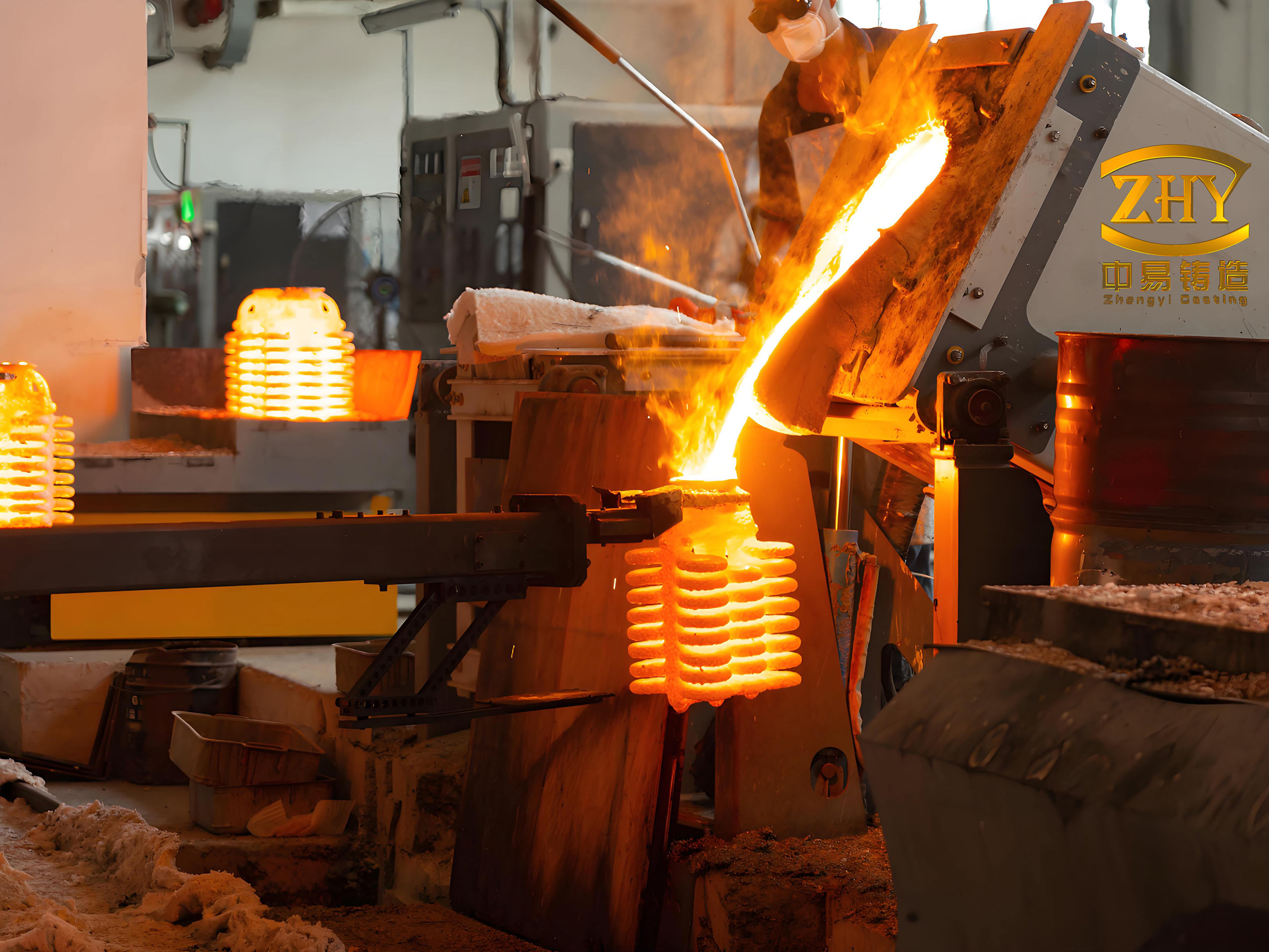
The evolution of automotive components, particularly the shift towards heavier-duty trucks and the adoption of advanced assemblies like welded axles replacing cast ones, has created a significant demand for large, high-integrity castings. These components, often with average weights exceeding 50 kg and some surpassing 200 kg, require exceptional dimensional accuracy and metallurgical quality. The lost wax casting process, renowned for its precision, is ideally suited for this task. However, transitioning from small-scale to large-scale lost wax casting presented formidable challenges. Standard practices were insufficient, leading to failures in producing合格 castings. Through dedicated process research and development over several years, we have successfully engineered and implemented a robust production methodology for high-quality, medium-to-large castings, now in serial production.
I. Process Foundation and Challenges in Scale-Up
The fundamental principle of lost wax casting involves creating a wax or polymer pattern, building a ceramic shell around it, removing the pattern, and pouring molten metal into the resulting cavity. Scaling this process magnifies several physical and thermodynamic challenges:
- Pattern Stability: Large, thin-walled wax patterns are prone to distortion under their own weight or during handling, directly transferring inaccuracies to the final casting.
- Shell Strength: The hydrostatic pressure exerted by a large volume of molten metal is substantially greater, demanding a shell with significantly higher green and fired strength to prevent cracking or deformation.
- Thermal Management: Controlling solidification in a large mass of metal is critical to avoid shrinkage defects. This requires precise control of pouring temperature and shell preheat temperature.
- Process Control: Drying and hardening times for thick ceramic shells, dewaxing methods, and finishing operations all require recalibration for larger dimensions and masses.
The core equation governing the pressure on the ceramic shell at the base of the sprue is a function of metal density and height:
$$ P = \rho g h $$
Where \( P \) is the pressure (Pa), \( \rho \) is the molten metal density (kg/m³), \( g \) is acceleration due to gravity (m/s²), and \( h \) is the height of the metal head (m). For a large casting, \( h \) can be 0.5m or more, leading to pressures several times higher than for a small casting.
II. Pattern and Gating System Engineering
The initial and perhaps most critical stage in lost wax casting is the creation of an accurate and robust pattern assembly.
A. Gating System Design and Fabrication
For small castings, pre-formed wax or plastic gating sticks were adequate. For large-scale production, we developed a flexible system using a standardized helical plastic core as a mandrel. A low-melting-point tin-bismuth alloy mold is fabricated around this core. This mold is then used to injection-mold wax runners and feeders of customized designs. This method offers significant advantages:
- Flexibility: Different gating configurations can be quickly produced by changing the alloy mold, allowing for optimization for different part geometries.
- Strength: The wax components are dense and uniform, providing a robust backbone for the pattern assembly.
- Reproducibility: The metal mold ensures dimensional consistency across all patterns.
The design of the gating system is governed by principles of fluid dynamics and heat transfer. A key goal is to achieve directional solidification towards the feeder. Chvorinov’s Rule estimates the solidification time:
$$ t = B \left( \frac{V}{A} \right)^n $$
Where \( t \) is solidification time, \( V \) is casting volume, \( A \) is surface area, \( B \) is a mold constant, and \( n \) is an exponent (typically ~2). For large castings, the modulus \( \frac{V}{A} \) is high, leading to long solidification times that must be managed by effective feeding via properly sized risers.
B. Dimensional Control and Anti-Distortion Tooling
Large, thin-walled wax patterns are susceptible to warpage during cooling and storage. Relying solely on natural, uncontrolled contraction leads to unpredictable and unacceptable final casting dimensions. Our solution involves a two-step compensatory process:
- Contraction Allowance Determination: A meticulous comparison is made between the dimensions of the injection mold cavity, the resulting wax pattern, and the final cast part. This establishes a precise, empirical contraction allowance for each critical dimension, which often differs from theoretical values due to constraints in the pattern assembly.
- Application of Correction Fixtures: Based on the identified distortion tendencies, rigid plastic or metal correction fixtures (jigs) are designed and manufactured. These fixtures are strategically clamped onto the vulnerable sections of the wax pattern assembly immediately after it is removed from the assembly fixture and during its cooling phase in a controlled water bath. The fixture physically constrains the pattern to the intended geometry until the wax has fully set. This proactive correction method has proven highly effective in批量 production.
III. Ceramic Shell Building: A Paradigm of Strength and Control
The ceramic shell is the mold in lost wax casting. For large castings, its integrity is non-negotiable. Our developed process involves significant enhancements to the standard shell-building protocol.
A. Increased Shell Thickness and Architecture
To withstand the increased metallostatic pressure, the shell thickness was systematically increased. The standard build for smaller parts was 6.5 layers (a prime coat followed by alternating slurry and stucco applications). For large castings, this was increased to a minimum of 8.5 layers, and for the most demanding geometries, up to 9.5 layers. This multi-layer architecture significantly increases the shell’s mechanical strength and thermal mass, drastically reducing the incidence of shell cracking or “run-outs” during pouring.
B. Optimization of Slurry, Binder, and Drying Parameters
Simply adding layers is insufficient. Each layer must be properly hardened and dried to achieve maximum strength. The increased thickness makes penetration of hardening agents and moisture removal more difficult. We optimized the entire cycle:
| Parameter | Small Castings | Large Castings | Purpose of Change |
|---|---|---|---|
| Ammonium Chloride (NH₄Cl) Hardener Concentration | 20-22% | 24-26% | Increase reaction rate for deeper and faster silica network formation (gelation) within the thicker shell. |
| Reinforcement Layer Hardening Time | 4-6 minutes | 8-12 minutes | Ensure complete hydrolysis reaction between the hardener and the colloidal silica binder throughout the layer’s thickness. |
| Post-Hardening Drying Time | 4-6 minutes | 8-12 minutes | Allow sufficient time for solvent (water) evaporation and the development of strong, continuous bonds between ceramic particles and layers. |
| Final Drying Time Before Dewax | ~1 week | 3-5 days | The more thorough per-layer drying creates a shell with higher “water resistance,” reducing the need for prolonged final ambient drying. |
The enhanced drying reduces the shell’s residual moisture, which has multiple benefits: shorter production lead time, reduced floor space for drying, and lower energy consumption for any subsequent forced drying. The shell’s final strength can be conceptually related to the inter-particle bonds formed by the binder. The strengthening from proper drying can be modeled as an increase in effective bond strength \( \sigma_b \).
IV. Melting, Pouring, and Thermal Management
The fusion of metal and mold requires precise thermal control to ensure sound castings.
A. Shell Preheat (Firing)
Although the shells for large castings are thicker, the number of patterns per cluster is often lower, improving furnace atmosphere circulation. Crucially, firing to the typical temperature for small shells (~1050°C) was found to cause excessive sintering and potential distortion of the large, heavy shell under its own weight at high temperature. Through experimentation, the optimal firing temperature range was established at 920-950°C. This temperature:
- Adequately removes all volatile residues.
- Develops sufficient fired strength.
- Minimizes thermal shock to the shell during pouring.
- Provides the correct thermal gradient for controlled solidification when combined with the correct pouring temperature.
The heat transfer during preheat and pouring is critical. The temperature gradient within the shell wall at the moment of pour affects the initial solidification rate. Fourier’s law provides a simplified view:
$$ q = -k \frac{dT}{dx} $$
Where \( q \) is heat flux, \( k \) is thermal conductivity of the shell, and \( \frac{dT}{dx} \) is the temperature gradient. A properly preheated shell reduces the initial gradient, promoting smoother metal flow and reducing thermal stress.
B. Metal Temperature Control
To combat shrinkage porosity in large thermal masses, lower pouring temperatures are essential. This promotes a shorter pasty zone during solidification, encouraging directional feeding toward the risers. Our controlled parameters are:
- Tap Temperature (Furnace): 1580-1620°C. This is the temperature at which the refined steel is tapped from the furnace into the ladle.
- Pouring Temperature (Ladle to Mold): 1560-1580°C. This slight drop accounts for heat loss during transfer and is the critical temperature for the casting event.
The relationship between superheat (temperature above liquidus), solidification mode, and shrinkage defect formation is central. Reducing superheat (\(\Delta T_{superheat}\)) is a key strategy for large lost wax castings.
$$ \Delta T_{superheat} = T_{pour} – T_{liquidus} $$
A lower \(\Delta T_{superheat}\) reduces the total heat the mold must absorb before solidification begins, favoring a more predictable and controllable solidification front.
V. Post-Casting Operations: De-shelling, Finishing, and Heat Treatment
Handling large, intricate ceramic shells and the castings within requires adapted techniques.
A. Shell Removal (De-shelling)
The traditional method of knocking off the shell with hammers is inefficient and potentially damaging for large parts with massive gating systems. Our process utilizes a pneumatic vibration decoring machine. The key is prolonged vibration time (several minutes) with the impact point focused on the pour cup or sprue base, allowing shock waves to effectively fracture the shell away from the metal.
B. Cut-Off and Finishing
Removing large feed heads and gates demands more than manual sawing. We employ a combination of methods:
- Oxy-Acetylene Torch Cutting: For heavy steel sections of the gating system.
- Abrasive Cut-off Wheels: For cleaner, more precise cuts closer to the casting body.
- Custom Fixturing: Dedicated holding jigs and rotation fixtures are designed for each major part type to safely and accurately position the casting during cutting operations, improving efficiency and worker safety.
C. Heat Treatment
Small castings are typically loaded into baskets for heat treatment (e.g., annealing, normalizing). For large castings, this is impractical. We now place castings directly and orderly onto the heat treatment furnace car. This eliminates the time and cost associated with basket loading/unloading and dramatically improves thermal efficiency, as the radiant heat from the furnace walls and convective heat from the atmosphere have direct access to all surfaces of the casting. The heating and cooling cycles must be carefully programmed to minimize thermal stresses in these large components.
D. Straightening (Corrective Action)
Despite all precautions, some distortion can occur due to residual stresses from casting or heat treatment. For large, complex shapes, manual straightening is ineffective. We design and build dedicated tooling for each part that exhibits a predictable distortion pattern. This tooling is then used in a large-capacity (e.g., 100-ton) hydraulic press to apply a controlled, mechanical correction to bring the casting back within specification limits.
VI. Results and Impact of the Developed Large-Scale Lost Wax Casting Process
The systematic development and implementation of these tailored process steps have enabled the successful production of large, high-quality steel castings. To date, over a dozen different part types have been put into serial production, with monthly output exceeding 10 metric tons.
The process has yielded significant qualitative and quantitative benefits:
- Reduced Rejection Rate: The comprehensive process control has driven the defect rate down from over 10% (typical when trying to produce large parts with small-part parameters) to below 4%.
- Enhanced Castability: The large gating systems designed for these castings not only feed solidification but also effectively vent mold gases and act as efficient slag traps, improving metal purity in the casting cavity.
- Economic Efficiency: While the per-part process cost is higher due to more materials and longer cycle times, the high “as-cast” dimensional accuracy significantly reduces machining costs. Furthermore, the reduction in scrap and shorter overall lead time contribute to a favorable total cost model.
The success of this large-scale lost wax casting initiative underscores the adaptability and precision of the investment casting process. It demonstrates that with focused engineering on pattern control, shell science, thermal management, and post-processing, the boundaries of the lost wax casting technique can be successfully extended to meet the demanding requirements of modern heavy-industry components. The process stands as a testament to the principle that precision is scalable.