
In my extensive experience with complex component manufacturing, the production of marine propellers presents a unique and formidable set of challenges. The requirement for a single, integral casting with large, thin, contoured blades, high surface finish, and stringent mechanical properties pushes conventional foundry techniques to their limits. It is precisely for such demanding applications that the lost wax casting process, also known as investment casting, proves to be an indispensable and superior method. This article details a comprehensive, first-person perspective on the methodologies, challenges, and solutions developed for the successful lost wax casting of underwater vehicle propellers, drawing from deep practical engagement with the process.
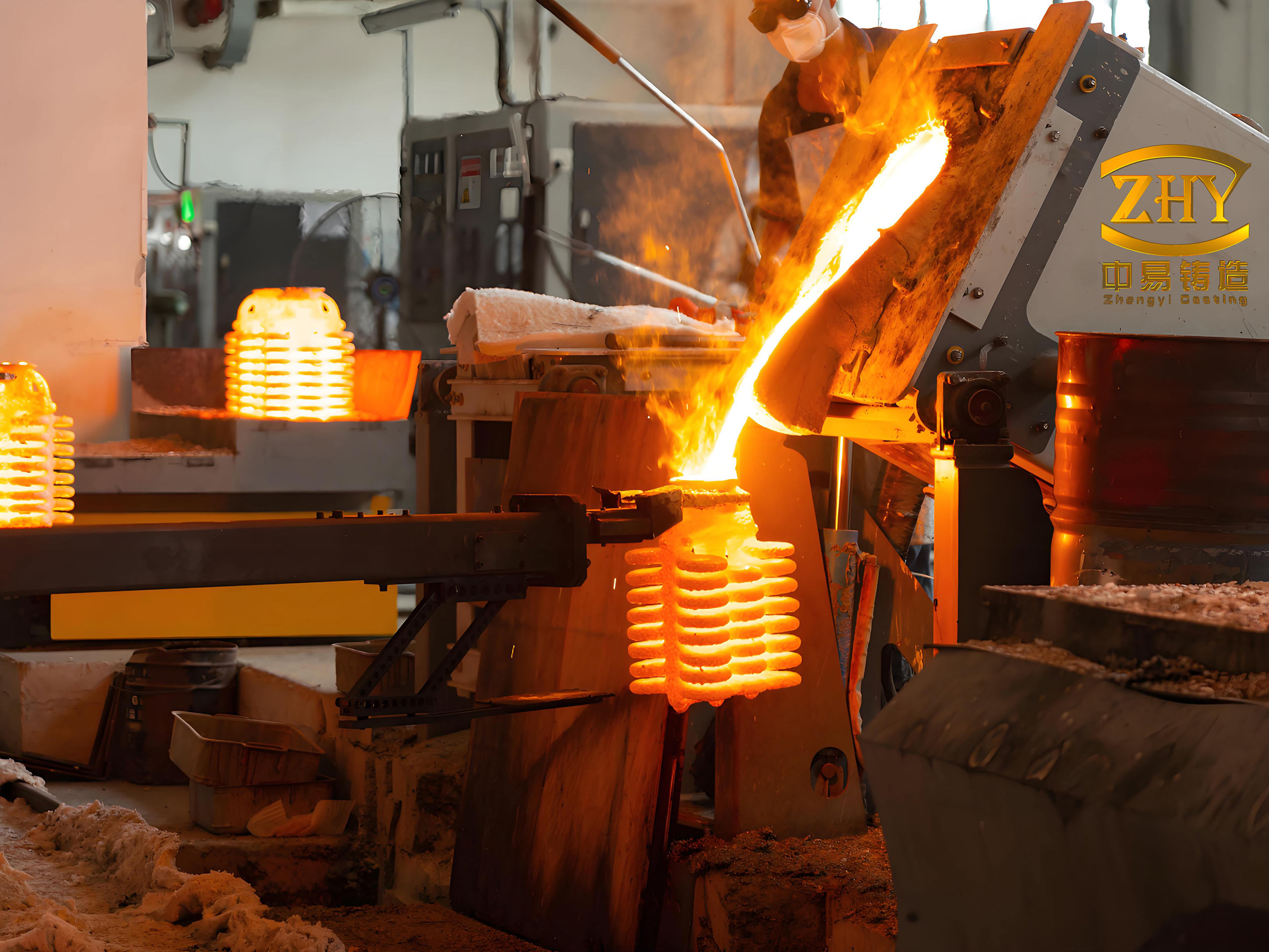
The fundamental advantage of lost wax casting lies in its ability to produce net-shape or near-net-shape components with exceptional dimensional accuracy and surface finish, directly from a wax pattern. For a propeller, whose blades are aerofoil sections virtually impossible to machine economically, this capability is not just beneficial—it is essential. The process sequence involves creating a precise metal die (mold) for wax pattern production, assembling these wax patterns onto a central gating system, repeatedly coating this “wax tree” with a refractory ceramic slurry to build a robust shell, melting out the wax (hence “lost wax”), firing the hollow ceramic mold, and finally pouring molten metal into it. After solidification, the ceramic shell is broken away to reveal the metal casting. The critical steps in the lost wax casting process can be summarized as follows:
The specific propeller under discussion is a classic example of a “large planar” casting. Constructed from ZG1Cr18Ni9Mo (a corrosion-resistant stainless steel similar to CF-8M), it features three blades with a diameter exceeding 400 mm. The blade geometry is extreme: edges as thin as 1.0 mm, with a maximum thickness at the root of only about 9.5 mm. The functional requirements are severe: high-speed rotation in seawater (over 3000 RPM), reverse loading directions, and the need for perfect hydrodynamic balance. Technically, the casting must be sound, with a surface finish on the blades better than Ra 1.6 µm after minimal polishing, and must exhibit high tensile strength (≥750 MPa) and ductility (≥12%). Any internal defect like porosity or inclusion near the blade edges, or external defects like folds or rough surfaces, is grounds for rejection.
Core Challenges in Propeller Lost Wax Casting
The pursuit of a flawless propeller via lost wax casting is a battle fought on three primary fronts: Geometry and Filling, Thermal Management, and Metallurgical Integrity.
1. Geometrical Filling and Mold Integrity: Filling thin, wide blades before the metal front solidifies is the first hurdle. The metal must travel from the central pouring cup, down the sprue, through the gates, and then radiate outwards across the broad, thin blade sections. The premature freezing of the metal meniscus leads to misruns or cold shuts. Furthermore, the ceramic shell itself must withstand the thermal shock of ~1550°C metal without cracking or allowing metal penetration, which would cause a “fused sand” defect on the critical blade surface.
2. Thermal Stresses and Solidification: This is the most significant source of defects. The geometry creates severe thermal gradients. The thick hub and blade roots act as hot spots, solidifying last and requiring feeding to avoid shrinkage porosity. Conversely, the thin blade edges solidify almost instantaneously. This differential cooling generates immense thermal stress, $\sigma_{thermal}$, which can be approximated by:
$$
\sigma_{thermal} = E \cdot \alpha \cdot \Delta T
$$
where $E$ is Young’s modulus, $\alpha$ is the coefficient of thermal expansion, and $\Delta T$ is the temperature difference between different regions of the casting. When this stress exceeds the high-temperature strength of the alloy, hot tears or cracks form, typically initiating at the stress-concentrating blade edges. Additionally, if the shell offers too much restraint during cooling, it can induce “shell cracking” or even cause the casting to crack upon cooling.
3. Metallurgical Quality: The alloy must be clean, fully deoxidized, and have the correct chemical composition to meet mechanical properties. Hydrogen pickup from moisture in the environment or charge materials can lead to hydrogen embrittlement and “fisheye” or flake-like defects (white spots) upon polishing and machining. Inadequate deoxidation can leave oxide inclusions that act as stress raisers, exacerbating crack formation.
Process Design and Optimization
Overcoming these challenges requires a holistic, optimized approach to every stage of the lost wax casting process. The following table summarizes the key process parameters and their optimization targets for propeller casting.
| Process Stage | Key Parameters | Optimization Goal | Rationale |
|---|---|---|---|
| Gating & Risering | Gate location, Sprue height, Riser size | Sequential solidification; High metallostatic pressure | Feed the hub last; Ensure rapid, complete fill of thin blades. |
| Pattern & Tooling | Wax injection pressure/temp, Mold design | Dimensional accuracy of thin blades | Produce a perfect wax replica; Core for hollow hub reduces wax usage & distortion. |
| Shell Building | Slurry viscosity, Refractory type, Drying conditions | High strength, Low restraint, Smooth interface | Prevent metal penetration and shell cracking; Allow for casting contraction. |
| Dewax & Firing | Dewax method, Firing temperature & cycle | Complete wax removal, Controlled shell preheat | Avoid carbon residues; Create thermal gradient for directional solidification. |
| Melting & Pouring | Melt superheat, Deoxidation practice, Pouring temperature | Clean, sound metal with good fluidity | Prevent inclusions and gas porosity; Balance fluidity vs. grain size. |
Gating and Feeding Strategy
The design of the gating system is paramount. For the propeller, a central down sprue attached directly to the hub’s bore was employed. This creates a tall metallostatic head, $P = \rho g h$, where $\rho$ is metal density, $g$ is gravity, and $h$ is the height of the sprue. This high pressure is crucial for forcing metal into the thin blade sections. The hub itself acts as a massive riser, feeding the blade roots as they solidify directionally from the tips inward. The goal is to establish a solidification sequence where the blade edges solidify first, followed by the rest of the blade, and finally the hub, which is fed by the sprue/riser.
Pattern Production and Dimensional Control
Creating the wax pattern is the first critical step in defining final casting quality. A multi-cavity aluminum mold was designed with individual injection points for each blade to ensure complete wax fill under controlled pressure and temperature. To manage wax shrinkage and distortion—a critical issue for thin sections—a post-injection “wax correction” process was implemented. The wax pattern assembly is immersed in warm water (~50°C) to make it pliable, then immediately placed in a calibration jig to restore perfect blade geometry. This step must be completed within a strict time window before ceramic coating to lock in the correct shape.
Ceramic Shell Engineering: The Key to Surface Finish and Dimensional Stability
The ceramic shell is not just a negative mold; it is an active participant in the thermal mechanics of casting. For propellers, the standard silica-based shell system often failed, leading to “shell buckling” or “drum skin” defects—where the shell deforms under thermal load, creating surface indentations or even holes on the blade. The solution was a fundamental upgrade to an all-alumina (Al$_2$O$_3$) system.
- Primary Slurry: A hydrolyzed ethyl silicate binder with high-purity fused alumina powder (200-325 mesh) was used. The slurry was maintained at a high powder-to-binder ratio (P/B ≈ 2.3:1) for maximum density and a low viscosity (~30 sec Ford Cup No.4) for excellent coverage.
- Application Technique: During dipping, a soft brush was used to manually ensure slurry penetrated every contour of the thin blade leading and trailing edges, eliminating air pockets.
- Stuccoing: Immediate, even application of coarse alumina sand (50/80 mesh) for the first two coats provided a strong mechanical key for subsequent layers.
- Controlled Drying: Strict control of temperature and humidity between coats was essential to develop shell strength without creating micro-cracks.
This alumina shell possesses a higher hot strength, better thermal shock resistance, and a smoother surface finish compared to silica, directly translating to a superior casting surface. A comparison of shell system properties is shown below:
| Property | Silica-Based Shell | Alumina-Based Shell | |
|---|---|---|---|
| Hot Strength | Moderate | High | Resists deformation under metal pressure (prevents “drum skin”). |
| Thermal Expansion | High (~14 x 10-6/°C) | Moderate (~8 x 10⁻⁶/°C) | Lower stress on casting during cooling; reduces hot tearing tendency. |
| Refractoriness | ~1700°C | >1800°C | No softening at pouring temperature; sharper definition. |
| Surface Reactivity | Can react with certain alloys | Chemically inert | Prevents slag/sand reactions on critical blade surfaces. |
Thermal Cycle Optimization: Dewaxing, Firing, and Pouring
The thermal history of the shell profoundly affects casting quality. Two major innovations were implemented here:
1. “Boxed Firing” for Stress Relief: Instead of firing shells empty in a furnace, they are completely buried in loose, refractory alumina sand within a firing box. This creates a near-isothermal environment during both heating and, more importantly, cooling. The sand buffer dramatically slows the cooling rate of the shell after it is removed from the furnace for pouring. This minimizes the thermal gradient ($\Delta T$) within the shell itself, reducing the thermal stress ($\sigma_{thermal}$) that can cause shell cracking and, by proxy, stress on the solidifying metal. The modified firing cycle is graphically represented below, showing the crucial slow-cooling zone facilitated by the sand bed.
2. “Skin Formation” Pouring Technique: Pouring temperature is a delicate balance. Too high, and it increases shrinkage and grain growth; too low, and the blades will not fill. An empirical method called “skin formation pouring” was perfected. The superheated alloy (~1570°C) is allowed to cool in the ladle. As it approaches the ideal pouring range (~1520°C), a thin, solidifying “skin” begins to form at the meniscus. Pouring at the moment this skin first appears ensures the metal has the maximum fluidity without excessive superheat. This technique, combined with the preheated “boxed” shell (~900°C), provides an optimal thermal gradient for rapid blade filling followed by controlled directional solidification.
Metallurgical Control: Deoxidation and Hydrogen Avoidance
To combat hydrogen-induced “white spots” and improve mechanical properties, a strict metallurgical practice was enforced:
- Charge Materials: All returns and ingots were sand-blasted to remove oxides and moisture.
- Deoxidation: Aluminum deoxidation was avoided due to the risk of forming hard alumina stringers that could initiate cracks. Instead, calcium-silicon (CaSi) was used for a more globular, less harmful inclusion morphology.
- Pouring Practice: The “skin formation” technique also allows time for dissolved hydrogen to escape from the melt before pouring, further reducing the risk of hydrogen porosity.
Defect Analysis and Corrective Actions
The journey to a reliable process was iterative, driven by defect analysis. The major defects encountered and their root cause/solution matrix are summarized below.
| Defect Observed | Likely Root Cause | Implemented Corrective Action | |
|---|---|---|---|
| Blade Misruns / Incomplete Fill | Insufficient metal head pressure; Low metal fluidity; Cold shell. | Central sprue on hub; “Skin formation” pouring into ~900°C boxed shell. | Consistent, complete blade filling achieved. |
| “Drum Skin” (Shell Indentations) | Low hot strength of silica shell; Metal pressure deforming shell. | Upgraded to high-strength alumina primary slurry and stucco. | Eliminated. Blade surface smoothness dramatically improved. |
| Hot Tears at Blade Edges | High thermal stress from constrained cooling; Shell restraint. | “Boxed firing” for slow shell cooling; Alumina shell (lower expansion). | Reduced to very rare occurrence; edge integrity secured. |
| Surface “White Spots” after Polishing | Hydrogen porosity or micro-shrinkage. | Dry charge materials; CaSi deoxidation; “Skin formation” pour for degassing. | Significantly reduced frequency and severity. |
Conclusion and Process Verification
The systematic optimization of the lost wax casting process for large, thin-walled propellers can be distilled into a core triumvirate of principles: 1) Boxed Firing for thermal stress management, 2) Calcium Deoxidation for metallurgical cleanliness, and 3) Skin Formation Pouring for optimal fill and solidification control. The integration of an advanced alumina ceramic shell system is the foundational enabler for this approach.
The success of this methodology is quantified not just by the aesthetic quality of the castings—which exhibited blade surfaces requiring only minimal polishing to achieve Ra 1.6 µm—but by the structural integrity. Radiographic inspection confirmed the absence of shrinkage in the critical blade root areas. Mechanical testing of coupons from the hub consistently exceeded the required 750 MPa tensile strength and 12% elongation. Most importantly, the yield rate for sound, machinable propellers stabilized above 90%, a testament to the robustness of the refined lost wax casting process.
This case underscores that lost wax casting is far more than a mere shape-forming technique for complex geometries. It is an integrated system of tooling design, material science (wax, ceramic, and metal), and precise thermal engineering. Mastering the interplay between these elements is what allows the lost wax casting process to conquer the extreme challenges posed by components like high-performance marine propellers, transforming a daunting manufacturing problem into a repeatable and reliable production reality.