
In the field of advanced manufacturing, the production of critical components like heavy-duty gas turbine blades poses significant challenges due to their complex geometries and stringent performance requirements. As an engineer specializing in computational materials science, I have extensively studied the lost wax investment casting process, which is widely used for fabricating these high-integrity parts. The lost wax investment casting technique involves creating a wax pattern, coating it with ceramic to form a mold, melting out the wax, and pouring molten metal—all steps that must be meticulously controlled to avoid defects. This article delves into the numerical simulation of this process, leveraging finite element methods to predict and mitigate issues such as shrinkage porosity and gas entrapment. Through this work, I aim to demonstrate how simulation tools like ProCAST can revolutionize traditional trial-and-error approaches, ensuring higher yield and reliability in lost wax investment casting.
The importance of heavy-duty gas turbine blades in energy generation cannot be overstated; they operate under extreme temperatures and stresses, demanding exceptional thermal strength and fatigue resistance. The lost wax investment casting process is ideal for such components because it allows for intricate shapes, including thin-walled sections with internal cavities. However, the very complexity that makes lost wax investment casting suitable also introduces risks. For instance, the blade design often features a thick hub (tenon) and a thin airfoil body, leading to uneven cooling and potential defects like shrinkage holes or micro-porosity. Traditional methods rely on empirical adjustments, but with advancements in computational power, numerical simulation has become a cornerstone for optimizing lost wax investment casting. In my research, I focused on modeling the entire process—from mold filling to solidification—to uncover the root causes of defects and propose data-driven improvements.
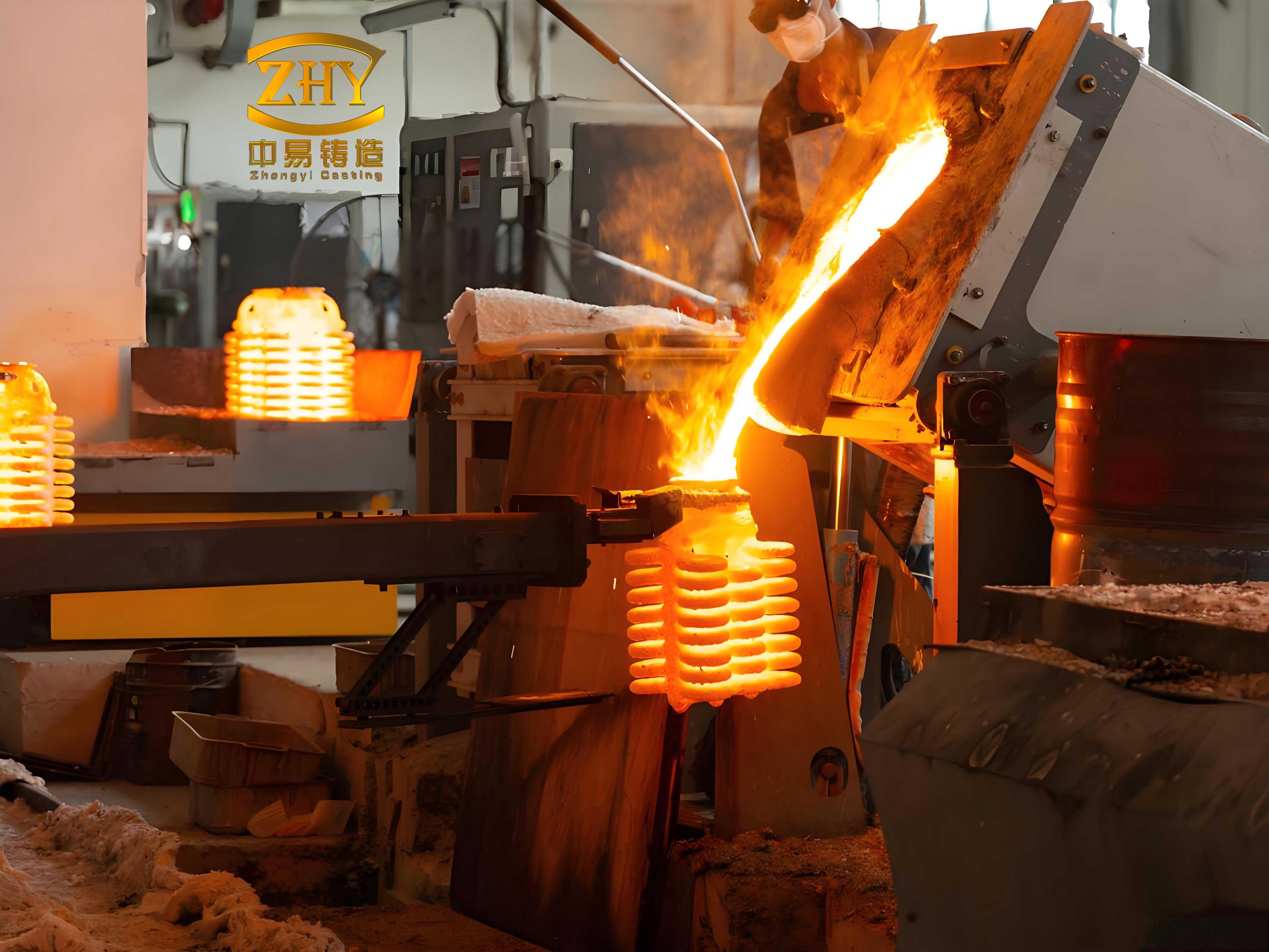
To begin, it’s essential to understand the physics governing lost wax investment casting. The process involves multiphase phenomena: fluid flow during mold filling, heat transfer between the metal and mold, and phase changes during solidification. Numerical simulation requires solving coupled equations for momentum, energy, and mass conservation. In my work, I treated the molten metal as an incompressible Newtonian fluid, accounting for temperature-dependent properties. The governing equations are central to predicting behavior in lost wax investment casting, and they can be summarized as follows. The momentum conservation equation (Navier-Stokes) is given by:
$$ \frac{\partial (\rho u_i)}{\partial t} + \nabla \cdot (\rho u_i \mathbf{V}) = \mu \Delta u_i – \frac{\partial p}{\partial i} + \rho g_i, \quad i = x, y, z $$
where \( u_i \) is the velocity component in direction \( i \), \( \mathbf{V} \) is the velocity vector, \( p \) is pressure, \( t \) is time, \( g_i \) is gravitational acceleration, \( \rho \) is density, and \( \mu \) is dynamic viscosity. This equation models the fluid dynamics during filling, crucial for identifying turbulence or air entrapment in lost wax investment casting. The energy conservation equation incorporates latent heat release during solidification:
$$ \frac{\partial (\rho c T)}{\partial t} + \nabla \cdot (\rho c T \mathbf{V}) = \nabla \cdot (\lambda \nabla T) + \rho L \frac{\partial f_s}{\partial t} + Q_{\text{net}} $$
where \( T \) is temperature, \( c \) is specific heat, \( \lambda \) is thermal conductivity, \( L \) is latent heat, \( f_s \) is solid fraction, and \( Q_{\text{net}} \) is net heat exchange via radiation. In lost wax investment casting, radiation plays a key role due to high temperatures, and I used a finite-element-based radiation model to accurately capture heat loss from the mold surface. Additionally, the volume-of-fluid equation tracks the fluid front:
$$ \frac{\partial F}{\partial t} + \mathbf{V} \cdot \nabla F = 0 $$
with \( F \) being the fluid volume fraction. For defect prediction, I employed a macro-micro porosity model based on Darcy’s law, which accounts for interdendritic feeding during solidification in lost wax investment casting:
$$ \nabla \cdot \left[ -\rho_l \frac{K}{\mu} (\nabla p_l – \rho_l \mathbf{g}) \right] – p_l \frac{\partial g_p}{\partial t} = -(\rho_s – \rho_l) \frac{\partial g_s}{\partial t} – (1 – g_s – g_p) \frac{\partial \rho_l}{\partial t} – g_s \frac{\partial \rho_s}{\partial t} $$
Here, \( \rho_l \) and \( \rho_s \) are liquid and solid densities, \( K \) is permeability, \( p_l \) is liquid pressure, \( g_s \) is solid volume fraction, and \( g_p \) is pore volume fraction. This equation helps quantify shrinkage porosity, a common issue in lost wax investment casting of thick sections.
Implementing these models requires careful discretization. For the blade geometry—a complex shape with varying thickness—I used non-uniform tetrahedral meshing to balance computational cost and accuracy. Thin regions like the airfoil walls demanded finer elements, while thicker areas like the tenon allowed coarser grids. The table below summarizes the mesh parameters for two gating system designs I analyzed, both typical in lost wax investment casting for turbine blades. Design 1 involved a single-blade cluster, while Design 2 used a two-blade cluster to improve yield.
| Component | Number of Elements | Maximum Element Size (mm) | Minimum Element Size (mm) |
|---|---|---|---|
| Design 1: Blade | 510,000 | 7.5 × 7.5 | 2.0 × 1.0 |
| Design 1: Mold Shell | 580,000 | 10.0 × 7.5 | 2.0 × 7.5 |
| Design 2: Blade | 530,000 | 7.5 × 7.5 | 2.0 × 1.0 |
| Design 2: Mold Shell | 550,000 | 10.0 × 7.5 | 2.0 × 7.5 |
Material properties are temperature-dependent, which is critical for accurate simulation in lost wax investment casting. The alloy used was K4002, a nickel-based superalloy common in turbine applications, and the mold was alumina ceramic. Their thermal properties vary with temperature, as shown in the tables below. These data were input as lookup tables in ProCAST to ensure fidelity.
| Temperature (°C) | Specific Heat, \( c \) (J·kg⁻¹·°C⁻¹) | Thermal Conductivity, \( \lambda \) (W·m⁻¹·°C⁻¹) |
|---|---|---|
| 400 | 406 | 9.63 |
| 600 | 398 | 12.14 |
| 700 | 452 | 14.24 |
| 800 | 494 | 16.33 |
For the ceramic mold in lost wax investment casting, properties are:
| Temperature (°C) | Specific Heat, \( c \) (J·kg⁻¹·°C⁻¹) | Thermal Conductivity, \( \lambda \) (W·m⁻¹·°C⁻¹) |
|---|---|---|
| 25 | 554 | 7.1 |
| 600 | 1089 | 4.8 |
| 800 | 1140 | 4.0 |
| 1200 | 1202 | 3.9 |
| 1400 | 1234 | 3.8 |
Boundary conditions were set to mimic industrial lost wax investment casting. The mold was preheated to 1050°C, and the alloy was poured at 1490°C in a vacuum furnace, with a fill time of 5 seconds. A constant inflow rate was assumed at the sprue. Radiation boundary conditions were applied to the mold exterior, using an emissivity of 0.8 for gray-body radiation—a standard approach in lost wax investment casting simulations due to the high-temperature environment.
Simulating the filling phase revealed critical insights. In Design 1, the top-gated system caused intense冲刷 of the mold and core near the tenon, but the flow was relatively orderly. However, Design 2, with a two-blade cluster, showed a concerning phenomenon: liquid streams converged at the mid-section of the pressure side (the convex surface of the airfoil). This convergence, combined with mold gas evolution, predisposed the area to gas entrapment—a defect often seen in lost wax investment casting of complex parts. The velocity fields computed from the momentum equation highlighted this issue, with recirculation zones forming at the confluence point. Such findings underscore the value of simulation in lost wax investment casting; without it, these flow patterns might go unnoticed until costly defects appear in castings.
During solidification, temperature fields evolved unevenly. In both designs, the ingates—channels connecting the sprue to the blade—were thinner and cooled rapidly, solidifying before the thicker tenon region. This prematurely blocked feeding paths from the riser, creating isolated liquid pockets. The energy equation predicted this thermal behavior, showing temperature gradients that favored inverse solidification (i.e., thinner sections freezing first). For instance, at 385 seconds in Design 1, the ingate was fully solid while the tenon remained mushy, as captured by the solid fraction \( f_s \). The mathematical representation of this is:
$$ f_s = \begin{cases}
0 & \text{if } T > T_{\text{liquidus}} \\
\frac{T_{\text{liquidus}} – T}{T_{\text{liquidus}} – T_{\text{solidus}}} & \text{if } T_{\text{solidus}} \leq T \leq T_{\text{liquidus}} \\
1 & \text{if } T < T_{\text{solidus}}
\end{cases} $$
where \( T_{\text{liquidus}} = 1380^\circ \text{C} \) and \( T_{\text{solidus}} = 1280^\circ \text{C} \) for K4002. This directly led to shrinkage defects, as predicted by the porosity model. The pore volume fraction \( g_p \) peaked in the tenon, indicating a high risk of macro-porosity or holes. In Design 2, the problem was exacerbated by the longer feeding distance, resulting in even larger shrinkage cavities. These simulations for lost wax investment casting clearly showed that the original gating designs were suboptimal, primarily due to inadequate ingate dimensions.
To validate the simulations, experimental castings were produced using the same lost wax investment casting parameters. The results aligned remarkably with predictions: gas pores were found at the pressure-side confluence in Design 2, and shrinkage defects appeared in the tenon for both designs. Metallographic analysis confirmed the location and size of porosity, providing strong evidence for the accuracy of the numerical models. This validation step is crucial in advancing lost wax investment casting technology, as it builds confidence in simulation-based optimization.
Based on these findings, I propose modifications to the lost wax investment casting process. The key is to redesign the gating system to promote directional solidification—where the thickest sections solidify last, ensuring continuous feeding. Specifically, enlarging the ingate cross-section at strategic locations can delay its solidification, maintaining a liquid channel for riser feeding. Additionally, adjusting the pouring temperature or mold preheat can alter thermal gradients. For example, a higher mold preheat might slow cooling in thin sections, but it must be balanced against mold strength requirements. The mathematical optimization can be framed as minimizing the objective function \( \mathcal{J} \), which represents defect severity:
$$ \mathcal{J} = \int_V g_p \, dV + \alpha \cdot \text{(gas entrapment indicator)} $$
where \( \alpha \) is a weighting factor. Through iterative simulation, an optimal design can be achieved, reducing defects in lost wax investment casting without physical trials.
Another aspect to consider is the role of process parameters in lost wax investment casting. For instance, vacuum level during pouring affects gas entrapment, and cooling rate influences grain structure. While my simulation focused on macro-defects, microstructural models can be integrated to predict properties like creep resistance. The table below summarizes key parameters and their effects, derived from my simulation studies.
| Parameter | Typical Range in Lost Wax Investment Casting | Impact on Defects | Recommended Adjustment |
|---|---|---|---|
| Pouring Temperature | 1480–1500°C | Higher temperature reduces premature freezing but increases shrinkage | Optimize around 1490°C |
| Mold Preheat | 1000–1100°C | Higher preheat slows cooling, improving feeding but risking mold failure | Use 1050°C with robust ceramic |
| Fill Time | 4–6 seconds | Shorter time reduces oxidation but may cause turbulence | Maintain 5 seconds with smooth gating |
| Ingate Thickness | 5–15 mm | Thicker ingates delay solidification, enhancing feeding | Increase to ≥10 mm at critical junctions |
In conclusion, numerical simulation is a powerful tool for advancing lost wax investment casting, especially for complex components like gas turbine blades. My work demonstrates that by solving coupled fluid-flow and heat-transfer equations, we can predict defects such as shrinkage porosity and gas entrapment with high accuracy. The use of ProCAST software, combined with tailored meshing and material models, allows for virtual prototyping that saves time and resources. For the blades studied, simulations revealed that original gating designs led to blocked feeding and flow convergence issues, which were confirmed experimentally. To improve lost wax investment casting outcomes, I recommend enlarging ingates and optimizing thermal parameters to ensure sequential solidification. Future research could integrate multiscale models for microstructure prediction, further enhancing the capabilities of simulation in lost wax investment casting. As manufacturing demands grow, such computational approaches will be indispensable for achieving high-quality, defect-free castings in critical applications.
Throughout this article, I have emphasized the repeated application of lost wax investment casting simulations to underscore their versatility. From aerospace to power generation, the principles remain similar: accurate physics modeling, robust numerical methods, and experimental validation. By embracing these techniques, industries can overcome the limitations of traditional lost wax investment casting, paving the way for more efficient and reliable production. The journey from wax pattern to final casting is complex, but with simulation, we can illuminate every step, ensuring that each blade meets the rigorous standards demanded by modern engineering.