
The traditional foundry industry, particularly for complex components, often faces significant challenges related to extended development cycles, high initial tooling costs, and cumbersome process trials for mold design. These factors make it difficult to fulfill small-batch, customized orders with the required speed and economic viability. In this context, the integration of additive manufacturing with conventional foundry techniques presents a transformative solution. Rapid lost wax investment casting technology has emerged as a widely adopted manufacturing method. This approach utilizes rapid prototyping to fabricate the sacrificial casting pattern, which is then used in conjunction with traditional investment casting processes to produce the final metal part. This technology eliminates the need for conventional cutting tools and hard molds, enables the production of geometries that are challenging or impossible with traditional methods, shortens lead times, simplifies production workflows, and meets the demand for high-quality, low-volume, and customized castings with rapid turnaround.
This article details a comprehensive study on applying Selective Laser Sintering (SLS) to the rapid fabrication of patterns for the lost wax investment casting process, using a complex inducer wheel as a case study. The research encompasses the entire chain: SLS pattern fabrication using polystyrene, post-processing including wax infiltration, numerical simulation of the casting process to predict defects and optimize parameters, ceramic shell building via the silica sol process, and final metal pouring. The objective is to establish a reliable and efficient digital workflow for producing high-integrity castings from complex CAD models.
Pattern Fabrication Based on SLS Technology
The first and most critical step in the rapid lost wax investment casting chain is the creation of a high-precision, sacrificial pattern. Among various additive manufacturing technologies, Selective Laser Sintering (SLS) is one of the most extensively used for rapid casting applications. While resin-coated sand is a common SLS material, it often requires secondary curing post-build and may struggle with the fabrication of large, complex parts due to limitations in inherent strength and the weight of the unsintered powder. Therefore, for this investigation, polystyrene (PS) powder was selected as the base material. Polystyrene offers several advantages crucial for investment casting: low density, minimal moisture absorption, good flow characteristics, a low melting temperature, and reduced shrinkage and warpage during processing. Compared to other polymeric powders, PS also generates less gas and leaves minimal ash residue during the subsequent shell burnout stage, making it exceptionally suitable for the lost wax investment casting process.
The CAD model of the inducer wheel was processed using slicing software and exported in the appropriate format for the SLS system. The fabrication was conducted on an XJRPSLS300 rapid prototyping machine. The key SLS process parameters were optimized as follows:
| Process Parameter | Value | Unit |
|---|---|---|
| Laser Power | 30 | W |
| Scanning Speed (Hatch) | 2300 | mm/s |
| Scanning Speed (Contour/Support) | 4500 | mm/s |
| Layer Thickness | 0.1 – 0.15 | mm |
| Powder Bed Temperature | ~70-75 | °C |
The SLS process works by discretely sintering powder layers using a laser. Due to the high scanning speeds, the PS powder does not always fully melt and coalesce. Furthermore, the rapid thermal cycles can induce curling and other dimensional inaccuracies. Consequently, parts produced via SLS often exhibit relatively poor density and surface finish, necessitating post-processing to enhance both their mechanical strength and geometric accuracy for the demanding lost wax investment casting process.
A critical post-processing step for SLS-fabricated PS patterns is wax infiltration. The pattern is typically dipped into a molten wax bath twice. This procedure serves four essential purposes: it significantly improves the surface finish and quality of the pattern; it increases the overall strength and handling robustness of the fragile PS model for subsequent shell building; it allows for the repair of minor shape imperfections or surface voids left from the sintering or depowdering stages; and it creates a compatible surface for the aqueous ceramic slurries to adhere to, as the inorganic slurry bonds better to the wax coating than to the raw polystyrene. For this study, a fully refined paraffin wax with a melting point of approximately 50°C was used. The wax infiltration was performed in a single-tank intelligent constant-temperature waxing machine at 65°C. The transformation from the raw SLS part to the finished, wax-infiltrated pattern is a pivotal stage in preparing for lost wax investment casting.
Dimensional accuracy throughout the multi-step process from CAD to final casting is paramount. The SLS process itself introduces dimensional variations due to phenomena such as sintering shrinkage, secondary sintering effects, and stair-stepping from the layer-based fabrication. The subsequent wax infiltration, involving thermal cycling, also causes volumetric changes in the PS model. To quantify these effects, critical dimensions on the inducer wheel blades were measured at specific cross-sectional planes. The dimensional relative error was calculated using the following formula:
$$ \varepsilon = \left( \frac{A_1 – A_0}{A_0} \right) \times 100\% $$
where $A_0$ is the nominal CAD dimension and $A_1$ is the actual measured dimension. The measurement results are summarized below:
| Measurement Plane | Nominal Dim. (mm) | Avg. PS Dim. (mm) | Rel. Error (PS) (%) | Avg. Waxed Dim. (mm) | Rel. Error (Waxed) (%) |
|---|---|---|---|---|---|
| Plane 1 | 5.42 | 5.41 | -0.185 | 5.84 | 7.75 |
| Plane 2 | 5.13 | 5.24 | 2.14 | 5.69 | 10.9 |
| Plane 3 | 3.42 | 3.53 | 3.22 | 3.96 | 15.8 |
The analysis indicates that the as-sintered PS pattern had a dimensional relative error ranging from -0.185% to 3.22%. After wax infiltration, the single-sided thickness of the blades increased consistently by 0.2 to 0.3 mm, which is a critical factor to account for during the initial CAD model scaling for the lost wax investment casting process.
Surface roughness is equally crucial, as it is directly transferred to the ceramic shell and ultimately to the metal casting. For delicate surfaces, non-contact optical measurement is preferred. The surface roughness (Sa) was measured using a white light interferometer on designated areas of the blade surfaces. The results demonstrate the dramatic improvement from waxing:
| Sample State | Measurement 1 (Sa, µm) | Measurement 2 (Sa, µm) | Measurement 3 (Sa, µm) | Average (Sa, µm) |
|---|---|---|---|---|
| As-Sintered PS | 31.666 | 29.952 | 35.897 | 32.505 |
| Wax-Infiltrated Pattern | 0.595 | 0.653 | 0.692 | 0.647 |
The wax infiltration and subsequent finishing completely eliminated the grainy surface texture of the SLS part, reducing the average surface roughness from approximately 32.5 µm to 0.647 µm. This corresponds to a surface finish quality improvement from a rough grade to a very fine grade, fully meeting the stringent requirements for precision lost wax investment casting.
Gating System Design and Numerical Simulation for Lost Wax Investment Casting
Prior to shell building and pouring, numerical simulation is employed to design an effective gating system and predict solidification behavior to minimize defects. The total mass of the inducer wheel casting was calculated to be 4.5 kg, with a target pouring time of 3.5 seconds. To ensure adequate feeding through the sprue, a pouring rate of 1.5 kg/s was selected. Based on standard foundry practice, a sprue with a diameter of 35 mm was designed, topped with a pouring cup of 80 mm in diameter and 80 mm in height.
This gating system was modeled in CAD software. The geometry was then meshed for simulation using PROCAST software, employing a variable mesh size to balance computational accuracy and time. The final mesh consisted of 29,401 elements. Accurate simulation requires defining the material’s thermophysical properties and boundary conditions. The alloy selected was 304 stainless steel. The interfacial heat transfer coefficient (HTC) at the metal-mold boundary was set to 750 W/(m²·K). Air cooling was specified as the dominant mode of heat dissipation after pouring. Key casting parameters were defined as follows:
| Parameter | Value | Unit |
|---|---|---|
| Alloy Density | 7930 | kg/m³ |
| Liquidus Temperature | 1454 | °C |
| Solidus Temperature | 1213 | °C |
| Target Pouring Temperature | 1600 | °C |
| Pouring Rate | 1.5 | kg/s |
| Shell Preheat Temperature | 1115 | °C |
The high pouring temperature was chosen to ensure complete filling of the thin blade sections, while the elevated shell preheat temperature reduces the thermal shock, minimizes the risk of mistruns in thin sections, and lowers the tendency for hot tearing. The heat transfer during solidification is governed by the general conduction equation:
$$ \rho c_p \frac{\partial T}{\partial t} = \nabla \cdot (k \nabla T) + \dot{Q} $$
where $\rho$ is density, $c_p$ is specific heat, $T$ is temperature, $t$ is time, $k$ is thermal conductivity, and $\dot{Q}$ represents any internal heat source (e.g., latent heat of fusion). PROCAST solves this equation numerically to predict the temperature field evolution.
The simulation results for the filling and solidification sequences were analyzed. The metal was shown to fill smoothly, first ascending along the central axis of the inducer and then filling the blades progressively from bottom to top. The filling was complete at approximately t=3 seconds. The subsequent cooling analysis revealed that the temperature gradient was well managed. Isotherms were distributed uniformly, and solidification initiated at the thin blade edges, progressed towards the hub, and finally occurred in the central sprue and pouring cup. This represents a favorable directional solidification pattern, where the thicker sections (sprue) solidify last, providing a continuous feed of molten metal to compensate for the volumetric shrinkage occurring in the casting during solidification. The Niyama criterion, often used to predict shrinkage porosity, can be expressed as:
$$ N_y = \frac{G}{\sqrt{\dot{T}}} $$
where $G$ is the temperature gradient and $\dot{T}$ is the cooling rate. Regions with a low Niyama value are prone to shrinkage porosity. The simulation confirmed that with the designed parameters, the critical sections of the casting maintained sufficiently high $G/\sqrt{\dot{T}}$ values, indicating a low risk of shrinkage defects. This validated the chosen parameters for the lost wax investment casting trial.
Experimental Validation of the Lost Wax Investment Casting Process
Following the numerical simulation, the complete lost wax investment casting process was executed to validate the digital findings.
Ceramic Shell Building
The wax-infiltrated pattern assembly was used to build the ceramic shell using a silica sol binder process (with SiO₂ content > 30%). A multi-layer shell was constructed to withstand the metallostatic pressure and thermal stress of pouring. The shell building sequence involved alternating dips in ceramic slurry and stuccoing with refractory granules of varying coarseness:
| Shell Layer | Slurry Binder | Stucco Material | Stucco Grain Size (Mesh) |
|---|---|---|---|
| Primary (Face Coat) | Silica Sol + Zircon Flour | Zircon Sand | 80-120 |
| Intermediate Coats | Silica Sol + Alumina Silicate | Calcined Alumina Silicate | 220 |
| Backup Coats | Silica Sol + Alumina Silicate | Calcined Alumina Silicate | 16-30 |
A total of 7 to 8 layers were applied to achieve the necessary shell strength and permeability.
Dewaxing and High-Temperature Firing
The process of removing the sacrificial pattern from the ceramic shell is called dewaxing. A key advantage of this hybrid approach is that the gating system was also SLS-printed and wax-infiltrated, bonded to the main pattern. This eliminates the need for traditional wax injection for gates and allows for a simplified dewaxing method. The entire shell was placed in a furnace for a combined dewaxing and firing cycle. The cycle involved an initial stage at 600°C for 1 hour to slowly melt, vaporize, and combust the wax and polystyrene pattern, followed by a high-temperature firing at 1000°C for 2 hours. This firing sinters the ceramic particles, bonding them together to create a strong, permeable mold capable of withstanding the molten metal. The burnout of the polymer pattern can be modeled as a first-order kinetic reaction in the high-temperature range:
$$ \frac{dm}{dt} = -k \cdot m $$
where $m$ is the mass of the combustible material and $k$ is a temperature-dependent rate constant. The extended high-temperature hold ensures near-complete removal of pattern residues. A properly fired shell for lost wax investment casting appears white or light white on the surface, is free of cracks, and has no visible carbonaceous deposits inside.
Melting, Pouring, and Finishing
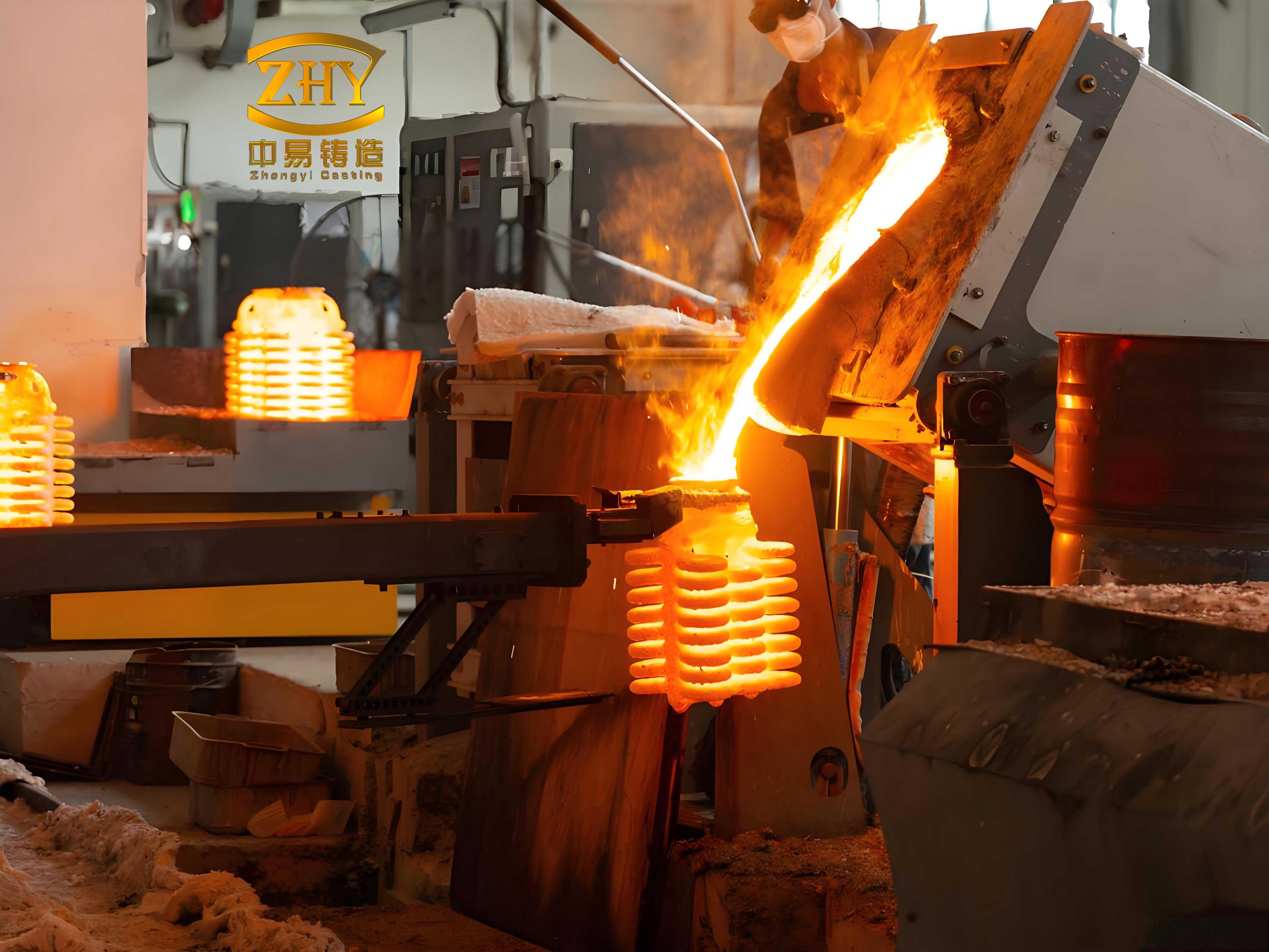
Prior to pouring, the fired shell was preheated to 1115°C in a furnace. This step eliminates any residual moisture and reduces the thermal differential between the mold and the metal, promoting fluidity and reducing turbulence. 304 stainless steel was melted in an induction furnace and superheated to the target pouring temperature of 1600°C. The metal was poured into the preheated shell at the calculated rate of approximately 1.5 kg/s. After pouring, the casting was allowed to cool in ambient air. Once cooled, the ceramic shell was mechanically removed via vibration and sandblasting. The gating system was cut off, and the casting underwent final finishing, including grinding and shot blasting, to reveal the final metal inducer wheel.
The final casting was inspected and measured. The dimensional accuracy of the metal part was excellent, with average relative errors on the key blade dimensions ranging only from 0.17% to 0.19% compared to the waxed pattern dimensions (accounting for solidification shrinkage). The surface roughness of the as-cast metal was measured to have an average Sa value of 0.693 µm, successfully replicating the high-quality finish of the wax pattern and meeting all design specifications. This confirms the effectiveness of the integrated SLS and lost wax investment casting process.
Conclusion
This study successfully demonstrated a complete digital-physical workflow for manufacturing complex high-quality castings via the integration of Selective Laser Sintering and traditional lost wax investment casting. Key findings are summarized as follows:
- Pattern Fabrication & Post-Processing: A polystyrene inducer wheel pattern was successfully fabricated via SLS using optimized parameters (Laser Power: 30 W, Hatch Speed: 2300 mm/s). The as-sintered pattern showed dimensional errors between -0.185% and 3.22%. Subsequent wax infiltration proved crucial, increasing blade thickness by 0.2-0.3 mm per side and dramatically improving the average surface roughness from ~32.5 µm to 0.647 µm, achieving a finish suitable for precision lost wax investment casting.
- Shell Preparation & Pattern Removal: A robust ceramic shell was built using a silica sol process with 7-8 layers. A two-stage furnace cycle (600°C for 1 hr, then 1000°C for 2 hrs) effectively removed the SLS/wax pattern with minimal residue, producing a strong, high-integrity mold for the lost wax investment casting process.
- Process Optimization & Validation: Numerical simulation using PROCAST software was instrumental in designing the gating system and predicting solidification behavior. The simulations validated the selected parameters: a shell preheat of 1115°C, a pouring temperature of 1600°C, and a pouring speed of 1.5 kg/s. The physical casting trial confirmed these parameters, producing a sound 304 stainless steel inducer wheel with exceptional dimensional accuracy (0.17-0.19% relative error on critical features) and a fine as-cast surface roughness of 0.693 µm.
This integrated approach effectively addresses the challenges of traditional casting for complex, low-volume components. It eliminates the need for hard tooling, drastically reduces lead time from design to metal part, and provides a reliable method for producing intricate geometries with high dimensional fidelity and surface quality. The lost wax investment casting process, when augmented with SLS-based patternmaking, proves to be a powerful and agile manufacturing solution for modern engineering needs.