
In the realm of precision manufacturing, lost wax investment casting stands as a pivotal technique for producing complex, high-integrity metal components, particularly those requiring excellent surface finish and dimensional accuracy. As a casting engineer deeply involved in advancing these methodologies, I have focused on addressing the persistent challenge of shrinkage defects—such as porosity and cavities—in critical parts like valve bodies. These components, often fabricated from medium-carbon alloy steels like 35CrNiMo for their high strength and toughness, are prone to solidification-related imperfections due to their inherent poor fluidity and significant liquid and solidification shrinkage. Traditional trial-and-error approaches to process optimization are not only resource-intensive but also time-consuming. Therefore, in this comprehensive study, I leverage the power of numerical simulation using ProCAST software to meticulously analyze and optimize the lost wax investment casting process for a representative valve body. The goal is to predict defect formation during filling and solidification, thereby redesigning the gating system and adjusting process parameters to enhance casting quality systematically.
The foundation of any reliable simulation is an accurate digital representation of the physical system. I began by constructing a detailed three-dimensional model of the valve body component using SolidWorks. The valve body, with overall dimensions of 352 mm × 300 mm × 183 mm and a mass of approximately 23 kg, features three flanges and a central thick section that are typical hotspots for shrinkage defects. This geometry is intrinsically challenging for the lost wax investment casting process. After modeling, the geometry was imported into the preprocessing module, MeshCAST, for discretization. A global element size of 10 mm was selected, resulting in a mesh comprising 107,128 surface elements and 462,351 volume elements. This level of discretization ensures a balance between computational accuracy and efficiency for the subsequent simulations of the lost wax investment casting process.
Defining the correct material properties and boundary conditions is paramount for a physically meaningful simulation. For this lost wax investment casting analysis, the alloy selected was 35CrNiMo steel. Its thermophysical properties, including density, thermal conductivity, specific heat, and fraction solid as a function of temperature, were input into the ProCAST database. The liquidus temperature for this alloy is 1,484°C. In lost wax investment casting, the ceramic shell mold plays a critical role in heat transfer. The interfacial heat transfer coefficient between the casting (and risers) and the ceramic shell was set to 500 W/(m²·K), a standard value for such processes. The initial shell mold temperature was set to 900°C, reflecting common preheating practices in industrial lost wax investment casting. The analysis parameters were configured for the standard “investment or shell casting” process within ProCAST.
The design of the gating and feeding system is the cornerstone of a successful lost wax investment casting operation. Initial conventional schemes, such as a bottom-gating system with the valve body placed horizontally, were simulated but revealed significant shortcomings. These included inadequate feeding to the bottom flange and a high risk of gas entrapment in the upper sections. After evaluating several alternatives through preliminary simulations, I opted for a top-gating system. In this optimized setup, the valve body is oriented vertically, with its flanges aligned upwards. A trapezoidal riser is placed atop each of the three flanges to promote directional solidification and provide the necessary metal feed. The ingates are connected to the top of the largest flange. A thin horizontal tie-bar is added at the bottom of the assembly to provide structural support to the wax pattern and ceramic shell, preventing distortion or breakage. Furthermore, two venting points are incorporated at the ends of the runner to facilitate the escape of gases and residual wax, thereby mitigating defects like gas porosity and mistruns. This configuration is specifically tailored for the lost wax investment casting process.
Determining the optimal pouring parameters is essential for a smooth filling process. The pouring time is a key variable. For steel castings, an empirical formula is often employed to estimate the pouring time \( t \):
$$ t = S \sqrt{G_{total}} $$
where \( S \) is a casting-specific coefficient (taken as 2 for this valve body) and \( G_{total} \) is the total mass of the casting, gating system, and risers. With a total mass of approximately 30 kg (including feeders), the calculated pouring time is 13.4 seconds. This aligns closely with the simulation results and establishes a target for the filling analysis. The pouring temperature is another critical parameter. Based on the alloy’s liquidus temperature and standard practice in lost wax investment casting, a range between 1,530°C and 1,570°C (50°C to 100°C above liquidus) was investigated. The initial simulation focus was set at 1,550°C.
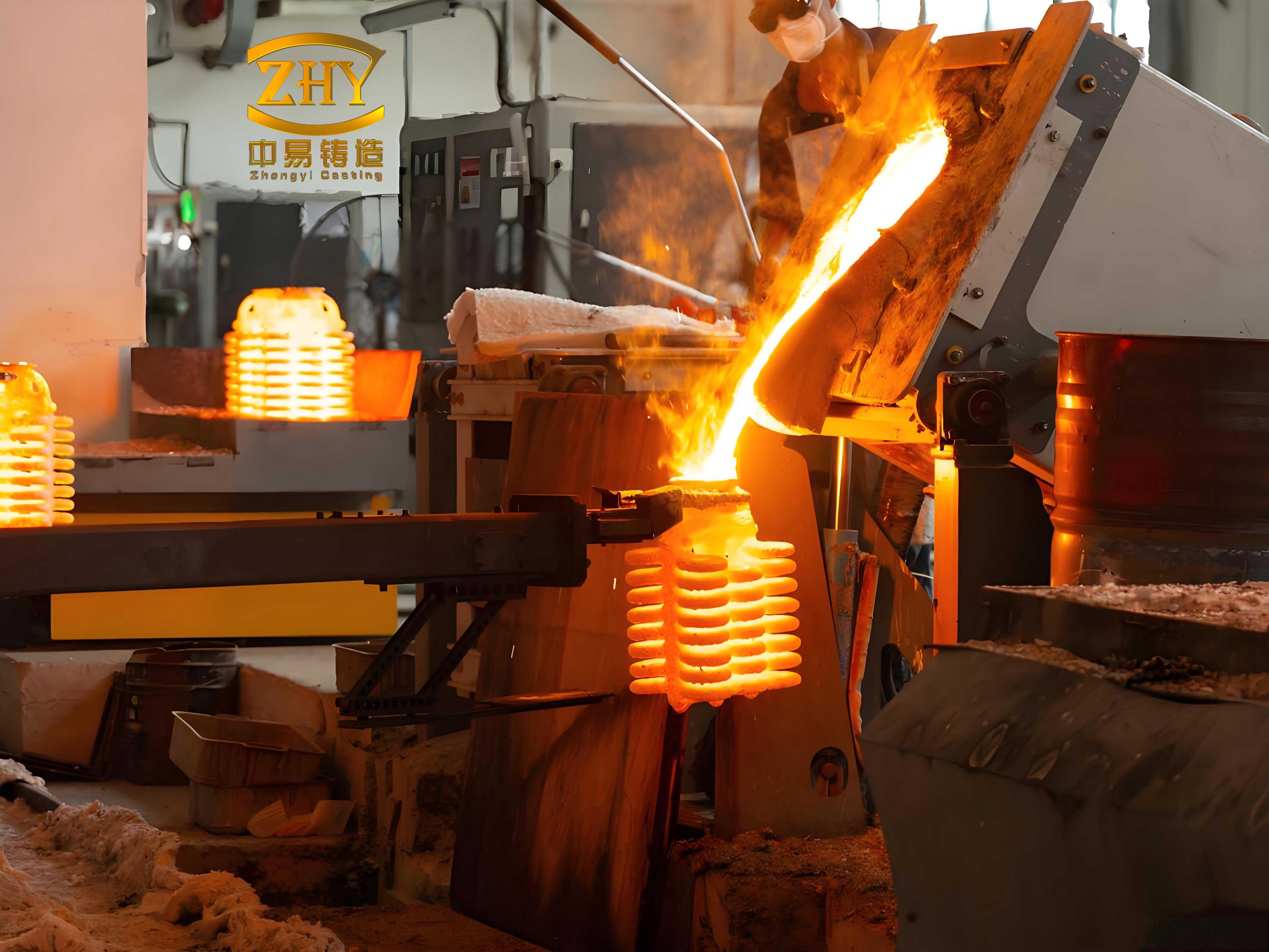
The filling simulation provides invaluable insights into the flow dynamics of the molten metal within the ceramic shell cavity. Using ProCAST’s fluid flow module, I simulated the filling sequence for the top-gating system with a pouring temperature of 1,550°C and a corresponding pouring rate of approximately 3.43 kg/s. The results, visualized through temperature contours and velocity vectors, indicate a stable and progressive filling process. The mold cavity is completely filled within 13 seconds, confirming the accuracy of the empirical calculation. The velocity field shows that the metal front advances smoothly, with localized velocities peaking at around 1.0 m/s in the runners—a value considered acceptable to avoid excessive turbulence. Particle trajectory analysis, a powerful feature for tracking potential oxide formation or gas entrainment, confirmed the absence of severe jetting or vortexing. No signs of cold shuts or misruns were observed, validating the efficacy of the designed gating system for this lost wax investment casting application.
While a defect-free fill is necessary, it is the solidification phase that ultimately determines the internal soundness of a casting produced via lost wax investment casting. ProCAST’s solidification module was used to simulate the thermal history and predict shrinkage porosity using a dedicated criterion (e.g., the Niyama criterion). The simulation clearly showed that the last regions to solidify were the risers, indicating that the principle of directional solidification was achieved. However, the location and severity of predicted shrinkage were highly sensitive to the pouring temperature. To quantify this, I ran solidification simulations at three different pouring temperatures: 1,530°C, 1,550°C, and 1,570°C. The results are summarized in the table below, which shows the total volume of predicted shrinkage porosity within the valve body casting itself (excluding the risers).
| Pouring Temperature (°C) | Simulated Filling Behavior | Total Shrinkage Porosity Volume in Casting (cm³) | Key Observations |
|---|---|---|---|
| 1530 | Stable but slower fill, higher thermal gradient at end | 3.36 | Minor porosity in lower flange; some risk of cold shut. |
| 1550 | Smooth, complete fill in ~13 s | 1.06 | Negligible porosity in casting; defects isolated to risers. |
| 1570 | Slightly turbulent fill with minor splashing | 4.59 | Significant porosity in central thick section and flanges. |
The underlying physics can be explained by considering the thermal gradient \( G \) and the solidification rate \( R \), which are critical parameters in shrinkage formation. The Niyama criterion \( NY \), often used to predict shrinkage porosity, is defined as:
$$ NY = \frac{G}{\sqrt{R}} $$
Areas where \( NY \) falls below a critical threshold are prone to shrinkage porosity. A higher pouring temperature (1,570°C) increases the total heat content, leading to a longer local solidification time and a shallower temperature gradient in the thermal center of thick sections. This reduces the \( G/\sqrt{R} \) ratio, promoting the formation of interdendritic shrinkage pores. Conversely, a lower temperature (1,530°C) can lead to premature solidification in some areas, potentially interrupting proper feeding. The simulation at 1,550°C strikes an optimal balance, maintaining sufficient superheat for smooth filling while establishing a steeper thermal gradient that drives feeding from the risers effectively.
Based on the simulation findings, the lost wax investment casting process was optimized with the following definitive parameters: a top-gating system as described, a controlled pouring temperature of 1,550°C, and a pouring time of 13.4 seconds. To further elucidate the thermal dynamics, the cooling curve analysis at a critical point in the valve body’s central section was examined. The local solidification time \( t_f \) can be related to the secondary dendrite arm spacing \( \lambda_2 \), which influences mechanical properties, by an equation of the form:
$$ \lambda_2 = A \cdot (t_f)^n $$
where \( A \) and \( n \) are material constants. The simulation output allows for the extraction of \( t_f \) values across the casting, ensuring that microstructural homogeneity is achieved. The final optimized process ensures that the last point to solidify in the entire system is within the riser, a fundamental rule for sound casting design. The following table contrasts key outputs between the initial (conventional) and optimized lost wax investment casting process.
| Process Aspect | Initial Conventional Process | Optimized Process via ProCAST |
|---|---|---|
| Gating System | Bottom-gating, horizontal orientation | Top-gating, vertical orientation with risers |
| Predicted Filling Issues | Potential cold shuts, gas entrapment in top flange | Smooth, progressive fill; no major turbulence |
| Solidification Sequence | Non-directional; hot spots in central body | Clearly directional; risers solidify last |
| Shrinkage Porosity Prediction | Significant in central thick section and lower flange | Effectively eliminated from casting body (< 1.1 cm³) |
| Expected Yield Improvement | Lower due to scrap from defects | Higher due to reliable soundness |
The benefits of applying numerical simulation to lost wax investment casting extend beyond defect prediction. It allows for a profound understanding of the transient heat transfer phenomena. The governing equation for heat transfer during solidification is the energy conservation equation, which in its general form for a moving medium can be expressed as:
$$ \rho c_p \frac{\partial T}{\partial t} = \nabla \cdot (k \nabla T) + \rho L \frac{\partial f_s}{\partial t} $$
where \( \rho \) is density, \( c_p \) is specific heat, \( T \) is temperature, \( t \) is time, \( k \) is thermal conductivity, \( L \) is latent heat of fusion, and \( f_s \) is the solid fraction. ProCAST solves this equation numerically, accounting for the release of latent heat and the changing thermo-physical properties during the phase change, which is central to the lost wax investment casting process.
In conclusion, this detailed investigation underscores the transformative power of numerical simulation in refining the lost wax investment casting process for complex, high-performance components like the 35CrNiMo steel valve body. By utilizing ProCAST software, I was able to move beyond intuition-based design to a data-driven optimization strategy. The simulation accurately predicted the formation of shrinkage porosity and identified the pouring temperature as a highly sensitive parameter. The optimized process—featuring a top-gating system, a pouring temperature of 1,550°C, and a filling time of 13.4 seconds—ensures a stable filling pattern and a controlled directional solidification. As a result, shrinkage defects are virtually eliminated from the casting body and contained within the sacrificial risers, significantly enhancing the overall quality and reliability of the final product. This case study serves as a robust template for applying similar simulation-led methodologies to a wide array of challenges in lost wax investment casting, paving the way for more efficient, cost-effective, and quality-centric manufacturing in the precision casting industry.
The journey of optimizing a lost wax investment casting process through simulation is iterative and insightful. Future work could involve exploring the impact of different shell mold materials with varying thermal properties on the solidification pattern. Additionally, coupling the thermal simulation with a microstructure prediction model could provide a direct link between process parameters and final mechanical properties. The integration of advanced machine learning algorithms with simulation databases could further accelerate the optimization cycle for lost wax investment casting. Nevertheless, the current study firmly establishes that virtual prototyping with tools like ProCAST is no longer a luxury but a necessity for achieving first-pass success and maintaining competitiveness in the demanding field of precision lost wax investment casting.