
In my extensive experience with lost wax investment casting, a process renowned for producing high-precision components with intricate geometries, I have encountered numerous challenges when dealing with complex thin-walled parts. One particularly demanding case involved the manufacturing of annular nozzles, which are critical components in industrial equipment. These nozzles feature an outer ring, an inner ring, and 28 curved blades, with blade thickness as low as 0.8 mm. The narrow gaps between blades and the thin sections made traditional casting approaches prone to defects like incomplete filling, significantly reducing yield. Through rigorous production practice, my team and I developed an optimized methodology that combines composite shell techniques with centrifugal casting. This approach not only ensured complete blade formation but also achieved excellent surface quality, meeting stringent customer requirements. Lost wax investment casting, with its ability to replicate fine details, was the foundation of this success, and in this article, I will delve into the detailed process, incorporating tables and formulas to summarize key parameters and principles.
The lost wax investment casting process begins with material selection. For the annular nozzle, the specification called for ZG10Cr13 stainless steel, a martensitic grade offering good corrosion resistance and mechanical properties. The chemical composition is critical for ensuring the final part’s performance, and it was meticulously controlled as shown in Table 1.
| Element | Minimum | Maximum | Target |
|---|---|---|---|
| Carbon (C) | 0.12 | 0.18 | 0.15 |
| Chromium (Cr) | 11.0 | 13.0 | 12.0 |
| Silicon (Si) | 0.8 | 1.2 | 1.0 |
| Manganese (Mn) | 0.5 | 0.7 | 0.6 |
| Phosphorus (P) | – | 0.03 | ≤0.03 |
| Sulfur (S) | – | 0.06 | ≤0.06 |
This composition was chosen to balance castability and service properties in the lost wax investment casting process. The low carbon content minimizes carbide formation, while chromium provides corrosion resistance. Controlling impurities like phosphorus and sulfur is essential to avoid hot tearing and embrittlement, common concerns in precision investment casting.
Moving to pattern fabrication, the wax model is the heart of lost wax investment casting. For the annular nozzle, the complex blade array made pattern removal from the mold difficult. Instead of using soluble cores, which are costly and complex to tool, we opted for a split-pattern approach. The pattern was divided into two main sections: the outer ring as one piece, and the inner ring with all 28 blades as an integral unit. These were injection-molded separately using a paraffin-stearic acid blend. To ensure complete filling of the thin blades, we optimized injection parameters. The wax temperature was elevated to 50°C to reduce viscosity, and injection pressure was set at 0.5 MPa. The relationship between injection pressure (P), wax viscosity (μ), and flow rate (Q) can be approximated using a simplified Poiseuille flow model for thin sections:
$$ Q = \frac{\pi \Delta P r^4}{8 \mu L} $$
where \( r \) is the effective radius of the blade channel, \( L \) is the flow length, and \( \Delta P \) is the pressure drop. For our case, increasing temperature reduces \( \mu \), thereby enhancing \( Q \) for a given \( \Delta P \), ensuring complete blade replication. After molding, the wax sections were assembled by welding, resulting in a precise pattern ready for shell building. This step underscores the adaptability of lost wax investment casting to complex geometries through clever pattern engineering.
The gating system design is pivotal in lost wax investment casting to ensure proper metal feeding and defect minimization. Given the annular shape and the planned use of centrifugal casting, we designed a simple yet effective system. It consisted of a single vertical sprue, which also served as a riser to compensate for shrinkage. The pouring cup was enlarged to prevent metal splash during centrifugal rotation. The gating ratio was empirically set to ensure smooth metal flow. A schematic representation of the setup was used, but in principle, the design minimizes turbulence and promotes directional solidification. The volume of metal required (V_m) can be estimated from the pattern volume (V_p) and anticipated shrinkage (ε):
$$ V_m = V_p (1 + \epsilon) $$
For ZG10Cr13, the linear shrinkage is approximately 2.0-2.5%, so \( \epsilon \approx 0.02 \). This calculation ensures adequate metal in the gating system to feed the thin blades during solidification in the lost wax investment casting process.
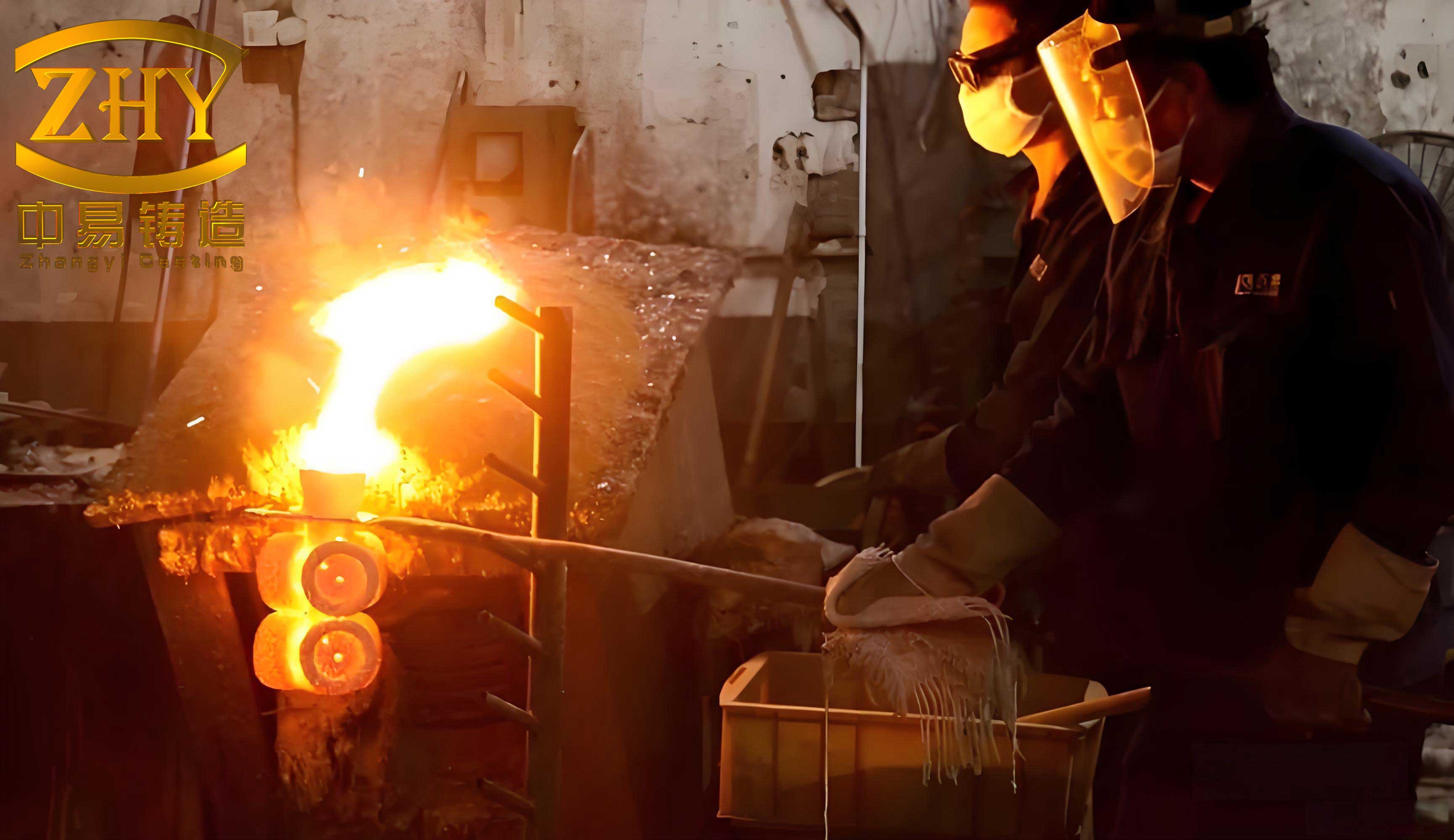
Centrifugal casting was employed to enhance mold filling for such thin-walled structures. We designed and built a vertical centrifugal casting machine, as traditional gravity pouring often led to misruns. The principle leverages centrifugal force to push metal into intricate cavities, overcoming surface tension and viscous resistance. The key parameter is rotational speed (N), which must be optimized: too high, and metal splashes; too low, and filling is incomplete. Based on literature and experimental trials, we found that a speed around 300 rpm worked well. The centrifugal force (F_c) acting on the metal is given by:
$$ F_c = m r \omega^2 = m r \left( \frac{2 \pi N}{60} \right)^2 $$
where \( m \) is the mass of metal, \( r \) is the radius of rotation (approximately 0.175 m for our nozzle), and \( \omega \) is the angular velocity. This force should exceed the resistance forces due to viscosity and surface tension to ensure filling. A dimensionless number, the Weber number (We), can be used to characterize the balance between inertial and surface tension forces:
$$ We = \frac{\rho v^2 L}{\sigma} $$
where \( \rho \) is metal density, \( v \) is the radial velocity, \( L \) is a characteristic length (e.g., blade thickness), and \( \sigma \) is surface tension. For successful filling in lost wax investment casting under centrifugal action, We should be above a critical threshold. Our empirical optimization led to N ≈ 300 rpm, which corresponds to an angular velocity \( \omega \approx 31.4 \, \text{rad/s} \) and a centrifugal acceleration of about 17 g. This significantly improved metal fluidity, eliminating cold shuts and ensuring complete blade formation. The machine featured a variable-speed transmission to adapt to different castings, a crucial flexibility in precision investment casting.
The shell building process is where the composite approach shines in lost wax investment casting. We used a hybrid shell: the first two layers employed silica sol binder for superior surface finish, while the subsequent reinforcement layers used sodium silicate binder for cost-effectiveness and faster production cycles. This composite shell combines the benefits of both materials, achieving a surface roughness Ra of approximately 3.2 μm, comparable to full silica sol shells but at lower cost. The detailed parameters for each layer are summarized in Table 2.
| Layer | Binder | Filler Powder | Powder-to-Binder Ratio (by weight) | Stucco Sand (mesh size) | Drying/Curing Conditions |
|---|---|---|---|---|---|
| 1 (Face) | Fast-dry silica sol (SKP type) | Zircon flour (270 mesh) | 3.8:1 | Zircon (80-120 mesh) | 25°C, 60% RH, 5 hours |
| 2 | Silica sol | Calcined coal gangue powder (200-270 mesh) | 2.2:1 | Coal gangue (70-100 mesh) | 25°C, 60% RH, >8 hours |
| 3 | Sodium silicate (modulus 2.8-3.2) | Coal gangue powder (200 mesh) | 1.2:1 | Coal gangue (40-70 mesh) | AlCl₃ hardening, 25 min, air dry |
| 4-6 | Sodium silicate | Coal gangue powder (200 mesh) | 1.3:1 | Coal gangue (16-30 mesh) | AlCl₃ hardening, air dry between layers |
| Final | Sodium silicate | Coal gangue powder | 1.3:1 | None | Air dry 24 hours |
The viscosity of the slurry is critical for uniform coating. For the face coat, we adjusted it to about 28 seconds using a flow cup. The coating process required careful manipulation: the wax pattern was slowly immersed and rotated in the slurry to ensure even coverage, especially in blade recesses. Any missed spots were touched up with a brush. After stuccoing, drying was meticulously controlled. For silica sol layers, the drying kinetics can be described by a diffusion-limited model:
$$ \frac{\partial C}{\partial t} = D \nabla^2 C $$
where \( C \) is the solvent concentration and \( D \) is the diffusivity, dependent on temperature and humidity. Maintaining 25°C and 60% RH allowed gradual moisture removal without cracking, essential for shell integrity in lost wax investment casting. The sodium silicate layers were hardened in aluminum chloride solution, which reacts to form silica gel, providing strength. The overall shell thickness buildup follows a logarithmic trend with layer count, contributing to sufficient strength to withstand metal pressure during centrifugal casting.
Dewaxing was performed in hot water at 95°C. Due to the composite nature, rapid heating to 100°C without boiling was necessary to quickly melt the wax and avoid shell cracking from steam pressure. The wax removal rate can be modeled using heat transfer equations. The time (t) to melt wax of thickness (d) is approximately:
$$ t \approx \frac{d^2 \rho_w c_w}{2k \Delta T} $$
where \( \rho_w \) is wax density, \( c_w \) is specific heat, \( k \) is thermal conductivity of the shell, and \( \Delta T \) is temperature difference. Fast dewaxing preserves shell strength, a key consideration in precision investment casting.
Alloy melting and pouring are final critical steps. We used a 150 kg medium-frequency induction furnace. Charge materials included returns, new steel, and ferrochromium, calculated to meet the target composition. After melting, the bath was heated to 1600°C, and ferro manganese and silicon calcium powder were added for deoxidation and inclusion modification. The superheat temperature (ΔT) above the liquidus (≈1520°C for ZG10Cr13) was maintained at 80°C to ensure fluidity. The heat required (Q) for melting can be estimated:
$$ Q = m \left[ c_s (T_m – T_0) + L_f + c_l (T_p – T_m) \right] $$
where \( m \) is mass, \( c_s \) and \( c_l \) are solid and liquid specific heats, \( T_m \) is melting point, \( T_0 \) is initial temperature, \( L_f \) is latent heat, and \( T_p \) is pouring temperature. For our batch, this ensured proper superheat. Before pouring, the shell was fired to 1080°C to remove residues and preheat, reducing thermal shock. The centrifugal machine was started, and metal was poured steadily into the rotating mold at 1600°C. The centrifugal force ensured complete filling of the thin blades, a testament to the synergy between lost wax investment casting and centrifugal techniques.
The results were highly satisfactory. The annular nozzles produced exhibited complete blade formation with excellent surface finish. The yield exceeded 95%, a significant improvement over conventional methods. This success highlights the effectiveness of the composite shell and centrifugal approach in lost wax investment casting for complex thin-walled parts. The process parameters we optimized are summarized in Table 3.
| Parameter Category | Specific Value or Range | Remarks |
|---|---|---|
| Wax Injection Temperature | 50°C | Ensures flow into thin sections |
| Wax Injection Pressure | 0.5 MPa | Adequate for pattern detail |
| Face Coat Slurry Viscosity | 28 seconds (flow cup) | For uniform coating |
| Silica Sol Drying Conditions | 25°C, 60% RH, 5-8 hours | Prevents cracks |
| Sodium Silicate Hardening | AlCl₃ solution, 25 minutes | Provides strength |
| Shell Firing Temperature | 1080°C | Removes volatiles, preheats |
| Centrifugal Speed | 300 rpm | Balances filling and splash |
| Pouring Temperature | 1600°C | Ensures fluidity |
| Alloy Composition | ZG10Cr13 (see Table 1) | Mechanical and corrosion properties |
In conclusion, the lost wax investment casting process, when enhanced with composite shells and centrifugal casting, proves exceptionally capable for manufacturing intricate thin-walled components like annular nozzles. The hybrid shell reduces costs while maintaining surface quality, and centrifugal force overcomes filling limitations. Key formulas, such as those for centrifugal force and heat transfer, guide parameter optimization. This methodology not only achieves high yields but also ensures dimensional accuracy and surface integrity, underscoring the versatility and precision of lost wax investment casting. Future work could explore further refinements, such as advanced simulation of fluid flow during centrifugal casting or novel binder systems, but the present approach stands as a robust solution in the realm of precision investment casting.
Throughout this article, I have emphasized the principles and practices of lost wax investment casting, demonstrating how systematic engineering can overcome production challenges. The integration of empirical data with theoretical models, as shown in tables and formulas, provides a comprehensive framework for similar applications. Lost wax investment casting remains a cornerstone of modern manufacturing for complex parts, and innovations like composite shells and centrifugal techniques continue to expand its capabilities.