
The production of high-integrity, thin-walled components from oxidation-resistant (scale-resistant) steel using the lost wax investment casting process presents a unique set of challenges. These alloys, designed for service at temperatures exceeding 800°C, offer excellent high-temperature strength and chemical stability. However, their casting characteristics—particularly for complex geometries with significant variations in wall thickness—demand precise control over every stage of the lost wax investment casting cycle. Common defects such as hot tears, shrinkage porosity, and cold shuts are prevalent if the process is not meticulously engineered. This article details the specialized lost wax investment casting methodology developed to overcome these challenges, focusing on the critical interplay between mold (shell) temperature and metal pouring temperature, encapsulated in what we term the “Pour-to-Shell Temperature Ratio.”
The target component under discussion is a large, intricate “charge carrier” or tray used in high-temperature heat treatment furnaces. It features a grid-like structure of thin intersecting ribs (approximately 3-4 mm thick) within a peripheral frame of only 5 mm, creating numerous thermal junctions. This design results in a component with a very high surface-area-to-volume ratio, making it extremely susceptible to premature solidification and feeding-related defects during the lost wax investment casting process. The material specification is analogous to AISI HK-type steel, with a typical nominal composition: C 0.35-0.45%, Si 1.5-2.0%, Cr 24-26%, Ni 18-20%, and often a small addition of Cerium (Ce) or other rare earth elements to enhance oxidation resistance and high-temperature stability.
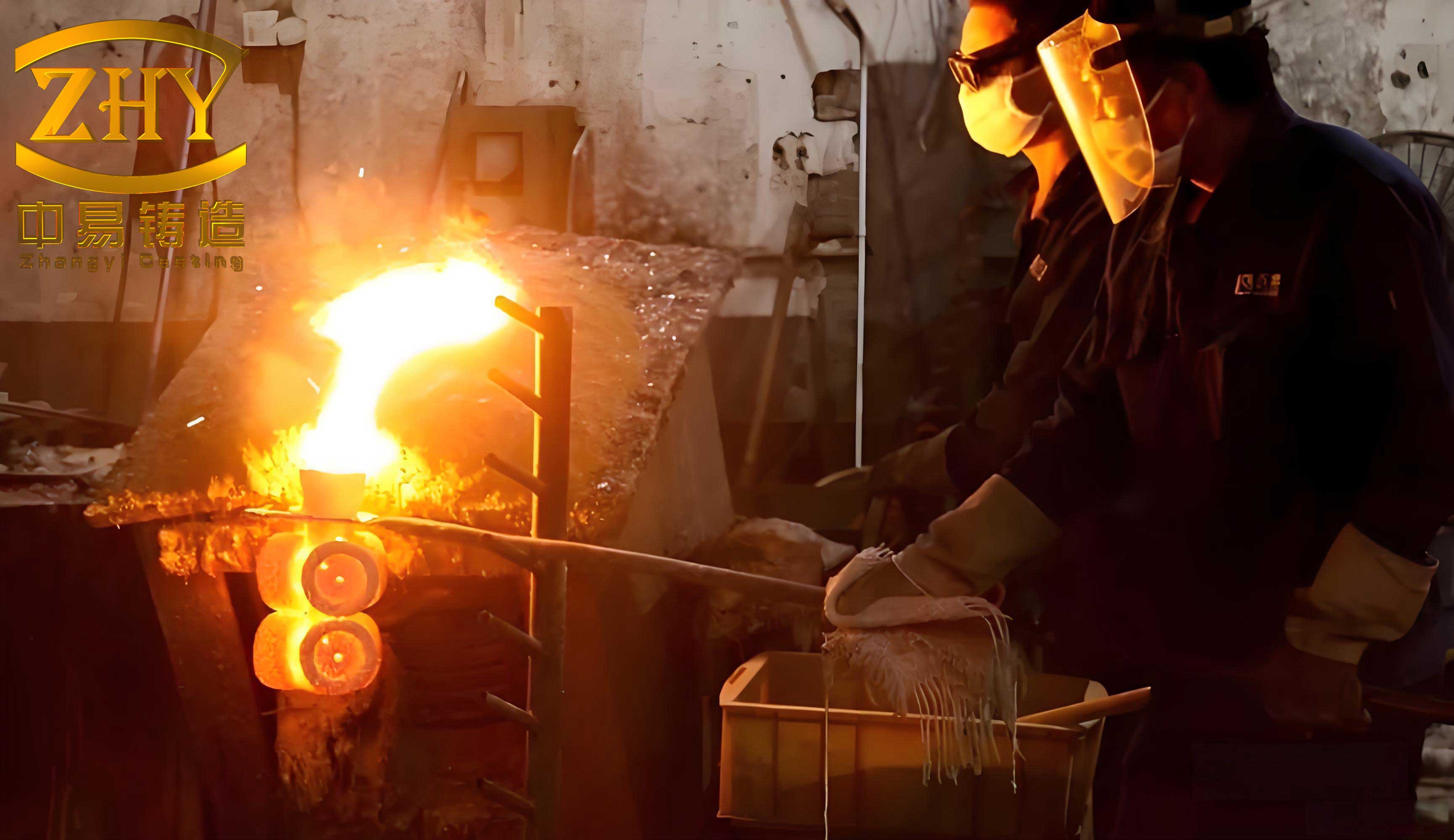
Gating System Strategy for Rapid Filling
The primary objective in gating such a thin-section component is to achieve complete cavity fill before the metal loses its fluidity. A top-pouring gating system is therefore essential to utilize the full metallostatic pressure head. The design must minimize turbulence while maximizing fill velocity. For the tray component, comparative trials between two gating layouts were conducted.
| Scheme | Orientation of Main Runner | Key Characteristics | Observed Outcome |
|---|---|---|---|
| Scheme A | Along the longer axis of the tray | Longer flow distance for metal to reach the far ends. | Higher incidence of mistuns and cold shuts at the extremities. |
| Scheme B | Along the shorter axis of the tray | Shorter, more direct flow paths; more even distribution. | Superior filling, reduced defects, better surface finish. |
Scheme B proved significantly more effective. By placing the main runner along the shorter dimension, the metal travel distance to the ends of the mold cavity is reduced. Multiple in-gates are attached from this runner to distribute the metal quickly across the width of the part. This configuration provides a higher effective pressure head and faster fill rates, which are critical for success in the lost wax investment casting of thin-walled oxidation-resistant steel parts.
The Pivotal Role of Shell Baking and Temperature Control
Conventional wisdom in lost wax investment casting with silica-based binders often cites a shell baking temperature range of 850-950°C. For oxidation-resistant steel castings, especially thin-walled ones, this is entirely inadequate. The core principle here is “hot shell pouring” or “red shell pouring,” meaning the shell must possess substantial thermal energy to delay the solidification of the metal long enough for complete filling and effective feeding of hot spots.
We identify three interlinked and critical shell thermal parameters: Baking Temperature, Soaking (Hold) Time & Temperature, and the often-overlooked Shell Pouring Temperature.
1. Shell Baking Temperature
The baking temperature must be aggressively elevated to provide the necessary heat reservoir. Data collected from production runs clearly shows the impact.
| Shell Baking Temperature Range | Probability of Cold Shut | Probability of Mistun | Recommended Status |
|---|---|---|---|
| 850°C – 950°C | > 60% | > 75% | Unacceptable |
| 1000°C – 1050°C | ~ 15-25% | ~ 20-30% | Marginal |
| 1100°C – 1150°C | < 5% | < 3% | Target Range |
The shell must be baked to a minimum of 1100°C to drastically reduce the probability of filling-related defects. This high temperature ensures the ceramic shell is thoroughly heated through its cross-section.
2. Shell Soaking Time and Temperature
Reaching the target temperature is not sufficient; the shell must be held (soaked) at that temperature to achieve thermal uniformity. A short soak results in a hot surface but a cooler core, which acts as a heat sink during pouring. The relationship between soak time and defect probability can be modeled. The probability of a defect $P_d$ decreases asymptotically with increased soak time $t_s$ at the target bake temperature $T_b$.
$$ P_d(t_s) \approx P_0 \cdot e^{-k \cdot t_s} $$
Where $P_0$ is the initial defect probability and $k$ is a process constant dependent on shell thickness and conductivity.
Empirically, a soak time of at least 120 minutes at 1100-1120°C is required. Soak times below 60 minutes lead to a defect probability of 40-60%, while a 120-minute soak reduces it to below 10%.
3. The Critical Parameter: Shell Pouring Temperature
This is the single most important and tightly controlled parameter. Shell Pouring Temperature is defined as the temperature of the shell’s inner cavity surface at the exact moment metal enters it. Due to rapid heat loss between furnace extraction and pouring, this temperature can be 100-150°C lower than the furnace set-point.
For the tray casting, the target shell pouring temperature is $980^\circ \text{C} \pm 10^\circ \text{C}$. To achieve this:
- Synchronization: Melting and shell baking operations must be precisely coordinated.
- No Backing Sand: Shells are poured immediately without the delay of embedding in sand, maximizing retained heat.
- Extreme Speed: The total time from shell extraction from the furnace to completed pour must be under 45 seconds, with the actual pour time under 10 seconds.
- Re-heating: If the shell cools below the threshold, it is returned to the furnace for re-heating and soaking.
Metal Melting and Pouring Temperature Philosophy
Contrary to intuition, the metal temperature must be controlled towards the lower end of its fluidity range. The governing principle is: “Low(er) temperature metal, Hot shell.” High superheat promotes gas dissolution, oxidation of alloying elements like Cr, and coarse grain structure.
For the HK-type alloy, the target pouring temperature is $1480^\circ \text{C} – 1500^\circ \text{C}$. The relationship between metal pouring temperature $T_m$ and defect formation is not linear; an optimal window exists.
Let $Q_{shell}$ be the heat content of the shell and $Q_{metal}$ be the heat content of the metal. For successful filling and feeding:
$$ Q_{shell} + Q_{metal} \geq Q_{critical} $$
where $Q_{critical}$ is the total heat required to keep the metal in the thin sections above the liquidus long enough for feeding. $Q_{shell}$ is a function of shell pouring temperature $T_{sp}$ and shell mass. $Q_{metal}$ is a function of $T_m$ and metal mass.
If $T_m$ is too high, it increases $Q_{metal}$, but also exacerbates shrinkage and gas defects. If $T_m$ is too low, even a high $Q_{shell}$ may be insufficient. The data shows a clear optimum:
| Metal Pouring Temperature ($T_m$) | Observed Defect Trend | Primary Mechanism |
|---|---|---|
| < 1470°C | Sharp increase in mistuns, cold shuts. | Insufficient fluidity, premature freezing. |
| 1480°C – 1500°C | Minimum defect frequency. | Optimal balance of fluidity and solidification characteristics. |
| > 1510°C | Increase in shrinkage porosity, coarse grains, oxide inclusions. | Excessive superheat, high gas pickup, increased volumetric shrinkage. |
Furthermore, chemistry adjustments affect this window. For a given grade, a lower carbon content allows a slightly higher pouring temperature (e.g., +10°C), while a higher carbon content necessitates a lower temperature (e.g., -20°C). Additions of W or Ce also require fine-tuning of this parameter.
The Unifying Theory: The Pour-to-Shell Temperature Ratio (浇壳比)
The key to consistently producing sound castings lies in managing the relationship between the two most critical temperatures: the Shell Pouring Temperature ($T_{sp}$) and the Metal Pouring Temperature ($T_m$). We define the Pour-to-Shell Temperature Ratio ($R_{ps}$) as:
$$ R_{ps} = \frac{T_{sp}}{T_m} $$
Both temperatures are in Kelvin for the ratio calculation to be physically meaningful, though they are commonly discussed in °C for operational purposes.
This ratio provides a direct indicator of the thermal gradient at the metal-shell interface at the moment of pouring. An optimal $R_{ps}$ ensures the shell does not act as a chilling source but rather as a thermal buffer.
| Shell Pouring Temp, $T_{sp}$ (°C) | Metal Pouring Temp, $T_m$ (°C) | Ratio $R_{ps}$ (K/K) | Casting Quality Assessment |
|---|---|---|---|
| 960 | 1490 – 1505 | 0.827 – 0.830 | Unacceptable. Shell too cold, high risk of mistuns. |
| 980 | 1480 – 1500 | 0.837 – 0.843 | Target Optimal Range. |
| 1000 | 1470 – 1490 | 0.848 – 0.854 | Acceptable to Good. |
| 1020 | 1465 (lower limit) | ~0.863 | Upper practical limit. Risk of metal fluidity issues. |
Expressed in its optimal form for oxidation-resistant steel thin-wall castings via lost wax investment casting:
$$ R_{ps}^{optimal} \approx 0.84 \pm 0.01 $$
Or, using the Celsius values commonly used on the shop floor for quick reference:
$$ \frac{T_{sp}(^\circ C) + 273}{T_{m}(^\circ C) + 273} \approx 0.84 $$
If $T_{sp}$ falls below approximately 960°C (giving $R_{ps} < 0.83$), achieving a sound casting becomes improbable regardless of $T_m$ adjustments, as the shell extracts heat too rapidly. The lost wax investment casting process for these materials is therefore a disciplined practice of achieving and maintaining this critical thermal balance.
Metallurgical and Process Summary
1. Melting Practice: Oxidation-resistant steels are prone to gas pickup and oxidation of chromium. Melting temperature should not exceed 1550°C, and holding time at high temperature must be minimized. Effective deoxidation practice (using Ca-Si, Al, or Ce) is crucial.
2. Grain Structure: The austenitic matrix of these steels benefits from the lower pouring temperatures enabled by hot-shell pouring. This practice restricts grain growth and reduces the formation of continuous carbide networks at grain boundaries, enhancing both room-temperature and elevated-temperature ductility.
3. Defect Control: Adherence to the high shell temperature protocol and the $R_{ps}$ ratio directly attacks the root causes of defects in lost wax investment casting:
- Cracking/Hot Tears: Reduced by minimizing thermal stress through a smaller initial temperature gradient (hot shell).
- Shrinkage Porosity: Improved feeding due to prolonged thermal gradient from shell to casting.
- Cold Shuts & Mistuns: Eliminated by rapid filling into a high-heat-capacity mold.
4. Performance Outcome: When the lost wax investment casting process is controlled within these parameters—particularly the Pour-to-Shell Temperature Ratio—the resultant castings exhibit refined as-cast structures, freedom from major defects, and consequently, enhanced high-temperature strength (creep resistance) and maximized oxidation/corrosion resistance. This directly translates to extended service life for components like charge carriers, burner nozzles, and furnace fixtures operating under severe thermal cycling conditions.
In conclusion, the successful lost wax investment casting of complex, thin-section oxidation-resistant steel components is an exercise in extreme thermal management. It moves beyond standard shell baking practices to a regime defined by high shell temperatures (>1100°C bake, >980°C pour), controlled low metal temperatures (~1490°C), and the strategic application of the Pour-to-Shell Temperature Ratio ($R_{ps} \approx 0.84$) as the unifying control parameter. This disciplined approach transforms the inherent challenges of the alloy and geometry into a reliable, high-yield manufacturing process.