
In the realm of advanced manufacturing, the integration of additive manufacturing with traditional casting processes has opened new avenues for rapid prototyping and low-volume production. As a researcher focused on material forming technologies, I have extensively explored the synergy between 3D printing and precision investment casting, particularly for complex components like transmission housings. This article delves into a comprehensive analysis of using 3D printed wax patterns in plaster mold investment casting, emphasizing dimensional accuracy, process stability, and economic benefits. The methodology not only accelerates product development but also maintains the high standards of precision investment casting, a term I will repeatedly emphasize to highlight its critical role in achieving tight tolerances and superior surface finishes.
Precision investment casting, also known as lost-wax casting, is a manufacturing process that produces intricate metal parts with excellent dimensional accuracy and surface quality. Traditionally, it involves creating a wax pattern, coating it with ceramic slurry to form a shell, melting out the wax, and pouring molten metal into the cavity. However, the fabrication of wax patterns through conventional molding can be time-consuming and costly for prototyping. With the advent of 3D printing, specifically using wax-like materials, we can now directly produce patterns without molds, significantly reducing lead times. This integration is particularly advantageous for applications in automotive and aerospace industries, where components like transmission housings demand complex geometries and high performance. In this study, I detail the technical route, key process parameters, and dimensional analysis for a transmission housing case, underscoring how precision investment casting benefits from D printing innovations.
The transmission housing is a critical component in vehicle drivetrains, requiring robustness, leak-tightness, and precise dimensions to ensure optimal performance. For prototype testing and small-batch production, traditional methods like die casting involve high tooling costs and long setup times. As an alternative, I propose using 3D printed wax patterns combined with plaster mold investment casting. This approach leverages the flexibility of additive manufacturing and the reliability of precision investment casting. To quantify the advantages, I compare the two methods in terms of cost, cycle time, and adaptability to design changes. The table below summarizes this comparison, illustrating why precision investment casting with 3D printing is ideal for rapid iteration.
| Process Type | Prototyping Cost | Lead Time | Design Change Flexibility | Suitability for Batch Production |
|---|---|---|---|---|
| Metal Die Casting | High (tooling costs exceed tens of thousands) | Approximately 3 months | Low (expensive mold modifications, risk of scrapping) | Mass production of finalized products |
| 3D Printed Wax Pattern with Precision Investment Casting | Low (around $1,000 per piece for pattern and casting) | About 25 days | High (no mold needed, digital adjustments are easy) | Single pieces or small-batch custom production |
Material selection is paramount in precision investment casting to meet mechanical properties. For the transmission housing, aluminum alloys are preferred due to their lightweight and strength. I compared the performance of casting produced via this integrated method with conventional die casting. The table below shows that precision investment casting with ZL101A aluminum alloy, after T6 heat treatment, surpasses die-cast ADC12 in tensile strength and hardness, while maintaining comparable dimensional tolerances and surface finish. This reaffirms the viability of precision investment casting for high-performance applications.
| Material Grade | Casting Method | Heat Treatment | Tensile Strength (MPa) | Elongation (%) | Hardness (HBS) | General Dimensional Tolerance (CT Grade) | Surface Roughness Ra (μm) |
|---|---|---|---|---|---|---|---|
| ZL101A | Plaster Mold Precision Investment Casting | T6 | 275 | 2 | 85 | CT5-CT7 | 3.2-12.5 |
| ADC12 | Pressure Die Casting | As-cast | 228 | 1.4 | 74 | CT4-CT7 | 1.6-12.5 |
The technical route for this integrated process involves several sequential steps: 3D printing of the wax pattern, plaster mold fabrication, dewaxing and baking, vacuum-pressure casting, and post-processing. Each step requires careful control to ensure the integrity of precision investment casting. I begin with the creation of the wax pattern using Selective Laser Sintering (SLS), a 3D printing technology that uses polymer powders infused with wax. The SLS process parameters are critical for achieving accurate patterns. For the transmission housing, I used an AFS500 rapid prototyping system with the following settings, which optimize layer adhesion and minimize deviations.
| Parameter | Value | Description |
|---|---|---|
| Build Chamber Dimensions | 500 × 500 × 450 mm | Maximum part size |
| Material | PSB Powder with Wax Infiltration | Polymer-sand blend for wax-like properties |
| Laser Sintering Power | 31 W | Energy input for bonding particles |
| Build Chamber Temperature | 110 °C | Pre-heat to reduce thermal stress |
| Layer Thickness | 0.15 mm | Resolution in Z-direction |
| Total Layers | 1,074 | Based on part height |
The SLS process builds the pattern layer by layer, following the CAD model. The dimensional accuracy of the wax pattern is influenced by factors such as data conversion errors, laser scanning precision, and post-processing shrinkage. To model these effects, I use a statistical approach where the overall deviation Δ can be expressed as a sum of independent error sources: $$ \Delta = \epsilon_{\text{CAD}} + \epsilon_{\text{scan}} + \epsilon_{\text{thermal}} $$ where $\epsilon_{\text{CAD}}$ is the error from converting CAD to STL format (typically <0.1 mm), $\epsilon_{\text{scan}}$ is the laser positioning error (approximately 0.05 mm), and $\epsilon_{\text{thermal}}$ is the thermal contraction during cooling. For precision investment casting, controlling these errors is essential to ensure final cast part accuracy.
After printing, the wax pattern is used to create a plaster mold. Plaster molds, composed of gypsum and refractory fillers, offer excellent replication of fine details, a hallmark of precision investment casting. The slurry formulation is crucial for mold strength and permeability. I developed a baseline recipe, as shown in the table below, which balances flowability, setting time, and resistance to thermal shock during casting.
| Component | Type/Typical Composition | Proportion (by weight %) | Function |
|---|---|---|---|
| Gypsum | α-hemihydrate, β-hemihydrate | 30-50% | Binder for mold formation |
| Refractory Fillers | Quartz powder, kaolin, bauxite, talc | 50-70% | Enhance thermal stability and reduce shrinkage |
| Additives | Silica sol, sulfates, cement (as modifiers) | <5% | Control setting time, improve strength, prevent cracking |
| Water | Temperature 30-40°C | 50-80% (relative to dry mix) | Facilitate slurry mixing and hydration |
The plaster slurry is poured around the wax pattern in a flask and allowed to set. Subsequently, the mold undergoes dewaxing and baking to remove the pattern and strengthen the mold. I optimize the baking cycle to prevent cracks, using a stepped temperature profile. The thermal process can be described by a time-temperature function: $$ T(t) = T_0 + \alpha \cdot t \quad \text{for } 0 \leq t \leq t_1, $$ then $$ T(t) = T_1 + \beta \cdot (t – t_1) \quad \text{for } t_1 \leq t \leq t_2, $$ where $T_0$ is room temperature, $T_1$ is an intermediate hold temperature (e.g., 200°C), and $\alpha$ and $\beta$ are heating rates. Typically, I use a slow ramp to 200°C over 4 hours, hold for 2 hours to burn out wax, then ramp to 700°C over 6 hours for sintering, followed by a cooling phase. This careful control ensures mold integrity for precision investment casting.
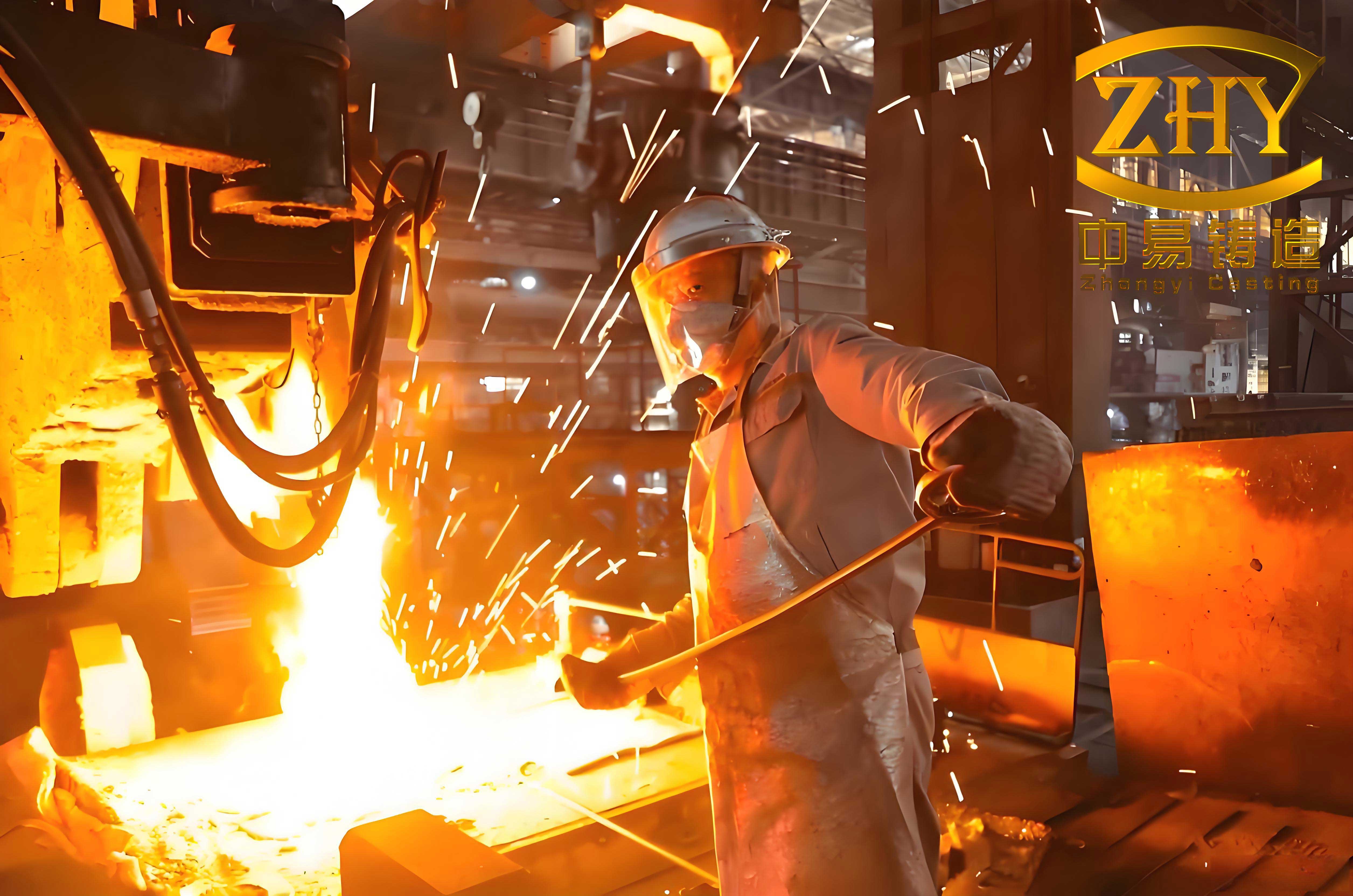
Casting is performed using a vacuum-pressure system, which combines vacuum pouring with pressurized solidification to enhance metal filling and reduce porosity—a key aspect of precision investment casting for aluminum alloys. The vacuum reduces air pressure in the mold cavity, facilitating flow into thin sections, while pressure applied after pouring improves feeding and densification. The pressure-time profile can be modeled as: $$ P(t) = \begin{cases} P_{\text{vac}} & \text{during pouring}, \\ P_{\text{app}} & \text{after pouring for } t \geq t_{\text{pour}}, \end{cases} $$ where $P_{\text{vac}}$ is below 1 kPa and $P_{\text{app}}$ is around 0.6 MPa. This combination yields castings with high mechanical properties, as evidenced by the tensile data earlier.
To evaluate the dimensional accuracy of this precision investment casting process, I conducted a comprehensive analysis on both the 3D printed wax pattern and the final aluminum casting. Using a non-contact optical scanner (ATOS-CS-2M), I captured point cloud data of the wax pattern and casting, then compared them to the original CAD model in GEOMAGIC software. The deviation at each point is calculated as: $$ d_i = \sqrt{(x_i – X_i)^2 + (y_i – Y_i)^2 + (z_i – Z_i)^2}, $$ where $(x_i, y_i, z_i)$ are coordinates from the scan and $(X_i, Y_i, Z_i)$ are from the CAD model. The overall dimensional accuracy is summarized by statistical measures like mean deviation $\mu_d$ and standard deviation $\sigma_d$: $$ \mu_d = \frac{1}{N} \sum_{i=1}^{N} d_i, \quad \sigma_d = \sqrt{\frac{1}{N} \sum_{i=1}^{N} (d_i – \mu_d)^2}. $$ For the wax pattern, I found $\sigma_d = 0.5468$ mm, with 98.89% of data points within ±3σ. For the casting, $\sigma_d = 0.483$ mm, with 97.34% within ±3σ. These results demonstrate that precision investment casting with 3D printed patterns achieves consistency close to CT5 tolerance grades (according to ISO 8062).
Further, I measured specific critical dimensions on the transmission housing casting, such as bore spacings and flange distances. The table below compares theoretical values with actual measurements, confirming the high precision of this investment casting approach.
| Measurement Location | Theoretical Dimension (mm) | Measured Dimension (mm) | Deviation (mm) | Tolerance Class Implied |
|---|---|---|---|---|
| Center Distance (Bore A to Bore B) | 78.0 | 78.4 | +0.4 | CT5 |
| Center Distance (Bore A to Bore C) | 85.0 | 84.5 | -0.5 | CT5 |
| Center Distance (Bore A to Bore D) | 193.15 | 193.8 | +0.65 | CT6 |
| Distance (Flange G to Flange H) | 141.0 | 141.8 | +0.8 | CT6 |
| Distance (Bore A to Boss E) | 151.0 | 151.6 | +0.6 | CT5 |
| Distance (Bore A to Boss F) | 185.0 | 185.8 | +0.8 | CT6 |
The application of this integrated precision investment casting method was validated through a trial production of 10 transmission housing units. The total lead time was 21 days, compared to over 60 days for die casting, representing a reduction of more than 50%. All units were machined, assembled, and tested successfully in a vehicle drivetrain, meeting performance requirements for strength and leak-tightness. This underscores the practicality of using 3D printing for wax patterns in precision investment casting for rapid prototyping.
In terms of process economics, the cost per piece for this precision investment casting method is significantly lower for small batches. I developed a cost model based on material, machine time, and labor. The total cost $C_{\text{total}}$ can be approximated as: $$ C_{\text{total}} = C_{\text{3D print}} + C_{\text{mold}} + C_{\text{casting}} + C_{\text{post-process}}, $$ where $C_{\text{3D print}}$ is proportional to the volume of the wax pattern and printing time, $C_{\text{mold}}$ depends on plaster materials, and $C_{\text{casting}}$ includes metal and energy costs. For a batch size $n$, the average cost per piece decreases due to shared setup, but for $n < 20$, this method is more economical than die casting. This makes precision investment casting ideal for custom or low-volume orders.
Looking ahead, the integration of 3D printing with precision investment casting can be further optimized through advanced materials and process monitoring. For instance, using computed tomography (CT) scanning for inline inspection could reduce deviations. Additionally, machine learning algorithms could predict and compensate for distortions in wax patterns, enhancing accuracy. I propose a feedback control system where dimensional data from castings are used to adjust 3D printing parameters, creating a closed-loop for continuous improvement in precision investment casting.
In conclusion, my analysis demonstrates that combining 3D printed wax patterns with plaster mold investment casting offers a robust solution for manufacturing complex aluminum parts like transmission housings. This precision investment casting process delivers high dimensional accuracy (achieving CT5 tolerance grades), excellent mechanical properties, and significant reductions in lead time and cost for prototyping. The key to success lies in meticulous control of each step—from SLS printing to vacuum-pressure casting—ensuring that the benefits of precision investment casting are fully realized. As additive manufacturing technologies evolve, their synergy with traditional casting will undoubtedly expand, paving the way for more agile and efficient production systems in high-tech industries.