
In the field of advanced manufacturing, precision casting, particularly investment casting, plays a critical role in producing complex components like turbine nozzles for gas turbine engines. These components operate under extreme temperatures, often reaching up to 1900 K, and require high reliability and economic efficiency. Traditional methods for developing casting processes rely heavily on empirical experience and multiple trial runs, which are time-consuming and costly. To address this, we leveraged numerical simulation tools to optimize the precision casting process for a turbine nozzle, focusing on improving metal utilization and minimizing defects. In this study, we utilized ProCAST software to analyze and enhance the filling and solidification stages, ensuring a robust investment casting approach. The key terms precision casting and investment casting are central to our methodology, as they define the high-quality forming techniques essential for aerospace applications.
The turbine nozzle, composed of an inner ring, outer ring, flange, and multiple blades, is fabricated from K4169 superalloy. Its geometry includes thin sections as narrow as 0.5 mm and thick regions up to 24 mm, posing challenges in achieving uniform filling and solidification. Initially, we designed a casting process with a top-bottom composite filling system, but simulations revealed significant issues. The filling process involved turbulent flow in the outer ring and flange areas, leading to risks of gas entrapment and slag inclusion. Additionally, the initial gating system resulted in a low metal utilization rate of only 12.13%, with defects such as shrinkage porosity concentrated in blade regions and the flange. Through iterative simulations, we optimized the process by switching to a bottom-filling method, adjusting riser dimensions and numbers, and incorporating iron sand in inter-blade gaps to promote directional solidification. This optimized investment casting process achieved a metal utilization rate of 43.18% and eliminated defects, as validated by actual castings meeting EMS52301/2 specifications.
To quantify the process parameters, we established a simulation setup in ProCAST with key inputs as summarized in Table 1. The model included a sandbox of dimensions 500 mm × 500 mm × 400 mm, and materials were assigned for the mold shell and alloy. The filling and solidification behaviors were analyzed under vacuum cooling conditions, with interface heat transfer coefficients and convergence criteria set to ensure accuracy.
| Parameter | Value |
|---|---|
| Casting Material | K4169 Superalloy |
| Mold Material | Mullite |
| Mold Thickness (mm) | 10 |
| Pouring Temperature (°C) | 1500 |
| Mold Temperature (°C) | 1050 |
| Furnace Size (m) | Ø2.2 × 2.6 |
| Cooling Method | Vacuum Cooling |
| Filling Time (s) | 4 |
| Interface Heat Transfer Coefficient (W/m²K) | 500 |
| Termination Steps | 100,000 |
| Convergence Precision | 1 × 10⁻⁵ |
| Filling Ratio (%) | 100 |
The initial filling simulation showed that at 40% filling, metal flow through the gating system caused分流 in the outer ring, leading to turbulence. By 45% filling, the confluence of metal from top and bottom paths resulted in unstable flow, increasing the potential for defects. The solidification analysis indicated that thin sections like blades solidified first, but isolated liquid regions formed in thicker areas, contributing to shrinkage. The defects were primarily due to improper temperature gradients and riser design. To model the solidification behavior, we used the Fourier heat conduction equation, which describes the temperature distribution during cooling:
$$ \frac{\partial T}{\partial t} = \alpha \nabla^2 T $$
where \( T \) is temperature, \( t \) is time, and \( \alpha \) is the thermal diffusivity. This equation helped us predict hot spots and optimize the riser placement for better feeding.
In the optimized precision casting process, we modified the gating system to a bottom-fill approach with a “funnel-cylinder” shaped pouring cup, replaced six large risers with eight smaller ones (40 mm length), and added iron sand between blades to enhance cooling. This promoted directional solidification,遵循 the Chvorinov’s rule for casting solidification time:
$$ t_s = k \left( \frac{V}{A} \right)^n $$
where \( t_s \) is solidification time, \( V \) is volume, \( A \) is surface area, and \( k \) and \( n \) are constants dependent on material and mold properties. By reducing the volume-to-area ratio in critical regions, we minimized defect formation. The optimized filling process demonstrated stable flow, with no turbulence observed at 60% filling, and solidification proceeded sequentially from thin to thick sections, eliminating isolated liquid zones.
To illustrate the improvement, Table 2 compares the initial and optimized process metrics, highlighting the gains in metal utilization and defect reduction. This underscores the efficiency of investment casting simulations in achieving cost-effective production.
| Aspect | Initial Process | Optimized Process |
|---|---|---|
| Filling Method | Top-Bottom Composite | Bottom Fill |
| Number of Risers | 6 | 8 |
| Riser Length (mm) | 110 | 40 |
| Metal Utilization Rate (%) | 12.13 | 43.18 |
| Defects (Shrinkage) | Present in blades and flange | Eliminated |
| Gating System Mass (kg) | 59.77 | 16.79 |
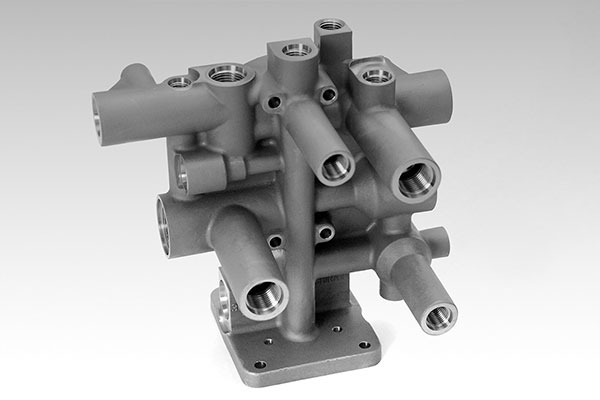
The simulation results for the optimized process confirmed a defect-free casting, with no shrinkage porosity detected in the final product. We validated this through production of 10 initial pieces and 50 small-batch units, all of which passed X-ray inspection per ASTM E1742 standards. The success of this investment casting approach demonstrates the power of numerical simulation in precision casting for complex components. As part of the process visualization, the following image represents a typical manifold steel component produced via investment casting, illustrating the intricate geometries achievable with this method:
Further analysis involved modeling the defect formation using porosity prediction models. For instance, the Niyama criterion, often applied in investment casting simulations, estimates shrinkage porosity based on thermal gradients and cooling rates:
$$ G / \sqrt{R} \leq C $$
where \( G \) is the temperature gradient, \( R \) is the cooling rate, and \( C \) is a material-dependent constant. In our optimized precision casting process, this criterion was satisfied across the casting, ensuring no defects. The use of iron sand in inter-blade gaps improved the local cooling rates, aligning with this model to achieve sound castings.
In conclusion, our study highlights the transformative impact of numerical simulation on precision casting, specifically investment casting, for turbine nozzles. By iteratively refining the process through ProCAST, we enhanced filling stability, achieved directional solidification, and significantly boosted metal utilization. This approach not only reduces development costs but also ensures high-quality components for demanding applications. Future work could explore advanced materials and multi-scale modeling to further optimize investment casting techniques in aerospace and other industries.