
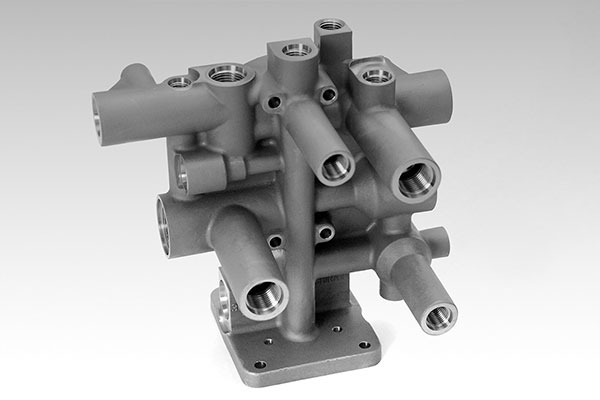
In recent years, the advancement of high-end manufacturing capabilities has led to the widespread application of investment casting for stainless steel components. This precision casting technique offers distinct advantages in producing small to medium-sized parts with complex geometries and intricate internal cavities, making it an indispensable method in many cases. However, the design and control of casting processes for components with complex internal structures present significant challenges, particularly in achieving high dimensional accuracy and surface quality.
In investment casting production, water-soluble wax or salt cores are commonly used to form complex internal cavities in castings. While these methods are effective, they involve dissolving the core from the wax mold, followed by conventional shell-building processes such as slurry coating and sand stuccoing. Additional manual operations or the assembly of multiple wax pieces may be required to form the complete mold. When the ratio of hole depth to diameter (H/d) exceeds 5, it becomes difficult to produce narrow slots and deep holes. For slightly larger holes and slots, although the shell can be successfully manufactured, the small volume of refractory material in these areas often leads to issues like sintering and sand adhesion, complicating the cleaning process. Therefore, the use of ceramic cores emerges as the optimal solution for such applications.
Currently, ceramic cores for high-temperature alloy investment casting have been extensively studied, with silica-based and alumina-based ceramic cores being relatively mature in application. However, silicon-based ceramic cores are prone to deformation when used at temperatures exceeding 1,550 °C, and silica can easily react with elements in stainless steel, leading to surface defects on castings and severely affecting core removal performance. Alumina-based ceramic cores exhibit high-temperature chemical stability and inertness but require strong alkaline solutions for removal, which can corrode stainless steel castings and compromise their quality.
In this study, we focus on developing magnesium-based ceramic cores for stainless steel investment casting. Magnesium oxide is employed as the base material, with CaCO3 as a mineralizer and wood flour as a pore-forming agent. The cores are fabricated using a pressing process, and we investigate the effects of the mineralizer and pore-forming agent on core properties. This research aims to explore ways to enhance the performance of ceramic cores and provide a reference for the development of magnesium oxide-based cores in precision casting applications.
The experimental methodology involved several key steps. The base material for the magnesium-based ceramic cores was magnesium oxide powder with a particle size of 400 mesh and a magnesium oxide content exceeding 98%. Reagent-grade calcium carbonate was used as the mineralizer, and wood flour sieved through a 200-mesh screen served as the additive for pore formation. According to the experimental design, magnesium oxide, calcium carbonate, and dried wood flour were weighed in proportion and placed in a planetary ball mill. The mixture was ball-milled for 2 hours at a speed of 350 rpm with a ball-to-powder ratio of 1:1. After ball milling, the mixed powder was sieved and placed in a dry beaker. A 5% polyvinyl alcohol solution was prepared, and a specific amount of powder and solution were mixed in a mortar and ground thoroughly.
For core formation, an appropriate amount of ceramic core powder was loaded into a mold and leveled. The mold’s inner surface was coated with silicone oil to reduce friction during pressing and facilitate demolding. The pressing was conducted on a hot press at a pressure of 6 MPa, with a holding time of 2 minutes. The sample dimensions were 60 mm × 10 mm × 6 mm. After pressing, the samples were transferred to a high-temperature furnace for sintering. The heating rate was set at 2 °C/min, with holding times of 30 minutes at 100 °C, 200 °C, 400 °C, 600 °C, 800 °C, 1,000 °C, and 1,200 °C to ensure uniform heating. Finally, the samples were sintered at 1,340 °C for 30 minutes and cooled with the furnace. At room temperature, the samples were removed, cleaned with a soft brush, and those without deformation or defects were selected for structural and performance testing.
The performance of the ceramic cores was evaluated through various tests. The room-temperature bending strength was measured using a three-point bending method on a universal material testing machine with a span of 30 mm and a loading speed of 0.5 mm/min. Six samples were tested for each group, and the average value was reported. The apparent porosity was determined using the water displacement method. The sintering shrinkage rate was calculated based on the dimensional changes of the cores before and after sintering. The dissolution and collapse properties were assessed by measuring the mass loss rate of the cores after immersion in an acetic acid solution. The cores were dried, weighed (initial mass m0), immersed in an 80 °C, 40% acetic acid solution for 10 hours, then cleaned with deionized water, dried at 110 °C for 2 hours, and weighed again (final mass m1). The mass loss rate K was calculated using the formula:
$$ K = \frac{m_0 – m_1}{m_0} \times 100\% $$
This formula is essential for quantifying the dissolution behavior in investment casting processes, as it directly relates to the efficiency of core removal in precision casting applications.
The influence of CaCO3 content on core properties was studied by preparing cores with pure magnesium oxide and additions of 5%, 10%, 15%, and 20% CaCO3 mineralizer, sintered at 1,340 °C for 30 minutes. The bending strength, porosity, sintering shrinkage, and dissolution properties were analyzed. The results showed that the addition of CaCO3 significantly affected these properties. For instance, the bending strength increased from 7.57 MPa for pure magnesium oxide cores to 24.03 MPa with 5% CaCO3 addition, but then decreased with further increases in CaCO3 content. The porosity initially decreased with 5% CaCO3 but increased gradually as CaCO3 content rose from 5% to 20%. Sintering shrinkage increased markedly from 0.22% for pure magnesium oxide to 0.97% with 5% CaCO3, remaining relatively stable with higher additions. Dissolution tests revealed that pure magnesium oxide cores disintegrated completely after 10 hours in acetic acid, while cores with CaCO3 maintained their shape but experienced surface erosion, with mass loss rates ranging from 45.17% to 55.34%.
To further understand the role of pore formation, wood flour was added as a pore-forming agent to cores with 5% CaCO3. The effects of wood flour additions of 1%, 3%, and 5% were investigated. As the wood flour content increased, the porosity of the cores rose significantly, from 28.07% with no wood flour to 39.77% with 5% wood flour. However, the bending strength decreased substantially, from 22.19 MPa with no wood flour to 4.73 MPa with 5% wood flour. Sintering shrinkage showed a non-linear trend, initially decreasing to 0.46% with 1% wood flour but increasing to 1.58% with 5% wood flour. The dissolution properties improved with higher wood flour content, as evidenced by increased mass loss rates in acetic acid, reaching 70.12% with 5% wood flour compared to 50.22% without wood flour.
The relationship between composition and core properties can be summarized using the following equations and tables. For example, the bending strength (σ) as a function of CaCO3 content (x) can be modeled empirically as:
$$ \sigma(x) = a \cdot x^2 + b \cdot x + c $$
where a, b, and c are constants derived from experimental data. Similarly, porosity (P) and sintering shrinkage (S) can be expressed as functions of additive content. The tables below provide a comprehensive overview of the experimental results.
| CaCO3 Content (%) | Bending Strength (MPa) | Porosity (%) | Sintering Shrinkage (%) | Mass Loss Rate (%) |
|---|---|---|---|---|
| 0 | 7.57 | 32.10 | 0.22 | 100.00 |
| 5 | 24.03 | 28.12 | 0.97 | 50.22 |
| 10 | 18.45 | 29.85 | 0.92 | 45.17 |
| 15 | 15.67 | 31.20 | 0.88 | 52.49 |
| 20 | 12.89 | 33.75 | 0.90 | 55.34 |
This table illustrates the trade-offs in core properties with varying CaCO3 content, highlighting the importance of optimizing mineralizer addition for investment casting applications.
| Wood Flour Content (%) | Bending Strength (MPa) | Porosity (%) | Sintering Shrinkage (%) | Mass Loss Rate (%) |
|---|---|---|---|---|
| 0 | 22.19 | 28.07 | 0.97 | 50.22 |
| 1 | 10.56 | 31.31 | 0.46 | 57.71 |
| 3 | 7.03 | 35.18 | 0.77 | 63.47 |
| 5 | 4.73 | 39.77 | 1.58 | 70.12 |
The data in this table demonstrate how wood flour additions enhance porosity and dissolution but reduce mechanical strength, which is critical for designing cores in precision casting processes.
In the casting trials, the developed ceramic cores were used to produce CF8 stainless steel samples via investment casting. A silica sol shell-building process was employed, with shell baking at 1,160 °C for 60 minutes. The molten steel was poured at temperatures between 1,570 °C and 1,575 °C. After cooling, the shells were removed by vibration for 15 seconds, and samples were cut from the mold assembly. Sand cleaning was performed using a belt-type shot blasting machine for 40 minutes. The samples with cores containing 1%, 3%, and 5% wood flour were evaluated for core dissolution in stainless steel castings. After shot blasting, the remaining core material in the small holes of the samples was dissolved in a 40% acetic acid solution at 80 °C. The dissolution depth was measured over time, and the results showed that cores with 5% wood flour had the fastest dissolution rate of 0.78 mm/h, while those with 3% wood flour had the slowest rate of 0.49 mm/h. Cores with 1% wood flour exhibited an intermediate rate of 0.57 mm/h.
The dissolution process can be described by a kinetic model where the dissolution rate (v) is proportional to the porosity (P) and inversely related to the sintering density. For a core of thickness L, the time t for complete dissolution can be approximated as:
$$ t = \frac{L}{v} $$
where v = k · P, and k is a constant dependent on the solution conditions. In investment casting, optimizing this rate is crucial for efficient post-casting operations.
Further analysis of the microstructural changes during sintering revealed that CaCO3 decomposition into CaO and CO2 at around 900 °C promotes solid-state sintering by forming solid solutions with magnesium oxide, leading to lattice distortion and enhanced diffusion. However, excessive CaCO3 increases porosity due to CO2 release, counteracting densification. The addition of wood flour creates additional pores upon burnout, which improves dissolution but weakens the core structure. The interplay between these factors can be expressed using composite material models, such as the rule of mixtures for porosity:
$$ P_{\text{total}} = P_{\text{base}} + \Delta P_{\text{additives}} $$
where ΔP represents the porosity contribution from additives like wood flour. Similarly, the bending strength can be correlated with porosity through empirical relationships like:
$$ \sigma = \sigma_0 \cdot e^{-bP} $$
where σ0 is the strength at zero porosity and b is a material constant. These models help in predicting core behavior under different compositions, aiding in the design of ceramic cores for investment casting.
In conclusion, this study demonstrates that magnesium-based ceramic cores offer a viable solution for stainless steel investment casting, with composition playing a critical role in performance. The addition of 5% CaCO3 as a mineralizer resulted in optimal comprehensive properties, including a bending strength of 24.03 MPa, sintering shrinkage of 0.97%, porosity of 28.12%, and a mass loss rate of 50.22% after 10 hours in acetic acid. Incorporating wood flour as a pore-forming agent significantly enhanced porosity and dissolution properties but at the cost of reduced mechanical strength. For instance, with 5% wood flour, the mass loss rate increased to 70.12%, but the bending strength decreased by 78%. In casting trials, cores with 5% wood flour exhibited the highest dissolution rate in stainless steel samples, at 0.78 mm/h. These findings highlight the importance of balancing composition to achieve desired properties in precision casting applications. Future work could explore dynamic solution conditions, such as agitation, to further enhance dissolution rates in investment casting processes.
The development of such ceramic cores is essential for advancing investment casting technologies, particularly for complex stainless steel components. By optimizing material compositions and processing parameters, we can improve the efficiency and quality of precision casting, meeting the growing demands of high-end manufacturing. Continued research in this area will focus on refining core formulations and exploring alternative additives to enhance performance while maintaining cost-effectiveness and environmental sustainability.