
In the realm of precision manufacturing, investment casting stands as a pivotal process for producing intricate and high-performance automotive components. As an engineer deeply involved in advancing this field, I have witnessed firsthand the transformative impact of integrating compound technologies into traditional investment casting workflows. This article delves into our comprehensive approach to enhancing wax pattern making and shell building processes through compound methods, which have significantly improved surface finish, dimensional accuracy, and cost-efficiency in automotive investment casting. The core of our innovation lies in synergizing low-to-medium temperature wax materials with a hybrid shell system combining silica sol and sodium silicate binders, tailored for high-volume production. By leveraging rigorous analysis and optimization, we have achieved remarkable outcomes, including the elimination of machining for over 60 types of automotive investment castings, leading to substantial annual savings. Throughout this discussion, I will emphasize the technical nuances, supported by tables and formulas, to elucidate how compound technology redefines the benchmarks in investment casting.
The foundation of any investment casting process is the wax pattern, which dictates the final quality of the cast component. Our journey began with a critical evaluation of conventional wax materials and molding techniques. Traditionally, we employed a low-temperature wax blend of paraffin and stearic acid, which, while cost-effective and easy to handle, presented limitations in strength and thermal stability. The melting point of this blend was approximately 50–51°C, with a narrow working range that complicated process control and often resulted in wax patterns with surface roughness around Ra12.5 to Ra25. To address this, we analyzed key performance indicators of wax materials, including melting point, softening point, shrinkage rate, and tensile strength. These parameters are crucial for ensuring pattern integrity during handling and shell building. For instance, the shrinkage rate directly influences dimensional accuracy, and we model it using the linear shrinkage coefficient formula:
$$ \alpha = \frac{L_0 – L_f}{L_0} \times 100\% $$
where $\alpha$ represents the shrinkage percentage, $L_0$ is the initial dimension of the wax pattern, and $L_f$ is the final dimension after cooling. A lower $\alpha$ is desirable to minimize distortions and maintain precision in investment casting. Our target was to reduce shrinkage to below 1%, necessitating a shift to modified wax compositions. We introduced additives to the paraffin-stearic acid blend, elevating the melting point to 60–70°C and the softening point above 35°C, thereby enhancing thermal resistance. Concurrently, we adopted medium-temperature waxes, such as the American 162-type, with a melting range of 70–80°C, which offered better stability for high-pressure injection molding. The viscosity of wax during injection is another critical factor, governed by the Arrhenius-type relationship for non-Newtonian fluids:
$$ \eta = A \exp\left(\frac{E_a}{RT}\right) $$
where $\eta$ is the dynamic viscosity, $A$ is a pre-exponential factor, $E_a$ is the activation energy, $R$ is the gas constant, and $T$ is the temperature in Kelvin. By optimizing injection temperatures between 54°C and 62°C, we achieved consistent flow characteristics, reducing defects like cold shuts or voids in wax patterns. The transition to high-pressure injection at 1.5–3.5 MPa, using automated machines, further improved pattern density and surface finish, as summarized in Table 1 below. This table compares the performance of different wax systems and their corresponding process parameters in investment casting, highlighting the evolution towards superior pattern quality.
| Performance Indicator | Paraffin-Stearic Acid Wax | Modified Low-Temperature Wax | American 162-Type Wax |
|---|---|---|---|
| Melting Point Range (°C) | 50–51 | 60–70 | 70–80 |
| Softening Point (°C) | ~31 | >35 | >40 |
| Shrinkage Rate (%) | 1.2–1.5 | 0.9–1.1 | 0.6–0.8 |
| Tensile Strength (MPa) | 1.0–1.2 | 1.3–1.5 | 1.6–2.0 |
| Injection Temperature (°C) | 45–48 | 56–59 | 54–62 |
| Injection Pressure (MPa) | 0.1–0.3 | 0.6–0.8 | 1.5–3.5 |
| Resulting Pattern Surface Roughness (Ra) | 12.5 | 3.2 | 1.6 |
Beyond wax properties, the equipment played a vital role. We replaced manual injection benches with computer-controlled high-pressure wax injection machines, enabling precise control over pressure and temperature profiles. This automation not only boosted productivity but also ensured repeatability—a key advantage in investment casting for automotive parts. The wax patterns produced exhibited a surface roughness as low as Ra1.6, setting the stage for high-quality shells. Additionally, we formulated a model to predict pattern deformation under stress, using Hooke’s law for elastic materials:
$$ \sigma = E \epsilon $$
where $\sigma$ is the stress, $E$ is Young’s modulus of the wax, and $\epsilon$ is the strain. By measuring $E$ for different wax blends, we could optimize composition to resist handling stresses during subsequent investment casting steps. These improvements in wax pattern making laid a robust foundation for the shell building phase, where compound technology truly shines.
In investment casting, the shell mold must withstand high temperatures and metallostatic pressures while replicating fine details from the wax pattern. Our analysis of shell materials and binders revealed opportunities for hybridization. Traditionally, we used sodium silicate binder with quartz-based refractories, which offered short drying times but limited surface quality, often resulting in castings with roughness up to Ra25. To overcome this, we evaluated three common binders: sodium silicate, silica sol, and ethyl silicate. Silica sol, with its colloidal silica particles, provides excellent surface coverage and stability, leading to smoother shells. However, its slow drying rate can bottleneck production. Sodium silicate, on the other hand, dries rapidly but may introduce sodium oxide residues that affect surface finish. By combining these in a compound shell system, we leveraged the strengths of each: silica sol for the face coat and transition layers to enhance detail reproduction, and sodium silicate for the backup layers to accelerate production. The choice of refractories was equally critical. We selected zircon flour and sand for the face coat due to their high refractoriness and low thermal expansion, minimizing shell cracking during dewaxing and pouring. For backup layers, alumino-silicate materials like mullite and high-alumina synthetic flour were employed for their cost-effectiveness and adequate strength. The interaction between binder and refractory can be described by the adhesion energy equation:
$$ W_{ad} = \gamma_{sv} + \gamma_{lv} – \gamma_{sl} $$
where $W_{ad}$ is the work of adhesion, $\gamma_{sv}$ is the solid-vapor surface energy, $\gamma_{lv}$ is the liquid-vapor surface tension, and $\gamma_{sl}$ is the solid-liquid interfacial energy. Maximizing $W_{ad}$ ensures better coating uniformity in investment casting shells. Our optimized slurry formulations are detailed in Table 2, which outlines the ratios and viscosities for each layer in the compound shell process. Viscosity was measured using a flow cup viscometer, with targets set to balance flowability and particle suspension.
| Coating Layer | Composition Ratio (by mass) | Viscosity (seconds) |
|---|---|---|
| Face Coat | Silica sol : Zircon flour : Defoamer : Wetting agent = 1 : 3.6 : 0.003 : 0.003 | 30 ± 2 |
| Transition Layer | Silica sol : Mullite flour = 1 : 2 | 22 ± 2 |
| Backup Layers (1-5) | Sodium silicate : High-alumina synthetic flour = 1 : 1.05–1.1 | 14 ± 2 |
The drying kinetics for silica sol-based layers are governed by moisture diffusion, which we modeled using Fick’s second law:
$$ \frac{\partial C}{\partial t} = D \nabla^2 C $$
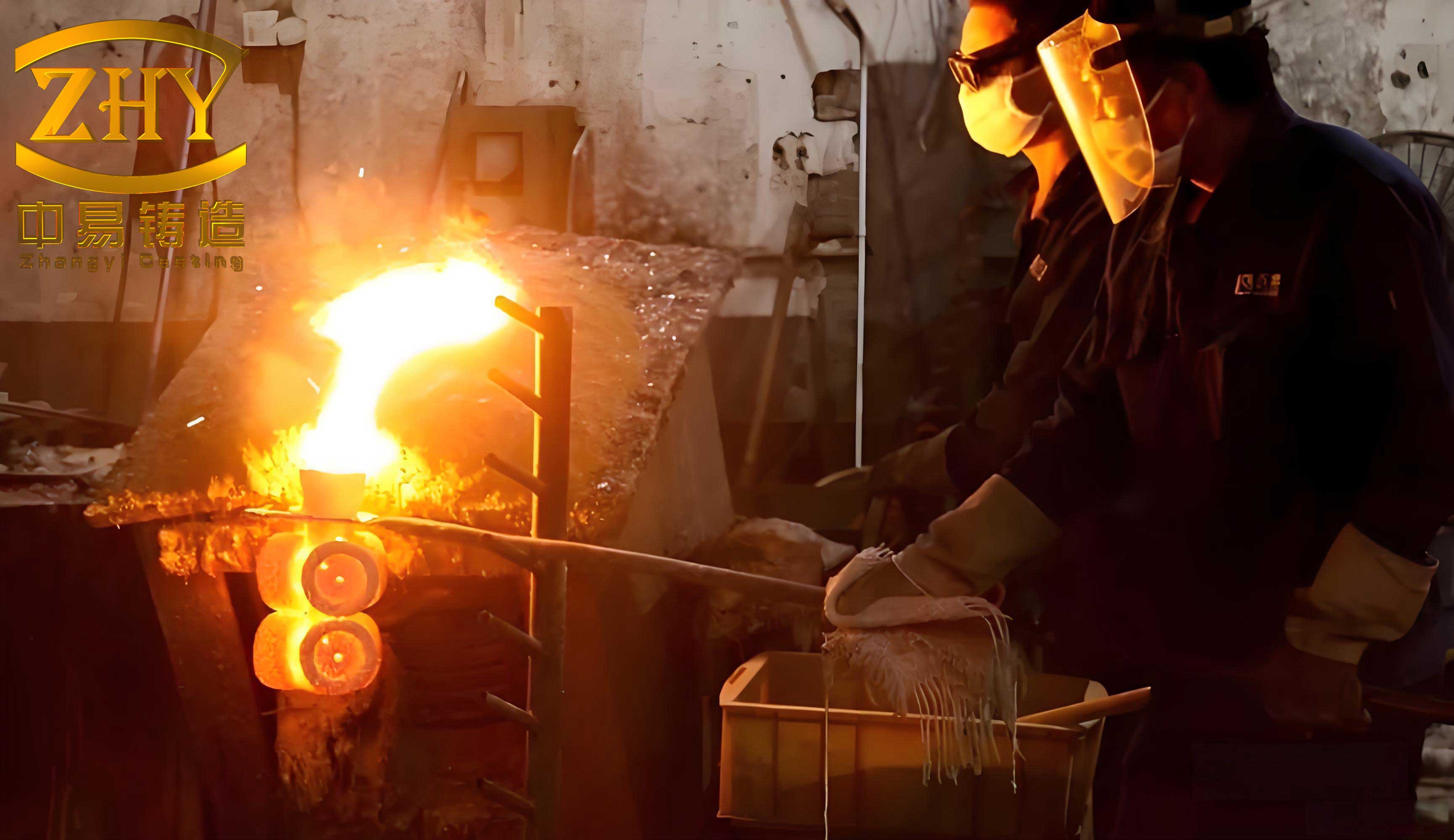
where $C$ is the moisture concentration, $t$ is time, and $D$ is the diffusion coefficient. By controlling the drying environment at 24±2°C and 50–60% relative humidity, we achieved consistent shell integrity. For the face coat, drying times of 5–7 hours were employed, while transition layers required 10–15 hours. To scale this for high-volume investment casting, we designed a 328-meter-long light-duty overhead conveyor drying line for the silica sol shells. This system allowed continuous movement of pattern assemblies, enhancing drying uniformity compared to static methods. The image below illustrates the precision achievable with such advanced investment casting processes, showcasing components produced via compound technology.
Transitioning to the sodium silicate backup layers, we maintained ambient hardening with ammonium chloride solutions, followed by drying at 25–35°C. The process parameters are summarized in Table 3, highlighting the efficiency gains from this compound approach. Notably, the backup layers were applied in a semi-automated dipping line, with cycle times reduced by 30% compared to full silica sol systems. This hybrid method not only preserved the surface quality imparted by silica sol but also met the throughput demands of automotive investment casting, which often requires thousands of shells per day.
| Shell Layer | Hardening Temperature (°C) | Hardening Time (min) | Drying Temperature (°C) | Drying Time (min) |
|---|---|---|---|---|
| Backup Layers 1-5 | 20-25 | 10-12 | 25-35 | 12-40 |
| Final Sealer Layer | 20-25 | 12-15 | 20-32 | 14-16 |
The synergy between wax pattern and shell improvements culminated in the compound technology’s application. We implemented this for over 60 automotive investment castings, including engine brackets, transmission parts, and suspension components. Monthly production volumes reached 150–180 tons, with a daily need for nearly 1,000 pattern assemblies. The compound shells demonstrated exceptional resistance to thermal shock during dewaxing, which we analyzed using the thermal stress formula:
$$ \sigma_{th} = \frac{E \alpha_t \Delta T}{1 – \nu} $$
where $\sigma_{th}$ is the thermal stress, $E$ is the elastic modulus of the shell, $\alpha_t$ is the coefficient of thermal expansion, $\Delta T$ is the temperature change, and $\nu$ is Poisson’s ratio. By selecting refractories with matched expansion coefficients, we minimized shell cracking. Dewaxing was performed using high-pressure steam at 150–168°C for medium-temperature waxes, ensuring complete removal without residue. The resulting castings, poured with steel alloys, exhibited surface roughness between Ra6.3 and Ra3.2, and dimensional accuracy conforming to CT5–CT6 per ISO standards. This level of precision eliminated the need for machining, a significant cost driver in investment casting. To quantify the dimensional consistency, we used process capability indices:
$$ C_p = \frac{USL – LSL}{6\sigma} $$
where $C_p$ is the process capability, $USL$ and $LSL$ are the upper and lower specification limits, and $\sigma$ is the standard deviation of dimensions. Our compound process achieved $C_p$ values above 1.33, indicating robust control in investment casting.
The economic impact of this compound technology has been profound. By canceling machining operations, we saved over 2 million yuan annually for our automotive client, equivalent to approximately $300,000 USD. This stems from reduced labor, tool wear, and material waste. Moreover, the compound shell system lowered overall production costs compared to full silica sol investment casting, as sodium silicate binders are more affordable and faster to process. We calculated the cost per shell using the formula:
$$ C_{shell} = C_{material} + C_{labor} + C_{energy} $$
where $C_{material}$ includes refractories and binders, $C_{labor}$ covers operator time, and $C_{energy}$ accounts for drying and hardening utilities. The compound approach reduced $C_{shell}$ by 15–20% relative to all-silica sol shells, while maintaining quality. Additionally, the lightweight conveyor line optimized floor space and energy consumption, aligning with sustainable manufacturing goals. These benefits underscore why investment casting, enhanced by compound methods, is pivotal for automotive mass production.
In conclusion, our development and implementation of compound technology in investment casting have redefined the production of automotive precision components. Through meticulous analysis of wax materials and shell systems, we integrated high-pressure wax injection with a hybrid silica sol-sodium silicate shell process, achieving superior surface finish and dimensional accuracy. The compound approach balances cost, speed, and quality, making it adaptable for diverse investment casting applications. As investment casting continues to evolve, such innovations will drive further efficiencies, supporting the automotive industry’s demand for lightweight, complex, and cost-effective parts. Future work may explore advanced simulation models to predict shell behavior or novel binder formulations to reduce environmental impact. Nonetheless, the success of this compound technology reaffirms the versatility and potential of investment casting as a cornerstone of modern manufacturing.