
In my extensive practice with precision lost wax casting, I have encountered numerous challenges related to producing large-scale steel castings, where factors such as mold strength and coating application often limit component weight. This article details my first-person experience in successfully manufacturing high-quality, heavy-duty castings weighing approximately 60 kg each in the rough, with a total weight of 120 kg including gating systems, using conventional precision lost wax casting techniques. The emphasis throughout is on achieving superior accuracy and reliability through precision lost wax casting, a process that demands meticulous control over every stage.
The casting in question was a critical load-bearing component, fabricated from ZG35 steel, requiring adherence to stringent aerospace standards. Specifications included comprehensive checks on chemical composition, mechanical properties, and X-ray non-destructive testing. The structure, as depicted, featured a three-way tubular configuration with uneven wall thicknesses ranging from 10 mm to 35 mm. Such complexity necessitated innovative approaches in precision lost wax casting to ensure integrity and performance.
One of the core aspects of this project was the shell mold preparation. In precision lost wax casting, shell strength is paramount, especially for large parts. To enhance durability, I increased the number of shell layers from the typical five and a half to seven, supplemented with sand backing during pouring. The shell-making process was meticulously designed, as summarized in Table 1 below, which outlines the coating and stuccoing parameters.
| Layer | Coating Composition | Specific Gravity | Stucco Material | Drying Protocol |
|---|---|---|---|---|
| Primary | Ethyl silicate 32 hydrolyzate with 280-mesh quartz powder | 1.55–1.67 | 50/100 quartz sand | Air-dry for 2–3 hours, followed by forced air for 0.5 hours |
| Secondary to Seventh | Same as above | 2.46–2.60 | 30/90 quartz sand | Same as above |
The drying cycle involved sequential air-drying and forced-air stages to ensure proper hardening. Dewaxing was accomplished using high-pressure steam, and the shells were then fired in a 75 kW box-type electric furnace at 900–950°C for 4 hours before casting. This rigorous shell preparation in precision lost wax casting withstood the thermal stresses of pouring and solidification, with all five shells remaining intact post-casting.
For pattern production, given the small batch size, I opted for economical plaster molds instead of metal dies—a common strategy in precision lost wax casting for prototyping or low-volume runs. The plaster mold was constructed in four layers comprising ten segments, balancing precision with ease of demolding. This approach facilitated accurate replication of the complex geometry while maintaining cost-effectiveness.
The gating system design was critical to the success of precision lost wax casting for such large components. It had to accommodate coating application while ensuring optimal filling and thermal distribution. The system, illustrated schematically, was engineered to meet several key requirements: excellent filling characteristics, rational temperature gradients, uniform metal flow to all distant points, and robust assembly for coating operations. To model the fluid dynamics and heat transfer, I employed fundamental equations. For instance, the metal flow velocity $$v$$ during pouring can be approximated using Bernoulli’s principle for incompressible fluids:
$$v = \sqrt{2gh}$$
where $$g$$ is gravitational acceleration and $$h$$ is the head height. The temperature field $$T(x,t)$$ within the mold during solidification can be described by the heat conduction equation:
$$\frac{\partial T}{\partial t} = \alpha \nabla^2 T$$
where $$\alpha$$ is thermal diffusivity. These principles guided the design to minimize defects in precision lost wax casting.
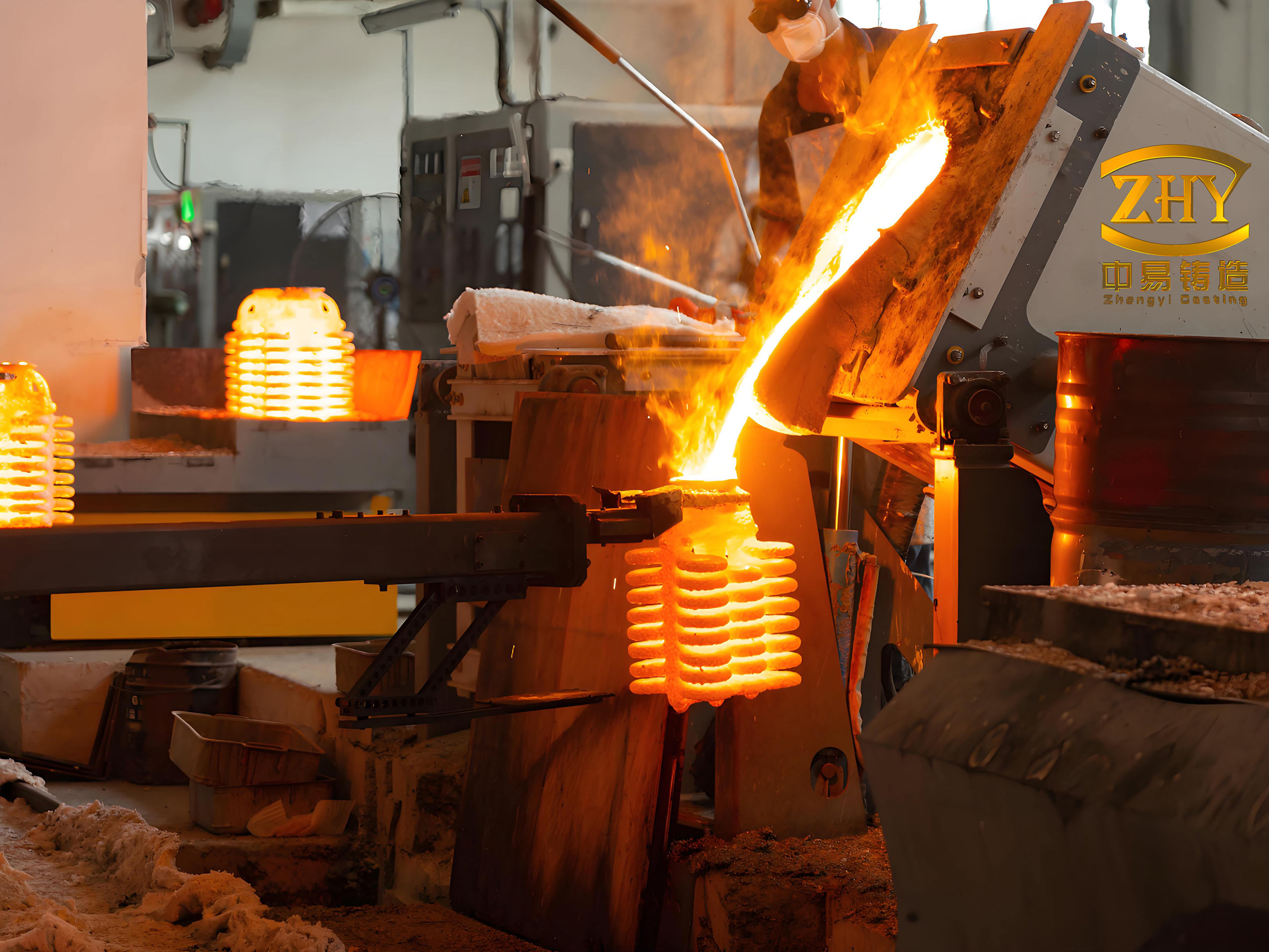
Additionally, I incorporated connecting channels between risers and runners to ensure simultaneous feeding of hot metal to all risers, enhancing feeding efficiency—a vital aspect of precision lost wax casting for thick sections. The pouring temperature was maintained at 1550–1560°C. To prevent premature splashing into risers, I covered the sand box with asbestos plates, leaving only an opening aligned with the pouring cup. Post-pouring, exothermic insulating compounds and asbestos covers were applied to risers to improve feeding and modulate the temperature field, further refining the precision lost wax casting process.
The success of this precision lost wax casting endeavor was validated through rigorous testing. All castings met the required aerospace standards, with X-ray inspection yielding satisfactory results and dimensions conforming to machining tolerances. This experience underscores the viability of precision lost wax casting for large steel components when supported by tailored shell systems, thoughtful gating, and controlled thermal management.
To delve deeper into the technical nuances, let’s explore the mathematical models that underpin precision lost wax casting. The strength of the ceramic shell, crucial for withstanding metallostatic pressure, can be related to its thickness and material properties. The maximum stress $$\sigma_{\text{max}}$$ in a cylindrical shell under internal pressure $$P$$ is given by:
$$\sigma_{\text{max}} = \frac{P r}{t}$$
where $$r$$ is the radius and $$t$$ is the thickness. In precision lost wax casting, optimizing $$t$$ through multiple layers, as done here, reduces stress and prevents failure. Similarly, the solidification time $$t_s$$ for a casting can be estimated using Chvorinov’s rule:
$$t_s = C \left( \frac{V}{A} \right)^2$$
where $$C$$ is a constant dependent on mold material and metal properties, $$V$$ is volume, and $$A$$ is surface area. For the uneven walls in this casting, I calculated differential solidification times to position risers effectively, a key consideration in precision lost wax casting. Table 2 summarizes the solidification parameters for different sections.
| Section | Wall Thickness (mm) | Volume (cm³) | Surface Area (cm²) | Estimated Solidification Time (s) |
|---|---|---|---|---|
| Thin region | 10 | 500 | 300 | 45 |
| Thick region | 35 | 2000 | 400 | 180 |
These calculations informed the gating design to ensure progressive solidification toward risers, minimizing shrinkage defects—a hallmark of precision lost wax casting. Furthermore, the coating viscosity $$\eta$$ plays a role in shell quality; it can be modeled using the empirical formula for colloidal suspensions:
$$\eta = \eta_0 (1 + k \phi)$$
where $$\eta_0$$ is the base viscosity, $$k$$ is a constant, and $$\phi$$ is the volume fraction of quartz powder. In my practice, I adjusted the specific gravity to control $$\phi$$, ensuring uniform coating application in precision lost wax casting.
Another critical factor in precision lost wax casting is the thermal expansion mismatch between the ceramic shell and the metal. The strain $$\epsilon$$ due to differential expansion can be expressed as:
$$\epsilon = (\alpha_m – \alpha_c) \Delta T$$
where $$\alpha_m$$ and $$\alpha_c$$ are the coefficients of thermal expansion for metal and ceramic, respectively, and $$\Delta T$$ is the temperature change. By selecting quartz-based materials with compatible $$\alpha_c$$, I minimized cracking risks during firing and pouring. The overall process efficiency of precision lost wax casting can be quantified using a yield ratio $$Y$$:
$$Y = \frac{W_c}{W_t} \times 100\%$$
where $$W_c$$ is the casting weight and $$W_t$$ is the total weight including gating. In this project, $$Y$$ was approximately 50%, which is favorable for large-scale precision lost wax casting.
In conclusion, my hands-on experience demonstrates that precision lost wax casting is fully capable of producing large, high-integrity steel castings when integrated with enhanced shell systems, economical pattern-making, and scientifically designed gating. The repeated success across multiple castings highlights the robustness of precision lost wax casting methodologies. Future advancements could focus on computational modeling to further optimize parameters, but the core principles of precision lost wax casting—emphasizing control, accuracy, and adaptability—remain indispensable. Through continuous refinement, precision lost wax casting will continue to push the boundaries of manufacturing for critical components in aerospace and beyond.